


In students’ lives, curriculum plays a major role to enhance learning experience. To deliver a relevant, meaningful, and effective learning environment curriculum is important.
But, have you ever thought about the role the curriculum development process plays in education?
If not, let me tell you. Curriculum development process is a well-defined roadmap helpful for schools, teachers, and students to define what and how to teach.
Below we will understand what curriculum development means, the six major steps in the process, and seven key principles.
Contents
What Is Curriculum Development?
Curriculum development is a structured procedure of creating, revising, and improving educational programs based on students’ needs, modern standards, and societal expectations.
It is an ideal approach for student engagement and holistic development. Also, understand the key role of NCERT in curriculum development.
Curriculum development involves:
- What should students learn?
- How should they learn it?
- How will learning be assessed?
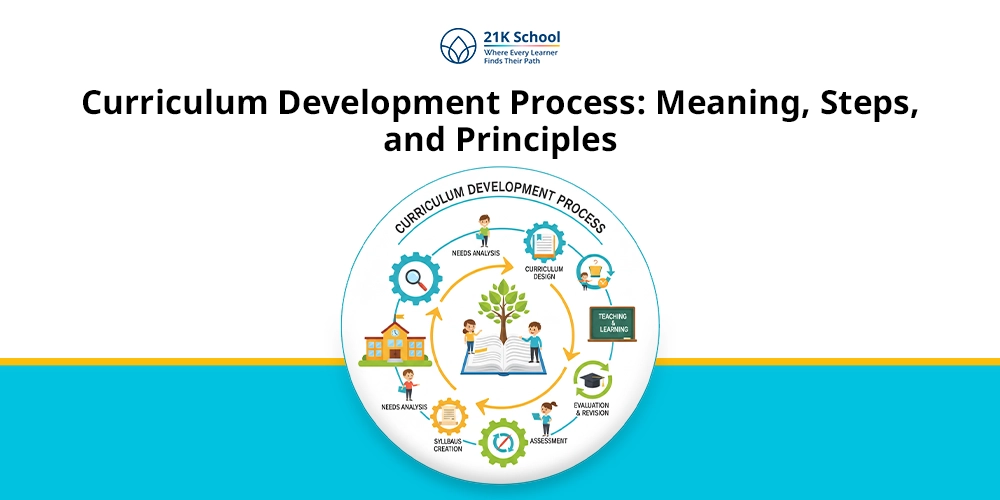
6 Curriculum Development Process
Go through 6 curriculum development process to enhance students learning:
1. Assessment of Educational Needs
The initial step is to identify the educational needs of students, teachers, and community. To identify need use methods like:
- Surveys
- Interviews
- Classroom observations
- Test results analysis
- Take feedback
2. Formulation of Objectives
The next step is formulation of objectives. Objectives are the foundation of the curriculum. Good learning objectives should be:
- Specific
- Measurable
- Achievable
- Relevant
- Time-bound
Remember, educational objectives should cover cognitive knowledge, affective attitudes, and psychomotor skills.
3. Selection and Organisation of Learning Experiences
Selection of right learning experiences for curriculum development is important for academic growth.
Including different activities that engage students and help them to conclude results make experiences more comfortable.
Some common examples of learning experience are:
- Classroom instruction
- Group activities
- Experiments
- Field trips
- Digital learning
4. Development of Materials
In the fourth point, designers create instructional materials which directly help in the learning process. It is important for the smooth curriculum implementation and concept understanding.
Some common examples of materials are:
- Textbooks
- Lesson plans
- Digital resources
- Worksheets
- Teacher guides
5. Implementation
Here, implementation simply means reinforcing the created curriculum in real-time.
For example, a teacher delivering a lecture with particular technique and material. To know more, one must read the role of teacher in curriculum development.
For successful implementation, one need to focus on:
- Teacher training
- Clear instructions
- Technology integration
- Classroom management strategies
6. Evaluation
The final step in the curriculum development process is evaluation which is helpful in understanding the effectiveness of curriculum.
Mainly there are two types: formative and summative evaluation. Formative evaluation can be conducted during the curriculum process.
While summative evaluation is held at the end of a programme. This guide towards continuing learning by customising according to results.
7 Key Principles of Curriculum Development Process
To meet students needs, given below are 7 key principles of curriculum development process:
1. Totality of Experiences
For overall development of students, curriculum should be developed through a holistic approach.
This means instead of limiting the curriculum to textbooks and exams, it must include both inside and outside experiences.
For example:
- Projects
- Play-based learning
- Social interactions
- Co-curricular activities
- Real-life learning
2. Child-Centredness
To make an effective curriculum, one should use the child-centred approach. Learning based on their interest, abilities, and learning styles help them to participate.
Child-centredness in curriculum is ideal because it:
- Encourages active participation
- Builds curiosity and creativity
- Makes learning enjoyable
- Supports different learning paces
3. Conservation and Creativity
Including conservation and creativity while developing curriculum helps students to respect traditions and think critically.
It helps in creating a good balance between old knowledge and new ideas. In this way, students prepare themselves for the present and future.
4. Integration
The curriculum must include knowledge, skills and practice experiences.
For example, a project may include language skills, science theory, and practical experiments.
5. Flexibility
A flexible learning approach is helpful for both teachers and students. In this way, one can adapt based on situations and needs.
Some common examples of flexible curriculum development are:
- Teachers modifying lessons.
- Students can learn at their own pace.
- Curriculum remains relevant over time.
6. Character Formation
A good curriculum focuses on strong values and character formation of students. It should include:
- Honesty
- Discipline
- Responsibility
- Respect
- Empathy
7. Social Fulfilment
Education is not limited to learning, it should be designed to contribute to society. It is important to develop students’ character and understand societal responsibilities.
Curriculum development must include teamwork, leadership, social responsibility, awareness of community issues, and problem-solving skills.
Conclusion
Curriculum development is a foundation of successful learning. It offers students an effective, relevant, and meaningful learning environment.
From assessing needs to evaluation, each step is important to design an effective curriculum to get high-quality education.
One must explore the best way to choose the right curriculum for your child.
By following the key principles and implementing effective curriculum nurtures students’ success. It’s time to become responsible and creative.
