

Teacher and educator are two widely used terms by parents and students. But, these terms are often interchangeably used and misunderstood.
That’s why understanding the meaning, purpose, scope, and style they use is important for everyone.
If you are someone who also thinks teacher and educator are the same then this blog is only dedicated to enhance your knowledge.
Contents
Who Is A Teacher?
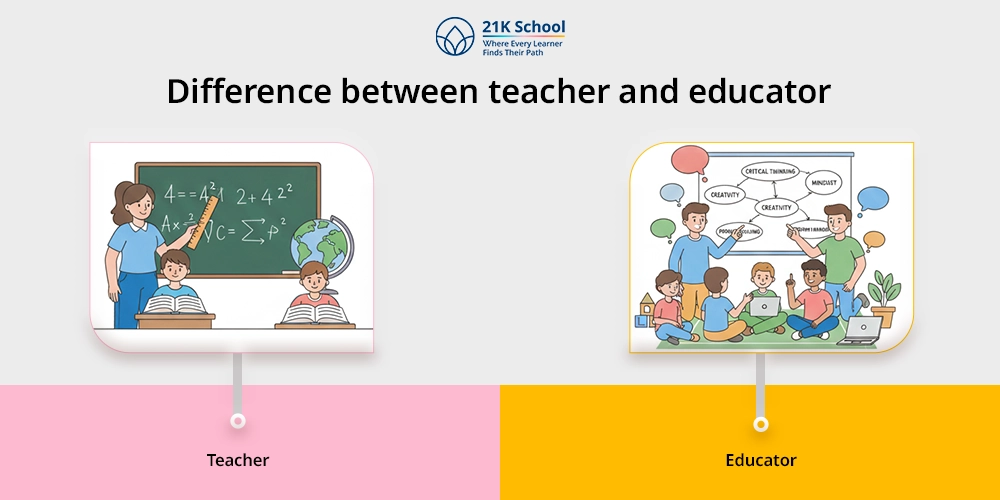
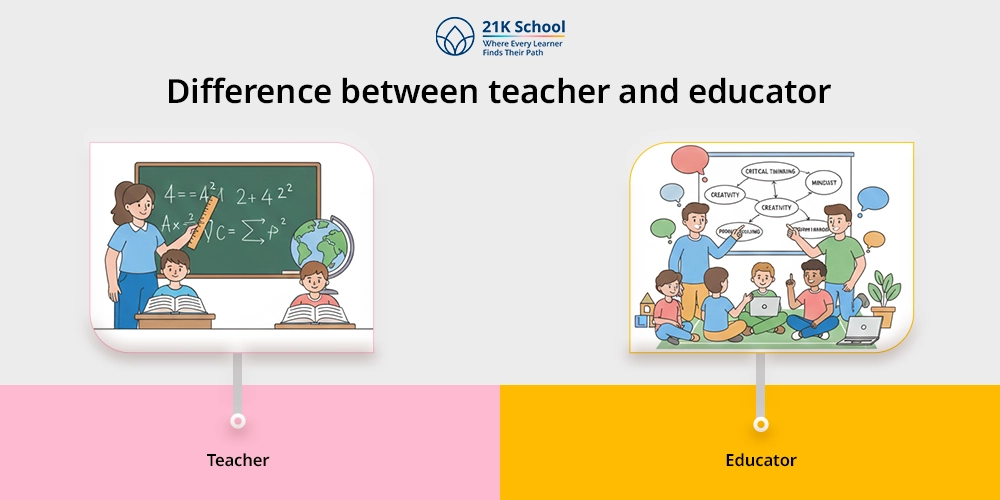
The teacher is a professional who is responsible to deliver knowledge, skills, and value in a formal environment like school.
Teachers mainly teach based on subjects, structured curriculum, plan lessons, assess learning outcomes. It directly helps in achieving academic standards.
Key responsibilities include:
- Preparing lesson plans and teaching a particular subject or grade.
- Conducting tests, evaluations and providing feedback.
- Explaining concepts clearly and maintaining discipline.
Who Is An Educator?
The term educator is broader than teachers who guide people to acquire knowledge, competence, or virtue, via the practice of teaching.
Educators play an essential role by providing holistic learning. This helps learners to develop intellectually, emotionally, socially, and morally.
Key responsibilities include:
- Helps students to go beyond academic subjects.
- Encouraging curiosity, creativity, and critical thinking skills.
- Provide support in emotional and social development.
- Building meaningful connections with learners.
7 Key Differences Between Teacher and Educator
Go through a quick overview on differences between teacher and educator to understand the key differences:
| S No. | Particular | Teacher | Educator |
| 1. | Meaning | A professional who delivers academic instruction | A mentor who facilitates holistic, lifelong learning |
| 2. | Purpose of Their Role | To ensure students learn subject content | To inspire personal, emotional, and intellectual growth |
| 3. | Qualifications | Formal degrees, certifications, and training | Not limited to degrees; includes skills, wisdom, and mindset |
| 4. | Teaching Methods | Structured, curriculum-based, formal | Flexible, experiential, student-centered |
| 5. | Relationship With Students | Often formal and instructional | Mentorship-focused, supportive, empathetic |
| 6. | Assessment Style | Tests, homework, and standardised exams | Observations, projects, real-life application |
| 7. | Scope of Work | Limited to classroom teaching | Extends beyond classroom and provide guidance, motivation, life skills |
1. Meaning
Teacher: Teacher is a professional who teaches in an educational institution with a structured curriculum.
Educator: Educator is a broader term as compared to teachers who influence learning in multiple ways. Educators facilitate holistic, lifelong learning.
2. Purpose of Their Role
Teacher: The main purpose of their role is mainly centered around academic results/outcomes.
Educator: The main purpose of their role is beyond academics. It focuses on life-long learning and personal growth.
3. Qualifications
Teacher: Qualifications required to become a teacher are formal degrees, certifications, and training.
Educator: On the other hand, qualifications required to become an educator are not limited to degrees. It includes skills, wisdom, and mindset
4. Teaching Methods
Teacher: Teachers use various teaching methods for students academic progress such as:
- Lectures and notes
- Assignments
- Worksheets
- Classroom discussions
Educator: Educators use flexible learning with a student-centered approach. Commonly used methods are:
- Project-based learning
- Real-world activities
- Group discussions and debates
- Role-playing
5. Relationship with Students
Teacher: The teacher student relationship is often formal, structured and instruction-based.
Educator: While an educator and student relationship is opposite. It is more supportive, trust-based, emotionally connected, mentorship-oriented.
6. Assessment Style
Teacher: Assessment style mainly used by teachers are:
- Tests and quizzes
- Homework
- Unit exams
- Standardised tests
Educator: Assessment style mainly used by educators are:
- Projects
- Class participation
- Observations
- Portfolios
7. Scope of Work
Teacher: Teachers work inside school and focus on classroom learning. They follow a structured curriculum with particular teaching hours.
Educator: While educators don’t provide structured learning in particular space. They guide students’ life skills, decision-making and career beyond the classroom.
Conclusion
Hope this blog is helpful to understand the real difference between the two important terms teacher and educator.
Both teachers and educators are essential for students’ academic success and personal growth.
However, the comparison helps students to work accordingly and achieve desired goals in future.

You may also want to read