

Technology has advanced, thereby reaching our classrooms. The time when we studied with the help of chalks, dusters, blackboards, and tedious note-taking has gone.
As the demands of 21st century learners and employer industries change, the method of teaching students also shifts.
This is why smart classrooms are being embraced in schools. A smart classroom combines a classroom using technology to achieve a more interactive and effective learning.
This article will let you know all the advantages of a smart classroom for teachers as well as learners.
Contents
- What is a Smart Classroom?
- 15 Advantages of Smart Classroom
- 1. Enhanced Student Engagement
- 2. Improved Understanding of Concepts
- 3. Supports Different Learning Styles
- 4. Promotes Interactive Learning
- 5. Access to a Wide Range of Learning Resources
- 6. Personalized Learning Experience
- 7. Improves Teacher Effectiveness
- 8. Encourages Collaborative Learning
- 9. Real-Time Assessment and Feedback
- 10. Saves Time and Increases Efficiency
- 11. Environmentally Friendly Learning
- 12. Enhances Digital Literacy
- 13. Supports Inclusive Education
- 14. Encourages Self-Directed Learning
- 15. Prepares Students for the Future
- Concluding Comments
What is a Smart Classroom?
A smart classroom is a classroom that is digitally furnished with high-tech devices and is utilized to improve the teaching and learning process in present times.
It involves the use of interactive white boards, projectors, computers, tablets, speakers, internet, learning software, or digital learning platforms.
These tools allow the teachers to introduce lessons as a video, animation, diagram, or simulations under interactive mode.
As compared to the traditional classroom, smart classrooms are learner-centered. Learners are motivated to socialize, ask questions, engage in discussions, and participate in digital activities in such classrooms.
The ultimate goal of a smart classroom is to enhance the quality of learning by ensuring the learning process is more visual, practical, inclusive, and engaging.
15 Advantages of Smart Classroom
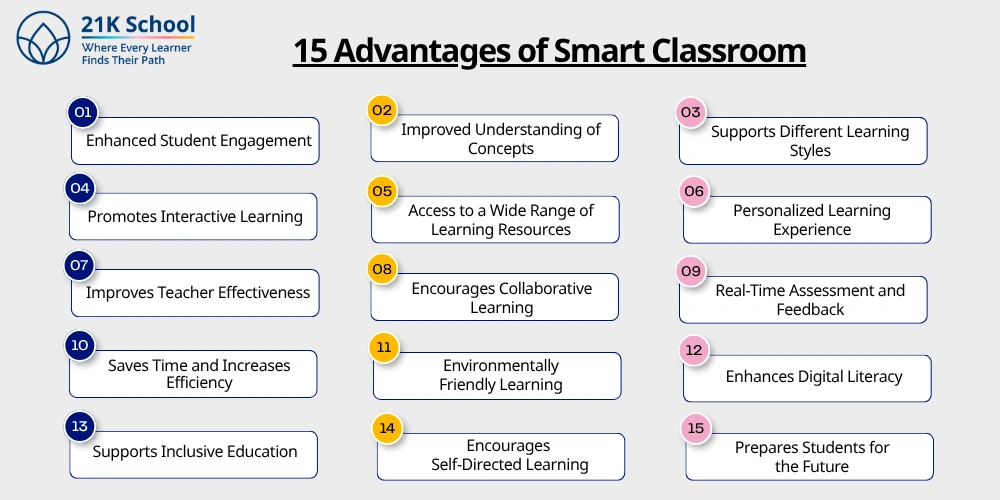
Smart classrooms are advantageous to learners and teachers because they can offer:
1. Enhanced Student Engagement
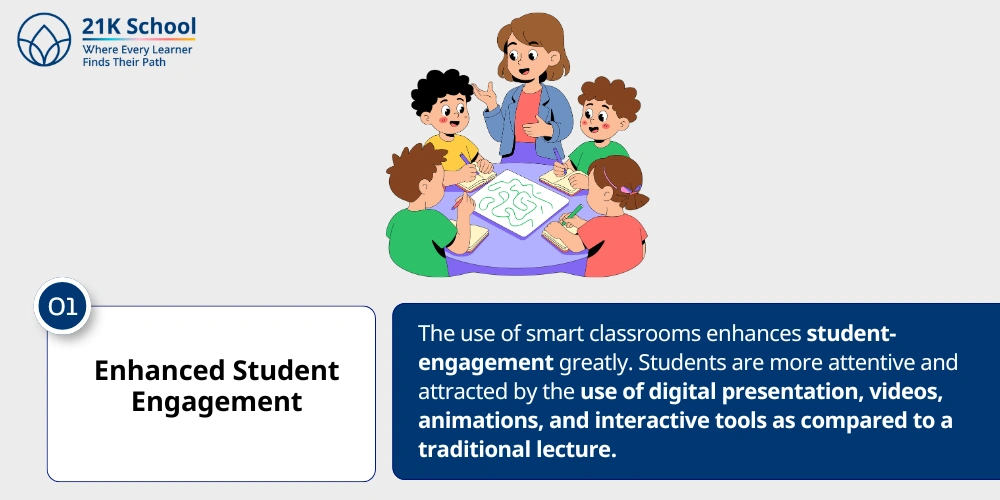
The use of smart classrooms enhances student-engagement greatly.
Students are more attentive and attracted by the use of digital presentation, videos, animations, and interactive tools as compared to a traditional lecture.
Students stay interested and feel less distracted when actively engaged in the learning process, through quizzes, polls, and discussions. Such an interactive approach adds fun in learning.
2. Improved Understanding of Concepts
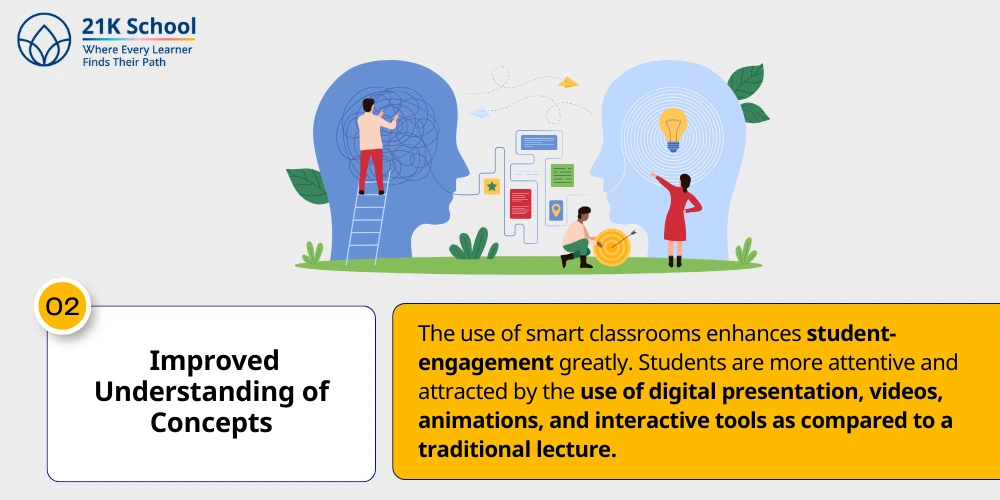
Conceptual clarity is also one of the best benefits of smart classrooms.
Visual explanations help in making abstract and complex subjects easier to understand. Scientific experiments, mathematical problems, biological cycles, and geographical concepts can be demonstrated easily with the help of animations and simulations.
This visual learning enables students to learn concepts more deeply and retain longer.
3. Supports Different Learning Styles
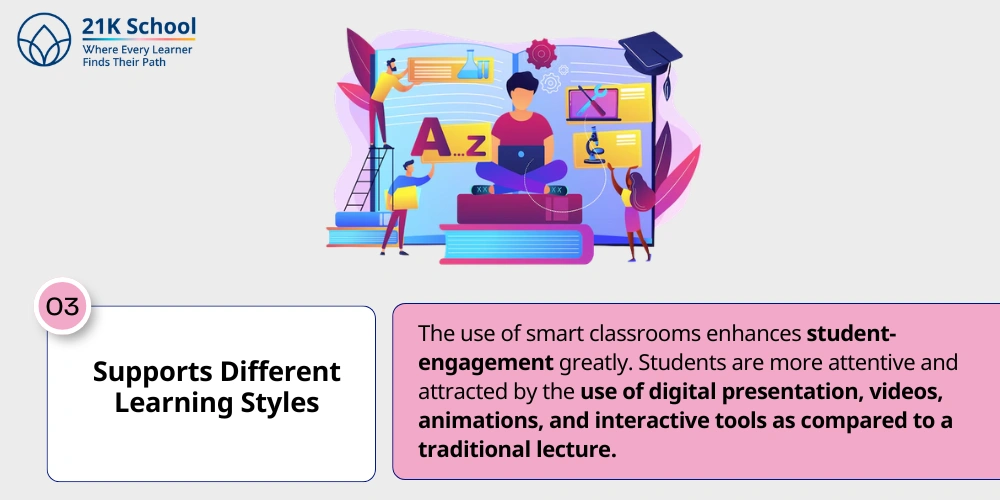
Different students learn differently. There are students who learn faster and better either through seeing images, listening, or practical presentations.
Smart classrooms achieve this by integrating videos, audio content, pictures, and interactive exercises to accommodate all learning styles. In this inclusive method of learning, all students can be provided with an equal access to effective learning.
4. Promotes Interactive Learning
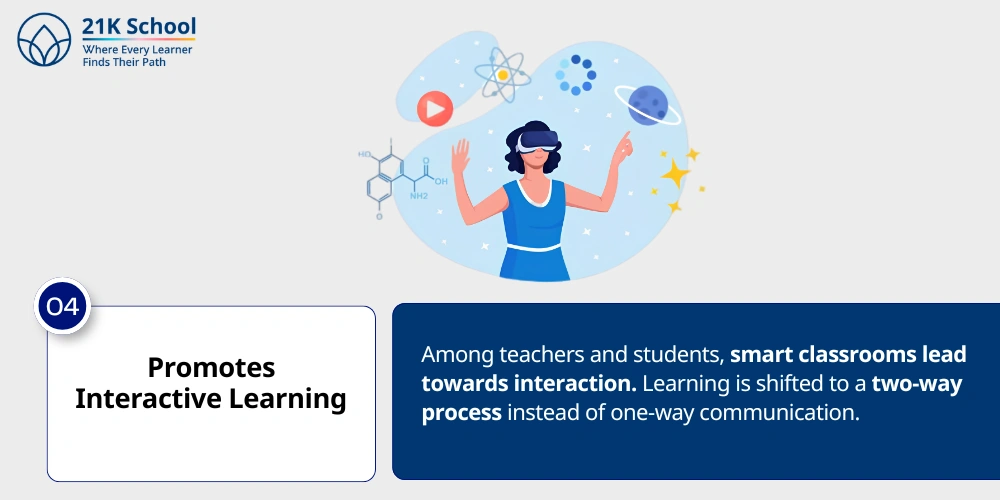
Among teachers and students, smart classrooms lead towards interaction. Learning is shifted to a two-way process instead of one-way communication.
Students are able to ask questions, do live quizzes, and exchange ideas in real time. This kind of learning boosts students confidence, supports active involvement, and makes learning fun.
5. Access to a Wide Range of Learning Resources
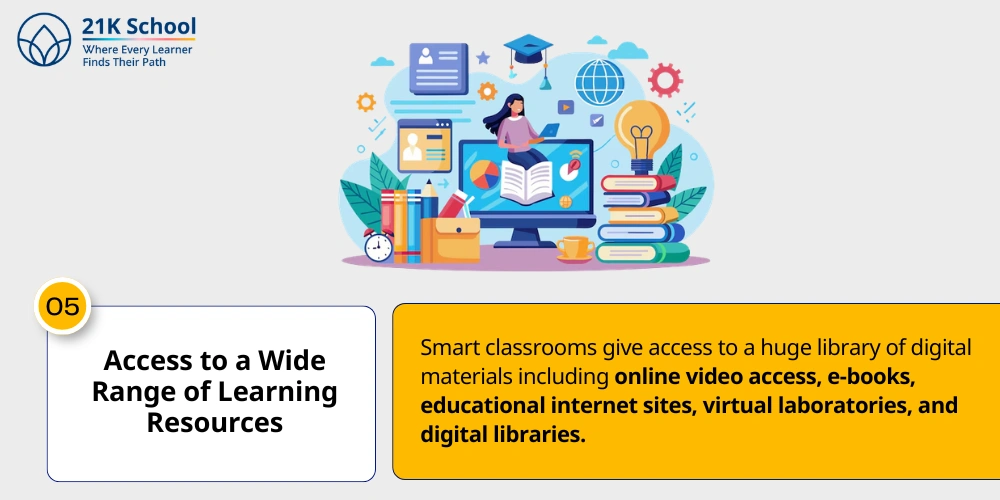
Smart classrooms give access to a huge library of digital materials including online video access, e-books, educational internet sites, virtual laboratories, and digital libraries.
Due to this feature, teachers and learners don’t need to rely entirely on textbooks.
This broad coverage of information increases knowledge, promotes research, and makes learning pertinent for all learners.
6. Personalized Learning Experience
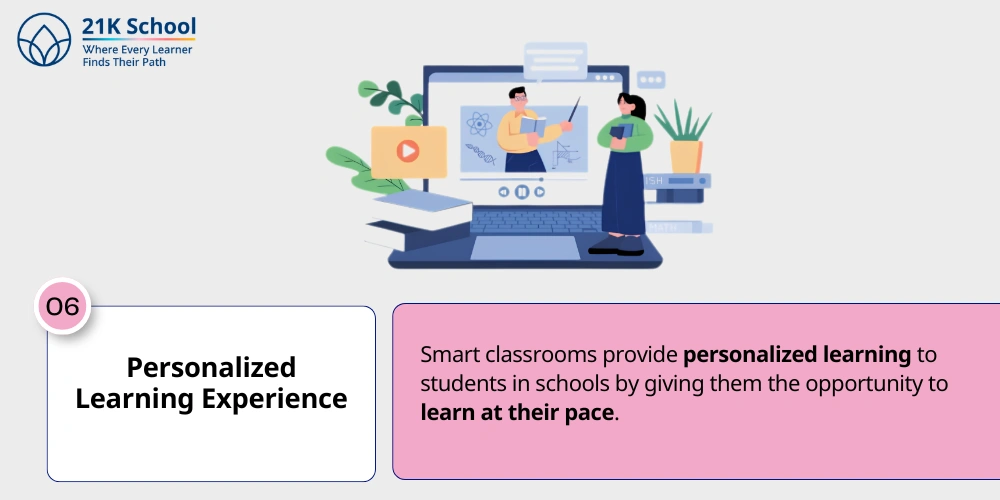
Smart classrooms provide personalized learning to students in schools by giving them the opportunity to learn at their own pace .
Quick learners are able to learn more advanced concepts, whereas slow learners may watch the recorded lessons and explanations again.
Teachers can monitor individual improvement and offer additional assistance where necessary. This one-on-one treatment enhances the learning of all students.
7. Improves Teacher Effectiveness
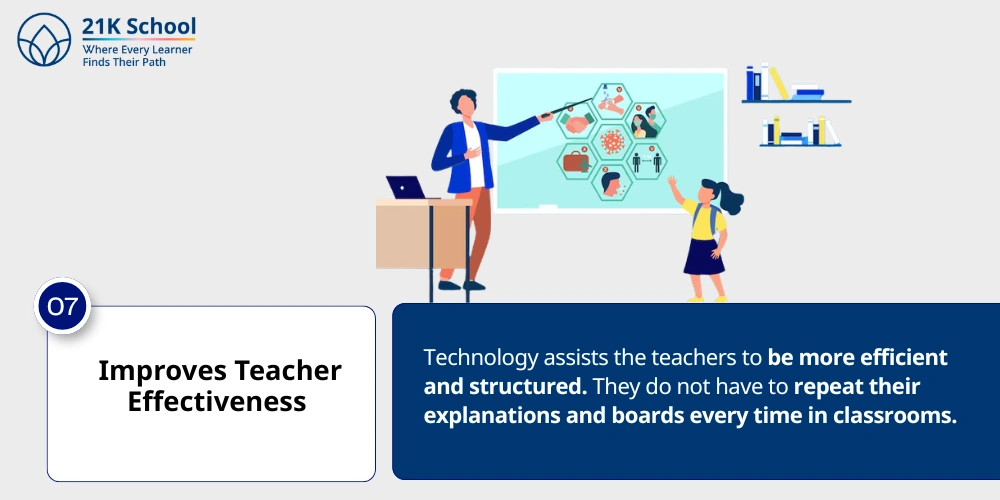
Technology assists the teachers to be more efficient and structured. They do not have to repeat their explanations and boards every time in classrooms.
Ready-made videos and lesson plans save time and effort in lesson preparation, which is one of the strong benefits of technology in education. This will enable teachers to invest more time in advising, mentoring, and communicating with the students.
8. Encourages Collaborative Learning
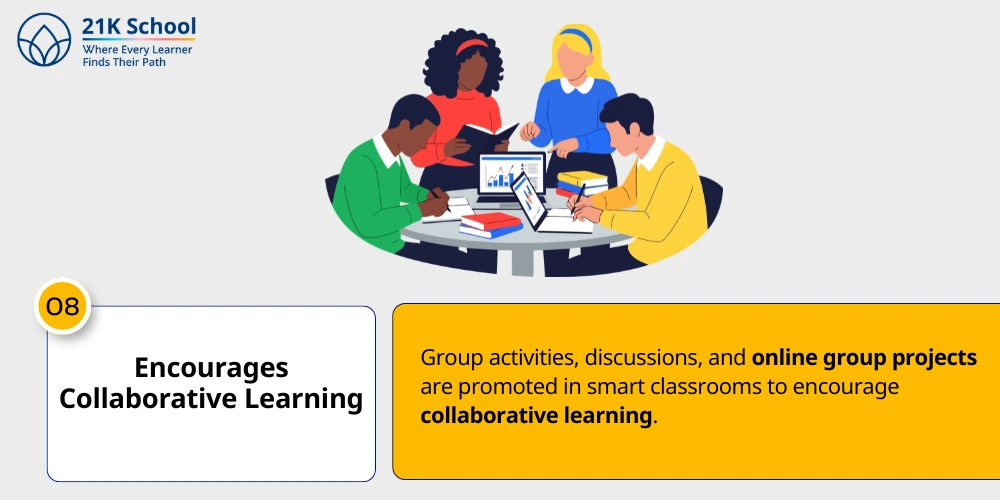
Group activities, discussions, and online group projects are promoted in smart classrooms to encourage collaborative learning. Through digital tools, students collaborate, exchange ideas, and solve problems at their own pace.
Group learning enhances teamwork, leadership skills, as well as communication, thus assisting students to learn together with their mates.
9. Real-Time Assessment and Feedback
Smart classrooms allow immediate evaluation of students’ abilities and knowledge with the help of formative assessment tools such as online quizzes, tests, and polls.
Educators are able to provide real feedback and offer help at all times.
This assists students to easily quickly identify and correct their mistakes. The assessment outcomes also enable teachers to change teaching methods when needed.
10. Saves Time and Increases Efficiency
Smart classrooms conserve time and ensure efficiency while learning.
Students can learn effectively without teachers writing lengthy notes. This is because all the contents can be found in the digital format.
Online systems can be used to record attendance, manage assignments, assessments, thus cutting down the need for paperwork. The time saved from these features can be put into additional discussions and fun learning activities.
11. Environmentally Friendly Learning
Smart classrooms facilitate paperless learning through the promotion of electronic notes, digital textbooks, and online assignments. This saves on the use of paper, thereby conserving trees and supporting sustainable education.
Sustainability and proper use of resources are also learned by the students through such environmentally friendly practices.
12. Enhances Digital Literacy
Students begin to use digital devices, online learning programs, as well as online services regularly within a smart classroom. This enhances their technical and digital literacy.
Digital literacy is a vital skill in the present-day era and early exposure would help the students become self-assured and responsible technology users.
13. Supports Inclusive Education
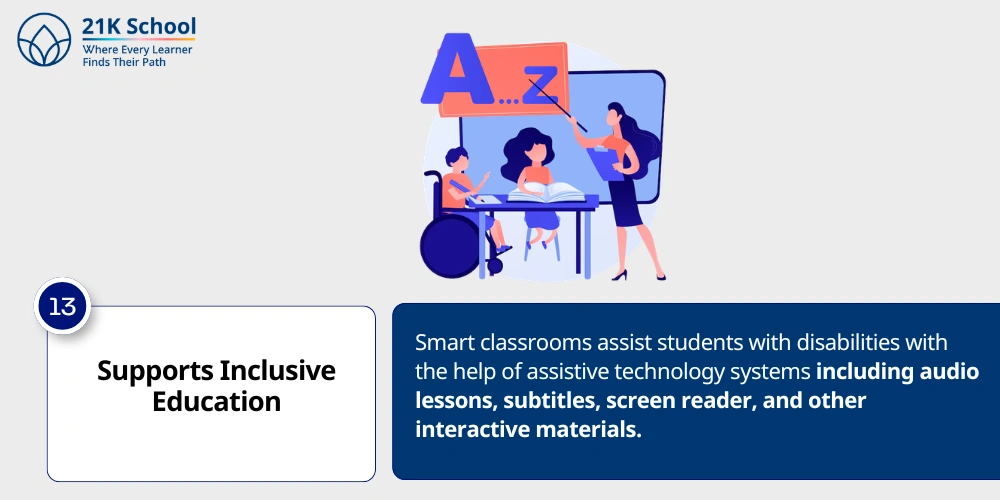
Smart classrooms assist students with disabilities with the help of assistive technology systems including audio lessons, subtitles, screen reader, and other interactive materials.
These services can provide an equal learning opportunity among all students despite physical or learning challenges.
Smart classrooms work on the principle of inclusive education that fosters equality among all learners.
14. Encourages Self-Directed Learning
Smart classrooms encourage students to depend on self-directed learning.
The easy availability of online resources promotes self-study, research, independent practice, and exploration among learners.
This would instill curiosity and responsibility in learning of students who want to develop lifelong learning habits instead of just academic skills.
15. Prepares Students for the Future
Smart classrooms equip students with better skills that align with technological skills and future jobs in the 21st century.
They acquire the ability to think critically, be creative, solve problems, communicate, and teamwork in these advanced classrooms.
Knowledge on technology instills confidence in the students and teaches them to hold their own ground in the contemporary workforce.
Concluding Comments
Smart classrooms have revolutionized the learning system after introducing technology in teaching and learning. They believe in the idea of education which is more interactive and helpful.
The advantages of smart classrooms are that they enhance understanding and build digital learning in students.
These classrooms also ensure efficient tools for teaching practices to reduce the unnecessary workload of educators, thus drawing their attention to real training of students.
Smart classrooms are important in this digital world as they equip students for 21st century challenges in future. Therefore, the introduction of smart classrooms is the key to enhancing the learning levels in contemporary times.

You may also want to read