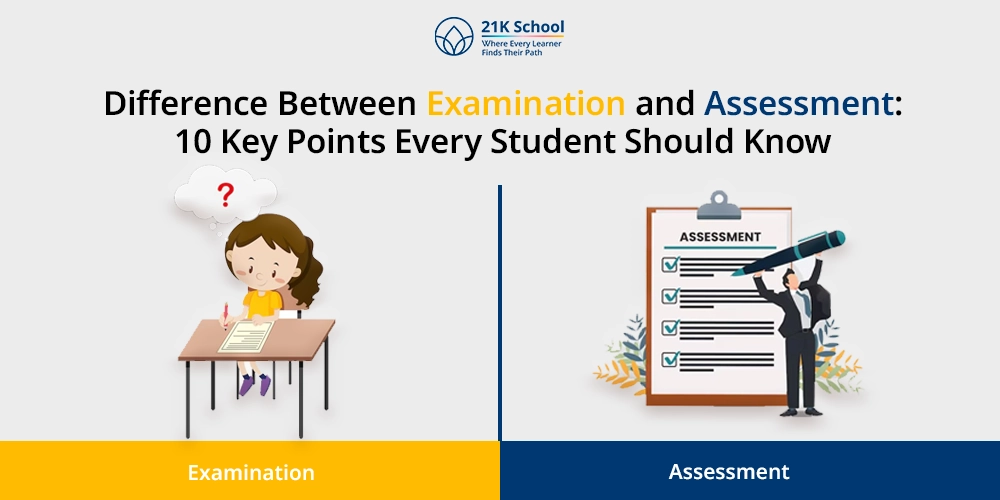
Difference Between Examination and Assessment: 10 Key Points Every Student Should Know
 Written byAnkita SinghaContent Specialist
Last modified: Jul 24, 2026 6 min read
In student life, learning requires examination and assessment for effective evaluation of progress and student knowledge, identifying strengths and weaknesses
Examinations and assessments are ideal to motivate students to study to overcome future academic and real-life challenges.
But people are often confused between these two crucial terms of education. The question always arises whether examination and assessment are the same or different.
To get the right answer this blog will help you to understand 10 key differences between examination and assessment starting with their meanings.
What is examination?
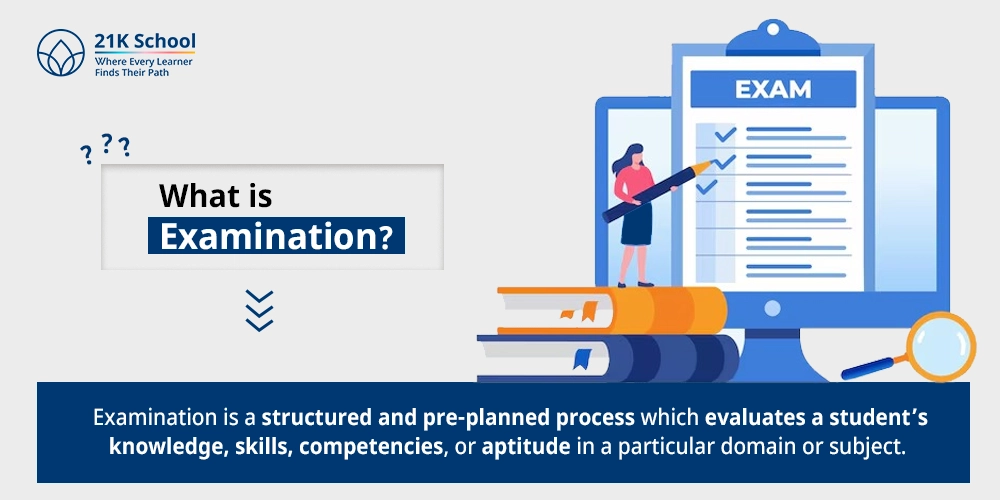
Examination is a structured and pre-planned process which evaluates a student’s knowledge, skills, competencies, or aptitude in a particular domain or subject.
Schools, professional institutions, training centres, colleges, recruitment bodies are some of the popular places where exams are taken under supervision.
The key advantages of the examination is to measure students’ knowledge. Exams are designed for different purposes from students’ career growth to job placements.
Some common types of examinations are written, oral, practical, online, open book exam and closed-book exam etc. Students can also learn how to study for exams effectively.
What is assessment?
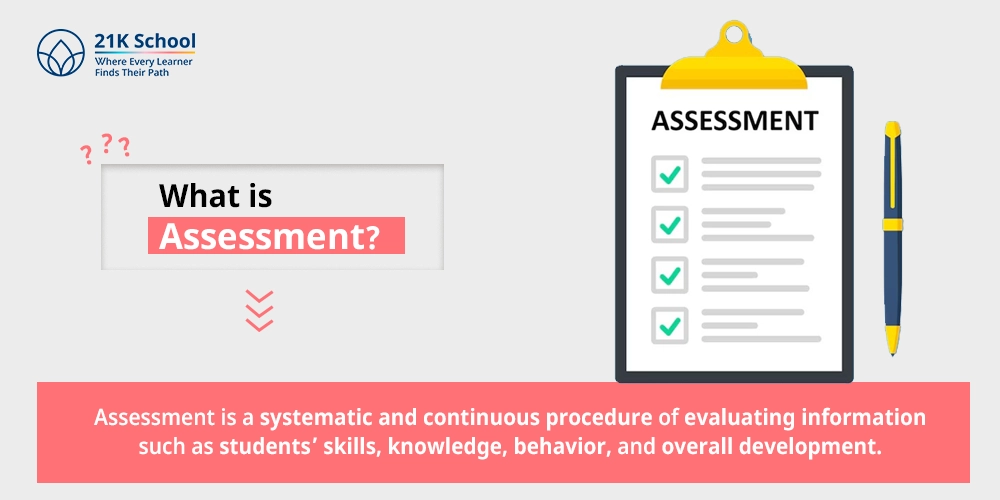
Assessment is a systematic and continuous procedure of evaluating information such as students' skills, knowledge, behavior, and overall development.
It is an ongoing academic process used to collect insights about a student's learning or a professional's performance and seek areas for improvement.
Assessments are ideal for students’ growth journey, both personal and professional. There are different types of assessment in education like diagnostic, summative, formative assessment etc.
Assessment in education is not limited to writing exams. It goes beyond, for example: projects, presentations, quizzes etc.
Difference between examination and assessment: 10 key points
Here is a table and detailed elaboration of the difference between examination and assessment help individuals to understand the comparison effectively:
| Number | Particulars | Examination | Assessment |
|---|---|---|---|
| 1. | Purpose | To judge academic achievement | To improve learning and teaching |
| 2. | Nature | Formal and standardised | Both Formal and Informal and flexible |
| 3. | Focus | Memory and content recall | Understanding, skills, and application |
| 4. | Frequency | Conducted occasionally | Conducted continuously |
| 5. | Scope | Limited to syllabus content | Broad, including skills and behavior |
| 6. | Stress Level | High pressure and anxiety | Low pressure and supportive |
| 7. | Timing | End of a course or term | Throughout the learning process |
| 8. | Feedback | Quantitative feedback | Qualitative feedback |
| 9. | Method Used | Written tests and exams | Projects, observations, quizzes, rubrics |
| 10. | Outcome | Grades, pass/fail results | Provides insights for adjustments to teaching and learning, not just a final score |
1. Purpose
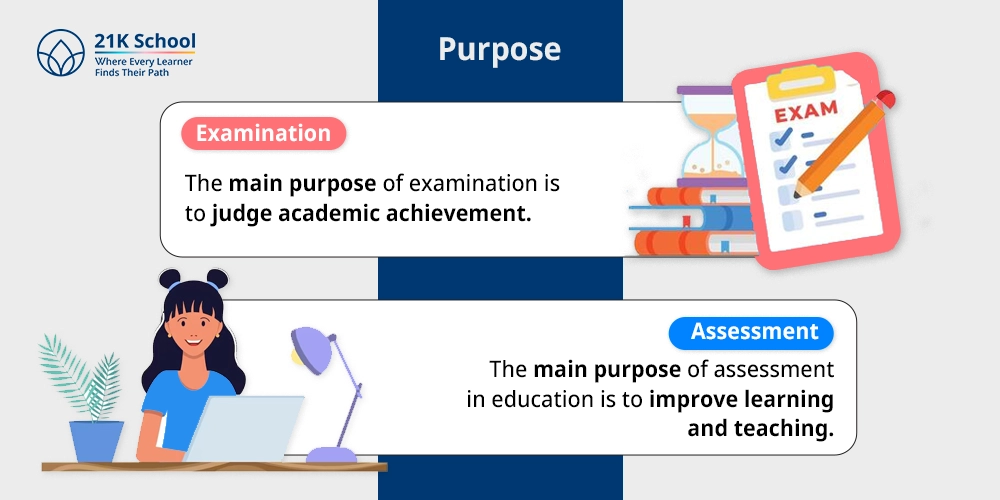
Examination: The main purpose of examination is to judge academic achievement.
Assessment: The main purpose of assessment in education is to improve learning and teaching.
2. Nature
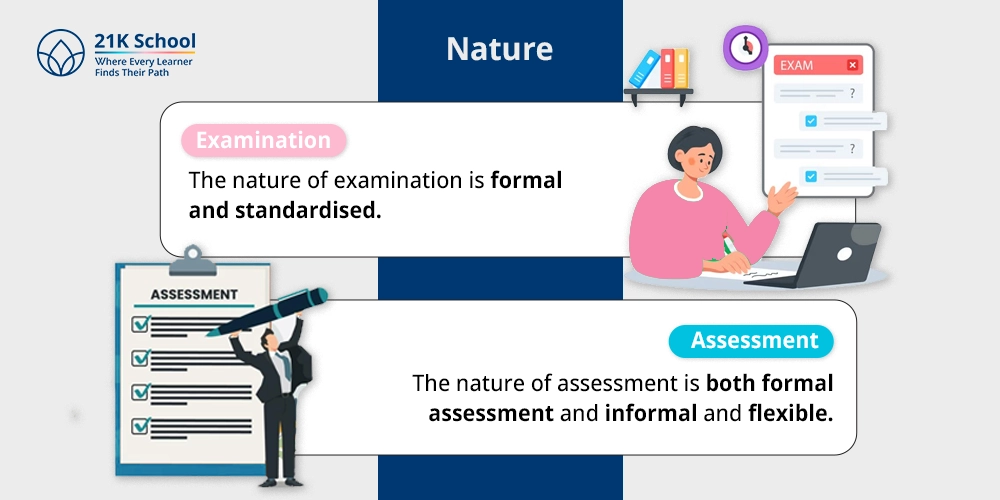
Examination: The nature of examination is formal and standardised.
Assessment: The nature of assessment is both formal assessment and informal and flexible.
3. Focus
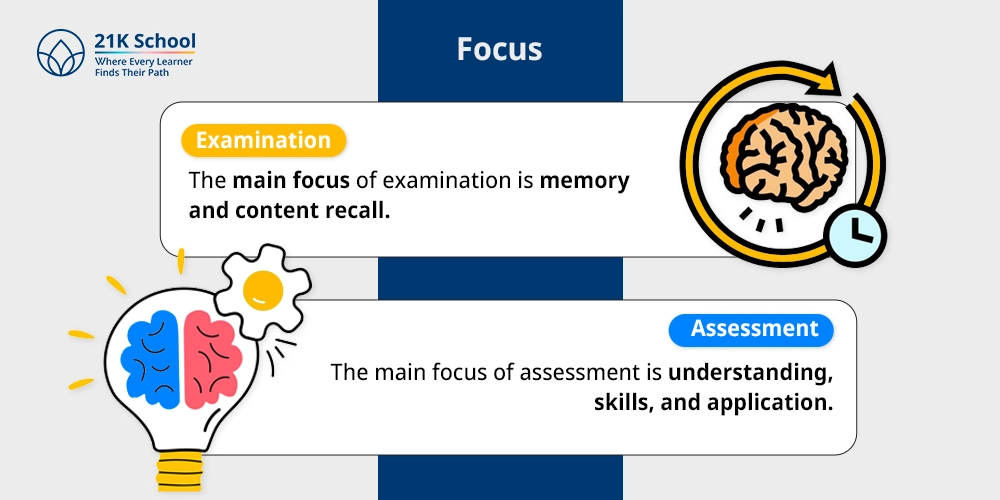
Examination: The main focus of examination is memory and content recall.
Assessment: The main focus of assessment is understanding, skills, and application.
4. Frequency
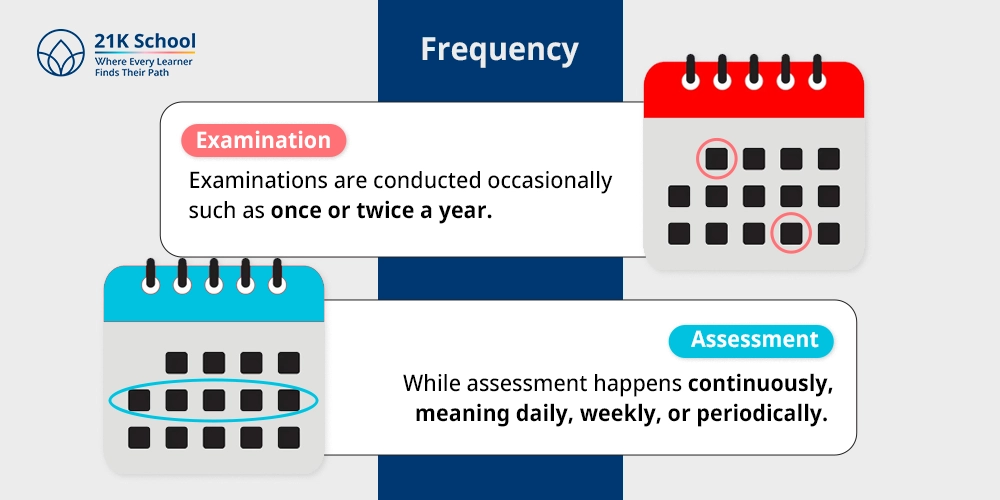
Examination: Examinations are conducted occasionally such as once or twice a year.
Assessment: While assessment happens continuously, meaning daily, weekly, or periodically.
5. Scope
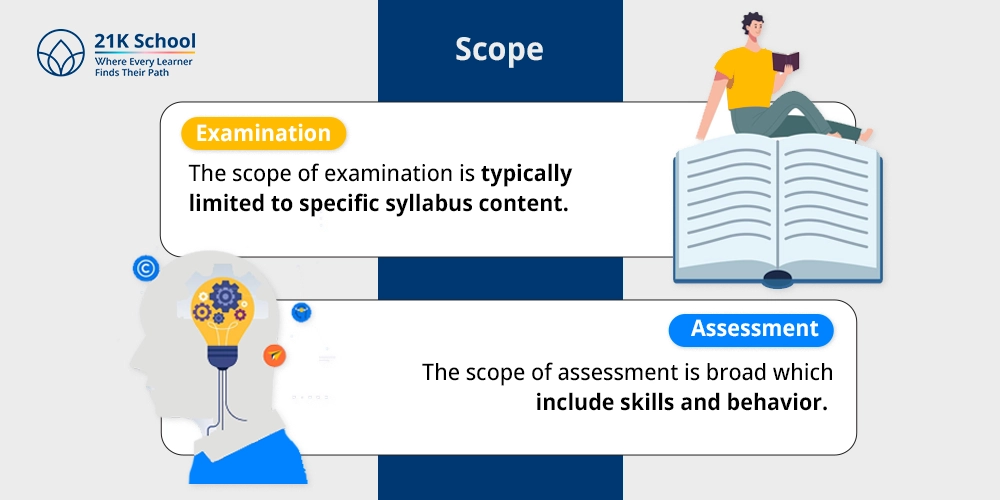
Examination: The scope of examination is typically limited to specific syllabus content.
Assessment: On the other hand, the scope of assessment is broad which include skills and behavior.
6. Stress level
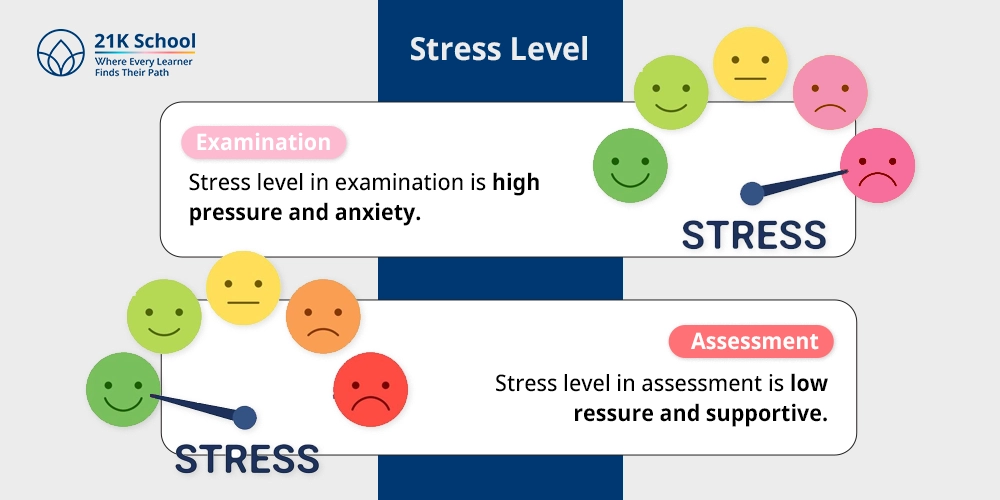
Examination: Stress level in examination is high pressure and anxiety.
Assessment: Stress level in assessment is low pressure and supportive.
7. Timing
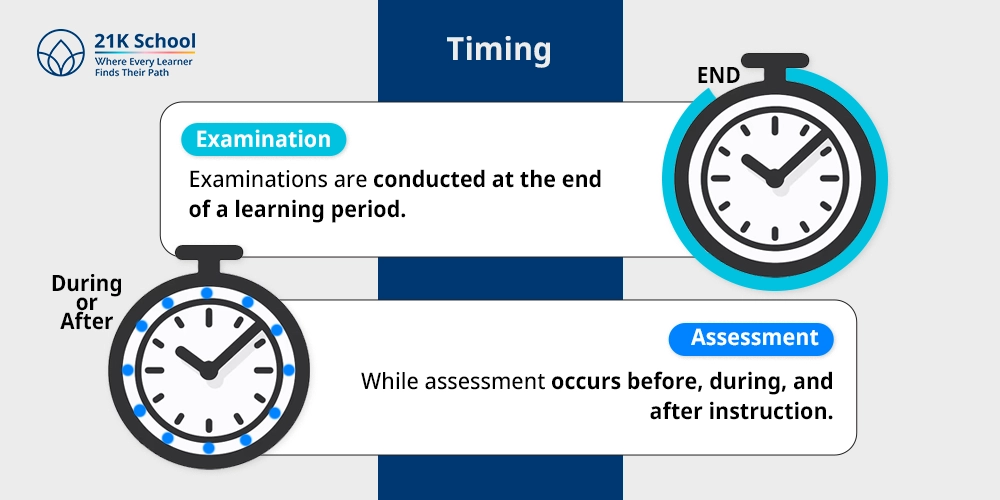
Examination: Examinations are conducted at the end of a learning period.
Assessment: While assessment occurs before, during, and after instruction.
8. Feedback
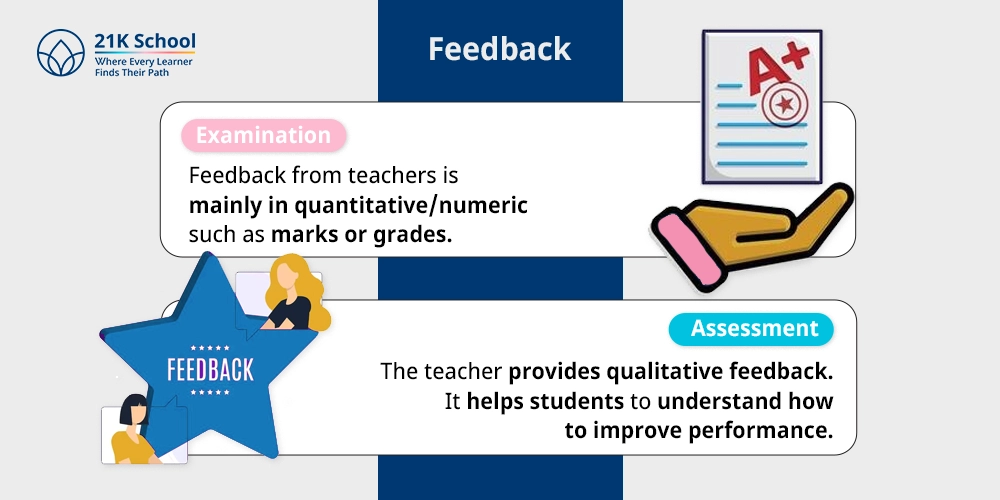
Examination: IIn examination, feedback from teachers is mainly in quantitative/numeric such as marks or grades.
Assessment: In assessment, the teacher provides qualitative feedback. It helps students to understand how to improve performance.
9. Method used
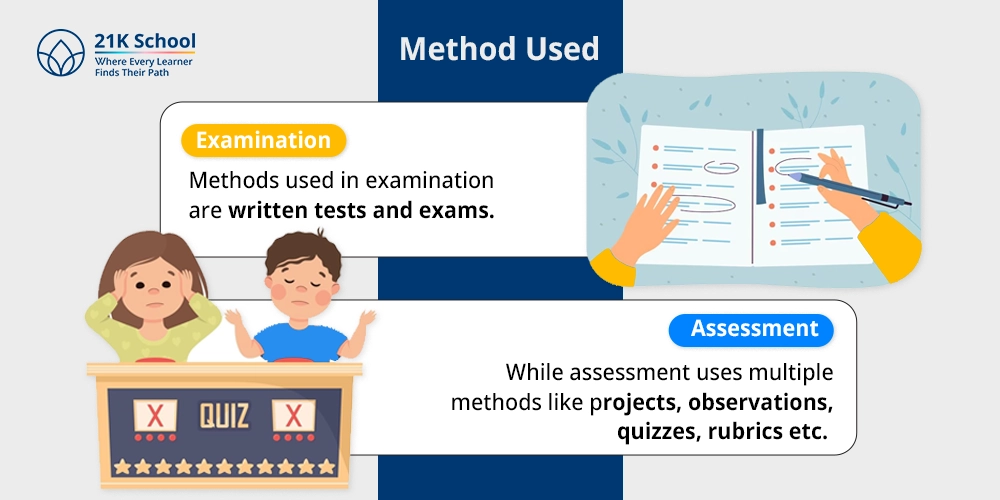
Examination: Methods used in examination are written tests and exams.
Assessment: While assessment uses multiple methods like projects, observations, quizzes, rubrics etc.
10. Outcome
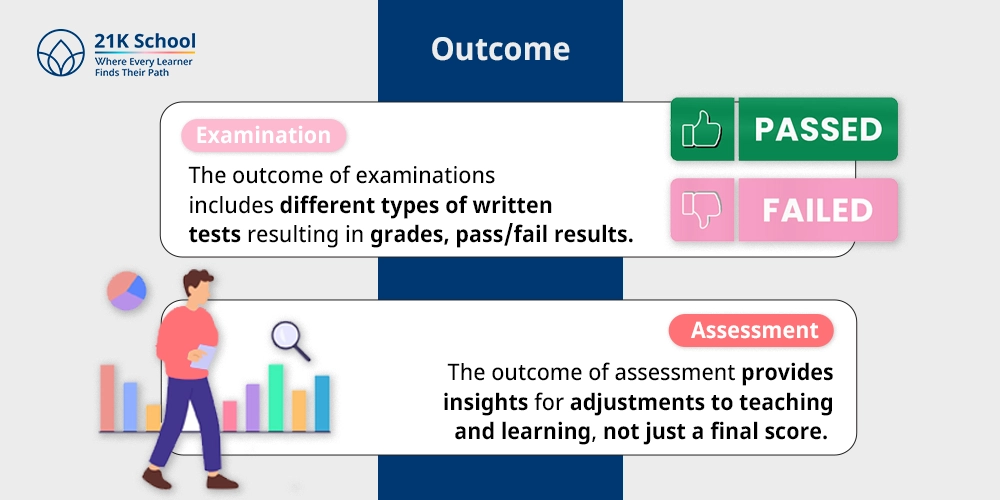
Examination: The outcome of examinations includes different types of written tests resulting in grades, pass/fail results.
Assessment: The outcome of assessment provides insights for adjustments to teaching and learning, not just a final score.
Conclusion
I hope the blog helps to understand both the concepts effectively. The content concludes that both examination and assessment are different from each other.
Assessment is a broad term that includes different activities like quizzes, tests, projects etc while examination is an essential part of assessment. Based on the above tables and detailed explanation implementation of both terms is highly impactful for personal and professional development.
Frequently asked questions
8 questions
What is the main difference between assessment and evaluation?
One of the main differences is assessment can be both formative and summative in nature. This means it support throughout the process. On the other hand, evaluation is summative in nature. It is judged in the end to find out the success.
Is an examination a part of assessment?
Yes, examination is a part of assessment. Assessment is a broader concept and examination is a type of assessment.
Are examinations always summative?
No, examinations are not always summative. However, traditionally examinations are designed to be summative in nature.
What are the advantages of examinations in students' lives?
Examinations offer various advantages in students' lives such as: It encourage students for good study habits It improve knowledge retention Students can develop critical thinking and problem-solving skills
What is the purpose of assessment in education?
The purpose of assessment in education is it guides students and teachers to modify the way they are working.
What are assessment tools in education?
Some popular assessment tools in education are quizzes, rubrics, portfolios, digital platforms.
How to conduct a needs assessment in education?
To understand the steps to conduct an educational needs assessment, go through: define purpose and scope identify stakeholders gather existing data collect new data analyse gaps and prioritise needs develop an action plan monitor and report
How do I prepare for an assessment test?
Students can prepare for an assessment test by: research the test practice strategically focus on weaknesses simulate test conditions gather tools
About the author
Ankita Singha
Content Specialist
Ankita Singha is an Education Content Specialist at 21K School, India’s first accredited fully online K-12 School. She focuses on the in-depth research and creation of the well-drafted guides on early childhood education, school admission processes, and CBSE/ICSE curriculum guidance. With more than 2 years of experience at 21K School, a fully accredited institute- Cambridge International (IA702) and Pearson Edexcel (94883), Ankita works closely with the school’s curriculum heads and academic coordinators. Ankita’s every article reflects on the official board guidelines, practical realities, and current policies of online education in 78+ countries. Ankita’s content has helped thousands of parents in understanding the topics like RTE eligibility, NIOS pathways, and age-appropriate admission criteria.
Every 21K School guide is written by our education team and reviewed by a subject facilitator before publishing.
Exploring a CBSE-pathway online school?
Talk to an advisor about 2026–27 admissions — no obligation.
Talk to an advisorComments
No comments yet — be the first to share your thoughts or ask a question.