How to Calculate Percentage of Marks of 6 Subjects: Formula & Board Rules
 Written byAnnapurna SContent Specialist
Last modified: 31 Jul 2026 7 min read
Are you trying to calculate the percentage of marks on your own? Then you're not alone. Many students try to figure out the math behind calculating marks across 6 subjects .
Understanding your performance and evaluating your percentage across 6 subjects is important. It is important to learn how to calculate the marks , as it clears the confusion while comparing the scores or preparing for admission in the college.
So, let's go through simple steps to calculate the marks and learn the basic formula to determine the overall percentage with examples and understand important board rules and avoid mistakes while calculating.
This guide covers the formula, worked examples, board-specific rules, and common mistakes to avoid.
How to calculate percentage of marks of 6 subjects?
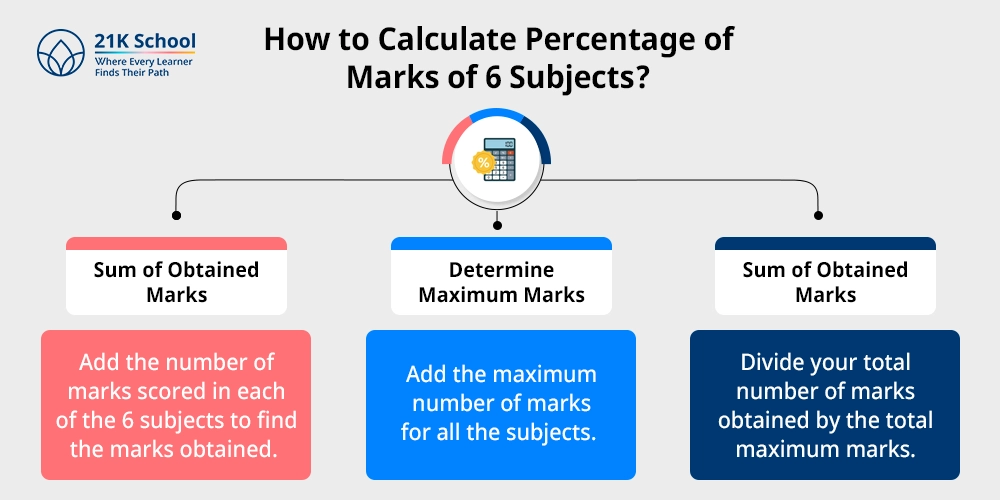
You can calculate the percentage of marks for 6 subjects by adding all your marks, dividing them by the total maximum marks, and then multiplying by 100.
The standard formula to apply is:
Percentage = (Total Marks Obtained ÷ Total Maximum Marks) × 100
Follow these simple steps to calculate.
- Sum of Obtained Marks: Add the number of marks scored in each of the 6 subjects to find the marks obtained.
- Determine Maximum Marks: Add the maximum number of marks for all the subjects. For example, if each subject is out of 100, the maximum number for marks for 6 subjects would be 6 ×100 = 600
- Divide and Multiply: Divide your total number of marks obtained by the total maximum marks. Then multiply the result by 100 to get your final percentage marks.
What is the basic formula to calculate the percentage of marks of 6 subjects?
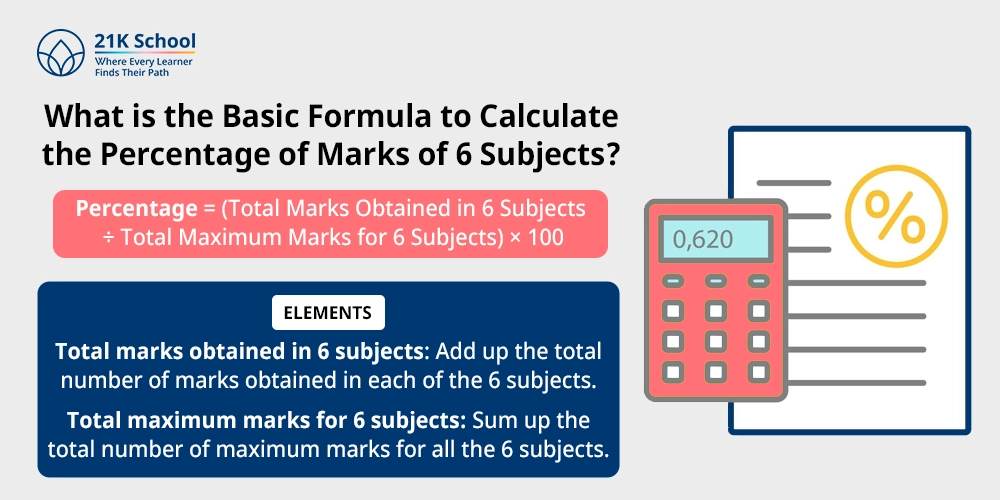
The basic formula to calculate the percentage of marks of 6 subjects is
- Percentage = (Total Marks Obtained in 6 Subjects ÷ Total Maximum Marks for 6 Subjects) × 100
This formula is used to calculate marks of all subjects. You just need to make sure to add the correct total marks.
Elements of the formula:
- Total marks obtained in 6 subjects: Add up the total number of marks obtained in each of the 6 subjects.
- Total maximum marks for 6 subjects: Sum up the total number of maximum marks for all the 6 subjects.
This formula works for most of the school boards and helps to get the correct overall percentage.
Example of calculating percentage of marks of 6 subjects
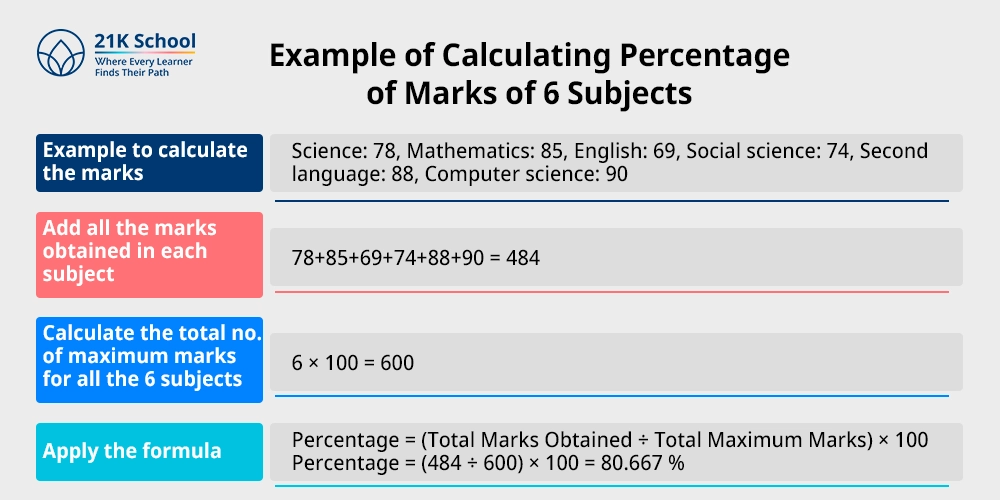
To understand the steps of calculation better let's try understanding it through the example below.
First make the note of the formula for calculating
Percentage = (Total Marks Obtained ÷ Total Maximum Marks) × 100
Example to calculate the marks:
A student has obtained the following marks in 6 subjects, where every subject is out of 100.
- Science: 78
- Mathematics: 85
- English: 69
- Social science: 74
- Second language: 88
- Computer science: 90
- Add all the marks obtained in each subject to find the total score.
78+85+69+74+88+90 = 484
- Calculate the total number of maximum marks for all the 6 subjects. With each of the 6 subjects out of 100.
6 × 100 = 600
- Apply the formula to calculate the percentage of total number of marks obtained in each subject by total number of maxim marks multiplied by 100.
Percentage = (484 ÷ 600) × 100 = 80.667 %
Therefore the overall percentage is 80.67% for students who scored 484 marks out of 600 for all the 6 subjects.
Important board rules
While calculating the percentage of marks for 6 subjects, it is important to go through the board rules for both CBSE and ICSE.
With the existence of five subject rules, these methods of calculation vary based on the board.
1. Central Board of Secondary Education (CBSE)
CBSE Board declares Class 10 results using a CGPA-based CBSE grading system and Class 12 results as raw marks with grades not percentage directly.
However, an indicative percentage can be derived. Marks are calculated using the best-of-five subject rule, with English as a compulsory subject.
If a student has taken an additional subject, its marks replace the lowest-scoring compulsory subject. Given that you score higher marks in the optional subject.
Conversion of CGPA for Class 10 is calculated by multiplying CGPA by 9.5 gives an indicative percentage.
2. ICSE (Indian School certificate examinations)
The subject marks are calculated through percentage. ICSE Board calculates the aggregate using English plus the best four other subjects.
The remaining subjects are counted if they are the highest-scoring ones among the candidate's subjects.
Subject percentage calculator
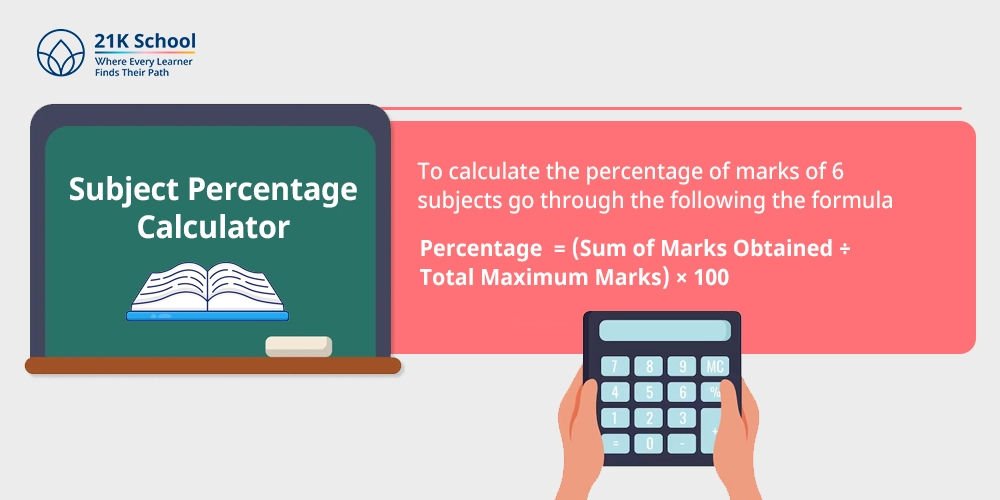
To calculate the percentage of marks of 6 subjects go through the following the formula
Percentage = (Sum of Marks Obtained ÷ Total Maximum Marks) × 100
- Let the marks obtained in each subject be m1, m2, m3, m4, m5, and m6.
- Add the number of total marks for 6 subjects. Each one of them will be 100. So let's consider it as T.
T = max1 + max2 +……+ max6
- Divide the sum of obtained marks by total maximum marks and multiply that result with 100 by applying the percentage formula.
Percentage = (∑ᵢ₌₁⁶ mᵢ ÷ T) × 100
Common mistakes that students should avoid
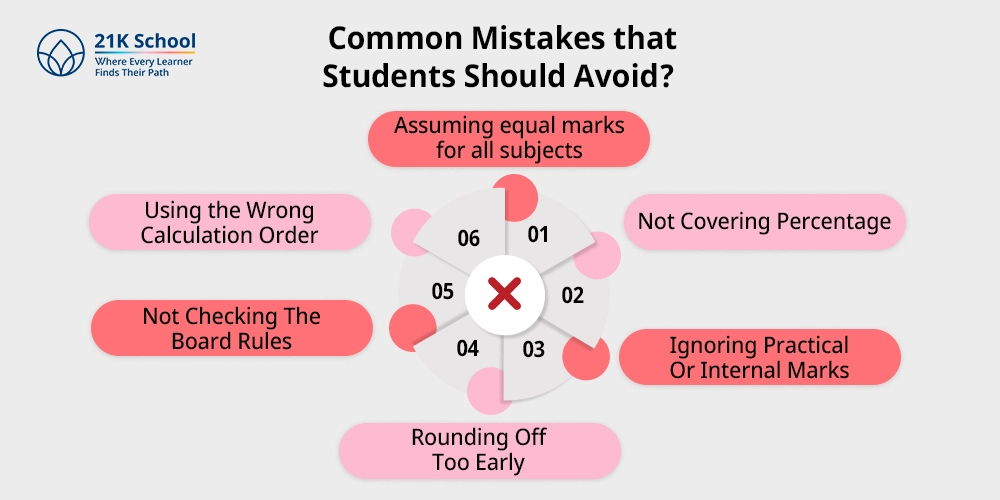
Students often choose the manual method over the online calculator available to verify the results correctly. Although students make some small errors that affect the final percentage.
Here are some errors to watch out:
- Assuming equal marks for all subjects
Many students assume all subjects carry equal marks and use a fixed total like 600 without verifying.
Explore major and minor subjects of CBSE class 12 in detail.
- Not Covering Percentage
Some students stop at the decimal value and forget to multiply by 100. The result is scaled in percentage.
- Ignoring Practical Or Internal Marks
Many students only focus on theory marks and ignore internal or practical components which leads to incomplete or incorrect total. For a correct approach, add total marks of the subjects based on the grading system requirements.
- Rounding Off Too Early
Early rounding off can change the final result. Do it only at the end if required.
- Not Checking The Board Rules
Some boards have different calculation methods. Follow through your respective board guidelines.
- Using the Wrong Calculation Order
Applying the formula incorrectly leads to errors. Divide first and then multiply by 100.
Conclusion
To calculate the percentage of marks for all the 6 subjects follow a standard formula while checking the results.
Before doing the math, go through the board criteria for optional and practical subjects. This helps you to calculate your total marks that resonate with the actual calculations.
With these simple steps, you can sum up the overall percentage of marks and determine your assessment during the results.
Frequently asked questions
5 questions
Can I calculate the percentage without a calculator?
Yes, you can calculate the percentage without a calculator by using simple mental math.
Is percentage important for college admission?
Yes, the board's percentage criteria is important for college admission.
How to calculate the percentage of the marks if each subject has different marks?
To calculate the percentage of the marks of each subject would require summing up all your obtained marks, divide it by the total maximum marks, and multiply by 100.
Can I calculate my percentage from CGPA?
Yes, you can multiply your CGPA by 9.5 to get an indicative percentage.
Should I calculate for 5 subjects or 6 subjects for board exams?
For the CBSE board exam, calculate the percentage by using the best of five subject rules.
About the author
Annapurna S
Content Specialist
Annapurna is an Education Content Specialist at 21K School, India’s first accredited fully online K-12 School with more than 20,000 learners across 78+ countries. She holds a Bachelor’s degree in Electronics and Communication Engineering that helps her structure information logically and structure technical concepts for an understandable educational content. With more than 3 years of experience at 21K School, a fully accredited institute- Cambridge International (IA702) and Pearson Edexcel (94883), Annapurna specialises in creation of the learner-centric resources for school-age students. Annapurna’s every article is based on the official resources and focuses on Cambridge/Edexcel, and CBSE curriculum frameworks. Annapurna’s content helps guardians, and learners to navigate through the modern online education system.
Every 21K School guide is written by our education team and reviewed by a subject facilitator before publishing.
Exploring a CBSE-pathway online school?
Talk to an advisor about 2026–27 admissions — no obligation.
Talk to an advisorComments
No comments yet — be the first to share your thoughts or ask a question.