

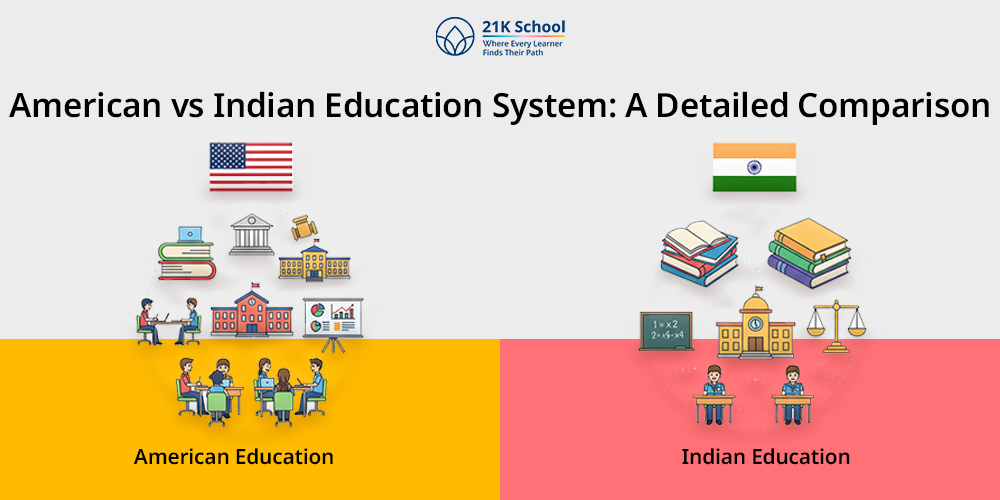
Education is playing a crucial role in giving shape to the students’ future & making them ready for professional achievements. Both the American & Indian Education systems target to educate & empower students.
But they are different in their structures, teaching styles, examination patterns, & overall learning approach. By knowing these differences, we can see the strengths & weaknesses of both the education systems.
Table of Contents
What is the American Curriculum?
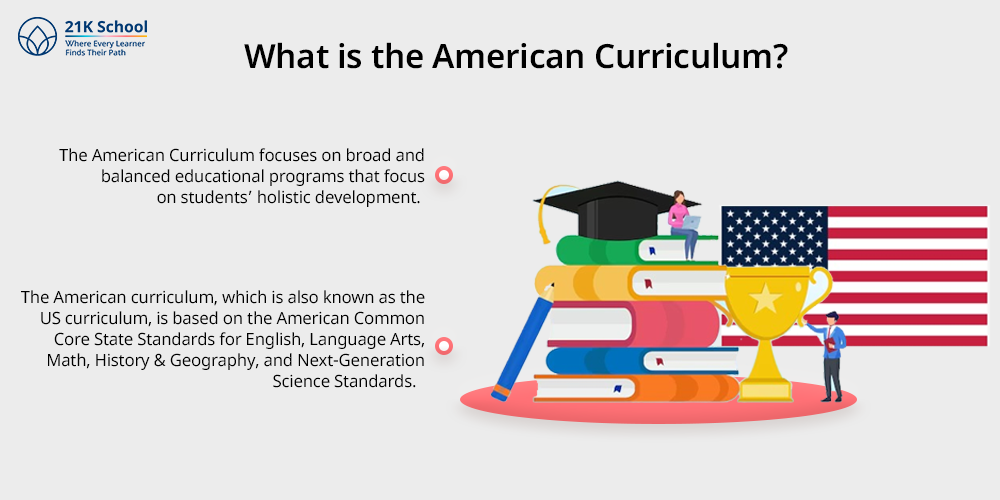
The American Curriculum focuses on broad and balanced educational programs that focus on students’ holistic development.
The American curriculum, which is also known as the US curriculum, is based on the American Common Core State Standards for English, Language Arts, Math, History & Geography, and Next-Generation Science Standards.
Along with the theoretical aspects, the American curriculum focuses on practical knowledge with a greater emphasis on extracurricular activities.
The curriculum of America focuses on developing all-round knowledge of students through practical exposure.
The subjects and programs designed by the American curriculum are to develop well rounded education that helps in developing holistic education .
In the American curriculum, students are assessed through exams, essays, and practical work, which helps in evaluating their performance.
Overview of the American Education System
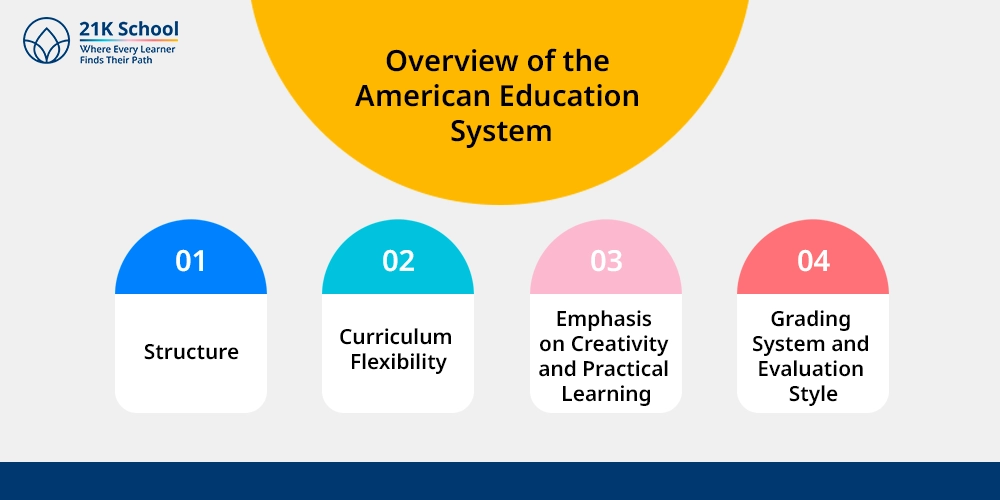
1. Structure
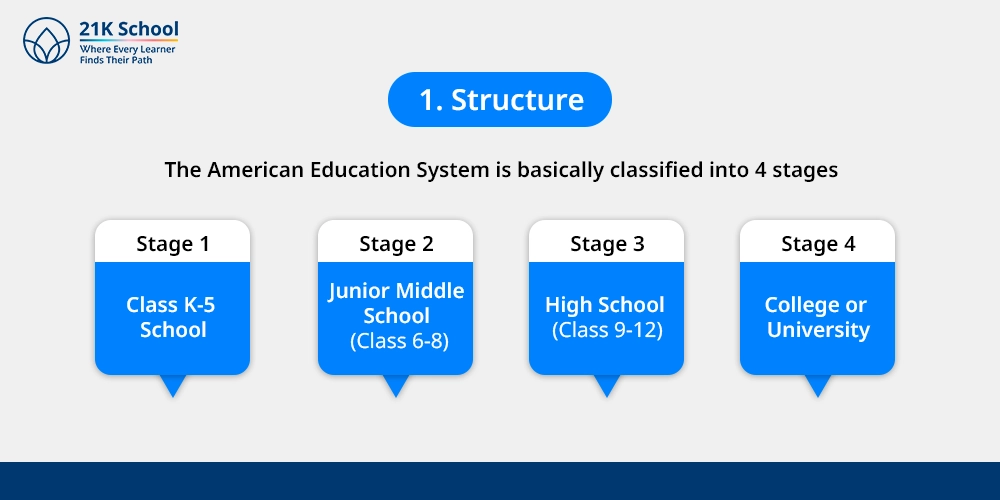
The American Education System is basically classified into 4 stages:
- Class K-5 School
- Junior Middle School (Class 6-8)
- High School (Class 9-12)
- College or University (Undergraduate, Post Graduate, Master’s, etc.)
This structured way of learning encourages students to achieve success gradually & explore all the subjects before focusing on the next.
2. Curriculum Flexibility
The important plus points of the American Education system is its flexible curriculum.
Here, the students are given the freedom to choose the electives as per their career goals & interests & they need to combine it well with their core main subjects.
By providing this flexibility towards education , it helps students to think creatively, analyze & solve critical problems strongly.
3. Emphasis on Creativity and Practical Learning
In the American education system, the learning strategy mainly prioritises creativity, critical thinking & practical-based learning which makes learning fun & interesting.
Teamwork, group projects, assignments, and extracurricular activities are an important part of this education system because students get involved actively.
It supports students to carry forward their skills of their interest & not to limit themselves to the textbook only.
4. Grading System and Evaluation Style
Generally in America, grading depends on daily assessments & tasks which includes homework , active participation in group discussions , quizzes, & exams.
The American education system mainly wants to promote students to use their creative mind or ideas to know various things instead of only focusing on exams.
What is the Indian Curriculum?
The Indian curriculum focuses on the Indian standard of education that follows the National Curriculum Framework (NCF). The Indian curriculum follows a standard learning system, which has an emphasis on structured learning.
The Indian curriculum aims at providing quality education across various subjects and disciplines. The Indian curriculum places a high value on academic achievement with tests and grades receiving special attention.
The Indian curriculum mostly focuses on traditional aspects of theoretical knowledge with an emphasis on the rote learning method. The structure of the Indian curriculum is divided into 3 stages known as Primary, Middle, and Higher Education.
The Indian curriculum focuses on the holistic development of students, which helps in enhancing problem-solving skills and developing [hom
Overview of the Indian Education System
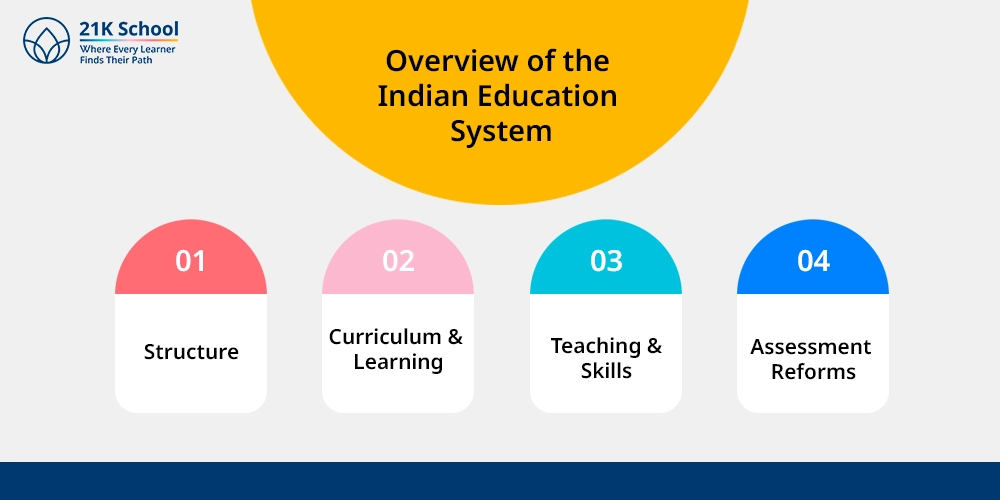
1. Structure
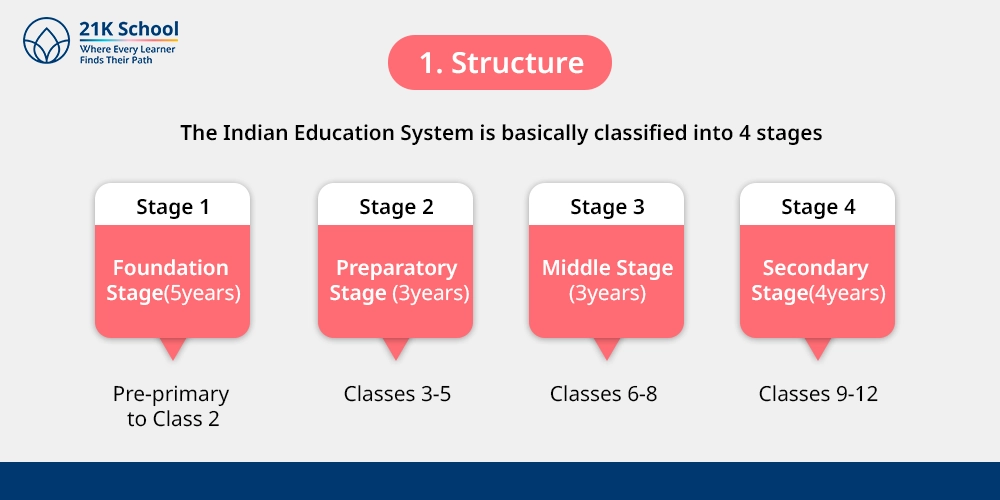
The Indian Education System also proceeds with a roadmap:
- Foundation Stage(5years):- Pre-primary to Class 2
Mainly based on play school & activity-related learning.
- Preparatory Stage (3years):- Classes 3-5
Emphasizes understanding the basic concepts of subjects
- Middle Stage(3years):- Classes 6-8
Enhances the practical & experiment-based learning
- Secondary Stage(4years):- Classes 9-12
Provides holistic education & with dynamic learning options
This structured framework is making students ready to prepare for competitive exams & higher studies & exams.
2. Curriculum & Learning
The academic curriculum is more dynamic, & offers student-centric learning . It encourages students to work more on getting ideas from the projects or experimental learning instead of only focusing on the textbooks.
They are also provided with opportunities to mix up their subjects from science or vocational subjects, according to their suitability & needs.
By making students this able for learning, it is developing a lot of skills that include problem-solving skills , creative ideas, instead of remembering facts.
3. Teaching & Skills
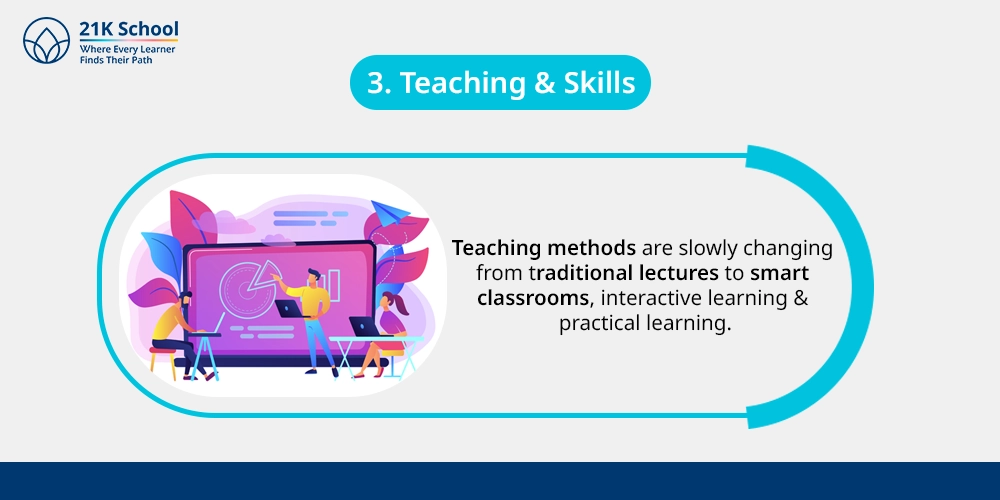
Teaching methods are slowly changing from traditional lectures to smart classrooms , interactive learning & practical learning.
This promotes the skills of communication , critical thinking & practical learning, which are currently required for the 21st century. Here, internships & practical learning help students to prepare both for professional & personal growth.
4. Assessment Reforms
The NEP 2020 is making major changes in today’s exam system. Board exams mainly focus on getting a deep understanding of the core topics, not just memorizing them.
Daily assessments, student participation & assignments are also a part of the grading system . This encourages students to solely focus on the entire learning process, be it professional growth or career development, not only in the final exams.
Key Differences Between American and Indian Education Systems
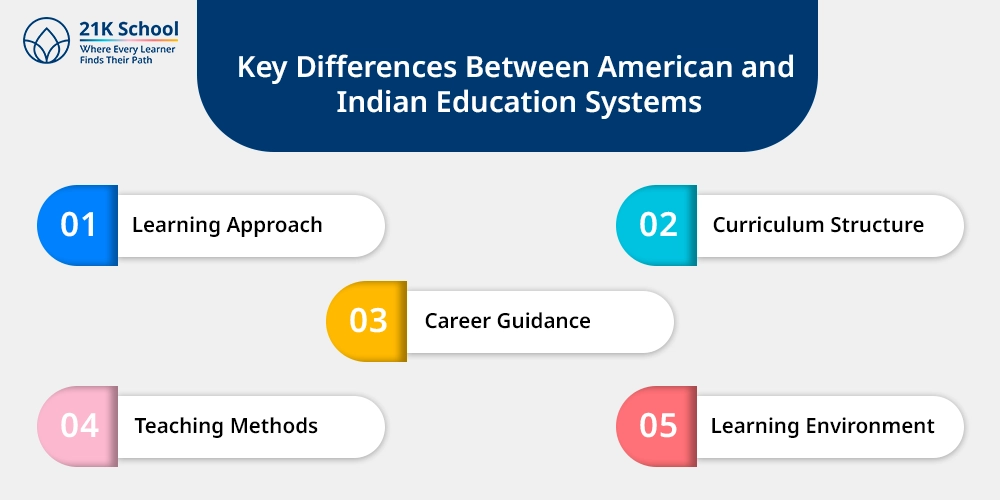
The education system across the world is not only shaping the students’ future & career goals, but they are also helping them in improving their analytical skills , critical thinking ability & creativity.
AMERICAN EDUCATION & INDIAN EDUCATION are different in many ways. Below are some key differences between the two systems:
| S.No | Aspects | American Education | Indian Education |
| 1. | Learning Approach | It is a more student-centric way & is focusing on critical & creative thinking skills. | It has a teacher-centered style but with recent scope for changes underway. |
| 2. | Curriculum Structure | It has a flexible structure, because it allows students to choose electives of their interests & career plans. | It is now focusing on a flexible structure based on NEP. |
3. | Career Guidance | It provides a wide range of career opportunities & a strong support on any concern. | It is still in its growing stage of providing huge career scopes to the students. |
4. | Teaching Style | It provides an interactive & team-based discussion over any particular topic & more emphasises practical-based learning. | It provides lecture-based knowledge but now is intended towards practical learning based studies. |
5. | Learning Environment | It always keeps the students motivated, self-confident, and creative. | It prioritises discipline, and child’s academic performance. |
| 6. | Assessment Method | The assessment method of the American curriculum focuses on Grade Point Average (GPA), which is evaluated through projects, quizzes, summative assessment and class participation. | The assessment method of the Indian curriculum mostly focuses on standardised exams and oral, and practical exams. |
| 7. | Extracurricular Activities | The American curriculum focuses on extracurricular activities like clubs, sports and the arts, which enhances students’ participation. | The Indian curriculum mostly focuses on the traditional aspect of learning, with less focus on extracurricular activities |
| 8. | Standardised Test | The American curriculum conducts standardised tests such as the SAT, GATE or ACT in order to provide admission to college. | Students who follow the Indian curriculum mostly take standardised tests such as NEET, JEE, or GATE in order to gain admission to college |
| 9. | Expensive | The American curriculum is considered more expensive as compared to the Indian curriculum, especially in higher education. | The Indian curriculum is considered as cost-effective, as compared to the American curriculum, because various government programs support free education. |
| 10. | Difficulty Level | The American curriculum is not considered too difficult; however, some subjects and their contexts are difficult. | The Indian curriculum is more challenging due to its rigorous examination format and emphasis on theoretical knowledge. |
1. Learning Approach
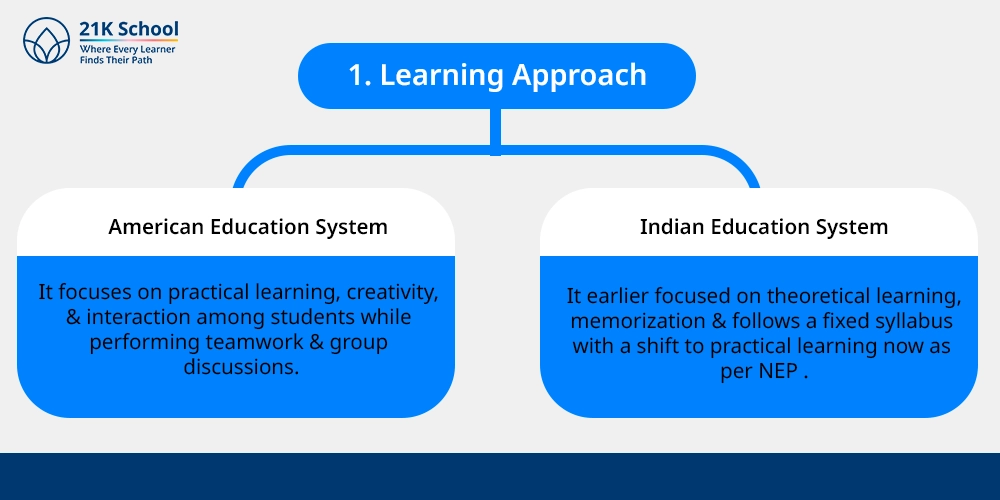
American Education System – It focuses on practical learning, creativity, & interaction among students while performing teamwork & group discussions.
Indian Education System – It earlier focused on theoretical learning, memorization & follows a fixed syllabus with a shift to practical learning now as per NEP .
2. Curriculum Structure
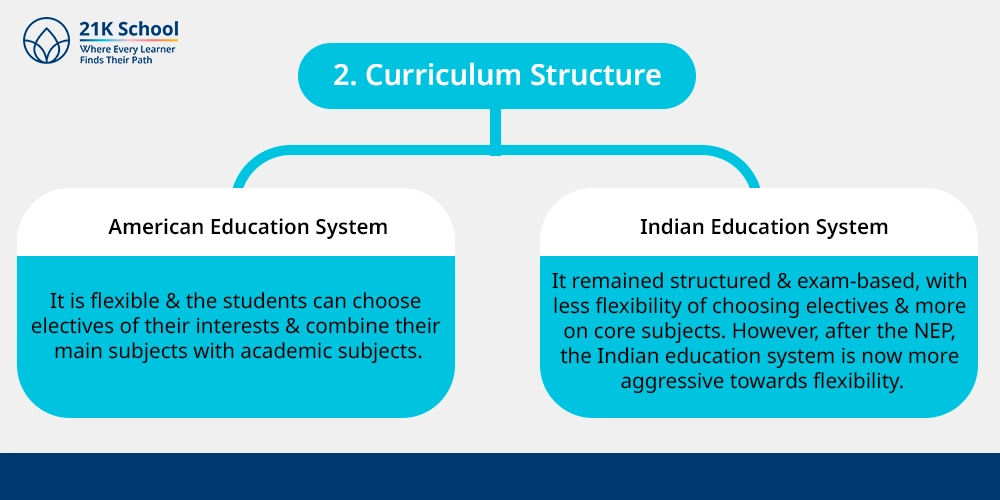
American Education System – It is flexible & the students can choose electives of their interests & combine their main subjects with academic subjects.
Indian Education System – It remained structured & exam-based, with less flexibility of choosing electives & more on core subjects. However, after the NEP , the Indian education system is now more aggressive towards flexibility.
3. Career Guidance
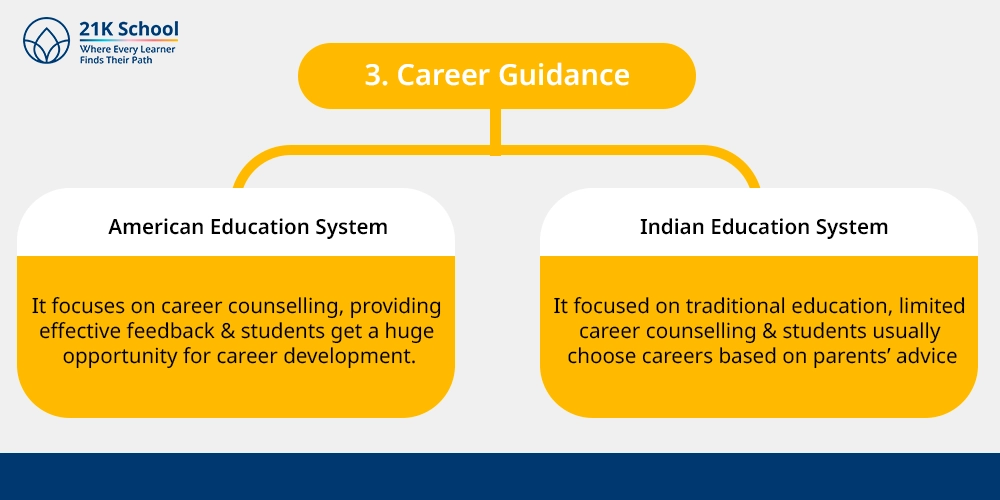
American Education System – It focuses on career counselling, providing effective feedback & students get a huge opportunity for career development.
Indian Education System – It focused on traditional education , limited career counselling & students usually choose careers based on parents’ advice. In recent times, Indian curriculum is switching towards a career-oriented approach as per NEP guidelines.
4. Teaching Methods
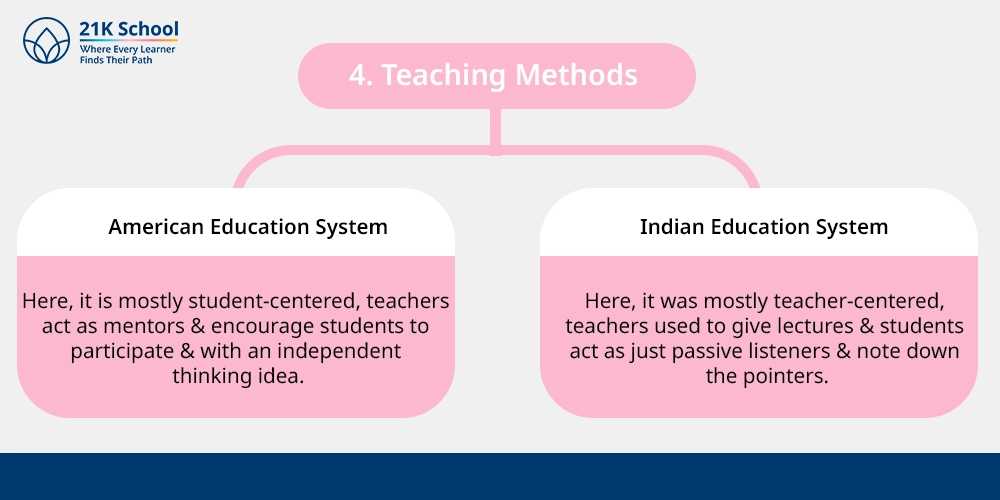
American Education System – Here, it is mostly student-centered, teachers act as mentors & encourage students to participate & with an independent thinking idea.
Indian Education System – Here, it was mostly teacher-centered, teachers used to give lectures & students act as just passive listeners & note down the pointers. After NEP, it is now more student-centered focusing on better student engagement .
5. Learning Environment
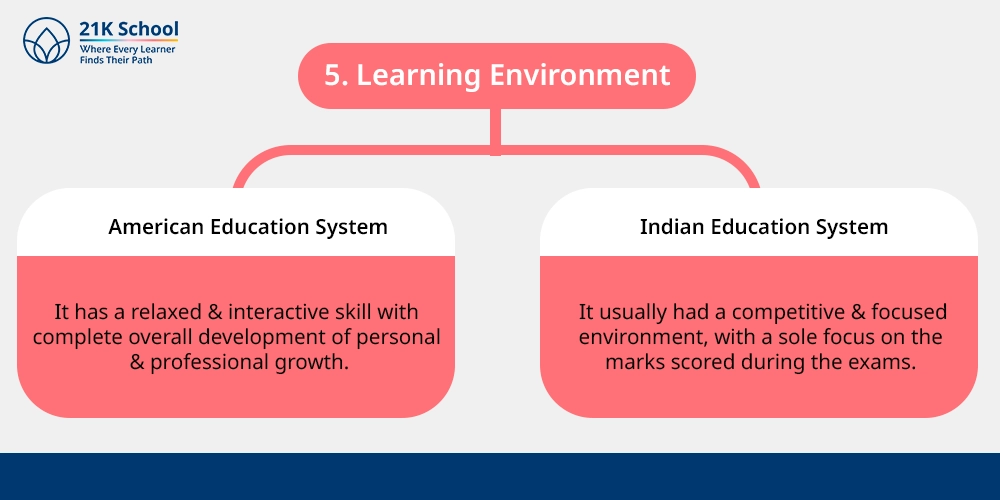
American Education System – It has a relaxed & interactive skill with complete overall development of personal & professional growth.
Indian Education System – It usually had a competitive & focused environment, with a sole focus on the marks scored during the exams . But now NEP is focused on creating a healthy learning environment .
6. Assessment Process
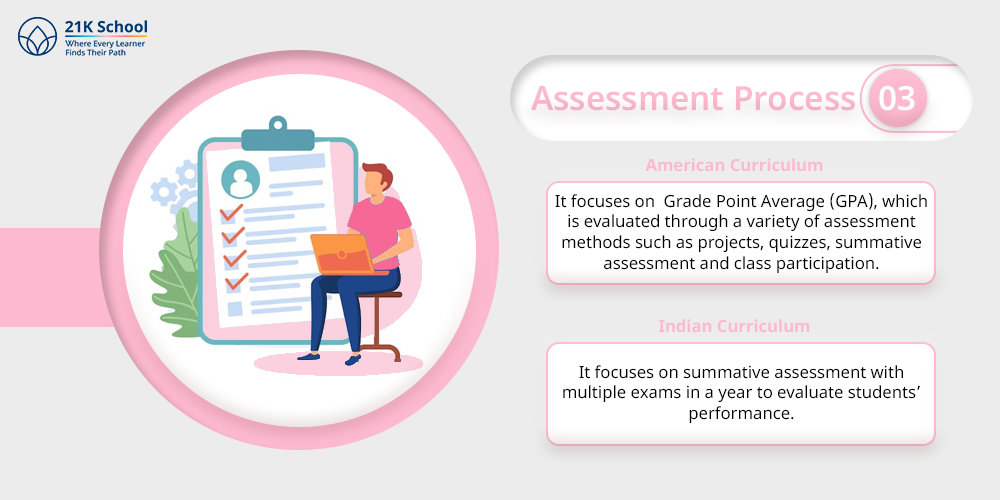
American Curriculum: The American Curriculum focuses on Grade Point Average (GPA), which is evaluated through a variety of assessment such as projects, quizzes, summative assessment and class participation. The American curriculum provides flexible assessment methods that enable it to meet its diverse needs.
Indian Curriculum: The Indian curriculum mostly focuses on standardised exams with an emphasis on traditional learning . The Indian curriculum mostly focuses on summative assessment with multiple exams in a year to evaluate students’ performance. However, students are also evaluated on the basis of practical and oral tests.
7. Extracurricular Activities
American Curriculum: American schools place a high value on extracurricular activities like clubs, sports and the arts because they believe that these pursuits are essential to students’ overall development.
Indian Curriculum: Indian schools mostly focus on the traditional aspect of learning with less emphasis on extracurricular activities. However, the NEP 2020 has also put an emphasis on extracurricular activities such as sports, games, as well as fun learning activities .
Explore the difference between extracurricular activities and co-curricular activities. .
8. Standard Tests
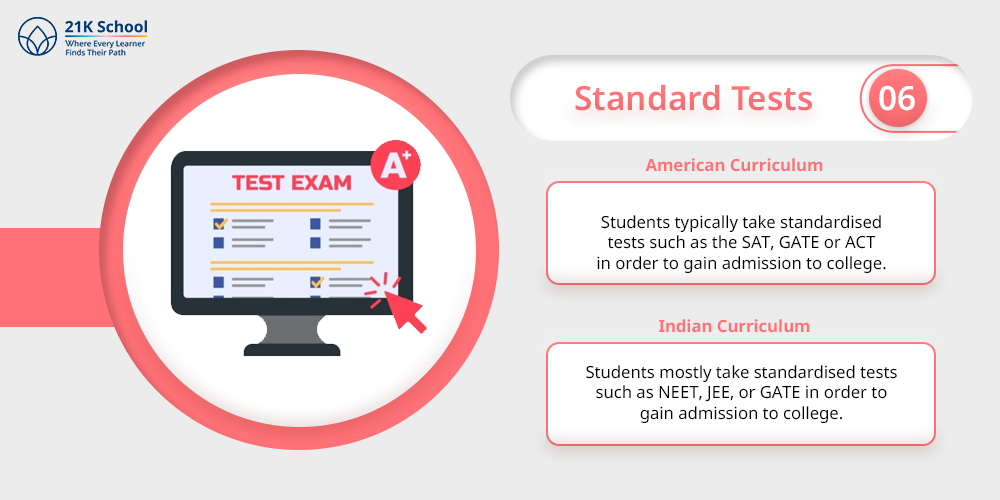
American Curriculum: Students with an American curriculum typically take standardised tests such as the SAT, GATE or ACT in order to gain admission to college. These assessments look at a range of skills and knowledge to evaluate students ability.
Indian Curriculum: Students with an Indian curriculum mostly take standardised tests such as NEET, JEE, or GATE in order to gain admission to college. These assessments are used to evaluate knowledge and students’ abilities.
9. Cost
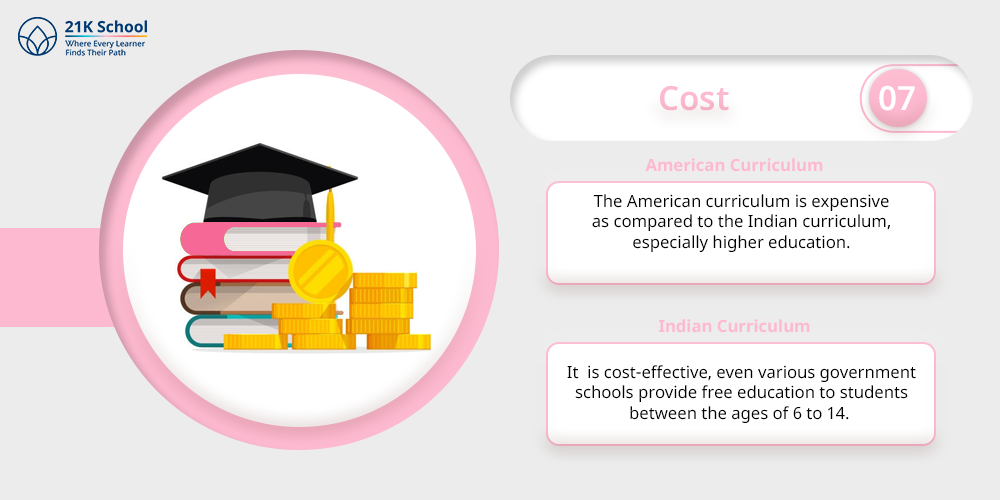
American Curriculum: The American curriculum is expensive as compared to the Indian curriculum, especially higher education. The cost of American education for both public and private institutions is extremely high. This causes many students to drop out of their courses.
Indian Curriculum: The Indian curriculum is cost-effective, even various government schools provide free education to students between the ages of 6 to 14. As compared to the American curriculum, various Indian private institutions are also less affordable.
10. Difficulty
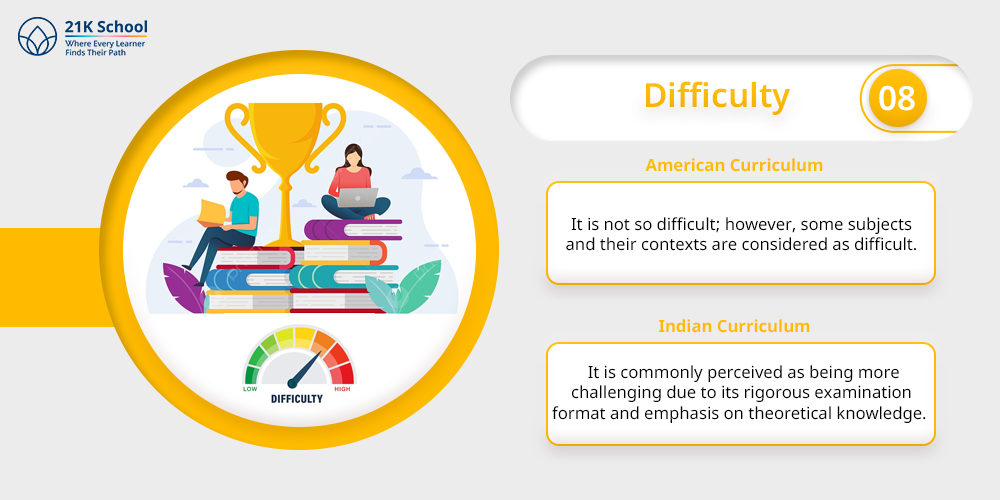
American Curriculum: The American curriculum is not so difficult; however, some subjects and their contexts are considered as difficult. The American curriculum provides flexibility, which allows students to study as per their own learning methods.
Indian Curriculum: The Indian educational system is commonly perceived as being more challenging due to its rigorous examination format and emphasis on theoretical knowledge. The Indian curriculum mostly focuses on standardised methods of memorisation and rote learning.
Read on to learn more about advantages of the Indian education system and also about problems in the education system of India.
Conclusion
The American & Indian Education systems together share different methods of learning .
The INDIAN SYSTEM earlier mainly focuses on textbook & theoretical knowledge & emphasized the main subjects & discipline-based exams. It has changed its direction after the introduction of NEP 2020.
Whereas the AMERICAN SYSTEM mainly focuses on creative thinking & practical-based learning & students are provided with lots of elective options they can choose according to their passion or wish.
Basically, both systems are not perfect & exact, but the mixture of the systems describes the importance of learning to design the future of the students.
The right choice solely depends on the students ’ career goals, planning & strategies.

You may also want to read

CBSE Class 10 Subject List: Compulsory & Optional Subjects
- Last updated on: 22 Aug, 2026
- 12 min read