CBSE 3 Language Policy 2026: Class 9 Rules, Languages & Exemptions
 Written byRahul PalContent Specialist
Last modified: Sep 7, 2026 10 min read
What is the CBSE 3 Language Policy, and how does it work?
The Central Board of Secondary Education (CBSE) has declared that it will have a major change in its language policy in Classes 9 and 10.
On 15 May 2026, the board released a statement according to which all learners of Class 9 in the 2026-27 academic year would be required to study three languages as a part of their curriculum in all CBSE-affiliated schools by July 1, 2026.
There will be no Class 10 board exam for the third language (R3). This policy assists students growing not only in their academics, but also in diversifying their language abilities.
Such knowledge about how the policy works can enable parents and students to make good language choices and enjoy a more balanced education.
What is the CBSE 3 language policy
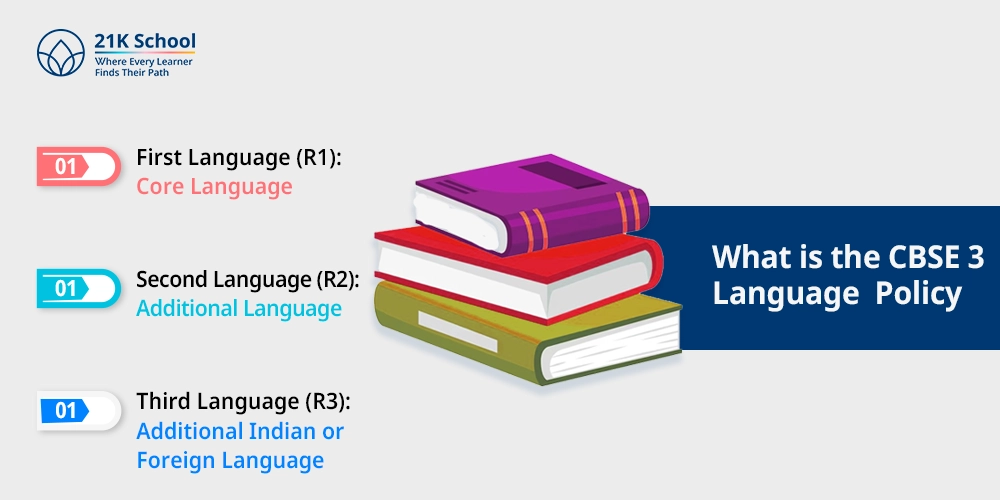
CBSE has already mentioned that the three languages will be mandatory courses for students in Class 9 that will begin on July 1, 2026. The recent CBSE circular on the instruction of three languages (R1, R2 and R3) in view of the three-language policy, with NCERT syllabus dictates that two or more native Indian languages must be instructed along with any other language.
However, as per the latest CBSE notification, the current batch of Class 10 will not have to follow the new language policy and the current batches studying in Class 7, Class 8, and Class 9 would not be required to give the board examination in the third language when they go to Class 10. The learners from current batches of Class 7, Class 8, and Class 9 who had already taken two foreign languages would continue with the same, with one additional native Indian language.
It is as stipulated by the National Education Policy of 2020 and the National Curriculum Framework for School Education (NCF-SE) 2023. However, the first language (R1) and the second language (R2) cannot be the same.
1. First language (R1): Core language
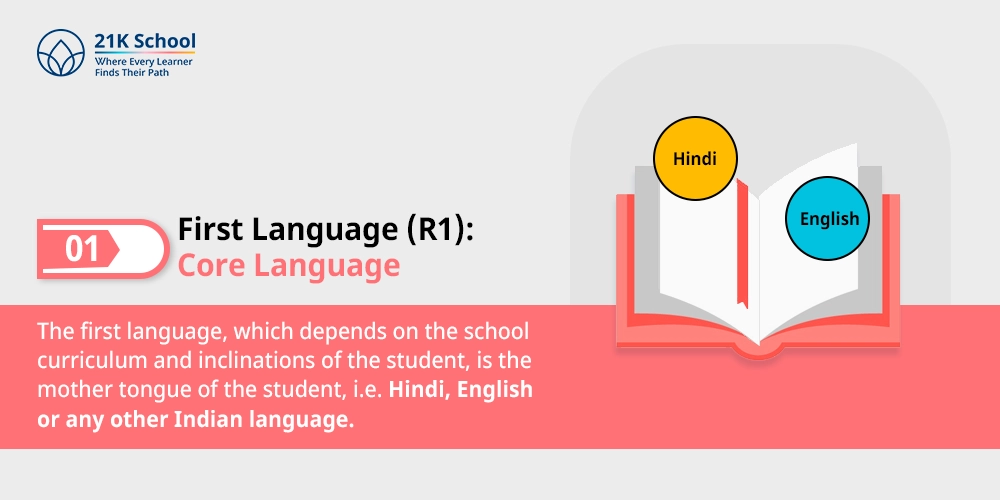
The first language, which depends on the school curriculum and inclinations of the student, is the mother tongue of the student, i.e. Hindi, English or any other Indian language.
2. Second language (R2): Additional language
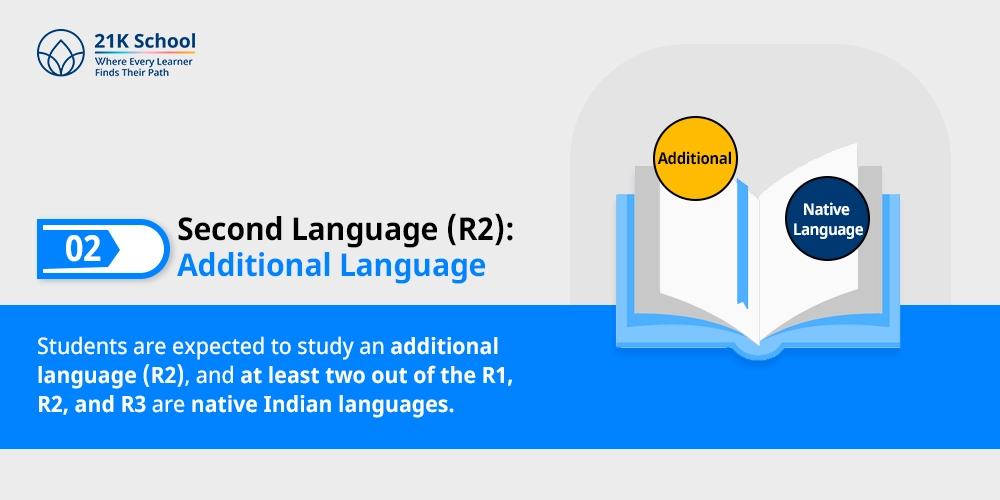
Students are expected to study an additional language (R2), and at least two out of the R1, R2, and R3 are native Indian languages.
It is important to note here that R1 and R2 can't be the same language.
3. Third Language (R3): Additional Indian or foreign language
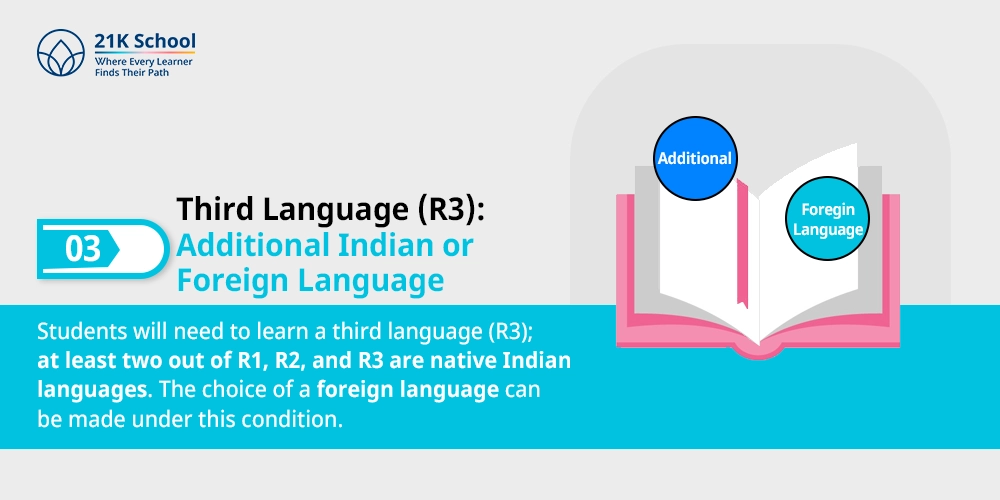
Students will need to learn a third language (R3); at least two out of R1, R2, and R3 are native Indian languages. The choice of a foreign language can be made under this condition.
R3 is mandatory but will be checked in-house by the school, and there will not be any Class 10 board examination.
Is the CBSE 3rd language compulsory?
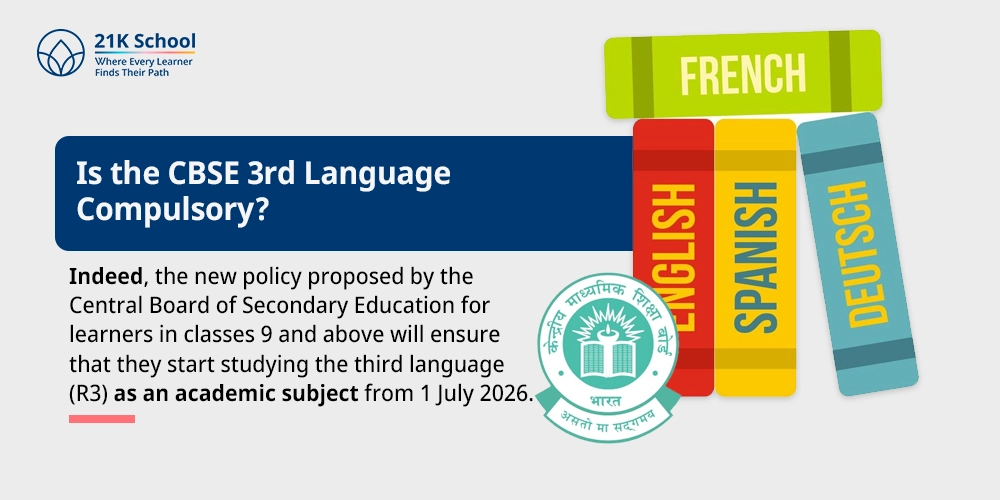
Indeed, the new policy proposed by the Central Board of Secondary Education for learners in classes 9 and above will ensure that they start studying the third language (R3) as an academic subject from 1 July 2026.
According to the National Education Policy 2020 and NCF (SE) 2023, the students will have to learn three languages (R1, R2 and R3), but two of them should be Indian languages.
The third language, however, is not pressured with board exams. The school will also internally examine the R3 student, and this will be written on the CBSE certificate of the student.
Poor performance in R3 will not deny a student the opportunity to appear for or pass the Class 10 boards.
Languages offered under the CBSE 3 language policy
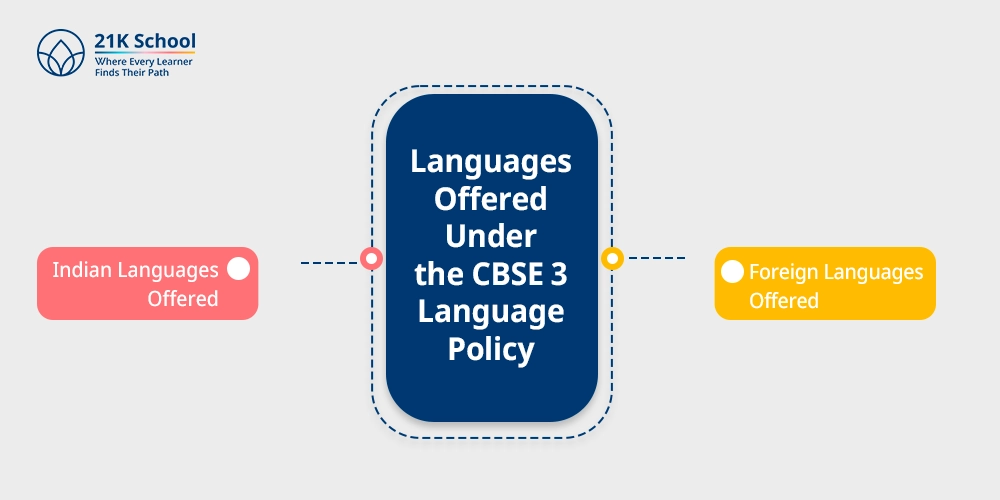
Depending on the languages taught in school, under the CBSE Language Policy, students have the freedom to select a list of Indian and foreign languages.
The policy requires the learners to study three languages, out of which at least two languages of India are required.
Learners are only allowed to take a foreign language as part of language studies when it is offered in the school, and the collective language mix is in accordance with CBSE recommendations.
1. Indian languages offered
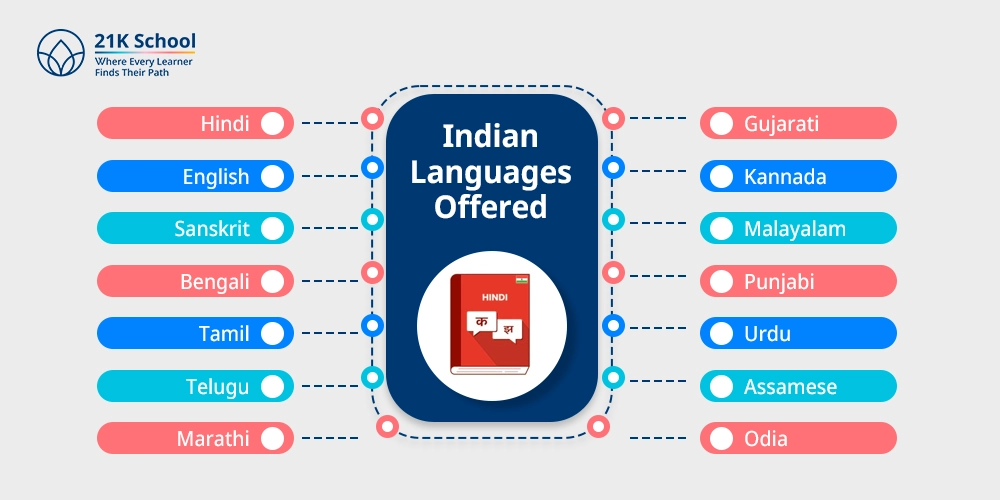
Common Indian language options may include:
- Hindi
- English
- Sanskrit
- Bengali
- Tamil
- Telugu
- Marathi
- Gujarati
- Kannada
- Malayalam
- Punjabi
- Urdu
- Assamese
- Odia
2. Foreign languages offered
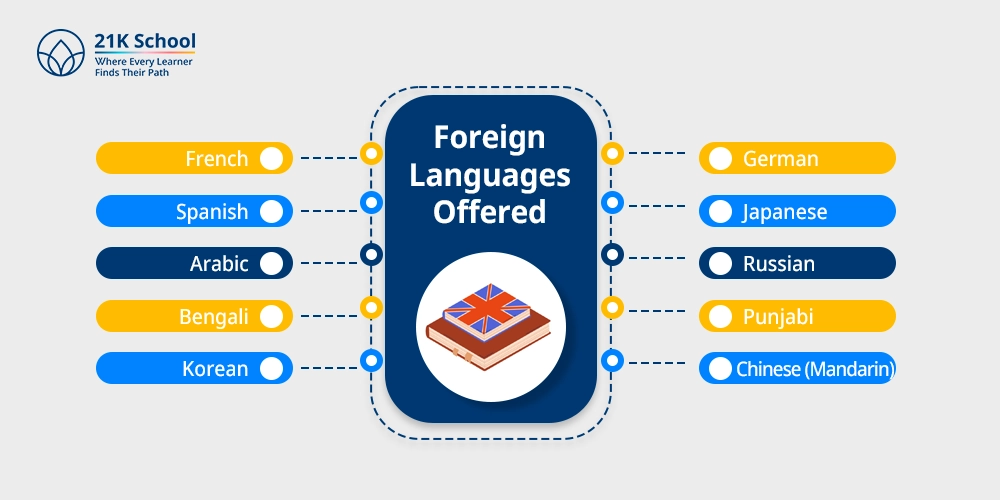
Some CBSE schools may also offer foreign languages, such as:
- French
- German
- Spanish
- Japanese
- Arabic
- Russian
- Korean
- Chinese (Mandarin)
Transition phase- not an immediate change
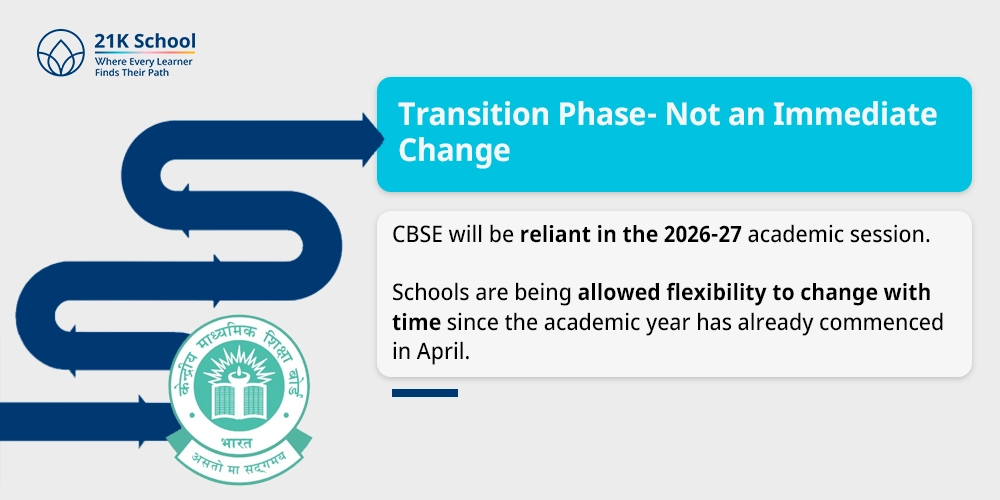
CBSE will be reliant in the 2026-27 academic session. Schools are being allowed flexibility to change with time since the academic year has already commenced in April.
It has also been emphasised that not a single student will lag behind in this alignment phase, and it is clear that learning is the primary objective and not student stress.
Accordingly, till the dedicated R3 textbooks are available, Class 9 learners shall use the Class 6 R3 textbooks (2026-27 edition) of the chosen language.
Local or regional literature, including poems, short stories, and non-fiction reading, will be provided in the schools as a way of filling the gap.
List of Languages in which Class VI R3 Textbooks are being developed by CBSE/ NCERT:
- Assamese
- Bengali
- Bodo
- Dogri
- Gujarati
- Kannada
- Kashmiri
- Konkani
- Maithili
- Malayalam
- Manipuri
- Marathi
- Nepali
- Odia
- Punjabi
- Santhali
- Sindhi
- Tamil
- Telugu AP & Telugu Telangana
If a learner is selecting any other language apart from these 19 languages, then they have to follow the SCERT or state resources.
While schools work through this transition, many parents are using add-on programs like the 21K School FLOWW language program, offering a rich portfolio of regional and international languages. The 13 languages offered are:
- Arabic
- ESOL
- French
- Hindi
- Japanese
- Kannada
- Malayalam
- Marathi
- Sanskrit
- Spanish
- Tamil
- Telugu
- Urdu
Will CBSE Conduct Board exams for the Third Language?
CBSE has announced that there will be no Class 10 Board Exam in the third language.
Schools will internalise all the R3 assessments . The marks will be transferred to the end certificate, but this subject will not stop the students from taking the Class 10 board exams.
It will be a shift towards promoting multilingual education, without burdening the students by subjecting them to further board tests. Nevertheless, the third language is an obligatory aspect of the curriculum, and the performance of the students could also be traced to their academic background.
Exemptions offered for the Third Language
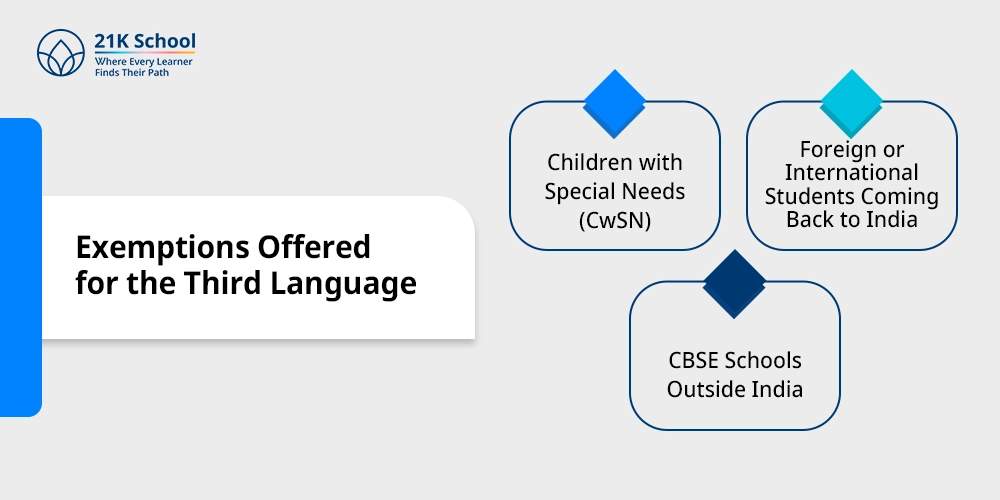
Despite being an obligatory one of the new CBSE 3 Language Policy, the third language (R3) could be expected to have certain exemptions and relaxations to interest specific groups of students. Some of the key relaxations made in CBSE to make it inclusive have been highlighted below.
1. Children with special needs (CwSN)
CBSE has said that it is possible to provide Special concessions to Children with Special needs as per the RPwD Act 2016. It includes the exemption from the second or/and third language, where applicable.
2. Foreign or international students coming back to India
The foreign or international students coming back to India can be given case-by-case exemptions from the requirement of two native Indian languages.
3. CBSE schools outside India
The schools located outside India can be allowed to prescribe exemptions or adjustments.
5 benefits of the CBSE 3 language policy
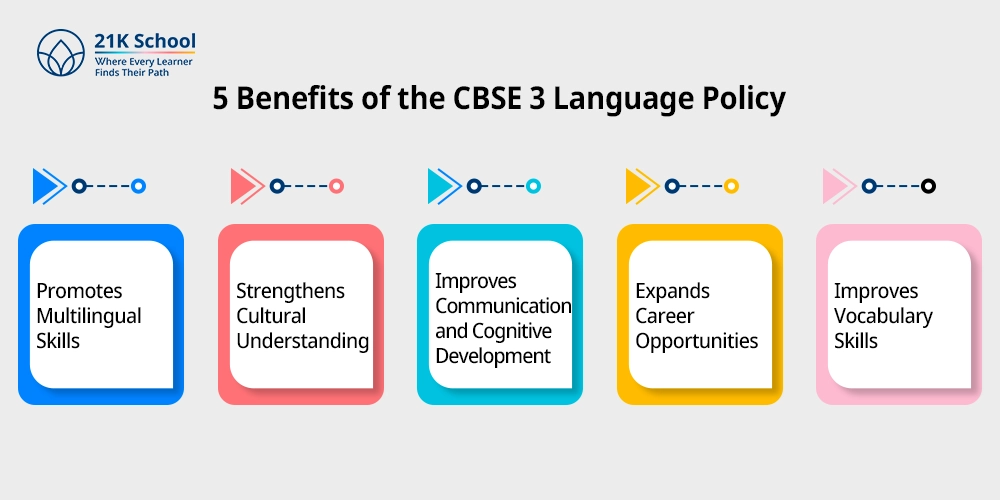
CBSE 3 language policy assists students in acquiring language skills, comprehending various cultures, enhancing their communication skills and providing them with more opportunities in education and even their career lives.
1. Promotes multilingual skills
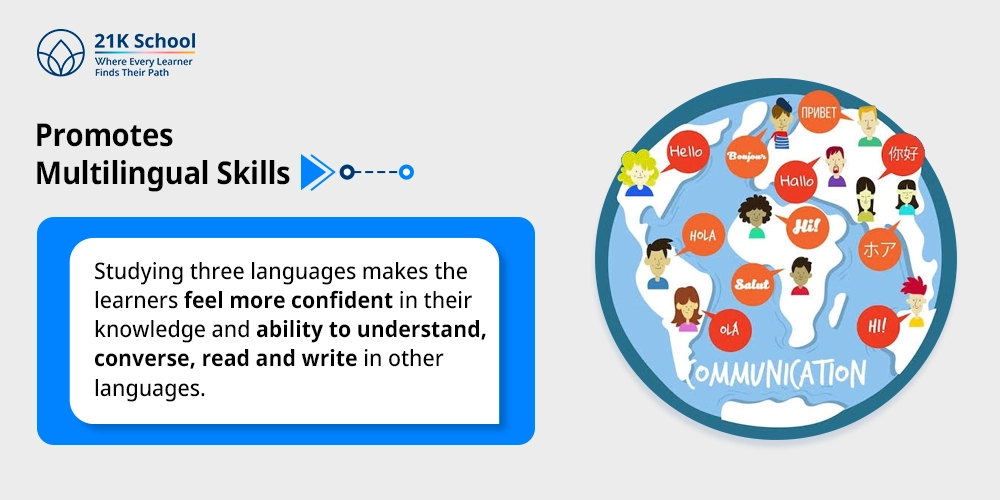
Studying three languages makes the learners feel more confident in their knowledge and ability to understand, converse, read and write in other languages. It instils flexibility in language and opens the students up to be willing to behave in a communicative mode within various academic, interpersonal and work circles.
2. Strengthens cultural understanding
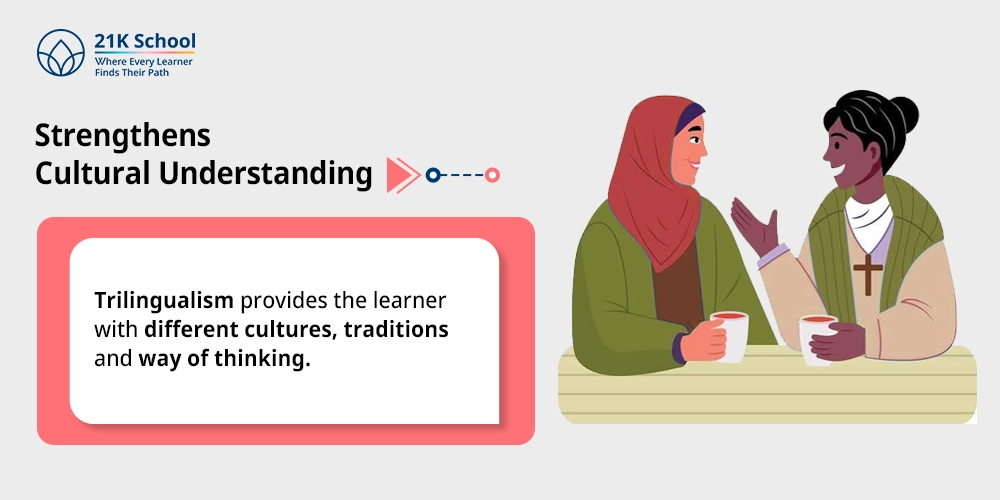
Trilingualism provides the learner with different cultures, traditions and way of thinking. It promotes respect for the linguistic diversity of India and teaches learners to have an extended vision and greater interest towards cultural differences.
3. Improves communication and cognitive development
Trilingualism develops both communication skills and the development of memory, attention capacity, and problem-solving skills . It has been found that such multilingual students will be more willing to achieve high cognitive flexibility and will be capable of adapting more to new learning demands.
4. Expands career opportunities

This can prove useful in further learning and the job market due to trilingualism. The skills of multilingualism are useful in the areas of business, education, translation, diplomacy, media and international communication.
5. Improves vocabulary skills
Exposing students to more than one language will mean that they will not only have a greater vocabulary, but they will also be in a position to develop better language structures. This has the ability to enhance general reading, writing skills and confidence in expressing ideas in a clear manner.
Conclusion
CBSE 3-language Policy is one such move in the right direction to enrich the idea of multilingual education and streamline school education according to the National Education Policy (NEP) 2020 and the National Curriculum Framework for School Education (NCF-SE) 2023.
This policy will boost communication, cultural sensitivity and general cognition development since the students will have knowledge of three languages.
Starting the academic session 2026-27, third language (R3) will be compulsory in Class 9 and will be gradually implemented in Class 10, according to the National Education Policy (NEP) 2020.
We would have informed parents and students who would make decisions based on their informed knowledge of the available options of language, how the assessment would be made and exemption
Frequently asked questions
5 questions
What is the three-language policy of CBSE?
According to NEP 2020, the CBSE three-language policy imposes the compulsory study of the three languages (R1, R2, R3) of Classes 9 and 10, two of which are the Indian languages.
Is the third language compulsory in CBSE Class 9?
Yes, Class 9 students will need to have a third language (R3) in the 2026-27 academic year. It will, however, be self-assessed by the school.
Are foreign languages included in the policy?
Yes, students can do the course in a foreign language, but that must be offered in their school; when the overall language mixture is not in compliance with the requirements of the CBSE, two Indian languages are obligatory.
Can students change their language choices later?
In certain cases, such changes in the language can even be allowed according to the school regulations and CBSE standards. Specific rules should be discussed with the school by the parents.
Is there any board exam pressure for the third language?
No, there will be no board exam pressure for the 3rd language. The assessment of the subject will be conducted by an internal school-based assessment, which will minimise the number of examinations of the learners.
About the author
Rahul Pal
Content Specialist
Rahul Pal is an Education Content Specialist at 21K School- India’s fully accredited online school recognised by the Cambridge International (IA702) and Pearson Edexcel (94883). His graduation from Journalism and Mass Communication from Swami Vivekananda University gives him a strong foundation in factual reporting, source verification, and investigative research. With around 2 years of experience at 21K School, he has written extensively for the CGPA conversion guides, marking schemes, and Indian and International boards (IGCSE, GCSE, and A-Levels). His articles are highly relevant for the guardians looking to guide their learners for board exam preparation across 78+ countries. All Rahul’s content is reviewed by the school’s academic team to ensure alignment with the latest board guidelines and latest notifications from the official resources
Every 21K School guide is written by our education team and reviewed by a subject facilitator before publishing.
Exploring a CBSE-pathway online school?
Talk to an advisor about 2026–27 admissions — no obligation.
Talk to an advisorComments
No comments yet — be the first to share your thoughts or ask a question.