

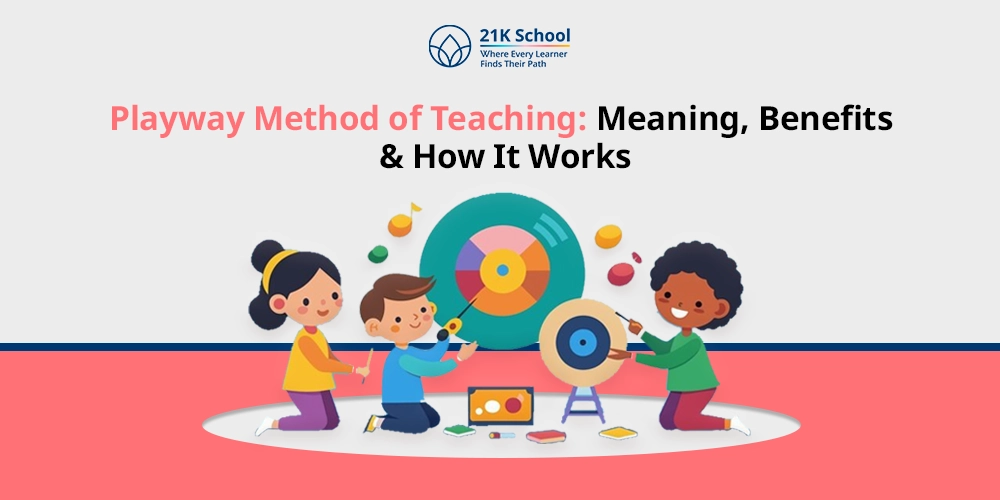
Have you heard about the playway method used by teachers to teach students?
This is the new method of learning where children learn the best through playing and enjoying rather than with just textbooks.
But, what is the need to shift to the playway method? What are the benefits that encourage people to switch to the type of education delivery?
In this article, we shall understand the playway method in detail, the philosophy behind it, objectives, features, and much more.
Contents
- What is Playway Method?
- Philosophical Basis of the Playway Method
- Objectives of the Playway Method
- 5 Principles of the Playway Method
- Characteristics of the Playway Method
- 5 Types of Play Used in the Playway Method
- 5 Importance of the Playway Method in Early Childhood Education
- Techniques in the Playway Method of Teaching
- 8 Advantages of the Playway Method
- 1. Makes Learning Enjoyable and Engaging
- 2. Reduces Stress and Fear of Education
- 3. Encourages Creativity and Imagination
- 4. Improves Social and Emotional Skills
- 5. Enhances Retention and Understanding
- 6. Promotes Physical Development
- 7. Builds Positive Teacher-Student Relationships
- 8. Develops Lifelong Love for Learning
- 5 Limitations of the Playway Method
- Playway Method vs Traditional Teaching Method
- How the Play-Way Method Supports Holistic Development
- Conclusion
What is Playway Method?
Playway Method is an approach of teaching and learning which sees play as the main medium of teaching.
This approach combines educational materials in the form of play, which acts as both meaningful and engaging to children, as opposed to using textbooks and lectures.
This process of learning comes naturally to children as they engage in role play, creative tasks, interactive learning, and games.
The method is based on the notion that children understand better through play. Henry Caldwell Cook coined the term “play way” method, in his book The Play Way.
The Playway Method enables children to test the ideas, find solutions to the problems, and learn in an informal way.
One learns subjects like language, mathematics, science, and social studies in the form of stories, games, songs, and activities.
Teachers motivate children to express themselves through play and activity-based learning.
Teachers ensure that small children get required exposure along with a supportive environment and necessary resources to reach their educational goals.
This eventually minimizes study-stress and boredom, hence making learning a happy process that each student wants to engage in.
Philosophical Basis of the Playway Method
The Playway Method follows strong philosophies of progressive education and child psychology.
It is inspired by the works of popular educational philosophers such as Jean Piaget, Friedrich Froebel, Maria Montessori, and John Dewey.
Jean Piaget stressed the idea that children form their knowledge consciously with active interaction with the surrounding world. To him, learning comes as an act of discovery instead of passive intake of information.
The Playway Method functions with this perception as it promotes learning through exploration and experimentation in children.
Friedrich Froebel, the founder of the kindergarten system, had the belief that the holistic development of a child happens through play.
He viewed play as the natural form of learning, and an outlet for inner thoughts and feelings by the child. The Playway Method is a way of following the philosophy of Froebel as it puts plays into the center of education.
The philosophy of learning-by-doing applied by John Dewey, is another solid theoretical background of the playway method. Dewey believed that education must be related to the real-life world and active-involvement of the child should be the best way of learning.
Similarly, the Playway Method encourages experiential learning by the use of meaningful activities.
In general, the philosophical foundations of the playway method consist of naturalism, constructivism, and pragmatism, which focus on the interests of the child, their experiences, and active-participation in the learning process.
Objectives of the Playway Method
The main objectives of playway method include a child’s holistic development and engaging learning:
- To boost cognitive thinking, reasoning, problem-solving, decision-making, mental skills, etc.
- To promote creativity and imagination by means of art, music, narration, and dramatic play.
- To enhance social skills like cooperation, sharing, communication skills, and working with groups.
- To facilitate emotional growth, ensuring that the children are able to express their feelings and develop self-esteem.
- To improve physical growth by use of movement involved in play and outdoor playing.
- To accommodate differences and support different learning styles and pace of learning.
- To develop lifelong learning patterns by fostering curiosity and self-motivation.
- To foster a cheerful learning process through a stress-free and engaging learning environment.
The playway method achieves these goals and secures a balanced growth of children, contributing to their overall holistic child development. It also equips students with future academic goals and challenges in life.
5 Principles of the Playway Method
Playway method functions based on the following principles:
1. Learning by Doing
Playway method is based on learning-by-doing which involves hands-on activities and experiential learning.
The practical experience derived from such activities often results in increased knowledge, comprehension, memorization, and practice.
Experiments, games, group discussions, and role-plays are some of the activities which enable children to experience concepts themselves.
Children learn faster and effectively when they participate actively in activities, instead of just following instructions.
2. Child-Centered Learning
The playway method is centered around students needs, abilities, preferences, and techniques.
Instead of following strict curriculums, teachers allow children to explore and learn through play-based learning. This ensures that children feel comfortable and valued in their learning environments.
3. Freedom and Flexibility
The playway method entails freedom and flexibility.
Children are given choice and freedom to explore, make decisions, and express themselves without the fear of failing.
The atmosphere of learning is very stress free as children can move around, interact, and experiment at will.
This freedom promotes independence, creativity, and confidence in learners.
4. Learning Through Joy
The playway method also has a significant aspect of joyful learning.
When the process of learning is accompanied by joy and excitement, children build a positive attitude towards learning.
When there is play, there is less stress and anxiety, which results in making learning an enjoyable activity.
This positive learning experience creates self-motivation and a passion for lifelong learning.
5. Active Participation
Children play and are actively involved in the learning process of the playway method.
Teachers organize activities like group work, discussions, fun learning activities, and games. It allows young students to participate and learn on their own, instead of observing passively as in regular classrooms.
Such interactive actions improve focus and cognitive development among children.
Characteristics of the Playway Method
You can distinguish playway method based on the following features:
1. Child-Centered Approach
The playway method puts the child in focus of the teaching-learning process. The learning experiences and activities selected are curated around the interests, needs, developmental stages, and abilities of children.
2. Learning Through Play
The primary medium of instructions is the playway method. Concepts are taught naturally and meaningfully through the use of engaging activities like songs, stories, dramatic play, and games.
3. Activity-Based Learning
Children learn by doing and not just by listening. Practical activities enable children to learn ideas directly through experience.
4. Happy and Stress-Free Atmosphere
The classroom environment is pleasant and cheerful. There is no fear of punishment or pressure of performance which makes learning fun and enjoyable.
5. Freedom and Flexibility
Children are allowed to have their freedom to make choices, communicate ideas, and explore learning materials.
Individual pace of learning is respected due to the flexibility in teaching.
6. Active Participation
All children actively engage in the process of learning. They are encouraged to take part in activities mentally, physically, socially, and emotionally.
7. Teacher as a Guide
Teachers are more like a facilitator or guide in the playway method of teaching.
This means that they do not impose a strict curriculum or learning methods like an instructor, and creates opportunities and support in learning.
8. Holistic Development
The playway method encourages intellectual, emotional, social, physical, and creative progress of the child.
5 Types of Play Used in the Playway Method
Since playway method revolves around multiple plays, the types of plays that are involved are mentioned below:
1. Physical Play
Activities involved in physical play, include jumping, climbing, dancing, running, and outdoor games.
This type of play helps in developing fine-motor skills and gross-motor skills development.
It also helps in balancing body chakras, which regulates excess energy of the body, and builds internal and external strength.
Physical play aids children in learning rules, playing as a team member, and gaining self-control.
2. Creative Play
Creative play involves creative activities for kids such as drawing, painting, music, singing, storytelling, and craft work.
It helps children demonstrate creativity and imagination. This further enables children to regulate themselves emotionally which in turn improves their aesthetic outlook.
Creativity play improves fine-motor skills through promoting originality for self-expression without the fear of judgment.
3. Constructive Play
Constructive play involves creation of objects with the help of materials such as building sets, blocks, clay, puzzles, etc.
This type of play develops problem-solving skills and logical thinking through strategizing and innovation.
During constructive play, the child acquires concepts about shape, size, balance, and structure that enhances the ability of hand-eye coordination.
4. Social Play
Social play can be seen when children interact and play with other kids.
Examples of social play might involve group games, collaborative activities, and team activities.
Social play helps in building collaboration, acquiring social regulations, understanding social norms, and building friendships.
It trains children to function well in society by enhancing their communication skills.
5. Dramatic and Role Play
Dramatic and role play involves imitating or simulating real-life scenarios pretending to be a teacher, doctor, shopkeeper or a parent.
This type of play helps in developing children’s language competence and encourages imagination.
It teaches the social roles and duties to children with practical implication and fosters emotional awareness.
5 Importance of the Playway Method in Early Childhood Education
Playway method is especially crucial for early childhood education because of the following reasons:
1. Help Children With Short Attention Spans
Young children have short attention spans.
The playway method is implemented by the use of interesting and diversified activities that enable the children to be more interested and concentrated.
The learning process becomes natural and entertaining as opposed to being coerced.
2. Matches Natural Instincts
Children are believed to be naturally curious about the world. Their natural instinct is to experiment and discover new things around them, and the playway method supports this behaviour of them.
3. Emotional Security
When children feel supported and cherished in a playful learning setting, they grow better as they have a sense of emotional security.
They feel confident to express themselves and ask questions from teachers freely without feeling any stress or anxiety.
4. Enhances Cognitive Growth
Children learn how to think, reason, memorize, and solve problems through play-based activities. Ideas acquired during these experiences are remembered more, thus improving cognitive development of children.
5. Supports Language and Social Development
Games such as storytelling, role play, and group discussions stimulate vocabulary, communication, and social interaction.
Children get to know how to communicate effectively and interact with others respectfully.
Techniques in the Playway Method of Teaching
Teachers and parents utilize the following techniques to implement playway method of teaching:
- Storytelling Technique: Imagination, listening skills, and moral values are developed in young learners with the help of stories.
- Learning Through Games: Educational games are utilized to teach concepts of mathematics, finances, and science.
- Song and Rhyme Method: Songs and rhymes are easier to remember for children. Teachers mostly use them to teach basic language proficiency and basic concepts.
- Activity and Project Method: Group projects or activities foster group-building and leadership from an early age in students.
- Dramatization and Role Play: Children learn about different roles around them through role plays and drama.
- Use of Teaching-Learning Materials (TLMs): Charts, toys, models, flashcards, and other teaching-learning materials make learning more practical.
- Experiential Learning: Knowledge acquisition through actual experiences like nature walks, observation, and experiments.
8 Advantages of the Playway Method
The following are the benefits of the playway method for students:
1. Makes Learning Enjoyable and Engaging
The playway method fosters excitement and curiosity which is naturally present in children. The use of games, songs, and role plays makes the lessons lively and interesting.
2. Reduces Stress and Fear of Education
Fear and punishment are often associated with exams in traditional classrooms.
The playway method eliminates stress and nervousness allowing children to feel comfortable and secure.
3. Encourages Creativity and Imagination
Creative works, music, storytelling, and role play are some of the creative activities that help children to think and express original ideas without any restriction.
4. Improves Social and Emotional Skills
Cooperation, sharing, empathy, patience, and emotional control are some of the aspects being taught through group play.
Children are taught to comprehend their own feelings and learn to respect others.
5. Enhances Retention and Understanding
The playway method is utilized at an early stage because it allows better retention and understanding because of different games, than rote learning.
6. Promotes Physical Development
Physical play helps in the physical development of small children as it builds their physique, muscle strength, and motor skills in the long run.
7. Builds Positive Teacher-Student Relationships
The interactions involved in the playway method helps build positive teacher-student relationships.
This cultivates trust, openness, and emotional attachment.
8. Develops Lifelong Love for Learning
When students enjoy learning through the playway method, they develop a love for learning.
Due to this, they seek learning opportunities and yearn for knowledge lifelong.
5 Limitations of the Playway Method
Playway method can be difficult to implement due to the following challenges:
1. Requires Skilled and Trained Teachers
If you think the playway method is easy to execute, you might be wrong.
The playway method of teaching requires trained teachers who understand the needs of students and know which type of play would suit each learner.
2. Large Classrooms
Playing games and performing other fun activities involve more interaction and utilization of several resources.
It could be difficult to manage a large classroom when you have to teach students through games and plays.
3. Time-consuming
Activity-based plays and learning can be more time-consuming as compared to taking regular lectures.
4. Lack of Proper Planning
Students can be easily distracted if the playway method is planned poorly. This is because it includes games and activities that interest children.
If the academic goals are vague in the minds of learners while participating in these activities, they might not achieve it and fail academically.
5. Assessment of Learning Outcomes
Measuring learning outcomes with the help of plays and games can be more challenging than assessing students through written tests or practical exams.
Playway Method vs Traditional Teaching Method
The table contains all the differences between playway method and traditional teaching technique:
| Aspect of Differentiation | Playway Method | Traditional Teaching Method |
| Centered around | Child-centered | Teacher-centered |
| Mode of Learning | Learning through play and activities | Learning through lectures and textbooks |
| Emphasis on | Emphasizes joy and freedom | Emphasizes discipline and memorization |
| Student Participation | Active participation of learners | Passive listening |
| Focus | Focus on holistic development | Focus mainly on academic achievement |
| Role of Teachers | Teacher acts as a guide | Teacher acts as an authority |
How the Play-Way Method Supports Holistic Development
The playway method enhances overall growth of the child, as it takes care of all features of personality development
This includes the physical development which is achieved via physical movement in games and outdoor play.
Through problem-solving, exploration, as well as creative thinking students develop intellectual development.
Emotional development is also improved by providing emotional comfort and self-expression.
Apart from this, learners develop social skills with the help of group play, cooperation, and communication.
Language development takes place through songs, stories, conversations, and role plays.
All-in-all, activities included in the playway method boosts creativity because of art, music, drama, plays, and imagination.
Conclusion
The playway method of teaching is something new for learners and teachers to be officially accepted and implemented in school curriculum.
To support this, many teachers have changed their teaching methods as they realise the importance of play in early childhood.
When children play, they feel interested and actively engaged in the process. They like it when it’s a game.
Activities like roleplays, discussions, interesting games, and light interactions help in student-bonding and manifests into practical learning.
So, if you are a teacher or a parent, you can choose to teach by playway method and see your kids advance in their skills gradually.

You may also want to read