

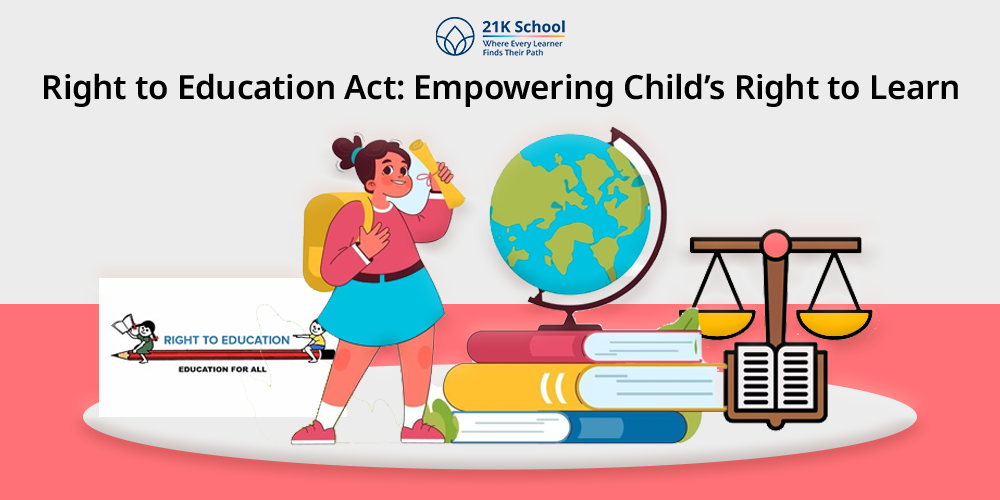
Education is a constitutional right of any human being and perhaps the most important foundation of creating a better society. The Right to Education (RTE) Act, 2009 is an iconic act in India. It provides free and compulsory elementary education to all between the ages of 6-14 years.
The law has transformed the Indian education system whose role has been to eliminate the problems of poverty, caste, and gender. Thus, affecting millions of children by impeding their accessibility to quality education.
This paper outlines the importance, history, key characteristics, and challenges of the RTE Act. It delves further into the effects of the RTE Act including the comparison with the National Education Policy (NEP) 2020.
Contents
- What is the Right to Education Act?
- 1. Section 3 – Right to Free and Compulsory Education
- 2. Section 4 – Age-Appropriate Admission for Out-of-School Children
- 3. Section 5 – Right to Transfer
- 4. Section 6 – Establishment of Neighbourhood Schools
- 5. Section 7 – Financial Responsibilities
- 6. Section 8 – Duties of Appropriate Government
- 7. Section 9 – Duties of Local Authority
- 8. Section 10 – Duty of Parents and Guardians
- 9. Section 11 – Pre-School Education
- 10. Section 12 – Responsibility of Schools for Free Education
- 11. Section 13 – No Capitation Fee or Screening Procedure
- 12. Section 14 – Proof of Age for Admission
- 13. Section 15 – Admission Throughout the Academic Year
- 14. Section 16 – No Detention and No Expulsion
- 15. Section 17 – Prohibition of Physical Punishment and Mental Harassment
- 16. Section 18 – Recognition of Private Schools
- 17. Section 19 – Norms and Standards for Schools
- 18. Section 20 – Power to Amend Schedule
- 19. Section 21 – School Management Committee (SMC)
- 20. Section 22 – School Development Plan (SDP)
- 21. Section 23 – Teacher Qualifications
- 22. Section 24 – Duties of Teachers
- 23. Section 25 – Pupil-Teacher Ratio (PTR)
- 24. Section 26 – Filling Teacher Vacancies
- 25. Section 27 – Prohibition of Non-Educational Deployment
- 26. Section 28 – Prohibition of Private Tuition
- 27. Section 29 – Curriculum and Evaluation Procedure
- 28. Section 30 – No Board Examinations
- 29. Section 31 – Monitoring by Child Rights Commissions
- 30. Section 32 – Grievance Redressal
- 31. Section 33 – National Advisory Council
- 32. Section 34 – State Advisory Councils
- 33. Section 35 – Guidelines and Directions
- 34. Section 36 – Prosecution Sanction
- 35. Section 37 – Good Faith Protection
- 36. Section 38 – Rule-Making Power
- History of Right to Education Act
- Principal Provisions of Right to Education (RTE) Act, 2009
- 1. Free and Compulsory Education
- 2. Age-Appropriate Admission & No Detention
- 3. Neighbourhood Schools
- 4. Free of Cost and Charges
- 5. Qualification and Allocation of Teachers
- 6. Continuous and Comprehensive Evaluation (CCE)
- 7. School Management Committee (SMCs)
- 8. Banning of Screening Procedures
- 9. No Corporal Punishment, no Expulsion
- 10. Emphasis on All-Round Development
- 11. 25% Reservation Private School
- 12. Minimum Standards
- Significance of Right of Children to Free and Compulsory Education
- Importance of Right to Education Act
- Benefits of RTE
- Implementation & Impact of RTE in India
- RTE Act vs NEP 2020
- Challenges of Right to Education Act
- Wrapping Up Thoughts
What is the Right to Education Act?
Right to Education Act (Right of Children to Free and Compulsory Education) or RTE Act, a revolutionary legislation, ensures Indian children aged between 6 and 14 years have access to free and compulsory education. This Act was passed in 2009 to ensure that children regardless of their socio-economic status have access to quality education.
The Act is also popular as:
- Right to Education (RTE) Act, 2009
- The Act of Parliament No. 35 of 2009
- Free and Compulsory Education Act
- Article 21A Act
The RTE Act aims at ensuring the right to education through legislation as one of the basic needs of the society. It claims to do it by lifting the imperfections such as schooling to the less privileged and a more open society.
Through this Act children get into a neighbourhood school until its completion. The neighbourhood schools are inspired by the Kothari Commission. It envisioned schools as an inclusive learning environment where children from all backgrounds learn together to become educated.
Both the government and private schools are required to work under the guidelines stated in law. They do so to make education free and equitable to all the children.
The main objectives of the Act is to increase enrolment levels, decrease the rate of dropouts, and maximize learning. Systems work together to foster holistic education .
In simple words, free education refers to the fact that no child shall be required to pay any fee or charges that may prevent them from completing elementary education.
The act also offers special protection for children with disabilities, in accordance with the Persons with Disabilities Act, 1996.
1. Section 3 – Right to Free and Compulsory Education
Children aged 6 to 14 are entitled to free education in neighbourhood schools. Some of the key points to consider are:
- Children may choose schools according to their needs
- No fees or charges for elementary education
- Provisions of the children with disabilities
2. Section 4 – Age-Appropriate Admission for Out-of-School Children
The section ensures that out-of-school children are admitted to age-appropriate classes with special training support and allowed to complete their education even if they cross 14 years of age.
3. Section 5 – Right to Transfer
Children can transfer between Government and aided schools without delay and the Transfer Certificates cannot block admission procedure.
4. Section 6 – Establishment of Neighbourhood Schools
Section 6 is popular for establishment of neighbourhood schools where students get universal access with States support.
5. Section 7 – Financial Responsibilities
Section 7 states financial responsibilities in which central and state governments share RTE costs.
6. Section 8 – Duties of Appropriate Government
The appropriate Government must provide free and compulsory elementary education to children.
Key duties under this section include:
- Ensure no discrimination against weaker sections and disadvantaged groups
- Monitor admission, attendance, and completion of every child
- Provide school buildings, teaching staff, and learning equipment
- Ensure good quality education conforming to norms and standards
- Prescribe curriculum and courses of study in a timely manner
- Provide teacher training
7. Section 9 – Duties of Local Authority
Duties of local authority includes:
- Maintain child records
- monitor schooling
- Provide infrastructure and teachers
- Ensure quality, and manage academic calendar.
8. Section 10 – Duty of Parents and Guardians
Duty of parents and guardians includes moral responsibility, government responsibility, and no penal provisions.
- Moral responsibility means parents need to make sure to admit to school.
- The government is responsible for systemic reform in universalising elementary education. They must collaborate with civil society to persuade parents facing genuine difficulties.
- Poverty-related non-enrolment is not criminalised.
9. Section 11 – Pre-School Education
The government helps in arranging pre-school education for children above three years to prepare them for elementary school.
10. Section 12 – Responsibility of Schools for Free Education
Responsibility of Schools for Free Education includes:
- Three-Tier Responsibility Framework
- Government Schools: Must provide free and compulsory education to all children.
- Government-Aided Schools: Free seats equal to aid received (minimum 25%).
- Private Unaided Schools: 25% seats for disadvantaged children
- Rationale for 25% Reservation
- Social Cohesion as the Larger Objective
- Why Admission Starts at Class I Only
11. Section 13 – No Capitation Fee or Screening Procedure
No school or person shall collect capitation fees.
Schools must adopt non-discriminatory, rational, and transparent admission procedures.
All children have equal capacity to learn. Differences arise from environment, not ability.
Admission Process include:
- 25% seats: Random selection.
- 75% seats: Rational, publicly stated criteria.
- No profiling of children or parents.
- No testing or interviews for any child or parent
12. Section 14 – Proof of Age for Admission
Admission of a child can’t be denied for lack of birth certificate. Acceptance of alternative documents or declarations are accepted.
13. Section 15 – Admission Throughout the Academic Year
No child can be denied admission during the academic year. If special training is required for special training, it must be fulfilled.
14. Section 16 – No Detention and No Expulsion
No child can be failed or held back until elementary education completion and aged 6 to 14 cannot be expelled.
The Act mandates Continuous and Comprehensive Evaluation (CCE). The assessments in school must be ongoing and supportive.
15. Section 17 – Prohibition of Physical Punishment and Mental Harassment
No child shall be subjected to physical punishment or mental harassment.
16. Section 18 – Recognition of Private Schools
Private schools must obtain a Certificate of Recognition and meet prescribed standards.
17. Section 19 – Norms and Standards for Schools
All schools must meet prescribed norms within three years of the Act’s commencement.
18. Section 20 – Power to Amend Schedule
The Central Government has the power to amend the Schedule on norms and standards as needed to keep requirements current and relevant.
19. Section 21 – School Management Committee (SMC)
SMCs must be formed in Government and aided schools, with parents as the majority members. While private unaided schools are exempt; in minority/private unaided schools, SMCs have only an advisory role.
20. Section 22 – School Development Plan (SDP)
The SMC prepares a School Development Plan. It covers children’s rights protection, infrastructure, teacher availability, classroom transaction, child assessments, and inclusiveness.
However, private unaided institutions are not required to prepare SDPs.
21. Section 23 – Teacher Qualifications
Teacher qualifications are prescribed by the National Council for Teacher Education (NCTE) as notified in 2010.
22. Section 24 – Duties of Teachers
Core Teaching Responsibilities are:
- Attend school regularly and transact syllabus in a timely manner
- Provide supplementary support to children who need it
- Conduct assessment of children’s learning
- Interact with parents regularly
23. Section 25 – Pupil-Teacher Ratio (PTR)
Maintaining the prescribed pupil-teacher ratios is important for the Government and local authority.
Teachers shall not be deployed for non-academic work except for decennial census, disaster relief, and elections.
24. Section 26 – Filling Teacher Vacancies
Vacancies in any school shall not exceed 10% of teacher strength. Proper staffing and balanced deployment ensures success.
25. Section 27 – Prohibition of Non-Educational Deployment
Teachers cannot be deployed for non-educational work except census, disaster relief, and elections. This ensures maximum time for classroom teaching.
26. Section 28 – Prohibition of Private Tuition
Teachers are prohibited from engaging in private tuition.
27. Section 29 – Curriculum and Evaluation Procedure
States must designate an authority to frame curriculum and evaluation which promote:
- constitutional values
- holistic development
- child-friendly learning
- mother tongue instruction (where possible)
- freedom from fear
- Continuous and Comprehensive Evaluation (CCE)
28. Section 30 – No Board Examinations
No child shall be required to pass Board examinations until completion of elementary education.
29. Section 31 – Monitoring by Child Rights Commissions
National Commission for Protection of Child Rights (NCPCR) and State Commissions oversee RTE implementation.
Key points to monitor are:
- Neighbourhood Schools: Classrooms, infrastructure, PTR, school hours
- Access: Physical and social access to schools
- Admission: Denial of admission, capitation fees, screening, demand for affidavits
- Entitlements: Textbooks, uniforms, library, sports equipment, mid-day meals, Special Training, certificates
- Classroom Transaction: No discrimination, no corporal punishment, appropriate teaching and evaluation.
- SMC Functioning: Appointments, regular meetings, teacher accountability, SDPs.
- Out-of-School Children: Never enrolled, dropouts, temporarily absent, permanent and seasonal migrants.
30. Section 32 – Grievance Redressal
A formal system is essential for addressing violations of children’s rights under the Act.
31. Section 33 – National Advisory Council
A National Advisory Council has been constituted to provide expert advice to the Central Government on the implementation of the Act.
32. Section 34 – State Advisory Councils
State Advisory Councils guide State Governments on effective implementation.
33. Section 35 – Guidelines and Directions
The Central Government may issue directions to Governments and local authorities.
The local bodies may guide SMCs ideal to create a hierarchical chain of implementation guidance.
34. Section 36 – Prosecution Sanction
Previous sanction of an authorised officer is required for prosecution of offences under the Act.
35. Section 37 – Good Faith Protection
Authorities are protected from legal action for acts done in good faith under the RTE Act.
36. Section 38 – Rule-Making Power
The Governments can make rules to implement the Act. However, the rules must be placed before Parliament.
History of Right to Education Act
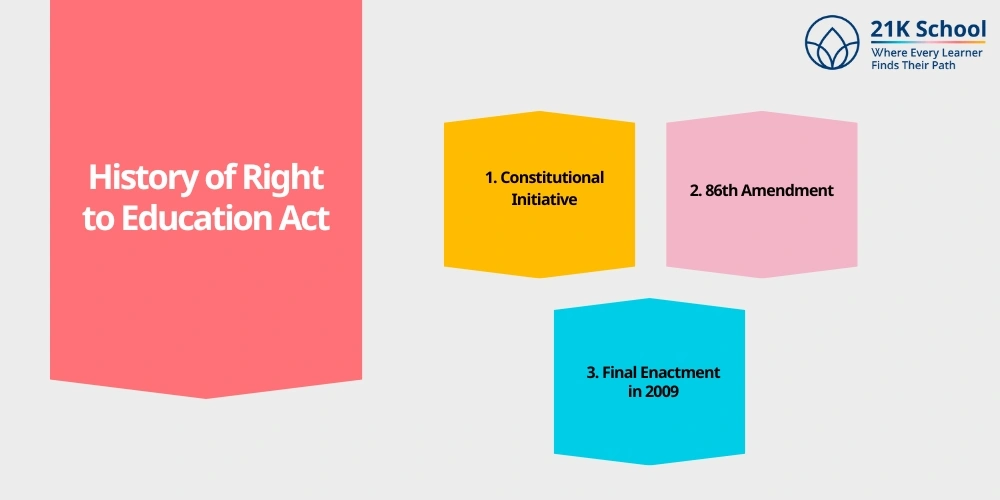
The path to the Right to Education had started a long time ago even before the Act was enacted. The most visible roots were from 2002, where the 86th amendment took place in its favour.
There were several efforts being made in India for an inclusive-all and free education. Some of the highlights follows:
1. Constitutional Initiative:
The concept of education as a right was built under Article 45, being the part of Directive Principles of State Policy. Its initial intention was to support free and mandatory education to all Indian children until the age of 14 years.
But this aim was not achieved in a number of decades owing to numerous social, economic, and infrastructure obstructions.
2. 86th Amendment:
Article 21-A was added to the Constitution of India by the 86th Constitutional Amendment in 2002 which made education a fundamental right. The push through courts enforced the set up of quality education for every child.
3. Final Enactment in 2009:
This amendment opened up the way to the RTE Act, which was passed in 2009, lastly. This paved the way for free education for children between 6-14 years of age, and 25% reservation in private schools.
People interpreted the law as a very important move towards achieving the vision of universal education in India. Thus, finally having a law dealing with the prevalence of illiteracy, dropouts and inequality in access to education.
Principal Provisions of Right to Education (RTE) Act, 2009
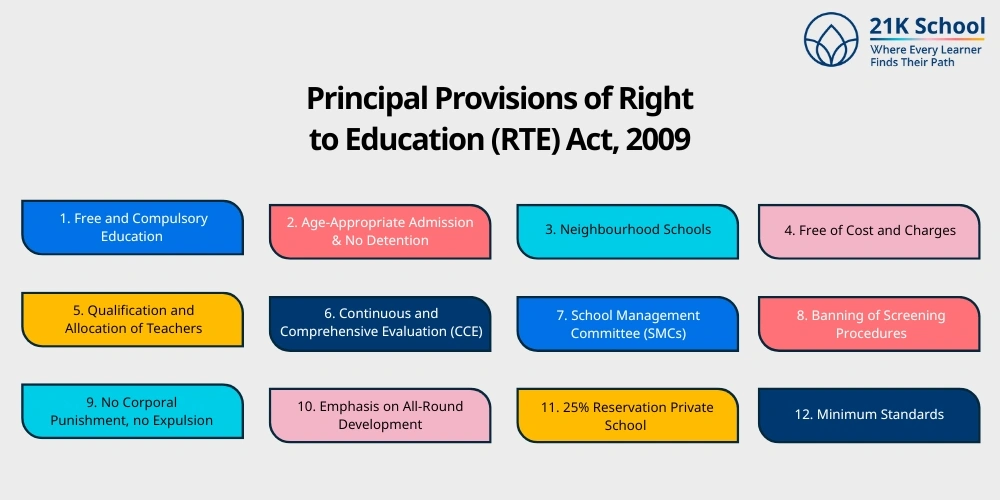
The RTE Act is elaborate and touches vast provisions to make sure that all the children are provided with good education. The main characteristics of the Act are provided below:
1. Free and Compulsory Education
The RTE Act assures free education to every child in the ages between 6 to 14 years. And this applies to all the public schools as well as the unaided schools (recognized by the government) which are privately managed.
There is no requirement for a child to pay any form of fee or any other costs.
2. Age-Appropriate Admission & No Detention
The Act directs that children must be enrolled in the classes that are of their age. And no child can be detained or expelled till Class VIII. This allows the separation of failure without punishment and does promote retention.
3. Neighbourhood Schools
The Act was meant to close the gap between schools and children by coming up with schools in neighbourhoods. This is aimed at having schools set up:
- Primary School (Classes I-V): Must be within 1 km of the residence.
- Upper Primary School (Classes VI-VIII): Must be within 3 km of the residence.
In this way, students’ education is easily accessible.
4. Free of Cost and Charges
No fees can be imposed on any of the children including admission fees, tuition or examination fees or any other cost. This guarantees that children from all backgrounds have access to equal education.
Especially to those born in poor families, should not lack a chance to have an education because of lack of money.
5. Qualification and Allocation of Teachers
The National Council for Teacher Education (NCTE) prescribes some minimum qualifications to be met by teachers. The Act also defines when schools should be equipped with proper teacher-student ratio to make learning successful.
It also includes the teachers responsibilities towards students like:
- Regular attendance
- Maintain records
- Completion of curriculum
- Assessment of students
6. Continuous and Comprehensive Evaluation (CCE)
The Act advocates Continuous and Comprehensive Evaluation (CCE) in addition to mere terminal examinations, and assessment of students. It is conducted on both academic and non-academic parameters to encourage all-round development.
7. School Management Committee (SMCs)
SMCs are established to bring teachers, parents and community members in the decision-making process. It is their role to guarantee functionality and quality of the school including budgeting and some curriculum related decisions.
8. Banning of Screening Procedures
To prevent admission through unnecessary tests, screening procedures are not applied through entrance exams or interview processes under the RTE Act.
9. No Corporal Punishment, no Expulsion
The Act is against corporal punishment and expulsion, which creates a safe learning environment where children can learn.
It prohibits physical and mental harassment such as:
- Discrimination
- Gender inequality
- Segregation of EWS students
10. Emphasis on All-Round Development
The Act lays stress not just on academic growth but on the development of life skills , sports, and co-curricular activities . Thus, facilitating wholesome growth of children.
11. 25% Reservation Private School
According to the Act, 25 percent of the seats must be allocated to the EWS/DGs in the private schools. These schools are reimbursed by the government for the expenses of educating such kids.
12. Minimum Standards
The Act is specific on the minimum infrastructure level of schools. Be it in terms of classrooms, toilets, drinking water and playground space, to provide conducive learning environments.
Significance of Right of Children to Free and Compulsory Education
The Right of Children to Free and Compulsory Education Act, 2009 is a right of every child to get free and compulsory education. The significance of Right of Children to Free and Compulsory Education includes:
1. Education as a Legal Right
The Right of Children to Free and Compulsory Education is not just a policy, it is a legal right which says every student should get the opportunity to learn freely.
It helps in taking the right action if a child is not enrolled due to various challenges like unawareness or poverty.
2. Focus on Quality Education
The Right of Children to Free and Compulsory Education focuses on providing quality education by proper student-teacher ratio and infrastructure to learn without challenges.
This helps in improving the quality of education from early childhood education.
3. Reducing Urban and Rural Gap
One of the significance of the Right of Children to Free and Compulsory education helps in reducing urban and rural gaps.
A structured alignment is used in both city and village schools to provide quality education.
4. No Discrimination
The scheme aims that no children should be treated unfairly due to caste, color, disabilities or background. Physical and mental harassment is strictly prohibited fir educational and personal growth.
5. Improvement in Enrolment
The scheme is significant for the improvement of students enrolment in schools. As per the data:
- The enrollment rise by about 19.4% between 2009 and 2016.
- By 2016, only about 3.3% of children (6–14 years) in rural areas were out of school.
Importance of Right to Education Act
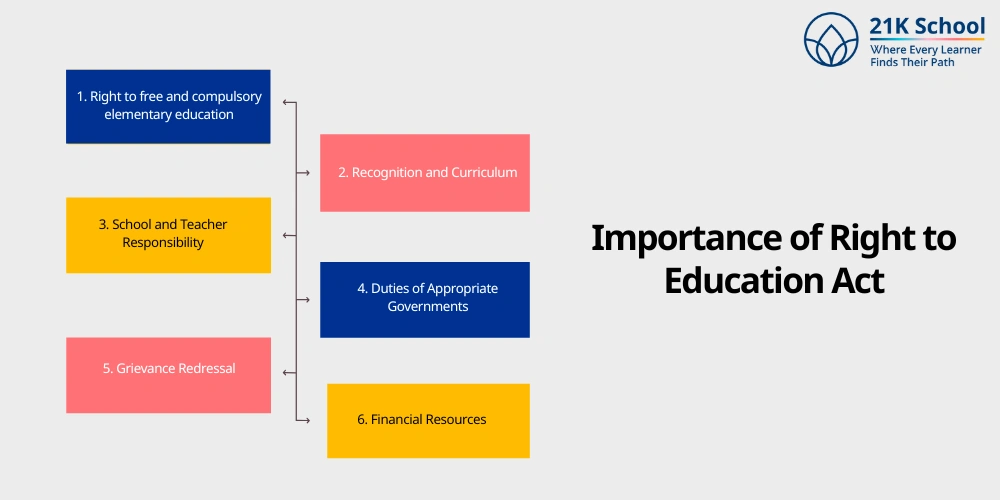
The Right to Education Act is a revolutionary bill to ensure that all children are entitled to education not as a privilege. Importance of the Act can be grasped in the following ways:
1. Right to free and compulsory elementary education
The Act makes education to every child a basic right. It ensures that there is free and compulsory elementary education to all children between the ages of 6-14 years. Hence leaving no child out because of financial or social reasons.
2. Recognition and Curriculum
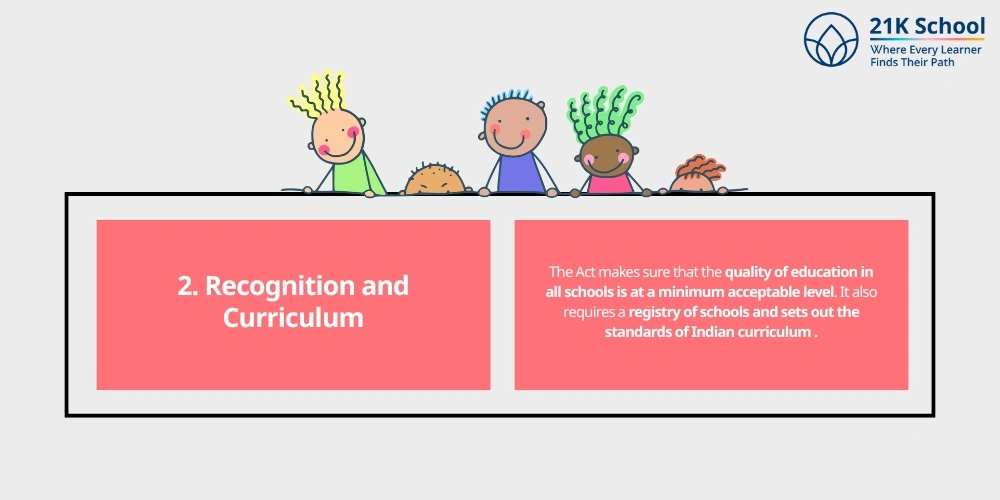
The Act makes sure that the quality of education in all schools is at a minimum acceptable level. It also requires a registry of schools and sets out the standards of Indian curriculum . Thus providing a level playing field to all institutions of learning.
3. School and Teacher Responsibility
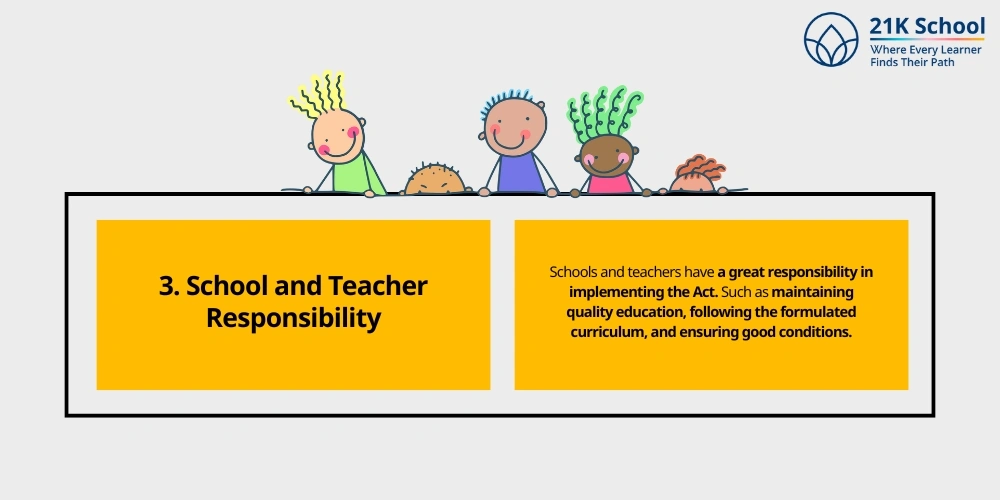
Schools and teachers have a great responsibility in implementing the Act. Such as maintaining quality education, following the formulated curriculum, and ensuring good conditions.
So that children can learn in a secure and positive learning environment .
4. Duties of Appropriate Governments
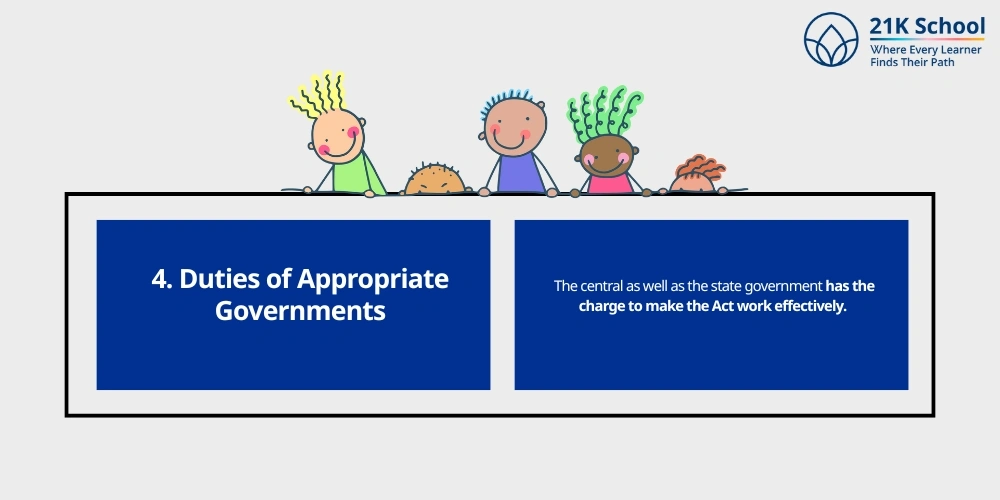
The central as well as the state government has the charge to make the Act work effectively. They have to work together to support it with proper funding, infrastructure and monitoring to ensure every child gets educated.
5. Grievance Redressal
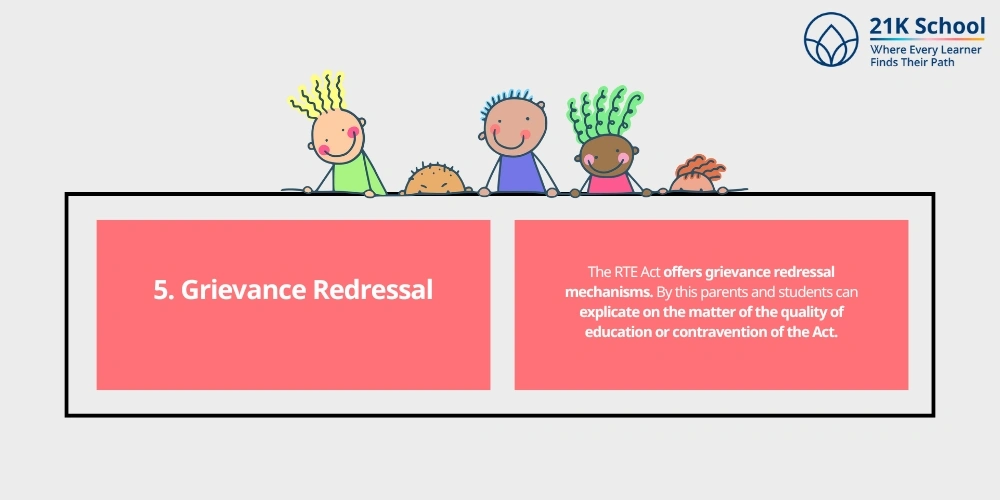
The RTE Act offers grievance redressal mechanisms. By this parents and students can explicate on the matter of the quality of education or contravention of the Act.
6. Financial Resources
The Act requires raising funds to achieve the objectives of the Act. This is to ensure that schools are equipped to offer free education to every child.
Benefits of RTE
The benefits of Right to Education (RTE) Act covers free and compulsory education for children between the age 6 to 14 years, improved enrollment rate, 25% reservation for EWS in private schools, and others like:
- Free education: RTE ensures free and compulsory education with no fees for exams, tuition, or admission with free textbooks, materials, and uniform.
- Improved enrollment rate: RTE improves the accessibility of kids to schools and hence help children dream beyond their social-economic status.
- Social equity: RTE ensures social equity by ensuring 25% reservation for kids from EWS background in private schools.
- Inclusive education: RTE ensures that there is zero discrimination in schools based on gender, color, or other parameters like detention until class 8 for reducing the dropout rates.
- Improved enrollment and literacy: RTE focuses on the significant rise in the school enrollment and literacy rates across India while maintaining the teacher-student ratio (30:1), curriculum standards, and mandating minimum infrastructure.
Implementation & Impact of RTE in India
Enrollment rates have improved greatly since the passing of the RTE Act. This has happened with millions of out-of-school children being added to the education system.
But with it there has also been less smooth execution. The problems like the absence of infrastructure, scarcity of qualified teachers, and disparity of implementation in states persist.
RTE Act vs NEP 2020
The main aim of the RTE Act is to achieve free and compulsory education. However, the National Education Policy (NEP) 2020 seeks to present a flexible, multidisciplinary, and holistic education system. The table of comparison can be seen below:
| Aspect | RTE Act, 2009 | NEP 2020 |
| Focus | Ensuring free and compulsory education | Holistic development, quality education |
| Scope | Primarily elementary education | Covers all levels of education (pre-school to university) |
| Curriculum | Standardized curriculum for all schools | Focuses on continuous professional development |
| Teacher Training | Specifies minimum qualifications | Focuses on continuous professional development |
| Assessment | Continuous and Comprehensive Evaluation | Focus on holistic, competency-based evaluation |
| Private Schools | 25% reservation for EWS children | Emphasizes flexibility and greater autonomy for private schools |
| Language | No clear stance on language policy | Promotes mother-tongue as medium of instruction |
Here are the latest details of National Education Policy , that infers these criteria along with empowering children.
Challenges of Right to Education Act
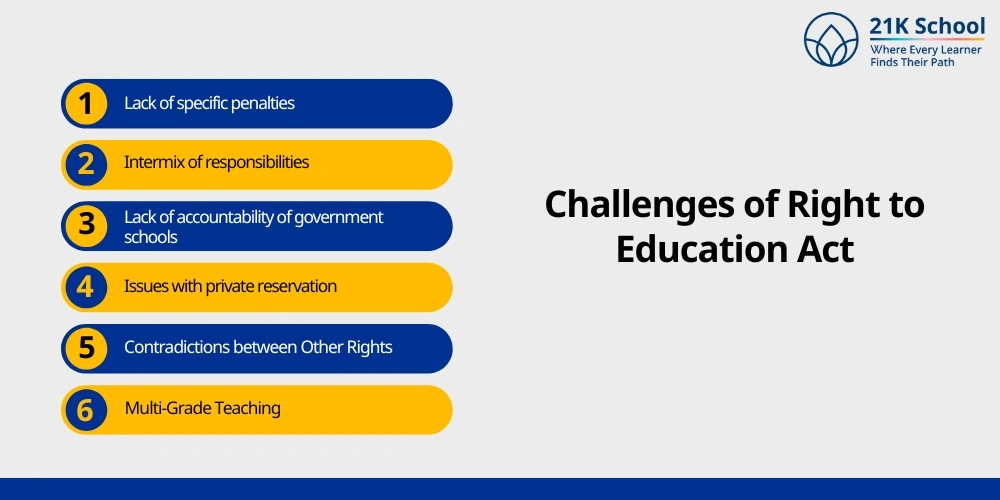
As much as the RTE Act has made considerable improvements in access to education. Still there are certain impediments that hinder its full achievement and efficiency. Such challenges are:
1. Lack of specific penalties
The main issue with the RTE Act is that it does not have applied strict measures to non-conformance by schools, especially the private ones. The fact that there is no deterrence, often results in unstable enforcement.
As schools do not adhere to policies such as 25% reservation or school infrastructure norms.
2. Intermix of responsibilities
The split in the duties of the central and state government has posed a problem in providing smooth and consistent enforcement. Policy formulation and funding lies with the central government.
Whereas operational aspects like establishment of schools and tracking their performance lies with state governments.
3. Lack of accountability of government schools
There is a poor level of accountability in most government-run schools even though the law requires quality education. These are problems such as teacher absenteeism, ineffective training, poor infrastructure especially in the rural locations.
4. Issues with private reservation
The 25 percent allocation of private schools has been opposed by school owners and administrations arguing it will overburden operations financially.
Globally, the government pledges to compensate schools in educating learners under this provision, but such payments have been lengthy and laborious.
5. Contradictions between Other Rights
Few instances have been argued out in court that the RTE act conflicts with other constitutional rights. And notably it’s been the right to property by owners of private schools.
Schools have claimed that the 25% quota denies them their property rights. Since they are forced to educate the students without fair compensation or no compensation.
6. Multi-Grade Teaching
In rural and undeveloped regions, schools encounter low rates of students and the lack of teachers. This gives rise to multi-grade teaching.
In the system, only one teacher is there, teaching more than one class and this could drastically lower the impact of learning.
Wrapping Up Thoughts
The Right to Education Act has been a super historical event in providing education to all children in India. It has opened doors to an even-handed and inclusive education for children of school-going age.
It can be seen that there has been relative success in realizing an increase in enrollments and less dropout rates. However, the implementation and quality-related issues still exist.
The NEP 2020, which is broad based, supports the objectives of the RTE Act. It does so in providing comprehensive education and in enhancing the learning outcomes.
The synergy between the RTE Act and NEP 2020 can change the paradigm in education in India. And education can be built as an instrument of social mobility and nation-building.

You may also want to read