

Learning in the 21st century is more than just getting good grades and achieving success in an academic journey. A child also questions, imagines, dreams, and feels.
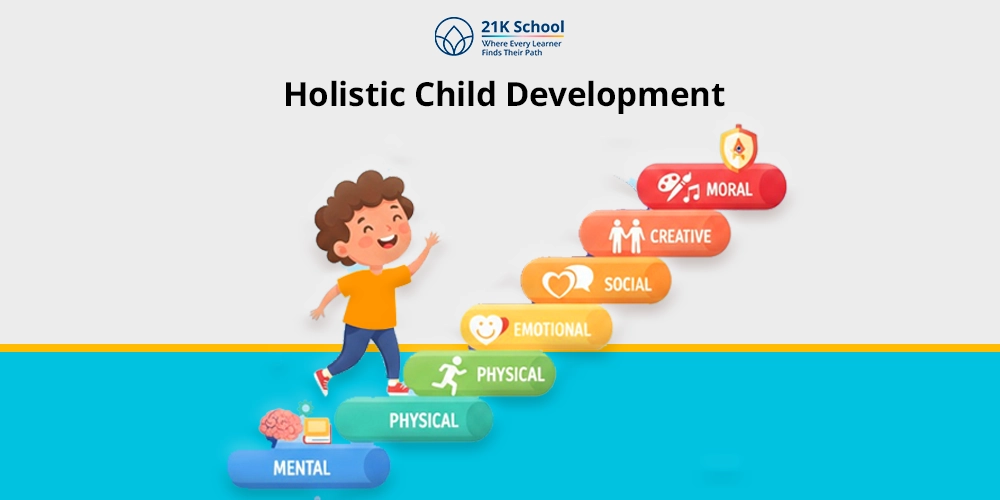
For overall growth, holistic child development is the key approach teachers should apply to improve intellectual growth, physical health, emotional strength, social skills , creativity, and moral values.
Holistic child development ensures students are able to succeed both academically and in life. This blog majorly focuses on holistic development of children.
Let’s begin with what holistic child development really means.
Contents
- What is Holistic Child Development?
- 6 Key Aspects of Holistic Child Development
- Examples of Holistic Child Development
- 5 Importance of Holistic Child Development
- 5 Roles of Teachers in Holistic Child Development
- 7 Simple Activities for Holistic Child Development
- 5 Key Benefits of Holistic Child Development
- 5 Challenges in Achieving Holistic Development
- Holistic Development in Early Childhood vs Adolescence
- Conclusion
What is Holistic Child Development?
Holistic child development is a process that supports overall development of children by understanding different aspects including mental, physical, emotional, social, creative, and moral.
In India, schools prefer to implement holistic development in students’ lives to help them in understanding and nurturing their unique abilities.
For better results, holistic child development in early childhood is essential for a strong foundation for the child’s continuous learning and wellbeing.
6 Key Aspects of Holistic Child Development
Holistic child development is ideal for students’ complete development. There are 6 key aspects one should go through for effective implementation:
1. Intellectual development
Intellectual development aims to nurture students to think, learn, reason, and solve simple to complex problems.
Through intellectual or cognitive development , students are able to understand the world around them.
Some common ways to promote intellectual or cognitive development are discussing various topics, asking open-ended questions, letting students solve problems independently, and using play-based activities.
2. Physical development
Physical development is an important aspect of holistic child development which promotes gross and fine motor skills from a young age.
Gross motor skills are physical activities that help students to use large muscle groups to control body movements.
Fine motor skills include activities that help in body coordination such as small muscles, especially those in the hands, fingers, wrists, and toes.
Physical movement keeps both mind and body active especially during challenging times. Physical development can be promoted by including gross and fine motor skills activities .
3. Social development
One of the key aspects of holistic child development is social development which helps them to learn how to interact with others and build relationships.
A student is socially developed when he or she understands social norms, communication skills , conflict resolution, and work in a team.
Developing these skills allows children to express themselves confidently, build healthy friendships, listen and respect others.
Parents and teachers support social development of children by group activities, role-playing real-life situations, sharing and cooperation.
4. Emotional development
Emotional development of children is all about understanding, expressing, and managing each other’s feelings.
They learn how to become emotionally aware, self-regulation, empathy , resilience , and self-confidence. Emotional intelligence is an essential part of holistic child development.
An emotionally developed child able to handle stress and failure, build strong relationships, and develop self-esteem.
5. Creative and moral development
Through creative development children can develop their mind towards art, music, dance, and drama.
This helps them to improve their imagination and innovation skills.
Teachers and parents can encourage creativity by introducing various activities in day-to-day operations.
6. Spiritual development
Spiritual development, which is not limited to religious knowledge , helps children develop inner awareness, purpose, and values.
To support spiritual development, one should encourage kindness, life values, gratitude and mindfulness.
Examples of Holistic Child Development
Check out some real-life examples of holistic child development:
- Children participating in school sports day to enhance physical abilities.
- Including storytelling sessions in the school to enhance language development, thinking skills, and moral values.
- Children learn maths through play to improve their critical thinking skills .
5 Importance of Holistic Child Development
Holistic child development is a necessity which gives the right environment to learn and grow.
1. Builds confident and independent individuals
It helps children to build confidence and independence by promoting social, emotional, physical, cognitive, creative and spiritual skills.
2. Supports mental and emotional well-being
Holistic development supports the mental and emotional well-being of children by understanding their:
- Emotions
- Manage stress and anxiety
- Develop resilience
- Build self-esteem
3. Improves academic performance naturally
When children are developed from all areas then learning becomes easy and enjoyable. Students can concentrate on what they really like.
4. Develops life skills and values
Holistic child development is important for development of life skills and values. Some common skills include communication, problem-solving , empathy, responsibility etc.
5. Prepares children for real-world challenges
Holistic development from early childhood prepares children for real-world challenges including handling failure, adapting to change, making ethical decisions etc.
5 Roles of Teachers in Holistic Child Development
In students’ lives, teachers play a crucial role in holistic child development. Some of the key role teachers play are:
1. Teacher as a facilitator
In holistic education , teachers work as a facilitator who helps children to become independent, critical thinkers, and confident decision-makers.
2. Student-centered teaching strategies
The approach teachers use in the classroom helps students to learn at their own pace. Some common strategies used are:
- Group discussions
- Project-based learning
- Experiential activities
- Personalised learning activities
3. Classroom environment and inclusivity
Teachers ensure students get safe, inclusive, and supportive classrooms to become holistically developed.
It helps them to share their thoughts, build social confidence, and open communication.
4. Assessment beyond exams
Holistic child development is not about academic scores and exams. It helps students to develop as a whole.
To do so, teachers create a positive learning environment where children focus on both academic and extracurricular activities .
5. Encouraging creativity and critical thinking
Implementation of holistic child development encourages creativity and critical thinking. Teachers encourage these skills by:
- Asking open-ended questions
- Promoting problem-solving activities
- Allowing creative expression
7 Simple Activities for Holistic Child Development
For holistic child development implementation of various activities help students overall growth. Activities include:
1. Puzzles
Including puzzles help in enhancing logical thinking, problem-solving skills , concentration and patience. In this way, teachers can support students’ mental growth.
2. Building games
Various building games such as blocks or construction enhance students creativity, imagination skills, spatial awareness, and fine motor skills.
Navigating mazes is one of the ideal activities to help in holistic child development. It is an ideal way to enhance their decision-making skills, hand-eye coordination skills, and concentration.
4. Arts and crafts
Arts and crafts classes are ideal to promote creative development. Teachers can guide students to engage in self-created work.
5. Storytelling
Storytelling in learning helps students in stress management, moral understanding, and emotional understanding.
6. Yoga for kids
Daily yoga for kids is a good habit to help students to become physically and mentally active. Mindfulness activities can also be an amazing way to promote concentration.
7. Science experiments
Simple science experiments enhance students’ critical thinking, curiosity and hands-on learning experience.
5 Key Benefits of Holistic Child Development
Holistic child development offers various benefits including better mental health of students to lifelong learning. Some key benefits are:
1. Better mental health
Holistic child development is essential for better mental health in which students understand, manage emotions, handle stress and develop resilience.
2. Strong personality and leadership skills
To build a strong personality and learn leadership skills , students need to become proficient in all aspects of holistic development.
3. Improved academic and career success
For students academic and career success holistic development helps learning meaningful, not forced. In this way children become physically, emotionally, and mentally strong.
By improving social development students are able to improve their personal and professional connections.
They learn how to behave in school, personal life, workplaces, and communities.
5. Lifelong learning attitude
Holistic child development promotes lifelong learning by creating a positive environment and mindset to change the world.
5 Challenges in Achieving Holistic Development
Holistic child development offers various benefits. However, benefits come with some challenges such as:
1. Academic pressure
Students feel academic pressure and limited other skills like creativity and social development. Balancing both is one of the major challenges.
2. Lack of awareness among parents
Many parents focus on academic achievement instead of overall development. This lacks other aspects such as social and creative development.
3. Limited resources in schools
Schools often unable to support overall development due to lack of resources like:
- Lack of trained teachers
- Less activity-based learning tools
- Supportive infrastructure
4. Digital distractions
Today digital distraction is a major challenge in which excessive screen time reduces students’ physical, social, and emotional growth.
5. Social and economic barriers
Due to various reasons like poverty, lack of access to quality education, social inequality can hinder holistic child development.
Holistic Development in Early Childhood vs Adolescence
To understand the difference between holistic development in early childhood vs adolescence, below mentioned is a quick table:
| Number | Particulars | Holistic Development in Early Childhood | Holistic Development in Adolescence |
| 1. | Focus of Development | Foundation building across all domains | Identity formation and independence |
| 2. | Learning Style | Play-based, experiential, and activity-oriented | Discussion-based, reflective, experiential, and goal-oriented |
| 3. | Assessment Methods | Observation, play-based evaluation | Projects, self-assessment, reflection, performance |
| 4. | Challenges | Attention span, emotional dependency | Peer pressure, identity crisis, emotional stress |
| 5. | Outcome | Builds strong developmental foundations | Prepares for adulthood and real-world responsibilities |
Conclusion
In students’ lives, holistic development is crucial for overall development. As a parent and teachers one must ensure to provide an effective learning environment.
The guide aims to showcase the importance, benefits, challenges, and ideal activities to implement holistic development in the classroom and home.
I hope parents and teachers understand the advantages of holistic development in students’ lives, especially from early childhood.

You may also want to read