

Do you know children at a young age experience new things in life especially in preschool?
Learning new and existing things is a magical and memorable time for children. In preschool, kids explore various fun activities and hands-on experiences rather than formal education .
To improve kids growth and development, cognitive abilities from a young age play a key role. Explore different popular cognitive activities for preschoolers.
Contents
- What are Cognitive Activities?
- 20 Popular Cognitive Activities for Preschoolers
- 1. Puzzle Solving
- 2. Vocabulary Building Activities
- 3. Storytelling
- 4. Counting Games
- 5. Playdough Fun
- 6. Imitation
- 7. Memory Cards
- 8. Building Blocks
- 9. Interactive Reading
- 10. Nature Exploration
- 11. Drawing and Copying Patterns
- 12. Music and Rhythm Activities
- 13. Scavenger Hunt
- 14. Pattern Recognition
- 15. Hide and Seek
- 16. Sorting Games
- 17. Social Interaction
- 18. Maths with Movement
- 19. Tracing Activities
- 20. Ask Open-ended Questions
- Conclusion
What are Cognitive Activities?
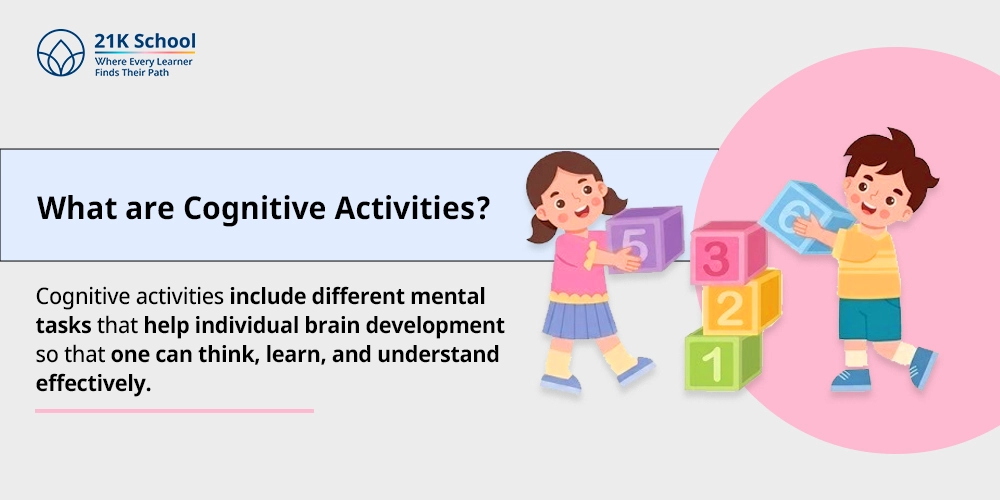
Cognitive activities include different mental tasks that help individual brain development so that one can think, learn, and understand effectively. Preschool kids who engage in cognitive learning and activities can maintain their:
- Mental agility
- Improves productivity
- Keeping the brain healthy and efficient
- Reduce the risk of cognitive decline
Some common cognitive activities for preschoolers are: counting math games, storytelling, memory cards, building blocks, and interactive reading.
20 Popular Cognitive Activities for Preschoolers
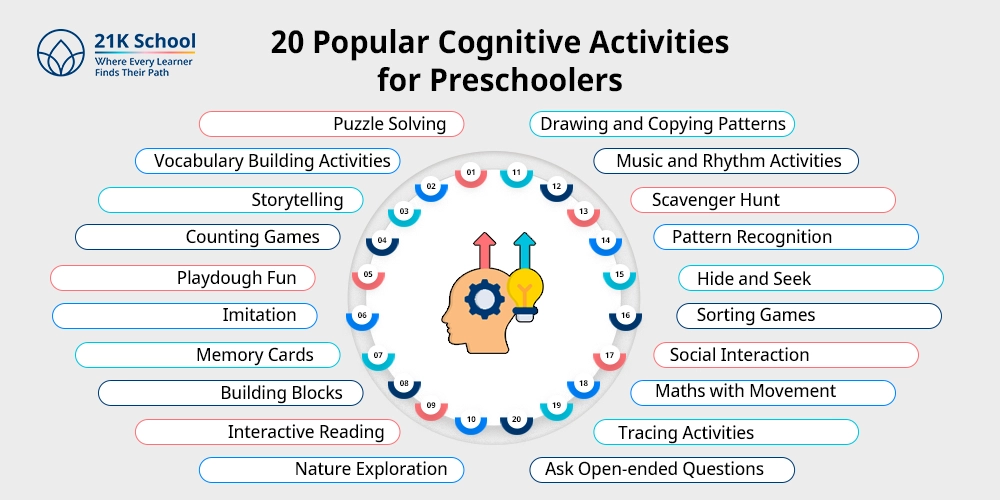
Following are some popular activities categories for preschoolers. Each one of these activities are engaging which allow children to learn naturally.
1. Puzzle Solving
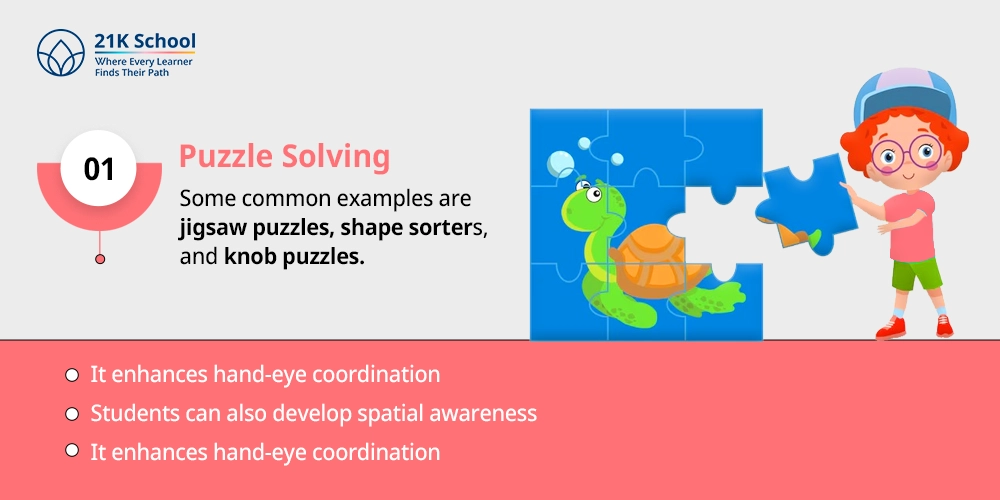
Puzzle solving is an amazing way for parents and teachers to promote cognitive skills in children. Some common examples are jigsaw puzzles, shape sorters, and knob puzzles.
Participating in different kinds of puzzles which helps in thinking logically, recognise patterns, and solve academic problems without obstacles. One needs to start with shapes, animals, numbers, or alphabet puzzles to engage children and gradually let them solve independently.
Cognitive Benefits of Puzzle Solving:
- It improves problem-solving and reasoning skills of students
- It enhances hand-eye coordination
- Students can also develop spatial awareness
- It also boosts patience and improves concentration as kids.
2. Vocabulary Building Activities
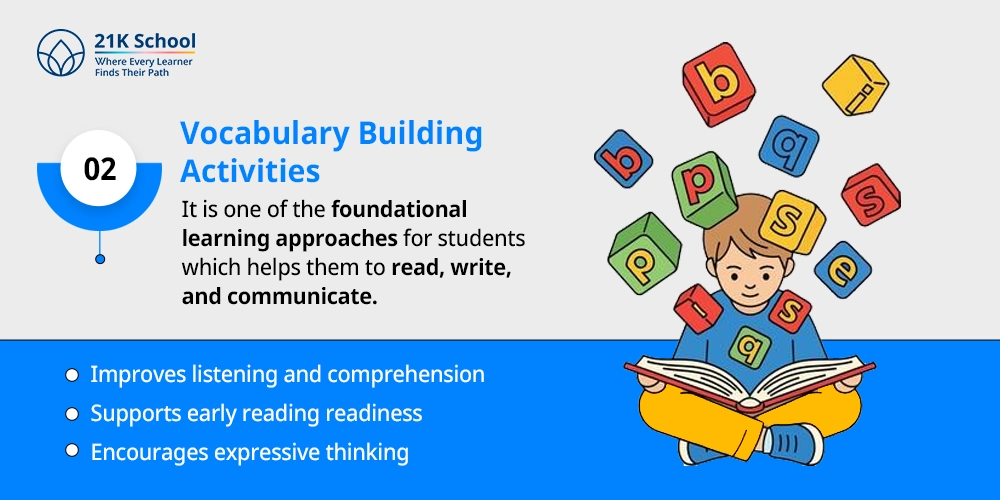
Vocabulary is one of the foundational learning approaches for students which helps them to read, write, and communicate. It is an important part of cognitive development in preschool children. It helps in understanding and expressing thoughts.
To improve students vocabulary , some common activities that teachers in the classroom and parents at home can implement include:
- Naming objects of house or classroom
- Singing rhyme songs
- Learning new words through peer and teacher interactions
Cognitive Benefits of Vocabulary Building Activities:
- Enhances language and communication skills
- Improves listening and comprehension
- Supports early reading readiness
- Encourages expressive thinking
3. Storytelling
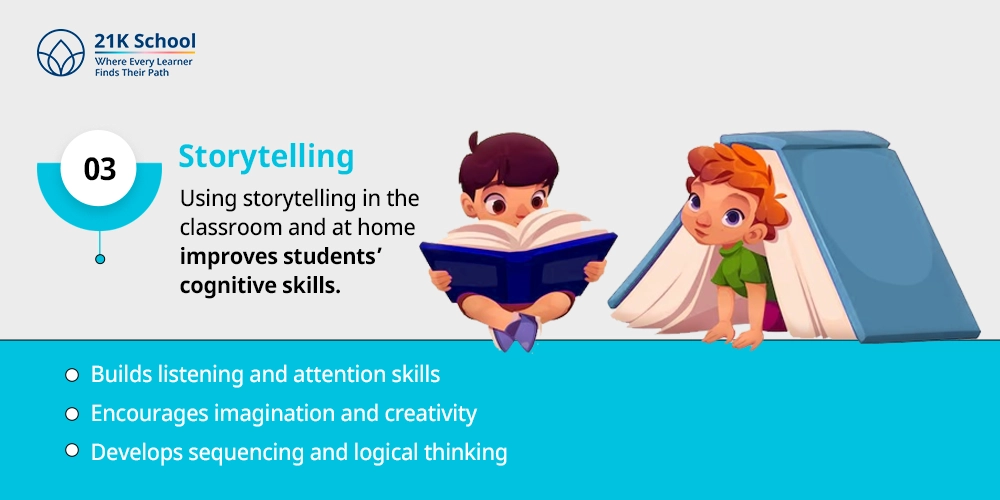
Using storytelling in the classroom and at home improves students’ cognitive skills.
Cognitive Benefits of Storytelling:
- Builds listening and attention skills
- Encourages imagination and creativity
- Develops sequencing and logical thinking
- Enhances vocabulary and comprehension
4. Counting Games
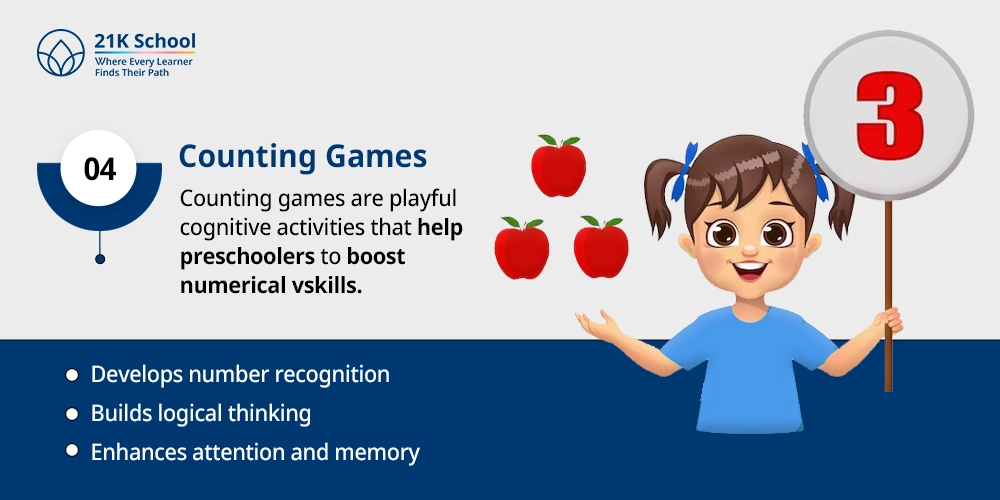
Counting games are playful cognitive activities that help preschoolers to boost numerical skills. In this way, the teacher lays the foundation of mathematics.
Preschoolers can learn by counting toys, fruits, steps, play board games with dice, sing songs and rhymes to build cognitive skills.
This helps children connect with and enjoy maths from an early stage, rather than viewing it as a burden.
Sort objects by size or color and count them for better understanding.
Cognitive Benefits of Counting Games:
- Develops number recognition
- Builds logical thinking
- Enhances attention span and memory
- Strengthens problem-solving skills
5. Playdough Fun
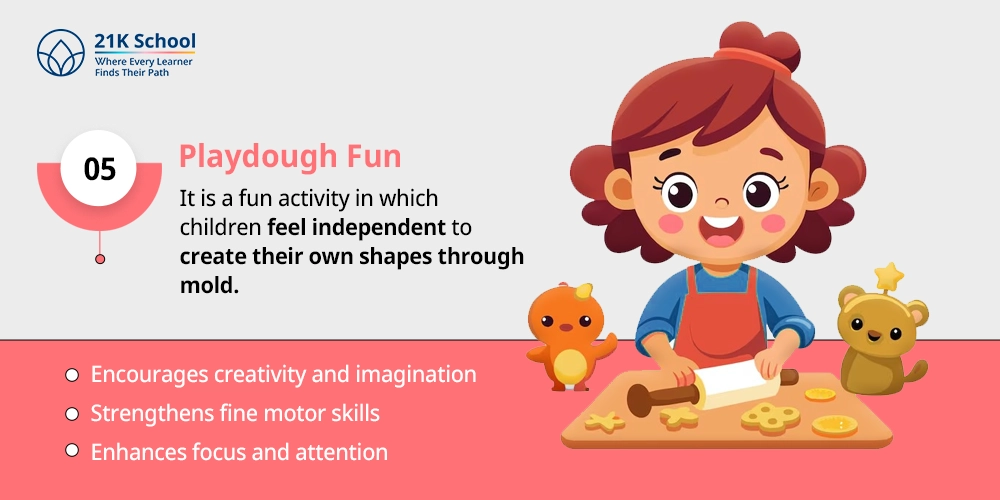
For preschoolers playdough is a fun activity in which children feel independent to create their own shapes through mold.
It is an effective activity that helps brains to work actively to develop cognitive and sensory skills. Some common ideas include:
- Creating animals through playdough
- Make letters and numbers
Cognitive Benefits of Playdough Fun:
- Encourages creativity and imagination
- Improves planning and problem-solving
- Strengthens fine motor skills
- Enhances focus and attention
6. Imitation
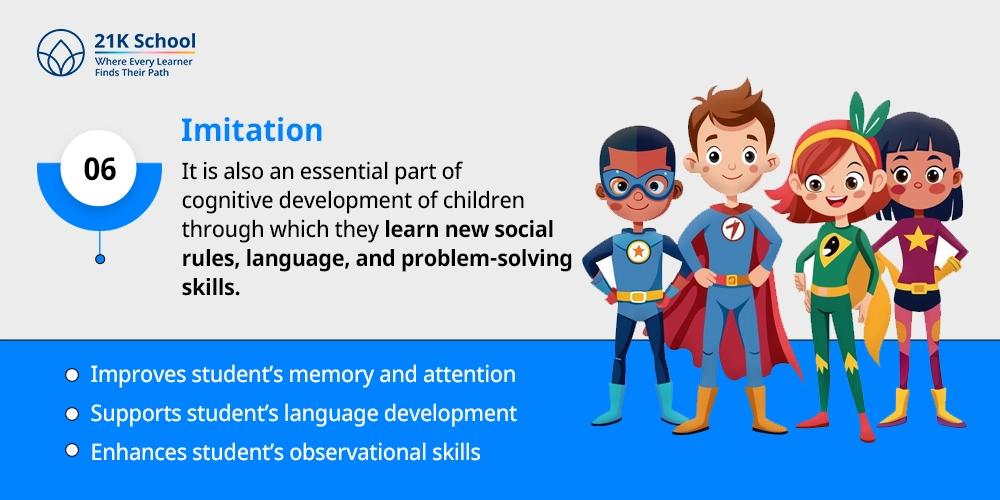
Imitation is also an essential part of cognitive development of children through which they learn new social rules, language, and problem-solving skills.
Some effective ways include:
- role-play
- tracing and copying shapes
- mirrors to make funny faces
Cognitive Benefits of Imitation:
- Improves students memory and attention
- Supports student’s language development
- Encourages individual’s social and emotional understanding
- Enhances student’s observational skills
7. Memory Cards
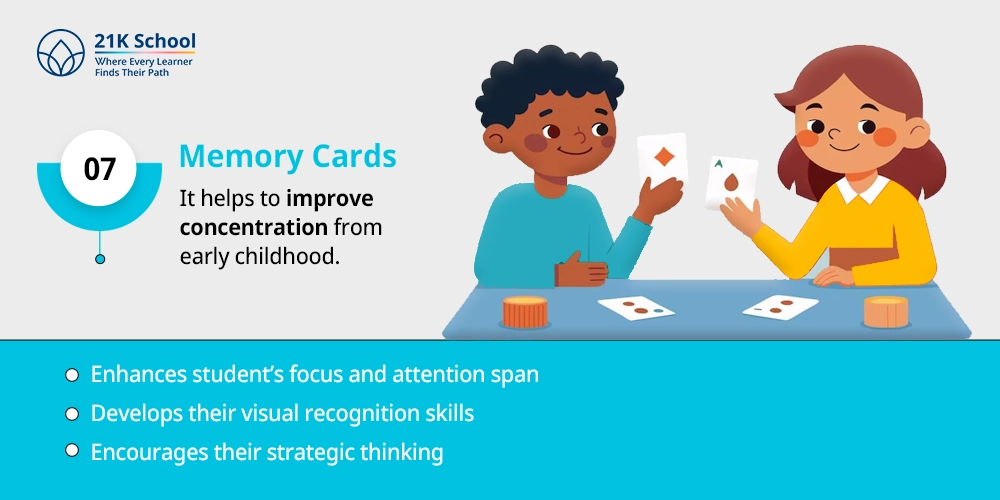
One of the popular cognitive activities is memory card games. It helps to improve concentration from early childhood.
The game begins with a student placing the cards face down then children flip two cards at a time and the objective is to find matching pairs.
Cognitive Benefits of Memory Cards:
- Improves their short-term and working memory
- Enhances student’s focus and attention span
- Develops their visual recognition skills
- Encourages their strategic thinking
8. Building Blocks
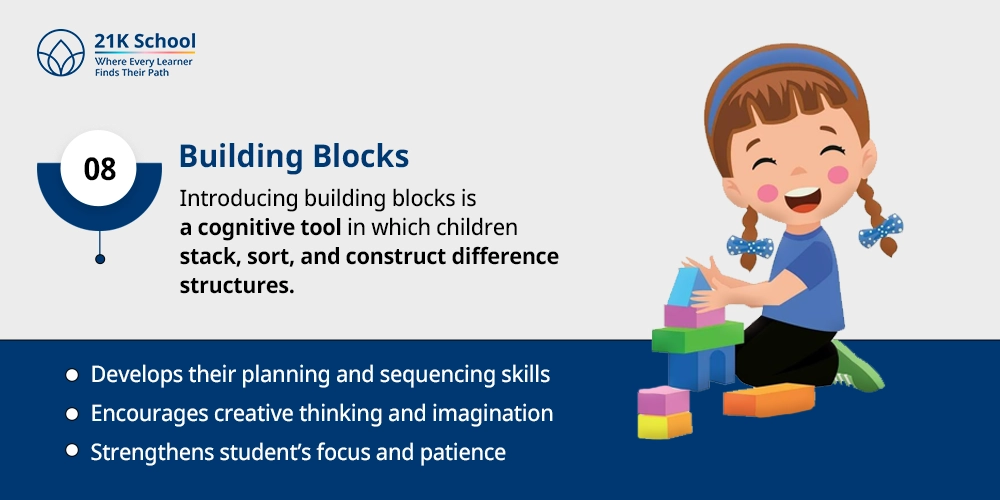
Introducing building blocks is a cognitive tool in which children stack, sort, and construct difference structures.
Through this activity preschoolers use logic, imagination, and critical thinking skills . Some common examples include creating houses, towers, bridges etc.
Cognitive Benefits of Building Blocks:
- Enhances student’s spatial awareness and reasoning
- Develops their planning and sequencing skills
- Encourages creative thinking and imagination
- Strengthens student’s focus and patience
9. Interactive Reading
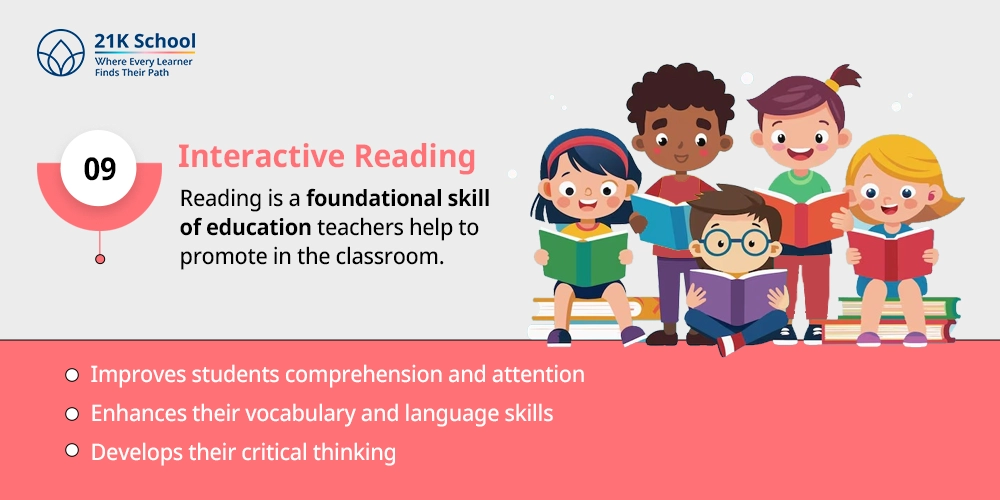
Reading is a foundational skill of education teachers help to promote in the classroom. It helps preschoolers to aim to improve child academic performance .
Interactive reading often happens through various ways like: Open-ended questions, discussions, and participation.
Cognitive Benefits of Interactive Reading:
- Improves students comprehension and attention
- Enhances their vocabulary and language skills
- Develops their critical thinking
- Encourages learning about curiosity and imagination
10. Nature Exploration
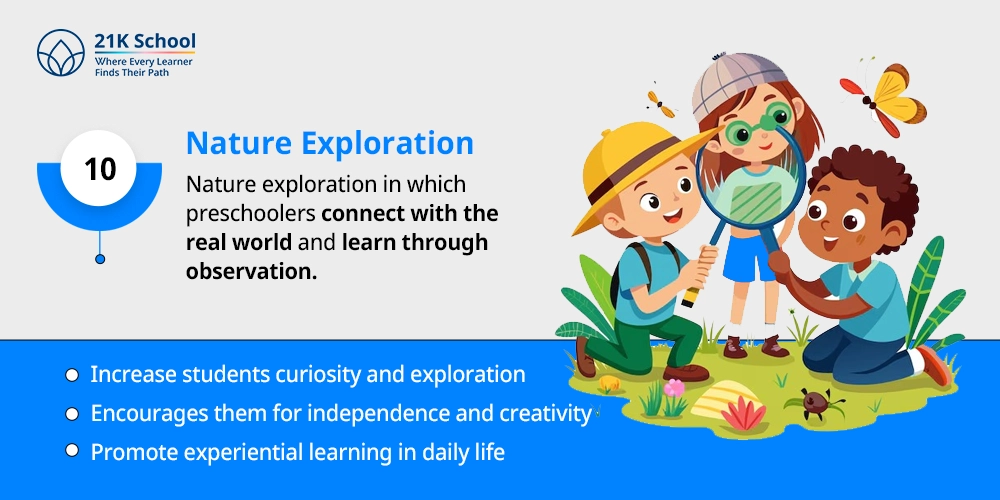
One of the activities that help in increasing students engagement and curiosity is nature exploration in which preschoolers connect with the real world and learn through observation.
Some simple ideas for preschool nature exploration are collecting leaves, stones, flowers, and sorting natural objects.
Cognitive Benefits of Nature Exploration:
- Connect with a dynamic environment for observation
- Increase students curiosity and exploration
- Encourages them for independence and creativity
- Promote experiential learning in daily life
11. Drawing and Copying Patterns
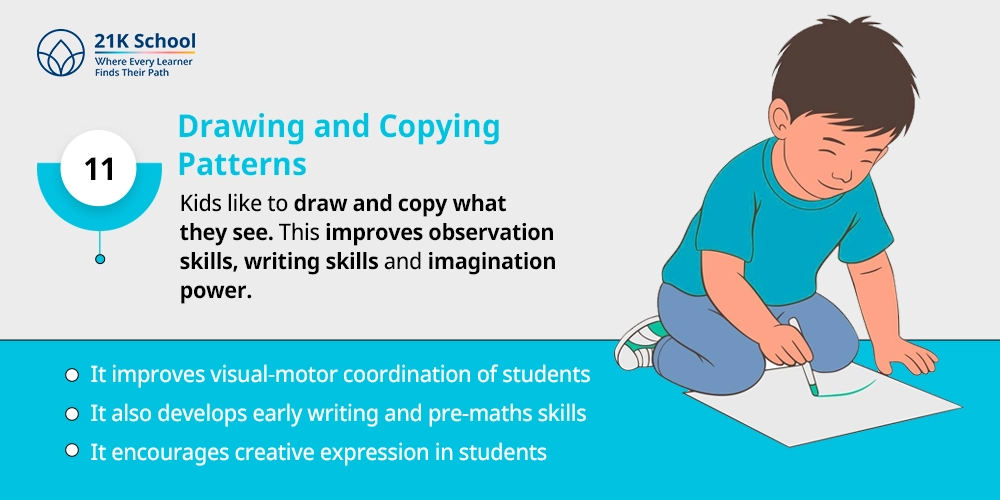
Kids like to draw and copy what they see. This improves observation skills, writing skills and imagination power.
Some easy and fun ideas for cognitive development include: Tracing lines, shapes, patterns, and objects from observation.
Cognitive Benefits of Pattern Drawing :
- It improves visual-motor coordination of students
- In this way one can enhance concentration and memory
- It also develops early writing and pre-maths skills
- It encourages creative expression in students
12. Music and Rhythm Activities
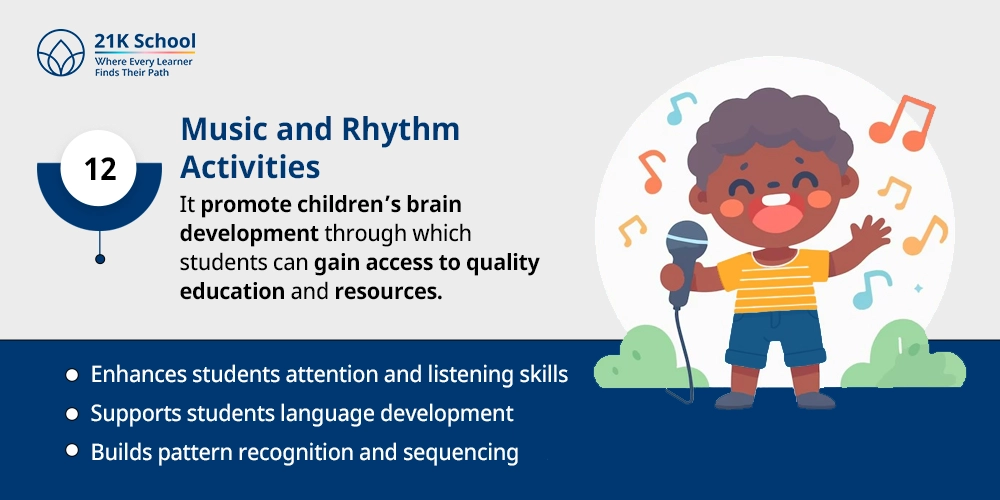
Fun activities like music and rhythms promote children’s brain development through which students can gain access to quality education and resources.
Some common ideas to make learning joyful are:
- Singing desired songs and rhymes for fun learning.
- Clapping or tapping on the table to match the rhythm.
- Playing simple instruments.
Cognitive Benefits of Music and Rhythm Activities:
- Improves students memory and auditory processing
- Enhances students attention and listening skills
- Supports students language development
- Builds pattern recognition and sequencing
13. Scavenger Hunt
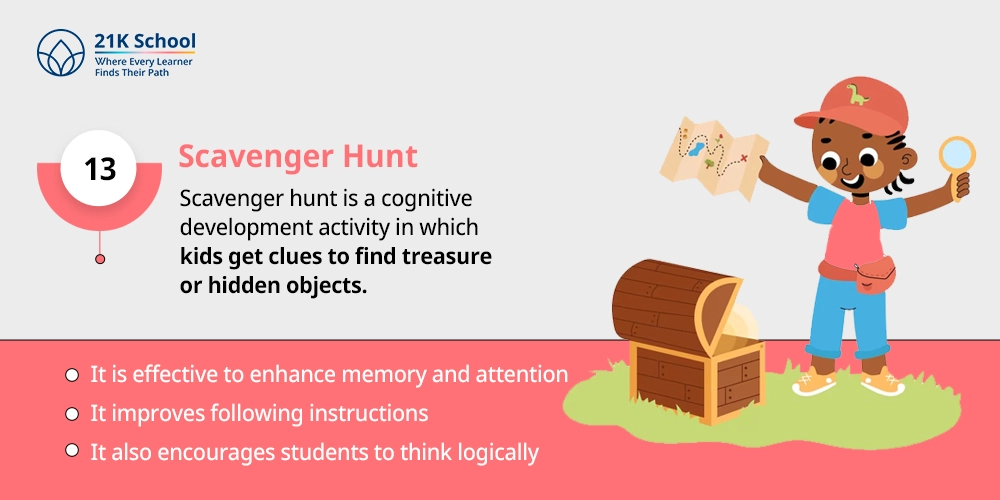
Scavenger hunt is a cognitive development activity in which kids get clues to find treasure or hidden objects.
The hunt helps them to think, observe, and solve through clues. It is an effective physical activity that engages kids for long periods of time.
Cognitive Benefits of Scavenger Hunts:
- It is effective to enhance memory and attention
- Students able to develop problem-solving skills
- It improves following instructions
- It also encourages students to think logically
14. Pattern Recognition
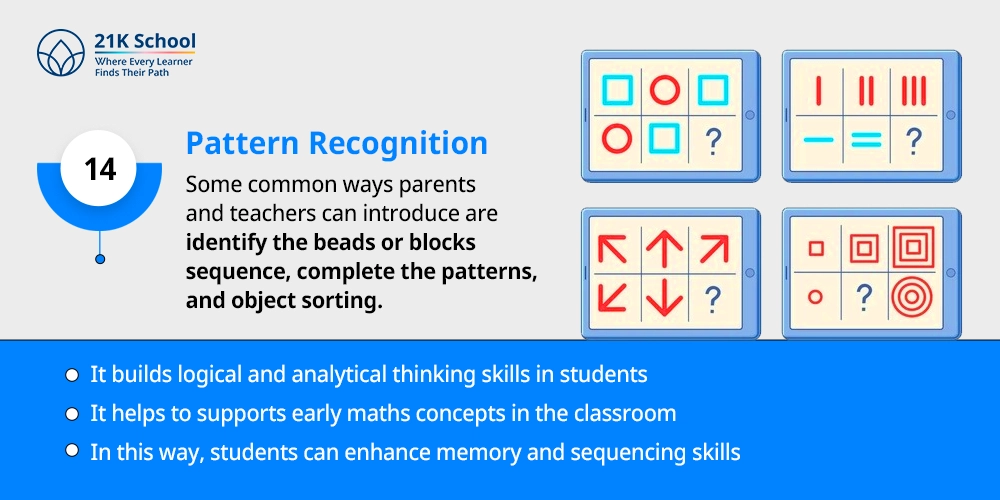
Pattern recognition is an educational activity for preschoolers in which children name different patterns encountered in day-to-day life.
Some common ways parents and teachers can introduce are identify the beads or blocks sequence, complete the patterns, and object sorting.
Cognitive Benefits of Pattern Recognition:
- It builds logical and analytical thinking skills in students
- It helps to supports early maths concepts in the classroom
- In this way, students can enhance memory and sequencing skills
15. Hide and Seek
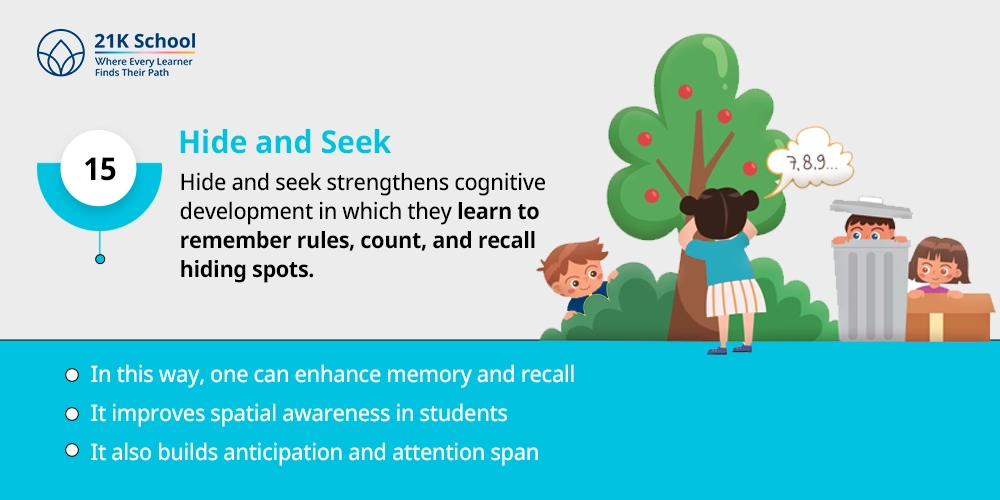
Hide and seek strengthens cognitive development in which they learn to remember rules, count, and recall hiding spots. The activity starts when a child closes their eyes and counts aloud. Then other children hide in different nearby places. The seeker yells, ‘Ready or not!’ and searches.
Cognitive Benefits of Hide and Seek:
- In this way, one can enhance memory and recall
- It develops individual’s logical thinking and planning
- It improves spatial awareness in students
- It also builds anticipation and attention span
16. Sorting Games
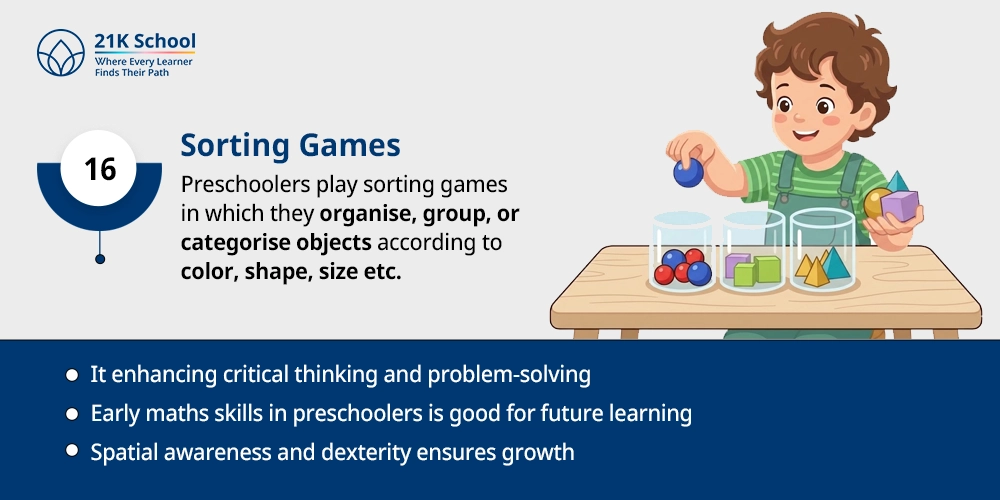
Preschoolers play sorting games in which they organise, group, or categorise objects according to color, shape, size etc.
It teaches some key concepts such as sorting the same and different. Some common activity include:
- Sorting buttons, beads, or blocks
- Matching everyday objects
Cognitive Benefits of Sorting Games:
- It enhancing critical thinking and problem-solving
- Early maths skills in preschoolers is good for future learning
- Spatial awareness and dexterity ensures growth
17. Social Interaction
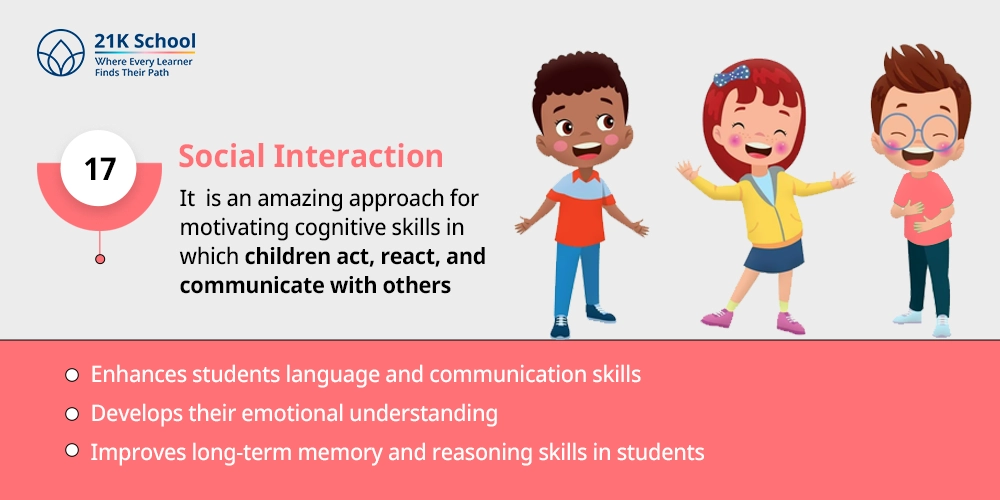
Social interaction is an amazing approach for motivating cognitive skills in which children act, react, and communicate with others. This encourages deep, meaningful relationships, shaping behaviors, and social structures.
Cognitive Benefits of Social Interaction:
- Enhances students language and communication skills
- Develops their emotional understanding
- Improves long-term memory and reasoning skills in students
18. Maths with Movement
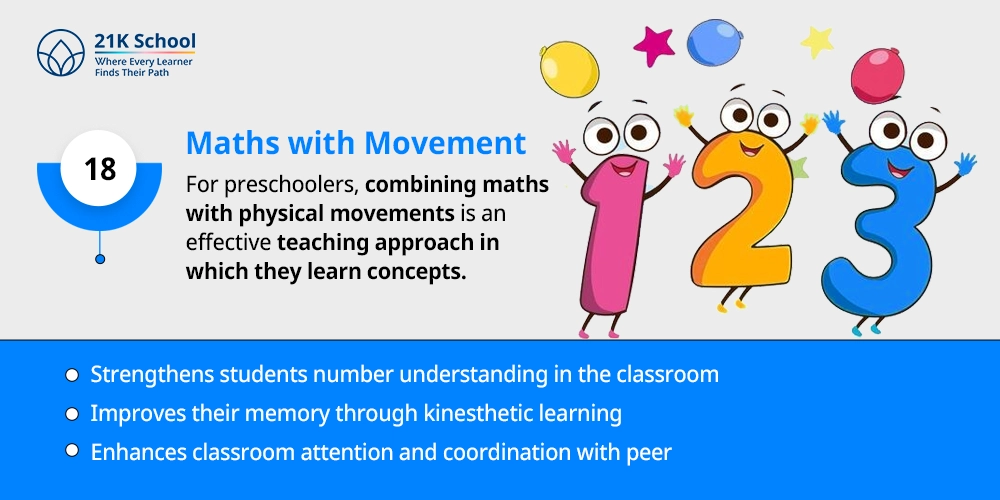
For preschoolers, combining maths with physical movements is an effective teaching approach in which they learn concepts.
It starts with using their whole body for example, jumping, dancing, etc. This helps to reinforce math skills such as counting and patterns.
Cognitive Benefits of Maths with Movement:
- Strengthens students number understanding in the classroom
- Improves their memory through kinesthetic learning
- Enhances classroom attention and coordination with peer
19. Tracing Activities
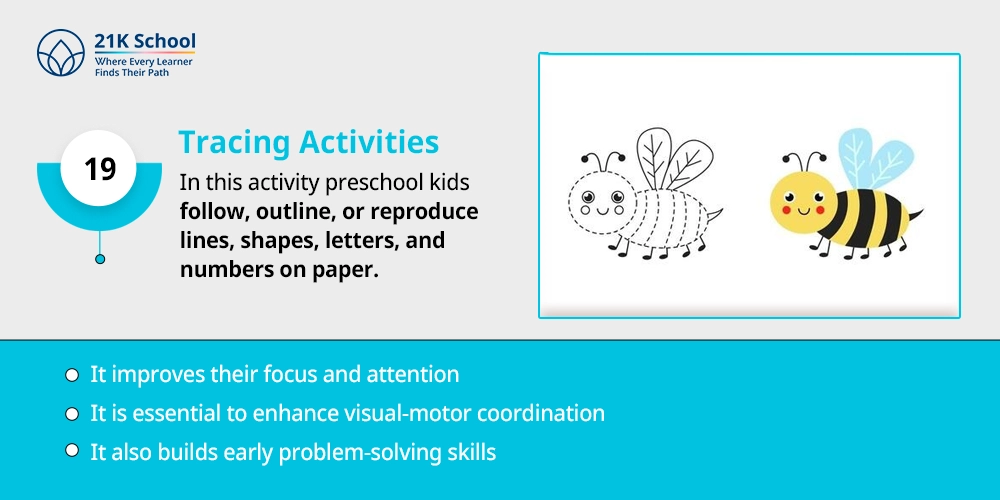
Tracing activities are different kinds of foundational exercises in which preschool kids follow, outline, or reproduce lines, shapes, letters, and numbers on paper.
Cognitive Benefits of Tracing Activities:
- It improves their focus and attention
- It is essential to enhance visual-motor coordination
- The activity supports letter and number recognition at young age
- It also builds early problem-solving skills
20. Ask Open-ended Questions
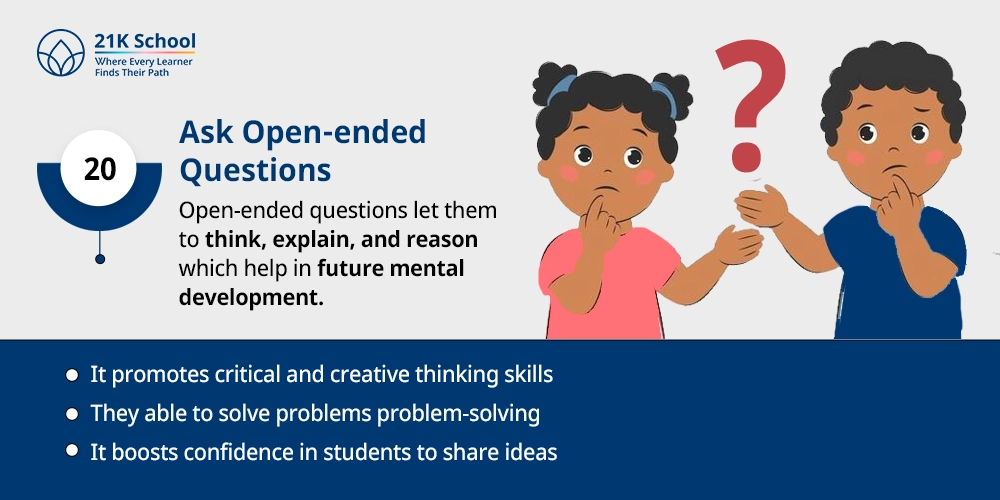
Asking open-ended questions is the simplest and most powerful activity for cognitive development. Open-ended questions let them to think, explain, and reason which help in future mental development.
Cognitive Benefits of Open-ended Questions:
- It promotes critical and creative thinking skills
- In this way students can enhance language and reasoning skills
- They able to solve problems problem-solving
- It boosts confidence in students to share ideas
Conclusion
Implementation of these activities in daily routine offers effective results like academic growth.
Using above-mentioned easy activities such as scavenger hunt, puzzles, outdoor exploration, sorting games, etc ensures mental, physical and personality development.
As a parent or teacher, introduce children to all the above-mentioned unique cognitive activities to make their learning flexible and meaningful.

You may also want to read