

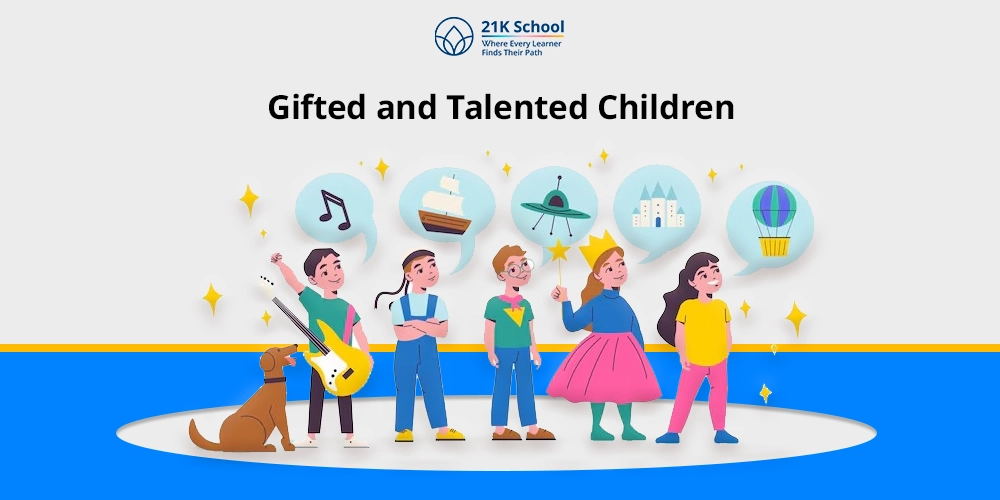
Gifted and talented children are blessed with an outstanding talent that can be differentiated among their classmates in terms of intellect, creativity, leadership, art or school/academics.
Their gifts are often manifested in unexpected ways, and they also have special emotional and interpersonal needs. These children must also be identified and developed so as to ensure they stay interested and confident and stay involved in learning .
Such commitment of the parents, teachers and schools leads to the fact that their abilities are evoked and their overall development and wellbeing is equally stimulated.
Contents
- Who are Gifted and Talented Children?
- Characteristics of Gifted and Talented Children
- How to Identify Gifted and Talented Children
- Challenges Faced by Gifted and Talented Children
- Importance of Early Identification of Gifted and Talented Children
- Role Of A Teacher For Gifted And Talented Children
- Concluding Thoughts
Who are Gifted and Talented Children?
Gifted and talented children are those who demonstrate talents that are significantly higher than the norm in comparison to their peers of the same age. They are able to be very intelligent, creative, leaders, artists, or very smart at school.
These are the children who are able to learn at a very rapid rate, think critically and show a high degree of curiosity or individuality. Their talent could be reflected in one or any of the below or a mix of them, and they require the guidance and support to make their talent evolve and succeed.
Characteristics of Gifted and Talented Children
Gifted and talented children are children possessing exceptional abilities in intellectual capacity, creativity, leadership skills or in art. They are usually developed thinkers, inquisitive and emotional in nature and possess certain needs regarding well-developed growth and development.
1. Intellectual Traits
The high intellect manifestation with the gifted and talented children has high levels of quick learners, good memory and a high level of curiosity.
They learn quickly, prefer complex things and challenging questions.
Routine or repetitive work can easily bore them. These children have the benefit of better learning at school, which arouses the desire to learn more.
2. Advanced Reasoning
Higher thinking makes the talented children think rationally, which makes them see a situation and solve problems. They learn concepts, recognise patterns and draw connections between concepts.
This ability helps them to predict the outcomes and oppose assumptions. They are, however, able to interfere with the rules or instructions and must be encouraged to enable them to put critical thinking skills and collaboration in balance.
3. Creative and Artistic Skills
Gifted children are also creative and artistic, and this is expressed through originality, imagination and expression. They are capable of being good artists, musicians, writers or dramatists.
The encouragement of the flow of artworks permits them to reveal emotions, be inventive and be empowered in their potential.
4. Leadership Skills
The majority of gifted children have innate qualities of leaders that include confidence, accountability and decision-making. They are able to mentor peers, plan or influence group outcomes.
They are able to communicate through good communication skills.
These children can be brought up with compassion, teamwork and principled leadership that is beneficial to them and those they lead.
5. Social Skills
Gifted children possess varied social skills. Some of them socialise effectively with their peers, and some prefer interacting with adults or spending time alone. They may fail to relate to age mates as they share different interests or levels of maturity.
Supportive environments allow them to feel free to make new friends, improve communication, and have emotional understanding and interpersonal skills in the long run.
6. Emotional and Behavioural Traits
Intense emotions, sensitivity and perfectionism are likely to be experienced by the gifted children. They are quite sensitive to criticism or failure and possess high expectations regarding them.
Emotional support, reassurance, and coping techniques enable them to manage their emotions and have a balanced emotional state.
7. Early Development
Many gifted children are observed to have some of the early developmental milestones, e.g. advanced language, early reading, or high-level problem-solving. They often show sustained attention and deep interest from a young age.
Early diagnosis would help parents and teachers to provide the appropriate stimulation, learning experiences, and emotional support to develop talents through the critical growth periods.
How to Identify Gifted and Talented Children
Gifted and talented children are detected through observation of greater abilities, standardised tests, teacher recommendation, parent reports and portfolio assessment. Early identification ensures that they will receive the appropriate course, support and specialised learning to develop.
1. Standardised Tests and IQ Assessments
The intellectual abilities which are measured by standardised tests and IQ tests also include reasoning, problem-solving, and understanding.
The instruments are employed to identify the superior level of cognitive abilities. They, however, should be combined with the other methods as tests do not necessarily determine creativity, motivation and non-academic talents.
2. Teacher Observations and Nominations
The teachers identify the gifted children based on how they behave in school, rate of learning, curiosity and problem-solving skills.
They are capable of nominating the students possessing a high degree of understanding, leadership or originality.
Teacher observations make good sources of information regarding everyday performance and interpersonal interaction. However, there is a need for training to reduce bias and ensure that the various talents are identified.
3. Parent Reports and Behavioural Checklists
The parent offers a provides valuable insight into the behaviours and abilities of a child outside of school. The behavioural checklists help in capturing such traits as intellectual curiosity, early development, creativity and motivation.
Parental feedback assists in identification because it assists in the realisation of the strengths that may not necessarily be observed in a classroom. Parent reports in combination with professional assessment help to provide a more balanced and comprehensive picture of the child.
4. Portfolio Assessment
Portfolio assessment entails a collection of the child’s work samples, projects, artwork, performance or other achievements over time. The primary focus in this approach is on creativity, problem-solving and learning skills in real-life scenarios.
Portfolios are also especially useful when it comes to identifying the talents in such areas as arts, leadership, or innovativeness. They provide a full-fledged image, not only the results of tests and scores.
5. Specific Academic Aptitude
Specific academic ability refers to exceptional ability in a given subject such as mathematics, science, language and music. Children may show a high level of knowledge, rapid advancement, development or interest in some subjects.
The educator can use the recognition of the subject-specific strengths to provide a particular enrichment, acceleration, or specialised instruction to help the talent develop.
Challenges Faced by Gifted and Talented Children
Such issues have to be faced by talented and gifted children, which include social isolation, peer pressure, emotional sensitivity, perfectionism, boredom, and developmental imbalance. The support of balanced learning and emotional development lies in identifying these problems at an early stage.
1. Social Isolation
When such children are not matched with other children in terms of their interests, level of thinking or maturity, gifted and talented children will feel isolated in society. They may experience an issue with identifying like-minded friends and misunderstanding.
Empowering peer groups, integrated classrooms, and channels of identification with other persons of the same calibre helps to reduce loneliness and facilitates the development of good socialisation in the day-to-day schools.
2. Peer Pressure
The talented children are normally pressured to hide their abilities so that they can fit into society. The reason is that they can perform poorly because they are afraid of potential teasing or rejection. Self-esteem and inspiration may be affected by this peer pressure.
Positive peer culture, which fosters acceptance and other confidence-building programmes, will assist the gifted children to learn to appreciate their gifts without being isolated and will facilitate proper emotional growth of learners in school.
3. Emotional Sensitivity
Gifted children are also emotionally sensitive, and their emotion is normally stronger compared to others. They are able to react intensively to criticism, injustice or failure. The increased sensitivity could lead to student stress or anxiety.
They will be able to control their feelings and have emotional balance in their daily life, at home, in a school setting, with the proper guidance of adults, with the help of emotional regulation, empathy, and coping strategies education.
4. Perfectionism
Gifted children practise perfectionism, which is setting extremely high standards for themselves. They are able to fear mistakes and avoid challenges in order to prevent failure. This can cause study stress, anxiety or procrastination.
Positive reinforcement, establishing goals that are achievable, and motivating them to understand that mistakes are part of learning and development and not failure, in the years of academic and personal development of childhood and teenage years.
5. Academic Boredom
Gifted students who are not challenged in the normal classes become bored at school, which leads to academic boredom. The boredom of classes and slow learning can decrease motivation and interest. This boredom, and this may lead to bad performance or misbehaviour.
Differentiation of instruction, enrichment and accelerated learning opportunities facilitate the sustaining of interest as well as encourages long term intellectual growth in a variety of subjects as well as grade levels across all schools in the contemporary world.
6. Asynchronous Development
The unevenness in intellectual, emotional and social development is asynchronous development. The gifted children may be intellectually advanced, but may have problems with emotions or interpersonal skills.
The comprehension of asynchronous development will assist the parents and teachers in providing equal support that will support emotional needs along with cognitive strengths throughout the schooling process and overall personality development.
Importance of Early Identification of Gifted and Talented Children
Recognising gifted and talented children at an early age helps to identify the strength of the child, personalised learning, social and emotional care, avoids disengagement and the child is directed in time to reach his or her maximum potential.
1. Helps in Identifying Talents
It is possible to identify the strengths, abilities and interests of the gifted and talented children at the right moment by means of early identification. It will help the parents and the teachers to have the knowledge about the potential of a child, be it regarding academics, arts, leadership or creativity.
The early recognition of talents will ensure that the talents are nurtured in the right way, and no talents are untapped in terms of the development and learning methods.
2. Individualised Learning Opportunities
The early intervention enables students to create individualised learning according to the capabilities and rates of a child. Gifted children are provided with enriched programmes, acceleration or even specially designed programmes which address their high ability level.
Individualised learning ensures that there is no boredom, motivation is heightened and in-depth learning is achieved. It also enhances the eternal intellectual growth since it aligns the educational experiences with the child’s personal strengths.
3. Social Wellbeing
Early recognition of gifted children helps in the social well-being of the children by meeting their emotional and social requirements, besides academics. The gifted children will not feel at home with others and hence will be isolated or anxious.
Early sensitisation will allow the educators to provide appropriate peer interactions, counselling and social skills support. This will help a child gain confidence, maintain healthy relationships and balance in the process of development.
4. Prevent Disengagement
The intervention early will help in preventing boredom in the regular classes. The gifted children need to be stimulated so that they can be interested in performing well or have behavioural problems.
Early recognition of their talents allows the teacher to present the student with a challenge that is meaningful and activities that they like, so that they can be motivated to ensure the student is focused on the task and actively participates in the learning activity.
5. Support Students
This will be identified, and thus, early intervention to meet the academic needs of the children who are gifted and talented will be done early to meet the emotional and social needs. It helps schools to arrange the correct interventions, advice, and enrichment opportunities.
Students experience that they are listened to and valued with pre-emptive assistance. This initiative plan will enhance self-confidence and long-term success because it will help the gifted learners attain their optimal potential in an enabling environment.
Role Of A Teacher For Gifted And Talented Children
To achieve intellectual, social and emotional potential, teachers provide gifted and talented students with emotional support, identify abilities among students earlier, differentiate curriculum, mentor students and promote their autonomy.
1. Social Emotional Support
The teachers provide their gifted children with emotional guidance on how to cope with sensitivity, perfectionism and stress. They encourage positive social interactions among peers, confidence building, and a positive learning environment.
This help implies that students will not be emotionally in an unbalanced state and socially sick to be able to take part in the learning process altogether.
2. Curriculum Differentiation
As a way of enriching, accelerating, and providing higher-level projects, the teachers change the curriculum to challenge the gifted students. The differentiation will remove boredom, encourage interest, and promote deeper understanding.
Individualised education allows the children to learn at their own level, and this allows intellectual growth and brings out the best in them academically in a favourable classroom environment.
3. Provide Mentorship
Teachers mentor gifted children to develop interests and objectives and offer constructive feedback. Mentorship develops competencies, confidence, and problem-solving.
It exposes the students to new experiences, establishes curiosity and facilitates individual and academic growth that helps the students realise their potential in a well-organised and conducive environment.
4. Early Identification
Teachers view giftedness as being manifested by rapid learning, curiosity and creativity. Early identification will offer early interventions, enrichment and support.
Early identification of talents enables educators to avoid boredom, loss of interest, and low performance rates, as learners will be in a position to receive the necessary support in achieving their academic and emotional success.
5. Promotes Autonomy
The gifted students are made responsible for their learning and are allowed to make personal decisions by the teachers. Promotion of self-development, problem-solving, creativity, and self-confidence are products of encouragement of independence.
It allows students an opportunity to pursue their interests, gain problem-solving skills, and achieve their goals, which helps them achieve long-term academic and personal growth.
Concluding Thoughts
Gifted and talented children are gifted children and therefore highly talented children whose talents should be identified at a tender age, their talents comprehended and nurtured to provide them with an opportunity to flourish.
Such children could be detected at a young age, and the parents, teachers and schools could enrich such children in terms of learning, emotional support and provide them with the right opportunities.
Gifted and talented children will be in a position to achieve their potential and experience healthy social and emotional growth since they will be developed in a balanced and supportive manner.

You may also want to read