
7 Activities to Encourage Curiosity in Children

Last modified: 7 Sep 2026 9 min read
Why is it so crucial to be curious? Curiosity, at its most fundamental level, will always keep a youngster at bay from being bored. An inquisitive child will actively research and come up with their own activity ideas rather than waiting for one to come along. Children have a natural desire to learn everything about their surroundings and are inherently interested. It is critical for children’s growth and well-being to allow them to be interested and explore their surroundings. Curious kids have a higher tendency to absorb and retain knowledge, stay interested in school, and perform better. Isn’t that what we all desire for our children? But, the question is, how to develop that spirit of inquisitiveness in your child? To answer this, let’s look at some of the activities to encourage curiosity.
7 activities to encourage curiosity
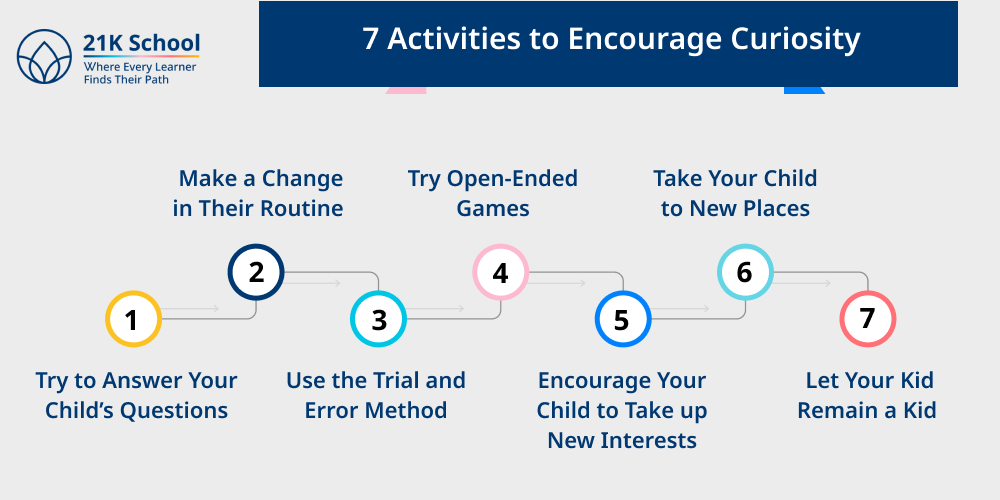
1. Try to answer your child’s questions
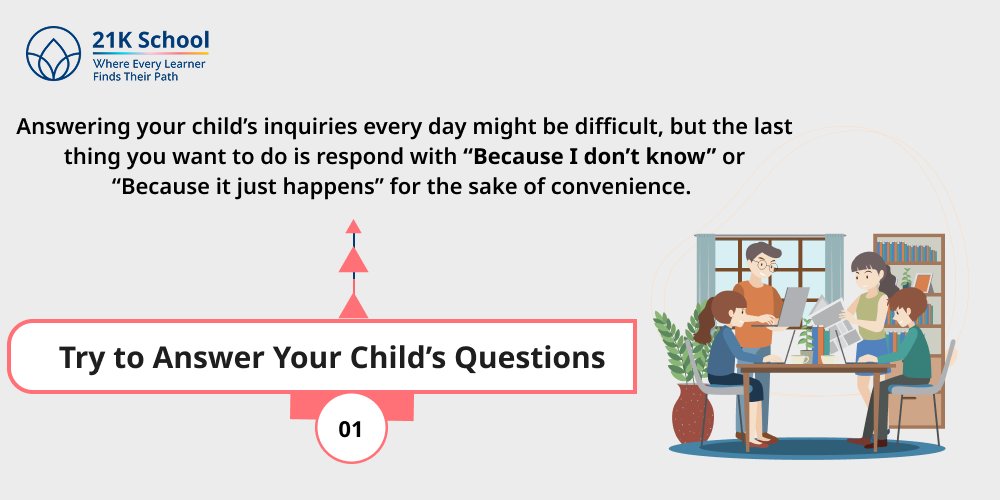
Answering your child’s inquiries every day might be difficult, but the last thing you want to do is respond with “Because I don’t know” or “Because it just happens” for the sake of convenience. This will not only make things more confusing for him/her, but it will also make the child less inclined to put her thinking and learning skills to work.
Instead, put effort into offering your child a response and involve them in further discussion of the issue. If you are not sure of an answer, indulge in an interesting activity. Sit down with your child and find answers together! Solicit their input on various locations to seek answers - whether books, magazines, the internet, etc. Thus, you can see that the process starts at the comfort of your home, where the child can learn and inculcate the habit of thoughtfulness and logical reasoning.
2. Make a change in their routine
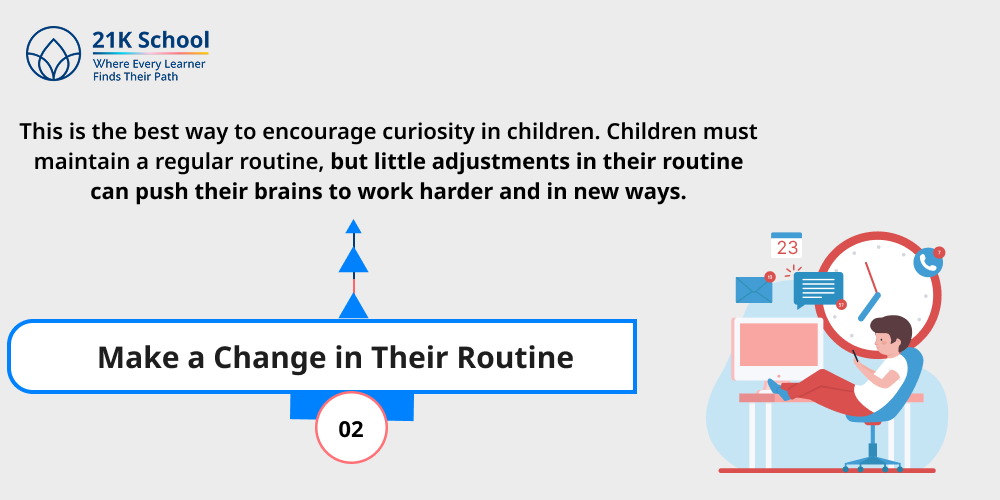
This is the best way to encourage curiosity in children. Children must maintain a regular routine, but little adjustments in their routine can push their brains to work harder and in new ways, which can pique their interest. It might be as simple as switching their cereal and letting them make their decision. Or maybe insert a new activity like playing crosswords into their routine.
3. Use the trial and error method

Using a trial and error method for learning is the best way to encourage curiosity. Allow your children to experiment and fail as they learn, whether they are stuck in a real-life problem or in a game. This helps in promoting learning. As adults, we frequently see a quick fix before our children can, or we believe we know the best approach to do a task. We take away a key and satisfying component of the learning process when we convey our thoughts to a youngster before letting them find their own. So try to take a step back and watch. You can provide support, but do not straightaway offer the answer!
4. Try open-ended games
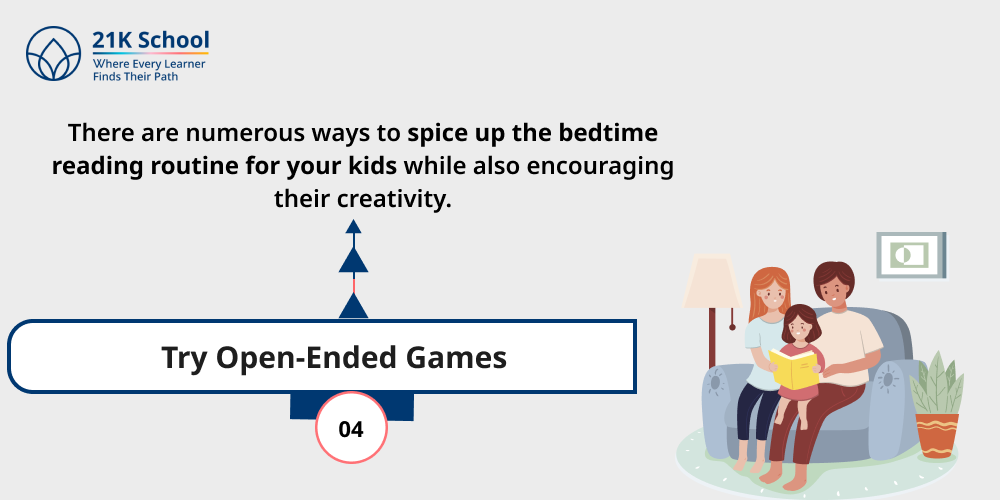
There are numerous ways to spice up the bedtime reading routine for your kids while also encouraging their creativity. Even if kids appear to like reading the same stories over and again, consider making it more entertaining by leaving the conclusion to their imagination. To further maintain their interest and attention in the narrative, you can also ask them to come up with a new title and write a new introduction. This is an innovative and among the best activities to encourage curiosity in kids.
Blocks and legos are excellent options to start with young children. But when children become older, what comes next? There are some fantastic opportunities like origami, Sudoku, and building games. You need to research and see what games can push your child’s limit and help him/her evolve brain functions.
5. Encourage your child to take up new interests
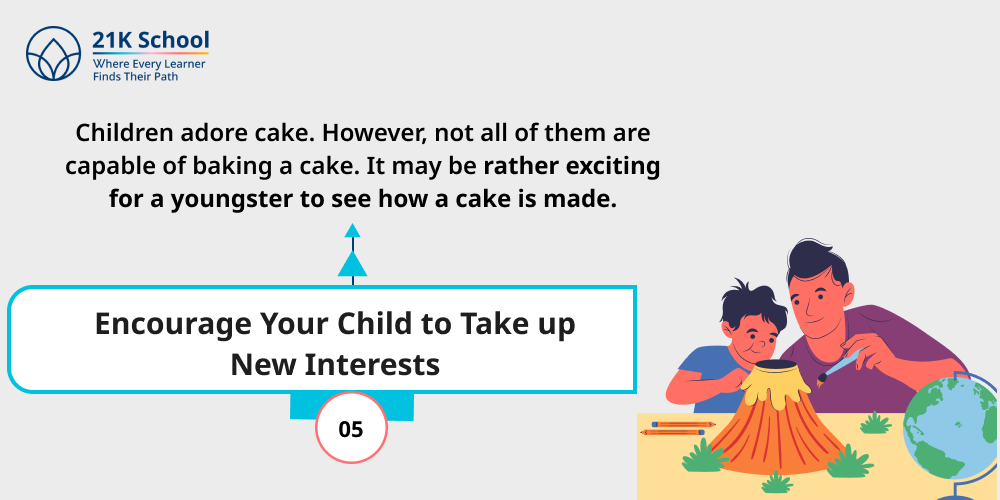
Children adore cake. However, not all of them are capable of baking a cake. It may be rather exciting for a youngster to see how a cake is made, from the materials to the finished product. Additionally, learning how to make it firsthand will stimulate all of their senses, including hearing instructions, seeing how the liquid batter changes to the sponge-like texture and colors, touching strange textures, smelling the cake as it bakes, and eventually tasting it.
You may already believe that your child should learn music, but have you given enough attention to the real benefits of doing so? Do you understand how music impacts the brain? People who study music really have a tendency to use both sides of their brains, although we all tend to favor one side of the brain over the other. Those with an inclination toward music become more adept at lateral thinking, which is the capacity to approach issues in a novel way. Your kid will be more intrigued about the world around them if they have a creative mind.
But again, yes, don’t force your interests on your child. We all have various interests, and research shows that only when we are passionate about something are we more likely to learn it. You can estimate it from your child’s preferences and dislikes as a parent, and, encourage his/her curiosity in the areas of knowledge he/she finds interesting.
6. Take your child to new places
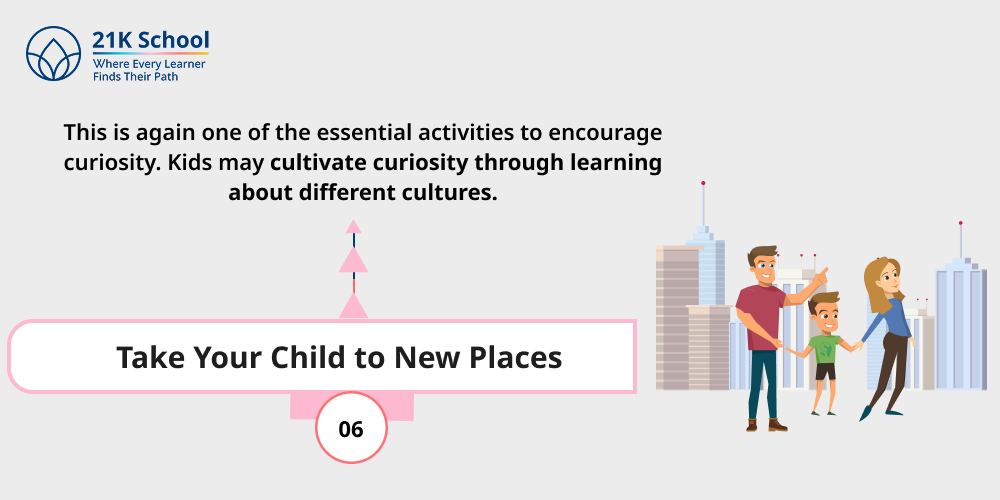
This is again one of the essential activities to encourage curiosity. Kids may cultivate curiosity through learning about different cultures. Additionally, local cuisine is a great method to learn more about another culture’s tastes, etiquette, and traditions. If you believe your children would appreciate it more, take them out to a nice lunch at an authentic Chinese, Spanish, Italian, or any other cuisine restaurant.
Traveling with your children to another nation is strongly advised so they may encounter different cultures, visit interesting sights, and make new friends . As often as you can, practice this. Traveling increases our curiosity, which is one of the major reasons we go on vacation. Therefore, introducing your children to this dynamic environment at a young age will encourage them to enjoy traveling throughout their entire lives.
7. Let your kid remain a kid
This is one of the most important activities to encourage curiosity in your child. It might be challenging as a parent to let your children do what they want. They frequently want to do the most annoying things. However, letting kids discover the world on their own terms is preferable as long as their most recent thought is not harmful. Toddlers begin to want to do things on their own at a certain age. Thus, it is advised to give them a chance. Interfering with their processes might have a detrimental impact on your child’s interests. It can be best to let kids make errors, so they can grow from them.
Conclusion
Following the above activities to encourage curiosity will instill confidence and admiration in your children by letting them gain interest and explore more. Additionally, you can expose children to the outside world and impart to them the wisdom that experiences are more valuable than material possessions. Co-curricular activities are intellectual and provide excitement to teaching and learning for both students and teachers is their best feature. Get outside, go exploring, and educate your kids about the environment. Curiosity will always lead to new opportunities along with fascinating, adventurous, and educational pathways.
Frequently asked questions
13 questions
How to encourage curiosity in a child?
When dealing with curiosity, parents and teachers should ask open-ended questions, offer children many opportunities for hands-on experiences, and let them explore their environment freely. Encourage their cause and always appreciate what they discover as this will instil a good character of learning in them.
What can educators do to promote curiosity in children?
Only when an educator makes an effort, is it possible to introduce interest into a child. They can pick some of the following options which include making or setting a context in the class, encouraging general opinions of the students as well as the use of different teaching aids that elicit curiosity and development.
How do you stimulate children's creativity and curiosity?
STEM strengthens the elements of creativity and curiosity through the provision of options for creative play, problem-solving, educationally purposeful ideas, experiences as well as a variety of opinions. This way educators can harness children's creativity and curiosity.
How to spark curiosity in students?
Engage students by coming up with examples from real-life situations, pro-formation of questions, and creating conditions that make students think with difficulty on their own. Explain to them about a rather entertaining form of content and it will be relevant to use activities that are more likely for their age.
Why should we encourage curiosity among children?
Educating children with interest makes them lifetime learners, emotionally well-endowed problem solvers, and creative. It improves knowledge acquisition and creates concern about the achievement of knowledge.
How to develop curiosity in students?
Create interest by giving them choices of knowledge, giving them an avenue to ask as many questions as possible, and using projects that will make them decide on the area they want to explore.
How does play support curiosity?
This is major because play offers children a chance to learn with little or no pressure offered to them. In other words, it cultivates problem-solving, innovation, and curiosity as they navigate through their daily settings.
Why should a teacher encourage curiosity?
Teachers should foster curiosity in the students to promote their critical skills, and independence in the classroom apart from enhancing fun in learning. Innovative learners are more eager and get to understand the knowledge in question better.
How Beneficial Is Curiosity To A Child?
Curiosity is beneficial in ways that provoke learning, exploration, and problem-solving and in ways that enable children to adapt to new situations by promoting problem-solving and resilience.
What are the different ways to encourage curiosity in children?
Some of the processes by which curiosity can be practised in children include experience, curiosity in using objects, teaching stories, outdoor play, questioning, and ensuring the child plays his or her favourite type of play.
What are the types of curiosity?
There are two main types of curiosity: There is epistemic curiosity which relates to the desire to acquire new information, and then there's perceptual interest which operates based on novelty and uncertainty.
How does curiosity enhance learning?
This makes students more receptive and also increases information grasping among them. They help increase the amount of studying, aid memory and help develop skills that allow for problem identification.
What are the signs of a curious child?
Curiosity-based children often ask questions, go in search of other things, find new experiences interesting, and have pleasant demeanors when acquiring new knowledge. If a child has such skills, they can be called a curious child.
About the author
21K School Team
Education Content Specialist
21K School Team is a group of highly talented and like-minded professionals focused on the creation of informative and engaging content for the audience. Coming from diverse writing backgrounds, the team comes up with unique ideas for sharing information with the 21K School audience. When not writing, you can find the 21K School Team members working closely with interdisciplinary teams for impactful content marketing.
Every 21K School guide is written by our education team and reviewed by a subject facilitator before publishing.
Exploring a CBSE-pathway online school?
Talk to an advisor about 2026–27 admissions — no obligation.
Talk to an advisorComments
No comments yet — be the first to share your thoughts or ask a question.