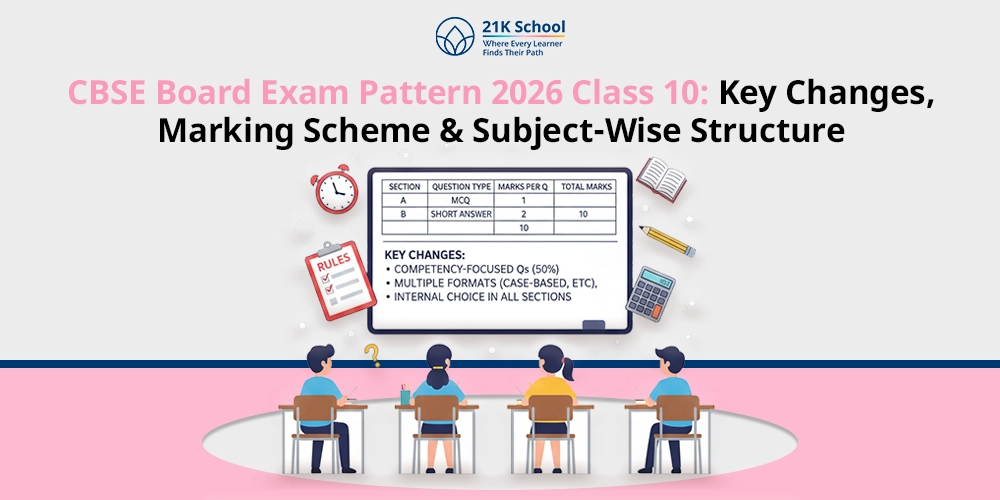
CBSE Board Exam Pattern 2026 Class 10: Key Changes, Marking Scheme & Subject-Wise Structure
 Written byAnkita SinghaContent Specialist
Last modified: Aug 28, 2026 8 min read
Examination plays a major role in students life especially when it comes to class 10 boards. From the latest information shared by officials before examination to exam pattern everything is important.
As students need to prepare early for good marks, it’s important to understand the examination pattern to boost confidence.
Students often stressed out to know the highlights of upcoming class 10 exams. That’s why this guide is all about what you want to know on the CBSE board exam pattern 2026 class 10.
What is the CBSE Board exam pattern 2026 Class 10?
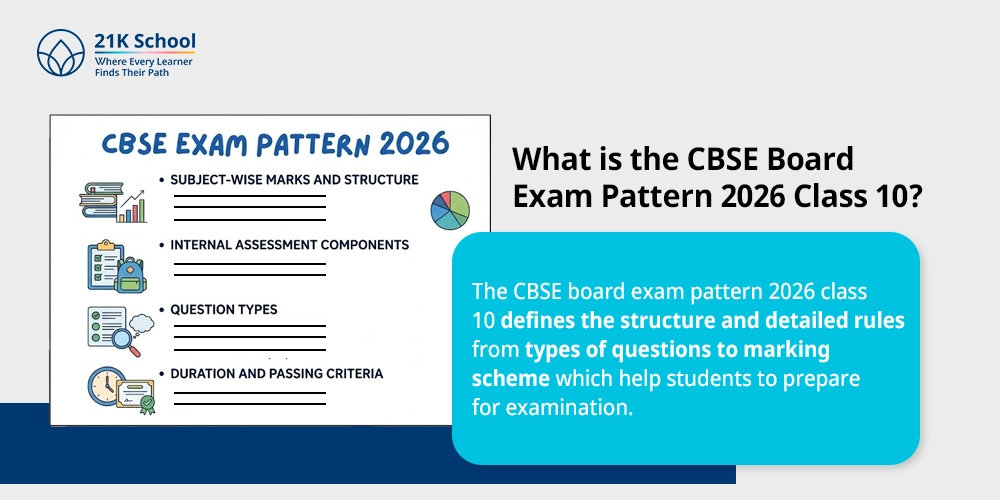
The CBSE board exam pattern 2026 class 10 defines the structure and detailed rules from types of questions to marking scheme which help students to prepare for examination.
It includes subject-wise marks and structure, internal assessment components, question types, duration and passing criteria.
CBSE board exam pattern 2026 Class 10: Key highlights
Check out the key highlights of the CBSE board exam pattern 2026 class 10 includes:
| S No. | Particulars | Details |
|---|---|---|
| 1. | Total number of subjects | Total number of subjects include: Mathematics Science Social Science English Hindi Some schools may offer additional electives/subjects. |
| 2. | Total marks per subject | Each subject is of 100 marks. It is divided into two parts 80 marks for theory exam and 20 marks for internal assessment. |
| 3. | Theory vs internal assessment weightage | Theory Paper: 80 marks. Internal Assessment: 20 marks. |
| 4. | Question paper duration | 3 hours for each subject. |
| 5. | Passing criteria | A student needs a total of 33% marks (33 out of 100) in each subject. |
| 6. | Important Timeline | For 2026, the main exam is scheduled from February 17 to March 10, 2026. And the second phase from May 15 to June 1, 2026. |
Types of questions in the CBSE Board exam pattern 2026 Class 10
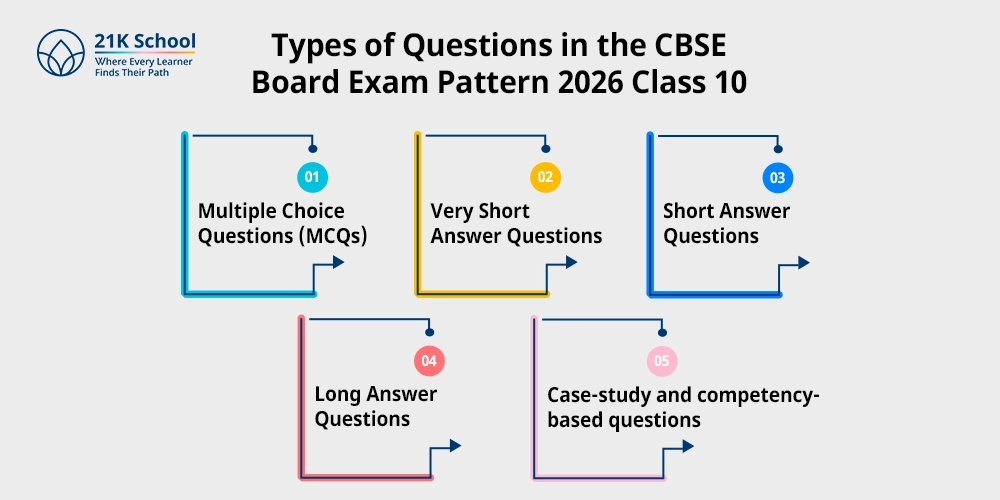
Check out different types of questions in the CBSE board exam pattern 2026 class 10 to prepare for exams:
1. Multiple choice questions (MCQs)
Multiple Choice Questions or MCQs are simple objective type questions in which students get options to pick the right answer to get marks in exams.
2. Very short answer questions
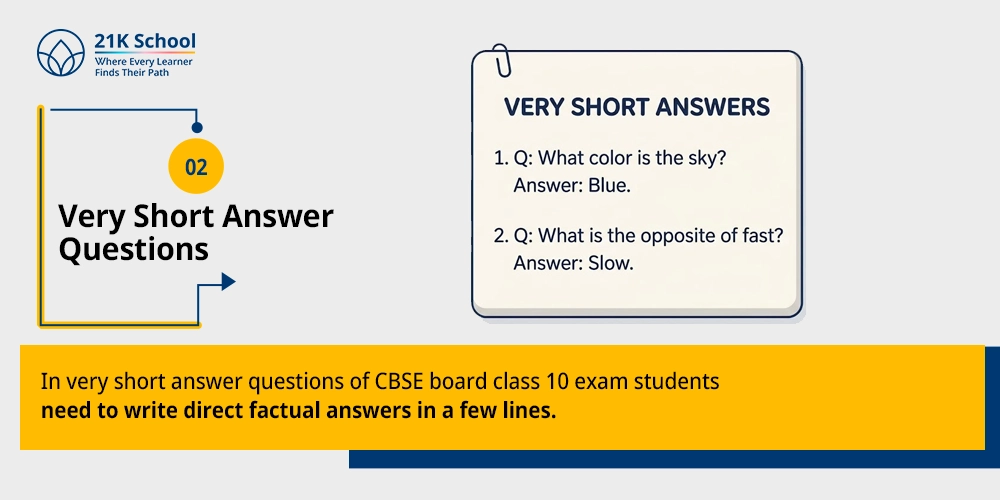
In very short answer questions of CBSE board class 10 exam students need to write direct factual answers in a few lines.
3. Short answer questions
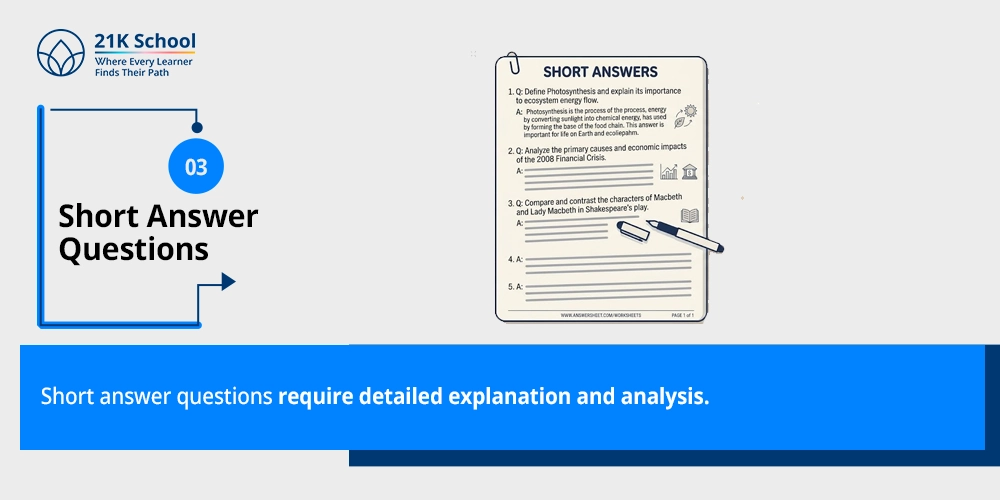
Short answer questions require detailed explanation and analysis.
4. Long answer questions
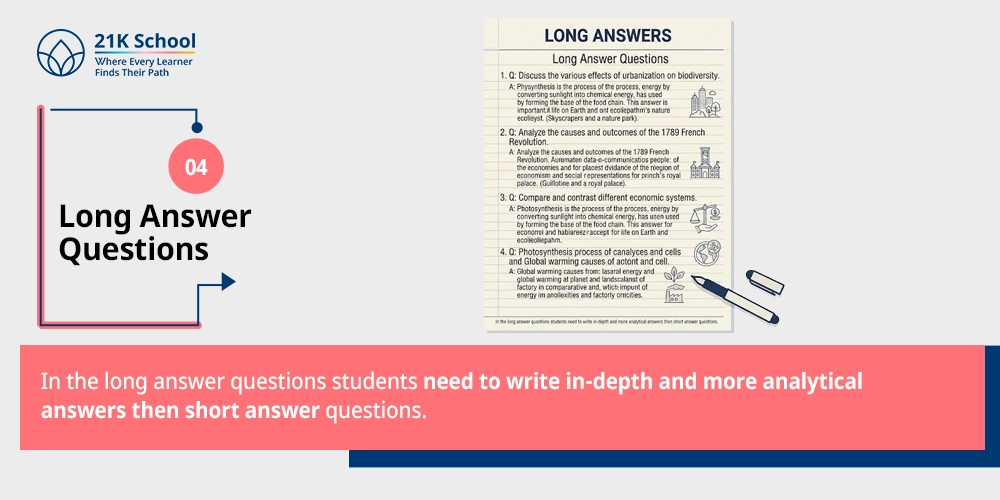
In the long answer questions students need to write in-depth and more analytical answers then short answer questions.
As it is for higher marks, detailed answers writing is important especially for step marking.
5. Case-study and competency-based questions
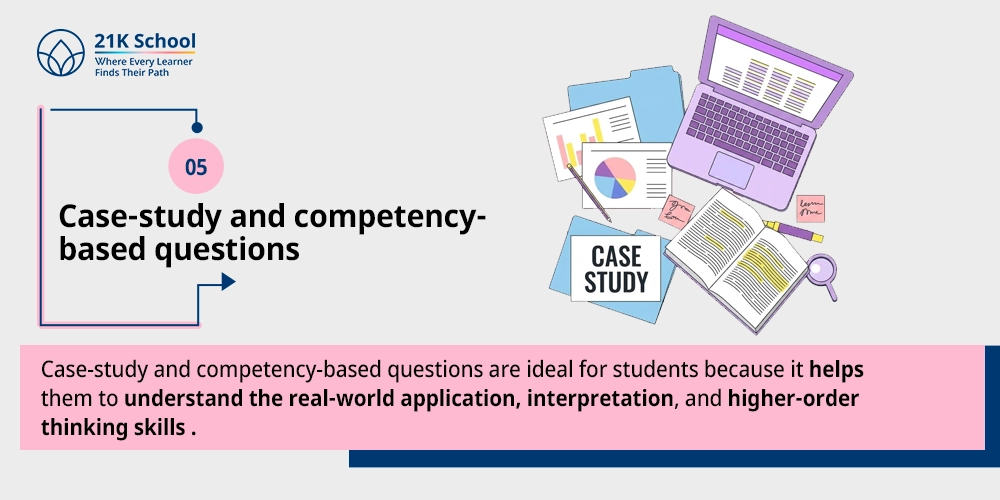
Case-study and competency-based questions are ideal for students because it helps them to understand the real-world application, interpretation, and higher-order thinking skills .
Major changes in the CBSE Board exam pattern 2026 Class 10
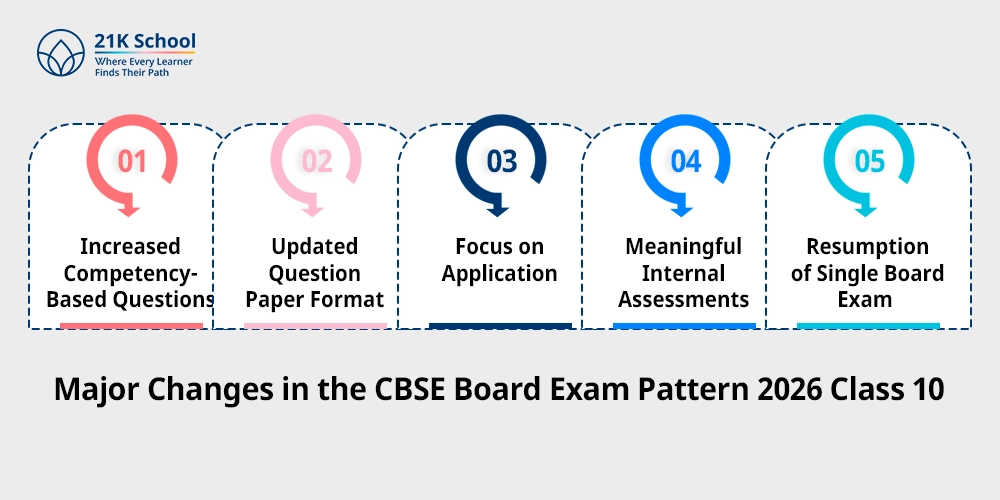
As compared to previous years, some of the main changes CBSE board exam pattern 2026 class 10 aligned with 2020 NEP policy guidelines which includes:
1. Increased competency-based questions
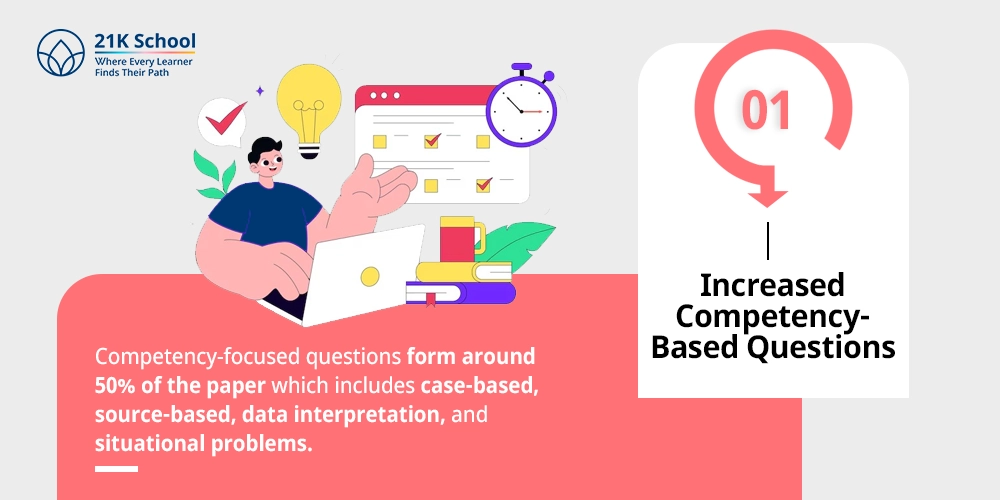
Competency-focused questions form around 50% of the paper which includes case-based, source-based, data interpretation, and situational problems.
2. Updated question paper format
Students get the combination of questions including MCQs, short answers, long answers, case-study and competency-based questions.
3. Focus on application
The main focus on:
- problem-solving
- analytical skills
- conceptual clarity in real-life scenarios
4. Meaningful internal assessments
In internal assessments CBSE Class 10 consider:
- project work
- practicals
- class activities
- holistic development
5. Resumption of single board exam
Starting from 2026, CBSE will conduct Class 10 board exams TWICE a year CBSE Exam Pattern Changes For Class 10 Students In 2026.
A main exam in February and an optional improvement exam in May. This is a major policy change aligned with NEP 2020.
Subject-wise CBSE Board exam pattern 2026 Class 10
Given below subjects of CBSE board exam pattern 2026 class 10 follows a common pattern in which the theoretical marks is 80 and internal assessment includes 20.
Go through the subjects structure of CBSE Board Exam Pattern 2026 Class 10:
1. Mathematics
Students can pursue the subject in two ways: either "Mathematics Basic" or "Mathematics Standard".
Here, the basic one is for those who don’t want to continue mathematics after 10th. While the standard one is for students who want to continue their career with mathematics.
Some common types of questions students encounter during mathematics examinations are:
- MCQs
- case-based problems
- short and long answers
2. Science
Science is a class 10th subject which consists of Physics, Chemistry, and Biology.
The subject includes hands-on work, diagrams and experiments. The exam contains a combination of:
- MCQs
- short answer
- long answer
- case-based questions
3. Social science
Social Science is a popular subject which consists of:
- History
- Geography
- Civics
- Economics
In this subject the questions are mainly based on application and use of maps in geography.
4. English
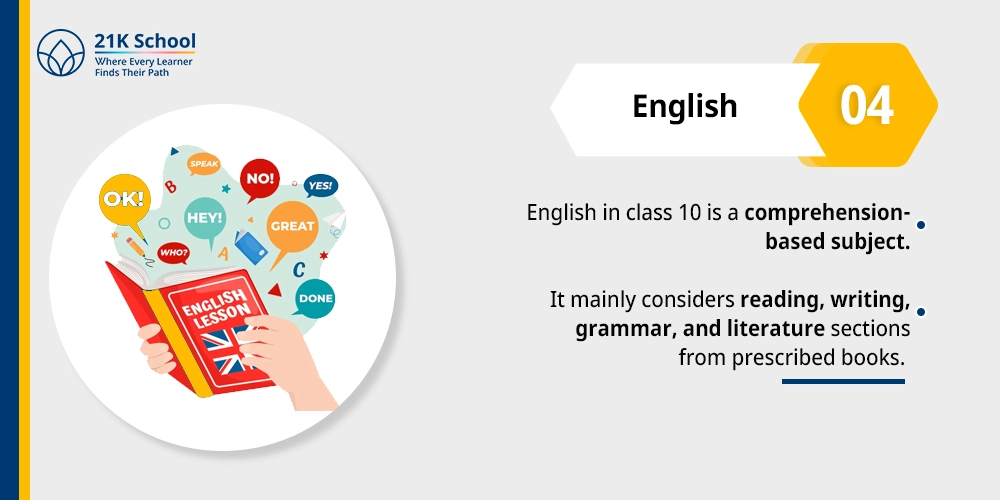
English in class 10 is a comprehension-based subject. It mainly considers reading, writing, grammar, and literature sections from prescribed books.
5. Hindi
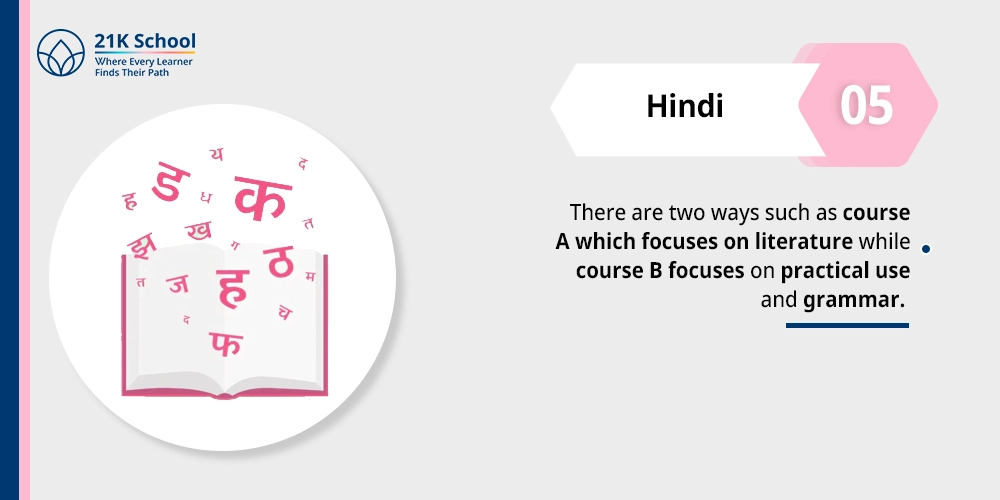
There are two ways such as course A which focuses on literature while course B focuses on practical use and grammar.
Note: To know more detailed information go through CBSE board official website for syllabus .
CBSE board exam pattern 2026 Class 10: Internal assessment and practical exams
Check out the quick table on internal assessment and practical exams of CBSE board exam pattern 2026 class 10:
| S No. | Particulars | Theory | Practical/Internal | Activities |
|---|---|---|---|---|
| 1. | Hindi | 80 | 20 | written tasksreading logs |
| 2. | English | 80 | 20 | listening activities speaking activities oral activities |
| 3. | Social Science | 80 | 20 | various projects assignments map activities |
| 4. | Science | 80 | 20 | practical files lab work viva |
| 5. | Maths | 80 | 20 | tests projects notebook reviews |
Marking scheme of CBSE Board exam pattern 2026 Class 10
The marking scheme of CBSE board examination pattern 2026 class 10:
- Theoretical Examination
80 marks
- Internal Assessment
20 marks
- Minimum Passing Criteria
33% per subject
- Grading System
9-point (A1 to E)
Conclusion
Class 10th is a milestone for students to succeed in both professional and personal life.
Hopefully, the guide helped you to understand the desired information about CBSE board exam pattern 2026 class 10 to prepare for upcoming examinations.
To know more information on CBSE board class 10 attendance required or CBSE grading system go through the latest blogs.
Frequently asked questions
6 questions
Has CBSE changed the exam pattern for Class 10?
Yes, the CBSE has introduced significant changes to the Class 10 examination pattern for the 2026 board exams. Some of the changes include competency-based focus, strict answer writing, sectional division etc.
How to Prepare for CBSE Class 10 Exams 2026?
Students can prepare for CBSE class 10 exams 2026 by: create a study plan focus on NCERT books practice previous year papers and sample papers revise regularly prioritise high-weightage topics
Is 92% in 10th good?
Yes, 92% in 10th good for a student to follow the desired career and job.
How to download the latest CBSE sample papers and blueprint?
Students can download the latest CBSE sample papers and blueprint by following: Go to the CBSE Academic portal Click on the "Sample Question Paper" Get the Sample Question Paper and the Marking Scheme Click each subject PDF to download
How many sets are in board exam Class 10 2026?
For the CBSE Class 10 Board Exams in 2026, expect multiple sets of question papers per subject.
Is CBSE the best out of 4 or 5?
CBSE doesn't have a "best of 4 or 5" board. It has a "best of five" rule for Class 10th. However, the "Best of Five" rule applies when students take 6 subjects. The board considers the best 5 subjects for percentage calculation, but CBSE doesn't officially declare percentages.
About the author
Ankita Singha
Content Specialist
Ankita Singha is an Education Content Specialist at 21K School, India’s first accredited fully online K-12 School. She focuses on the in-depth research and creation of the well-drafted guides on early childhood education, school admission processes, and CBSE/ICSE curriculum guidance. With more than 2 years of experience at 21K School, a fully accredited institute- Cambridge International (IA702) and Pearson Edexcel (94883), Ankita works closely with the school’s curriculum heads and academic coordinators. Ankita’s every article reflects on the official board guidelines, practical realities, and current policies of online education in 78+ countries. Ankita’s content has helped thousands of parents in understanding the topics like RTE eligibility, NIOS pathways, and age-appropriate admission criteria.
Every 21K School guide is written by our education team and reviewed by a subject facilitator before publishing.
Exploring a CBSE-pathway online school?
Talk to an advisor about 2026–27 admissions — no obligation.
Talk to an advisorComments
No comments yet — be the first to share your thoughts or ask a question.