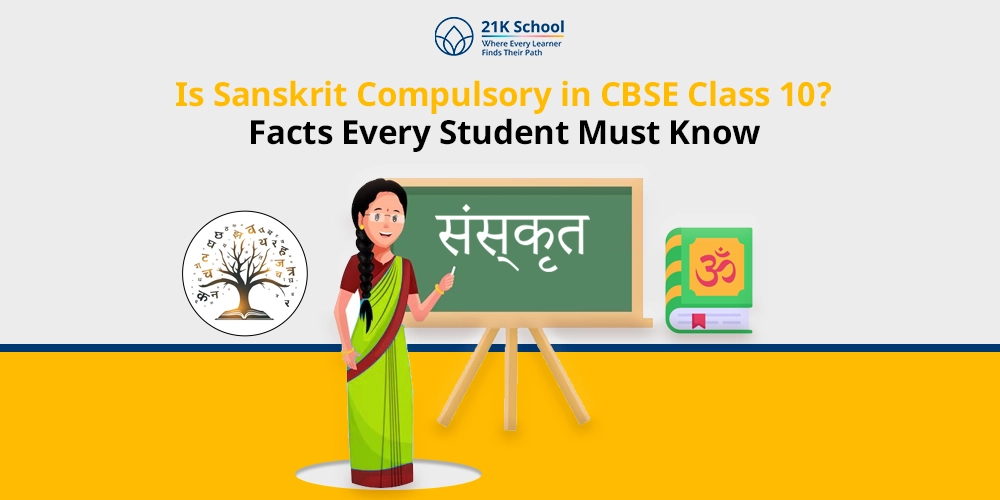
Is Sanskrit Compulsory in CBSE Class 10? Facts Every Student Must Know
 Written byRahul PalContent Specialist
Last modified: Jul 23, 2026 13 min read
Whether Sanskrit is a compulsory subject in Class 10 CBSE is the major worry of the majority of the students and parents. This misunderstanding is quite common in various schools that offer various languages.
One should also study the CBSE language policy before choosing the subjects. This guide justifies the need for or against Sanskrit, the alternative available, and how students, by taking into consideration their interests and academic aspirations, can make the right choice of language.
Is Sanskrit compulsory in CBSE Class 10?
No, Sanskrit is not mandatory in CBSE Class 10. The students are required to have a second language, but the students have a wide range of choice, and they may choose Hindi, Sanskrit or any other language offered by their school.
This will depend on the school curriculum and the availability of teachers. Sanskrit is not the only one of the second subjects, and the students can select a language as per their interest, comfort and possible score.
CBSE Class 10 language policy
The five-subject format of the board examination needed by CBSE compels the students of Class 10 to study two languages. It is through the understanding of this procedure that Sanskrit gets its way.
1. First language
The first language is almost invariably English, which is compulsory for all students of CBSE. The English subject is included in the Class 10 board exam and is, anyway, a mandatory subject regardless of the school one attends and the other subjects that one may choose to pursue.
Some of the students who do not speak English as their first language and use either Hindi or some other regional language as their first language can use Hindi as their first language and English as a second one, though in most CBSE schools, English is the first language.
2. Second language
The second language is the student’s choice, and in situations where Sanskrit is generally taught. CBSE also leaves schools with the choice of offering any language that is recognised as a second-language subject. The common options of CBSE schools include Hindi, Sanskrit and Regional languages (Bengali, Tamil, Telugu, Kannada, Malayalam).
The second language you acquire in Class 10 is nothing but the same language that you have studied since Class 6 or Class 9, based on the Class 10 structure of your school.
3. Optional language
CBSE also enables the student to opt for a third language as an optional or add-on subject. This sixth option subject may be optional and may be used instead of the lowest-scoring main subject in the best-of-five computation.
Sanskrit is also a voluntary additional subject, in which students choose Sanskrit as the additional subject they want to be graded on, with it not counted as one of their 5 core subjects.
When do students choose Sanskrit?
Various academic and personal reasons make students learn Sanskrit in Class 10. These can be interpreted to give the reasons why Sanskrit is a common non-compulsory language among the CBSE learners
1. Middle school subject continuation (Class 6-8)
Many students would choose to take Sanskrit in Class 10 as they have already taken the subject in Classes 6-8. The same language will keep them conversant with grammatical, vocabulary and concept rules.
This smooth flow reduces the study stress and gives one confidence, such that it becomes easy to achieve high marks, unlike learning a completely new language in classes at higher levels.
2. Included in school curriculum
Sanskrit is already taught as an option subject in some schools, and therefore, it is a natural choice for the students. Schools tend to convince students to take courses in languages through the aid of systematic instruction and educators.
Limited options play a role, and the student is normally left with the choice of official languages that are offered in the institution.
3. Personal interest
Other students like the study of Sanskrit, due to its cultural, historical or linguistic value. The interest in ancient work, interest in Indian background or in the structure of language can encourage them to use it.
The students will tend to be engaged, better understand, and have good grades without the perception that they are overwhelmed when they are interested in the subject being taught.
4. Scoring advantage
Sanskrit is also reported to be a scoring subject because the syllabus is clear, and there can be no doubt in the pattern of the exam. The questions are not too complex, especially in the grammar and translation sections.
Good grades can be achieved by practice and with the help of the right knowledge by students. This scoring potential perception makes most students opt in favour of Sanskrit so as to gain a percentage.
Why Sanskrit feels “Compulsory” in many CBSE Schools
Even though it is not a mandatory subject that is necessary in CBSE, somehow, Sanskrit is mandatory for a good number of students in Class 10. This is related to several reasons.
1. School curriculum structure
Where a school has taught Sanskrit either as a second or third language since Class 6, and has not taught choices, there is no practicable choice in the curriculum to be offered to a student in a school so taught.
The action of the school practically makes Sanskrit the sole option which can be taken, although the policy of CBSE, which allows others to be used, allows them.
2. Subject continuity rules
Switching between Class 9 and Class 10 and a different language subject is not an administrative convenience, and most schools do not adjust or even allow it.
In case you studied Sanskrit in Class 9, then your school will most certainly demand that you continue with it in Class 10, so that continuity in the history of board examinations can be maintained.
3. Lack of awareness
The reason behind this is that Sanskrit is not a requirement in CBSE, as many students and parents are unaware of this fact.
When schools come up with a study schedule that encompasses Sanskrit, it is presupposed that it is compulsory. Unless this is proactively inquired about, the families remain on their course without them knowing that there are possibilities.
4. Teacher and school recommendations
The schools that have Sanskrit teachers and the department established would naturally consider Sanskrit to be the preferred language to use. Students who are unaware of other options tend to follow the school’s recommendation.
Benefits of choosing Sanskrit in Class 10
The academic advantages of taking Sanskrit in Class 10 are there. It may help improve the scores, improve the language proficiency, and reduce the exam stress, which makes it an easy and handy field to learn.
1. Increase overall percentage
It is possible to increase the percentage of students using Sanskrit because it is generally assumed that it is easier to score in compared to other subjects. The paper pattern is also most likely to predict, and the answers are more straightforward.
Students can also achieve good marks through constant practice, provided they understand the grammar and translation, which thus affects their Class 10 board results positively.
2. Foundation for other languages
The study of Sanskrit also offers a decent foundation towards the understanding of the majority of the Indian languages, including Hindi, Marathi and Bengali, as they have similar origins. It is also more conversant with grammar formations, vocabulary and sentence constructions.
The linguistic basis helps the students in mastering other languages much more easily, and in the long-term, the students develop improved communication skills and comprehension skills.
3. High scoring potential
Sanskrit is a top scorer due to the fact that it has a well-organised syllabus, and questions are not difficult. The direct ones are parts like grammar, translation and those that contain a textbook question.
Students are in a position to practise achieving good grades with ease. This makes it one of the strategies that students would prefer so that they can record the best scores in Class 10 exams by the boards.
4. Need to focus less
Students may not need to spend as much time on Sanskrit once the fundamentals are understood. The material covered in the syllabus is not extensive, and after regular revision, the students are able to memorise the concepts faster.
This enables them to devote additional time to the main subjects such as Maths and Science, thus it is a good option towards balanced preparation to ensure exams are done.
5. Career advantages
Though not an obligatory requirement in the majority of professions, it can come in handy to students who might wish to major in linguistics, literature, history or Indology. It is also value adding in competitive examinations in which language skills are of great value.
Besides this, the knowledge of Sanskrit will also provide a niche academic and research prospect in the field of ancient literature and cultural awareness .
Compulsory subjects in CBSE Class 10
Class 10 students of CBSE must study a standardised body of subjects that offer a proportionate academic foundation in the disciplines of languages, science and social studies.
- Languages: Students are required to learn two languages, usually English and a second language like Hindi, Sanskrit or a local/ foreign language that the school is providing.
- Mathematics: This subject deals with numerical skills, problem solving and reasoning with choices such as Standard and Basic.
- Science: An integrated course that is based on the basic principles of Physics, Chemistry and Biology to develop science.
- Social Science: Covers History, Geography, Political Science, and Economics to enable students to learn about the society, government and the world around them.
Is it possible to drop Sanskrit before Class 10?
Yes, you can drop Sanskrit before Class 10, but this will depend on the time and what your school policies allow you.
1. Before Class 9
It is the most opportune time that you can change language topics. Classes 8-9 are the period when students usually drop one of the three languages that they had learned in middle school.
If you desire to switch the language you use to address Sanskrit with another one, then Class 9 would be the right moment to raise this issue with your school. At this stage, a change will be accommodated in most schools.
2. Between Class 9 and Class 10
CBSE stipulates uniformity regarding the selection of the subjects in two years of secondary education (Class 9 and 10) that culminates in the board examination.
In the majority of schools, the subject changes are not permitted after Class 9 begins. This would normally involve the administrative approval to change at this stage, and this may not be feasible in every school.
Tips for choosing the right language in Class 10
This is because it is a vital decision in Class 10 to choose the right language. Look at interest, scoring potential, strengths, syllabus, future goals and expert guidance.
1. Consider your interest
Being curious about the matter, one is stimulated to learn always, to memorise, and to reduce the level of stress of test-taking.
In case students are interested in a language, there are high possibilities that they will be better in classroom activities, complete their assessments successfully and pass both theoretical and practical examinations.
2. Check scoring potential
Certain languages, such as Sanskrit, are said to be easier to score because of predictable patterns and a restricted syllabus.
Assessing the scoring potential will allow students to maximise the percentages. The strategy involved in taking board exams can be to choose a language that suits your strength and minimise the chances of losing marks that would not have been lost anyway.
3. Evaluate your current strength
Look back at what you have done or what your previous classes were like. When a person is good at a particular language, then most likely, it will be easier to stick to that language instead of learning a new one.
Grammar, vocabulary and comprehension knowledge will ensure one is certain, the learning curve will be lower, and one will be capable of focusing more on other rudimentary subjects.
4. Understand the syllabus
Check the syllabus and pattern of the exam for each language before selecting. Other languages place more emphasis on grammar and some on comprehension or the ability to write.
Knowing the amount of work and nature of questions enables the students to determine whether they will be able to cope with the course effectively with their other subjects.
5. Future academic goals
Consider your future in language studies. Some of the languages may be used in competitive examinations or work and other higher education.
By selecting a language that will enable you to accomplish your long-term goals, you ensure that it is not no more than a scoring option in Class 10.
6. Seek guidance
Talk to teachers, seniors, or academic counsellors. They are able to give information on the level of difficulty, trends in scoring and policies of specific schools.
Advice from an experienced person enables the students to make a knowledgeable choice between interest, scoring potential, and workload to strike a balance.
Conclusion
Sanskrit is optional in the CBSE Class 10, although it is a very popular optional language because of its scoring points, continuity, and academic advantages.
It is important to note that students will have to select a language with consideration of their interests, comfort, and career, but with regard to school regulations and advice.
An informed choice will guarantee a fair working load, improved performance, and improved education and employment future.
Frequently asked questions
9 questions
Is Sanskrit compulsory in CBSE Class 10?
No, Sanskrit is not mandatory. Depending on the language available in their school, students may take it as an optional second language or pick up from the previous classes.
Can I choose a language other than Sanskrit in Class 10?
Yes, CBSE gives the student options of other languages, such as Hindi, regional languages or foreign languages, provided at the school. Sanskrit is not the only option.
Which languages are offered in CBSE Class 10?
A variety of common languages (Hindi, Sanskrit, Bengali, Tamil, Telugu, Kannada, Malayalam, French, German and other regional or foreign languages) are used depending on the school.
Is Sanskrit a scoring subject in Class 10?
Yes, Sanskrit can be said to be a scoring subject, as it has a structured syllabus, predictable questions, and easy grammar and translation questions.
Can I change my language subject before Class 10?
It is so easy to change before Class 9. Most schools discourage change after the start of Class 9 because the subject continuity rules of CBSE do not permit the subject to be changed.
Is Sanskrit compulsory in CBSE Class 10 Term 1?
No, Sanskrit is not mandatory in terms of either Term 1 or any CBSE Class 10 exam. It is still an optional language, depending on the choice of the student and the availability of the school.
Is Sanskrit compulsory in CBSE Class 9?
In Class 9, Sanskrit is optional. It is also one of the languages that students can have, depending on the school they are in.
How many languages are compulsory in CBSE Class 10?
CBSE Class 10 requires two languages to be compulsory, one first language and one second language.
Is 3rd language compulsory in CBSE Class 10?
No, there is no requirement to have a third language in Class 10. It is studied throughout middle school level, and is an optional curricular subject.
About the author
Rahul Pal
Content Specialist
Rahul Pal is an Education Content Specialist at 21K School- India’s fully accredited online school recognised by the Cambridge International (IA702) and Pearson Edexcel (94883). His graduation from Journalism and Mass Communication from Swami Vivekananda University gives him a strong foundation in factual reporting, source verification, and investigative research. With around 2 years of experience at 21K School, he has written extensively for the CGPA conversion guides, marking schemes, and Indian and International boards (IGCSE, GCSE, and A-Levels). His articles are highly relevant for the guardians looking to guide their learners for board exam preparation across 78+ countries. All Rahul’s content is reviewed by the school’s academic team to ensure alignment with the latest board guidelines and latest notifications from the official resources
Every 21K School guide is written by our education team and reviewed by a subject facilitator before publishing.
Exploring a CBSE-pathway online school?
Talk to an advisor about 2026–27 admissions — no obligation.
Talk to an advisorComments
No comments yet — be the first to share your thoughts or ask a question.