


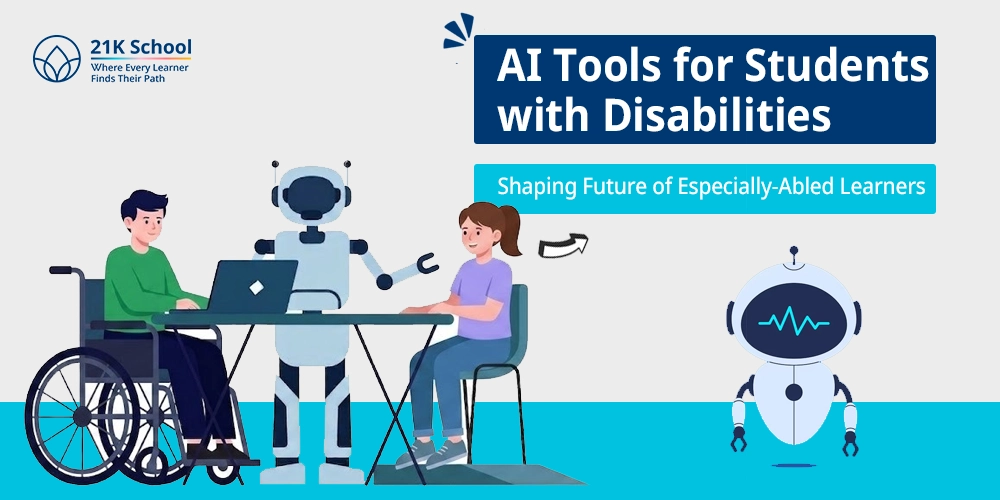
Learners with disabilities face more challenges than children without disabilities, and AI tools can help such children study and become successful in future.
AI tools for students with disabilities can enable them to comprehend the lessons better.
We will see some examples of these AI tools in this article. Read on to learn about the challenges in implementing AI tools usage.
Contents
What are Disabilities in Education?
Disabilities in education are those conditions that inhibit a learner from studying or fully engaging in the normal classroom setting.
These disabilities are different and have varying levels of severity. Each disability needs a special kind of support and accommodation.
You might have seen how AI in education has improved the situation for learners with sensory impairments, learning disabilities, and neurodivergent disorders.
Varieties of Disabilities
The following types of disabilities mainly affect learners:
1. Physical Disabilities
Physical impairments have an impact on coordination or motor functions of a learner. A child with physical disabilities faces difficulties while writing or using a mouse and keyboard for studying purposes.
AI assistance that converts speech to text can be utilised appropriately to help learners who struggle with writing. Many adaptive devices are also available to make learners’ lives easier and let them have access to education.
2. Visual Impairments
Students who are visually impaired find it challenging to read printed text, interpret diagrams, or access digital resources due to loss of partial or complete vision. Screen readers and text-to-speech systems are examples of AI tools that are critical in dealing with these challenges.
These applications transform written texts into audio, where students can listen to their learning resources. Also, they can describe images and objects using visual recognition tools that can aid students in understanding the presented information.
3. Hearing Disabilities
Hearing impairments entail the partial or total loss of hearing ability, thereby affecting the ability of the students to hear verbal instructions or lecture discussions.
This may cause miscommunication and a decrease in participation in classroom activities.AI tools in captioning offer real-time captions of spoken information, so that students can read what is being said.
4. Learning Disabilities
Attention and learning disabilities are due to disorders such as dyslexia, dyscalculia, and ADHD, which influence information processing in students. Such students might have difficulties in reading, writing, attention, and making mathematical calculations.
As an example, text-to-speech technology can be used to support learners with dyslexia to read aloud, whereas adaptive learning environments can dynamically modify the level of difficulty depending on the student. Learners can also use top AI-based apps like NaturalReader to ease their learning processes through multi-sensory text processing.
AI Assistive Technology in Education
Assistive technologies monitored and operated through AI are extremely functional for learners with disabilities. These AI tools enable personalised, self-directed learning as they have variations that allow them to cater to how learners read, write, and comprehend the taught materials.
Learners feel more independent with these tools. Their learning abilities improve because they can access AI tools that best support their challenges. These services come from tools like Speechify (text-to-speech tool), Dragon Naturally Speaking (speech-to-text tool), Seeing AI (visual assistance tool), and Quizlet (cognitive abilities tool).
8 Types of AI Tools for Students with Disabilities
Some of the most common AI tools that facilitate learning for disabled learners include:
1. Text-to-Speech (TTS) Tools
Text-to-speech tools translate text into natural-sounding words and phrases. These are quite useful among students who have visual impairments or face problems with reading
Learners need to study from multiple textbooks and notes from online resources. The TTS also eases learning that is very straining to the eye.
2. Speech-to-Text (STT) Tools
Speech-to-text tools convert speech into written words to help physically challenged or students with disabilities having difficulty with writing. Students can dictate what they want, do assignments and take notes without typing or writing. This improves their level of productivity and lessens the frustration.
3. Screen Readers
Screen readers have proved extremely useful for learners who are visually impaired and face issues while reading from computer screens, laptops or smartphones. Learners can read the text aloud as these tools navigate them well through online web pages and their menus. This is so that learners can continue learning independently.
4. AI-Based Captioning Tools
AI-based captioning tools are also being appreciated in today’s times. Learners struggling with hearing can read the subtitles generated by these captioning tools. This enables them to take part in classroom discussions and understand video-based lectures efficiently.
5. Smart Note-Taking Tools
AI-based note-taking applications have the capacity to record lectures, transcribe speech, and summarise the main highlights. The tools can come in especially handy with students who have difficulty concentrating or need to write quickly. They automate taking notes, thus enabling students to concentrate on the content.
6. Personalised Learning Platforms
These platforms can customise their educational materials based on the requirements of the learner using AI. They also assess performance, figure out the strong and weak areas, and change the level of difficulty accordingly. This means that students are receiving focused attention and they learn at their own pace.
7. Visual Recognition and Assistance Tools
These tools apply AI to identify items, scan printed texts, and give descriptions of their environment. They have particular utility in the case of visually impaired students, by enabling them to navigate their world and to comprehend visual content more easily.
8. Communication Tools
Learners with speaking or conversation issues can rely on AI-driven communication tools to ease their difficulties. These tools have the ability to transform written words into speech or enable communication using pictures and symbols. They allow students to communicate with teachers and others, and enhance social inclusion.
5 Benefits of AI Tools for Students with Disabilities
Utilising AI tools can be beneficial for specially-abled learners as it enables:
1. Enhanced Accessibility
AI tools change the content into audio, text, and visual versions to make it more easily accessible. They assist students in breaking down the screen in terms of reading, hearing, or movement.
This guarantees everyone equal opportunities to access sources of education. This makes learning inclusive and flexible.
2. Personalised Learning Experience
AI modifies lessons according to the learning pace and ability. It determines strengths and weaknesses using performance analysis. Individualised attention and focused practice are provided to students. This enhances conceptual comprehension and long-term memory.
3. Increased Independence
Students do not have to be constantly assisted by teachers or peers in doing their tasks. There are tools such as speech recognition and screen readers which assist in their assignment work. AI-based tools build self-reliance and confidence among learners with disabilities so that they can achieve the best grades and become successful in future.
4. Helps in Offering Inclusive Learning Environments
AI helps students with disabilities study alongside peers by promoting the significance of inclusive settings in the classroom and group discussions . This will boost feelings of solidarity and social inclusion in a manner that enhances the general development of students.
5. May Contribute to Improved Academic Performance
Assistance from AI tools may result in better grades and academic results. The AI tools are more informative with interactive support. Students are able to study at a flexible pace as real-time feedback enables learners to correct errors in a short time.
5 Challenges of AI Tools for Students with Disabilities
AI tools are useful for learners with disabilities, but implementing these tools can be tough. The challenges of utilising AI tools include the following:
1. High Cost of Technology
The majority of AI tools are costly to buy and cannot be afforded by all students or schools. This provides unequal access to learning support. Cost is also a significant obstacle to large-scale adoption.
2. Lack of Awareness
Numerous educators and students lack knowledge of existing AI tools, because of which they might be unfamiliar with their use. This limits the advantages that they may yield. To increase usage, there should be awareness programs regarding the same.
3. Technical Issues
AI tools are generally dependent on technical precision. If there are any technical issues in the setup of hardware, software, or internet connection, it can obstruct the learning plans of learners. This can make AI less efficient in the field of education.
4. Data Privacy Concerns
Misuse of the data gathered by artificial intelligence tools can pose privacy risks to both personal and educational information of learners. Sensitive student information can be compromised or abused, and that’s why it requires the use of strong data protection.
5. Need for Training
Students and teachers need to be trained to utilise AI tools. Unless directed, tools might not be effective. It may require time and effort to learn how to use them. To derive the greatest advantage of AI technology, it is important to have facilitators trained properly.
Final Comments
AI tools for learners with disabilities are the upcoming gadgets that can promote inclusive education in our society. These tools can benefit a huge part of our population and contribute to the national development of a country as a whole.
AI technology in education enables learners to practice and comprehend lessons that may be inaccessible to them because of some physical, social, emotional, and physiological limitations. Though AI tools are costly, the government can help schools and organise workshops to cut the individual costs and train facilitators on their usage.
