


Have you ever thought about how the Kolb Learning Model transforms experience into learning?
Learning becomes more efficient when learners actively participate in the learning process, reflect on their experiences, and translate the knowledge
into real-life situations.
It has gained even more importance in contemporary learning and training in the workplace.
The Kolb Learning Model provides a methodological approach towards experiential learning, which helps an educator create an interactive learning process and enable a student to learn critical thinking and problem-solving skills and acquire practical skills.
Contents
- What is the Kolb Learning Model?
- History of the Kolb Learning Model
- The Four Stages of the Kolb Learning Cycle
- Kolb’s Four Learning Styles
- 5 Importance of Kolb Learning Model
- 5 Benefits of the Kolb Learning Model
- Kolb’s Experiential Learning Model
- Kolb’s Experiential Learning Cycle Example
- 5 Limitations of the Kolb Learning Model
- Conclusion
What is the Kolb Learning Model?
Kolb Learning Model or Kolb Experiential Learning Theory (ELT) is a learning theory which was developed by David A. Kolb in 1984. It elaborates on the concept that learning is an ongoing process and knowledge is founded on experience.
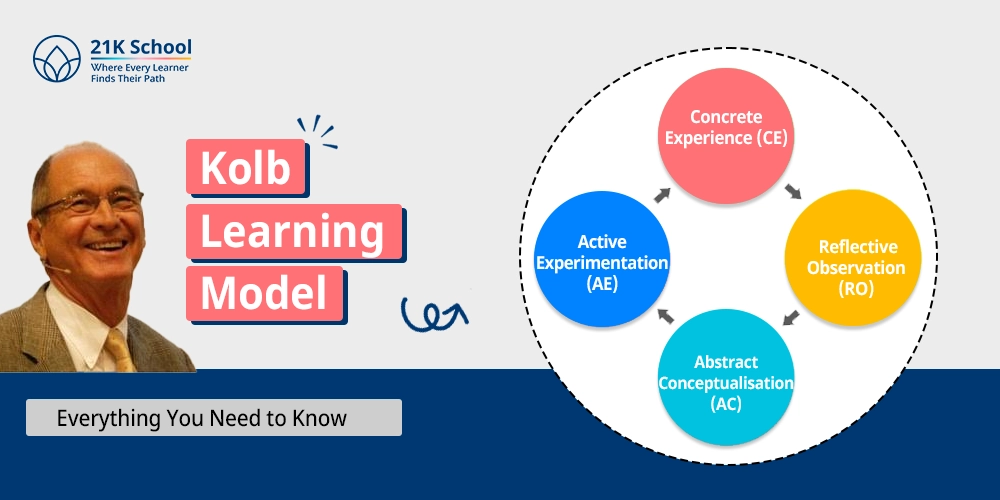
According to the model, good learning is attained when an individual goes through a four-step process that involves Concrete Experiences, Reflective Observation, Abstract Conceptualisation and Active Experimentation.
The other factor that is defined in the theory is the four learning styles that are dictated by the perceptions and reception of information by people.
The Kolb Learning Model, which is popular in the educational sector, in the training of corporations and in professional development, assists learners in bridging theory with practice as well as enhancing their knowledge through practice.
History of the Kolb Learning Model
Kolb Learning Model is a learning model that was created by a US educational theorist, David A. Kolb, and was initially published in a book in 1984 in his book Experiential Learning: Experience as the Source of Learning and Development.
The model was formulated on the belief that learning was experience-based and influenced by the contributions of great theorists such as John Dewey, Kurt Lewin and Jean Piaget.
Combining their ideas about experience, reflection, experimentation and cognitive development, Kolb created a four-stage process of learning which explains how people learn and use new knowledge.
Kolb Learning Model has come to be widely applied in the educational profession, corporate training, leadership development and professional learning worldwide.
The Four Stages of the Kolb Learning Cycle
The Kolb Learning Cycle is a four-step cycle which relates all four stages of learning where learners gain, process and utilise knowledge within the experience.
1. Concrete Experience (CE)
The first stage is Concrete Experience, whereby the learners are involved in the new experience or scenario.
Instead of just looking, they orient themselves to the activities, discussion, experiments or tasks, and set a practical base of meaningful learning about the same and reflect on the same in the future.
2. Reflective Observation (RO)
Reflective Observation is one of the critical ways of studying the experience and reflecting on it in various ways.
Students analyse what has already happened, what successes and challenges were reached, how the outcomes were compared to the expectations and what students learnt, which can be applied to further their knowledge, and only at that time conclusions are made.
3. Abstract Conceptualisation (AC)
Abstract Conceptualisation is the level at which the learners are trying to make some sense of what they are thinking and come up with theories, ideas or general principles.
They connect the real-life experiences with the information that they possess and form patterns and develop logical arguments that may be applied in subsequent education and decision-making.
4. Active Experimentation (AE)
The last stage is Active Experimentation, in which learners utilise the knowledge and ideas they have developed in real life.
They test out strategies, address issues and process results and, depending on the outcome, they initiate the process of another cycle of experiential learning and ongoing improvement.
Kolb’s Four Learning Styles
Kolb identified four learning styles that individuals learn and receive information in a specific manner in line with the experiential learning cycle.
1. Diverging
The diverging type of learner prefers to view things in a new way. They are innovative, creative and are adept at coming up with ideas.
They prefer to talk in groups, brainstorm, and learn to observe, and therefore are good in a team-based and interpersonal environment.
2. Assimilating
Absorbing types of learners like logical thinking, systematic facts and theories. They are fond of thinking, reading and listening to the explanations by experts.
They are good analytical learners concerned with principles and models other than the practical applications.
3. Converging
The converging learning style has to do with the application of ideas in solving practical problems. These learners incorporate technical, experimentation and choice.
They enjoy having a practical solution founded on logical thinking, and they are effective in situations where they have to solve problems and put them into practice.
4. Accommodating
Accommodating learning style learners learn best when they do and can be engaged in the learning process.
They like to move around, to familiarise themselves with new situations and get educated on the job. Their intuition and experimentation lead them; thus, they will certainly be capable of handling real-life problems and collaboration.
5 Importance of Kolb Learning Model
Based on experience, reflection and application, the Kolb Learning Model helps people learn and makes the learning process easier and more significant.
1. Promotes Experiential Learning
The Kolb Learning Model highlights direct experience as a way of learning as opposed to passive memorisation.
It encourages learners to do practical activities, critically evaluate their lives and apply new information so that they can compute the underlying meaning and improve their memory.
2. Encourages Reflective Thinking
The model encourages contemplation of experiences that the learners go through, the strengths and weaknesses they possess and the methodologies of thinking.
Reflective thinking allows students to be more conscious of the process of learning, make good decisions and continuously increase their knowledge, skills, and total academic performance.
3. Improves Problem-Solving Skills
Problem-solving skills are critical thinking skills that are learnt as the learner undergoes experience, reflection, conceptualisation, as well as experimentation.
With the model, they will be able to analyse a situation, think of the possible solutions and use relevant strategies to address both academic and real-life problems.
4. Supports Lifelong Learning
The Kolb Learning Model can assist in coming up with a lifelong learning habit where a person becomes motivated to acquire knowledge out of each experience.
It encourages flexibility, self-growth and lifelong learning and helps students learn new things and gain some skills in any area of their personal and professional life.
5. Enhances Learner Engagement
Learning through the model is more interactive as it engages students in practical experiences and discussions, reflection, and hands-on experiences.
Active learning will enhance motivation, in-classroom activities, generate learning momentum, as well as motivate learners towards becoming more responsible for their learning process.
5 Benefits of the Kolb Learning Model
The Kolb Learning Model possesses several strengths as it makes the learning process interesting, practical, reflective and effective for learners in diverse settings.
1. Promotes Active Learning
Kolb Learning Model welcomes learners to partake in the learning process via real-life experiences, discussions and practical activities.
The field experience supplements the process, making it more interactive, more powerful, and the learners are more accountable in the process of learning.
2. Improves Critical Thinking
The model creates critical thinking through the analysis of the experiences, reflecting on the outcomes and being able to critically judge various solutions by the learners.
The process also aids them in making informed choices, solving complicated problems and logical thinking both in their academic, professional and real life.
3. Supports Personalised Learning
Kolb learning styles take into consideration the fact that individuals do not learn in the same way.
The model allows teachers to adjust instructional strategies based on learners’ preferences and provides the opportunity to design individual learning experiences that increase participation, comprehension, and overall academic achievement whilst meeting the unique needs of the learner.
4. Enhances Knowledge Retention
Learning through experience and reflection of oneself allows the learner to understand concepts more than by rote learning.
The Kolb Learning Model augments long-term learning and enables learners to recall and utilise the information with confidence since they put the knowledge into practice, with the assistance of getting feedback on the outcome.
5. Develops Practical Skills
The Kolb Learning Model emphasises applying theoretical knowledge in real-world situations.
With constant experimentation and practical learning, students gain skills in practical, communication, teamwork and problem-solving that are beneficial in higher education, careers, and in their lives.
Kolb’s Experiential Learning Model
The Experiential Learning Model is a theory of learning which was developed by David A. Kolb in 1984 and according to which the process of learning is an experience.
The model suggests that good learning is an ongoing process through which people learn through experiences, contemplation, conceptualisation and experimentation.
Kolb does not see learning as a way of gaining knowledge, but rather focuses on how learners build on the knowledge through a process of changing their experiences.
The model has found a wide application in education, training at the workplace, leadership development, as well as professional learning with the aim of encouraging active, reflective and practical learning.
Kolb’s Experiential Learning Cycle Example
A practical experience can be considered an understanding of the Experiential Learning Cycle by using an example of an experience that can be converted into valuable knowledge and improved performance.
1. Learning a Bicycle
Riding a bicycle is an example of a good learning activity. Practising, acquiring the right techniques and practising are all ways of learning that the student learns themselves through self-reflection.
- Concrete Experience: The learner rides a bicycle first of all, and she is not aware of how to find balance.
- Reflective Observation: They consider what has caused them to lose control or have a problem steering.
- Abstract Conceptualisation: They know that good posture, balance and constant pedalling improve control.
- Active Experimentation: They apply these lessons during the next practice, and gradually they become a qualitative rider.
2. Solving a Maths Equation
Mathematics will become easier when the students learn from their errors. The issues which they solved assist them in enhancing their knowledge and problem-solving abilities.
- Concrete Experience: A student tries to work out a difficult maths equation.
- Reflective Observation: They read out the solution and indicate any mistakes in calculations or equations.
- Abstract Conceptualisation: They know the proper way and learn a rationale as to why the old way was wrong.
- Active Experimentation: They work on the related issues using the refined method to reinforce their learning.
3. Public Speaking
An open environment does not allow speaking skills to be developed without practising and reviewing. With the help of each presentation, learners can identify the areas of their strengths and areas of improvement.
- Concrete Experience: This scenario involves a student speaking to the audience of students or in their lesson.
- Reflective Observation: They assess their confidence, pace of speaking and their involvement with the audience.
- Abstract Conceptualisation: They learn the techniques of looking people in the eye, thinking and speaking in a proper way.
- Active Experimentation: They will apply these techniques in subsequent presentations in order to become better speakers.
4. Online Learning
Online learning assists the students in continuing with the practice and offering feedback and self-evaluations to enhance.
- Concrete Experience: A pupil is taking an online lesson, quiz or assignment.
- Reflective Observation: They will look over their performance and see what ideas they perceive have been challenging.
- Abstract Conceptualisation: They get to know the right concepts and get to know more effective study methods .
- Active Experimentation: They use them during lessons and assessments to use them in future in order to improve their learning outcomes.
5 Limitations of the Kolb Learning Model
The Kolb Learning Model, despite its popularity of this model, has its flaws, which can affect its applicability in most learning environments.
1. Not Suitable for Everyone
Kolb Learning Model assumes that all learners experience the same cycle of learning in terms of experience.
Nonetheless, people can learn differently, have different personalities, and different educational needs; therefore, the model might not be apt to describe the way in which all individuals learn and acquire knowledge.
2. Limited Learning Preferences
Kolb categorises learners as four types of learning styles; however, not all would fit into a single category.
This model fails to respond to different behaviours of learning as learning preferences are not subject-independent phenomena, and they change as time progresses.
3. Limited Consideration of Cultural Differences
Individual learning processes are given a lot of attention, and the cultural, social and environmental factors are given very little attention.
Variety in students concerning the aspect of culture is a possibility too, and this is not discussed and explained properly in the model.
4. Time-Consuming Implementation
The implementation of the Kolb Learning Cycle in all four stages needs to be well-planned, actively engaged, and reflected on and evaluated.
It may be quite time-consuming and hence cannot be easily applied in classes with negligible teaching time.
5. Less Suitable for Theoretical Subjects
Kolb Learning Model is best applied in activity-based learning . Highly abstracted topics, courses that are more theoretically based or reading-intensive issues may not necessarily be a good fit to enable the complete experiential learning process.
Conclusion
Kolb Learning Model is another widely used experiential learning model that emphasises experiential learning, reflective learning , abstract learning, and practical learning.
It also assists learners to think critically and develop problem-solving and practical skills by identifying various learning styles as well as through participation
Despite some limitations of the model, it is very effective in education, training in the workplace and professional development. By doing so in the appropriate forms, it will offer exciting learning experiences which will lead to both academic success and lifetime learning
