

Are you eagerly waiting for your CBSE class 10 results?
If yes, then you must have been worrying about the minimum passing marks in your CBSE class 10 examinations. Having a detailed knowledge of the minimum passing marks helps understand your ranks better.
So, today let us deep dive into the minimum passing marks for your class 10 CBSE examination for the year 2026. We’ll help you with the marks distribution, passing marks for practical subjects, and other aspects also.
Contents
What are the Passing Marks for CBSE Class 10?
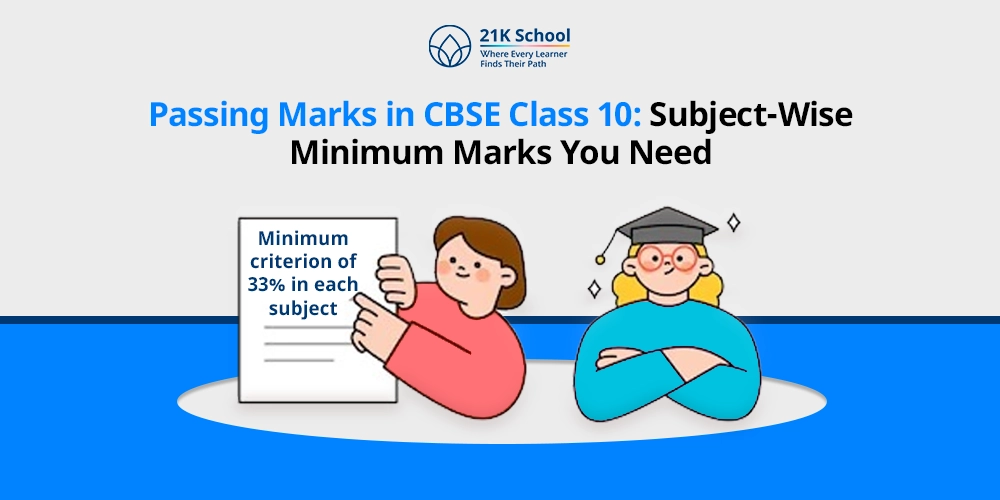
A class 10 student needs to score a minimum criterion of 33% in each subject to pass CBSE board examination. This rule is applicable for all the major subjects in CBSE class 10 board exam.
| Sr.No | Component | Maximum marks | Minimum passing marks (33%) |
| 1. | Theory examination | 80 | 26 marks |
| 2. | Internal/Practical assessment | 20 | 7 marks |
| 3. | Total marks per subject | 100 | 33 marks |
In an 80 mark theory paper, students need to score 26 marks to meet the passing marks criteria
Key points to remember:
- Students should score at least 33% marks in each subject to pass the CBSE Class 10 board exams.
- The final subject score is calculated by combining theory and internal assessment or practical marks.
- Students must pass in five subjects to receive the CBSE Class 10 passing certificate.
These points help students and parents understand how CBSE calculates final subject scores.
Overview of Marks Distribution
The passing marks criteria for CBSE Class 10 board exam is clear now.
Let’s understand how the marks are distributed for each subject and assessment types.
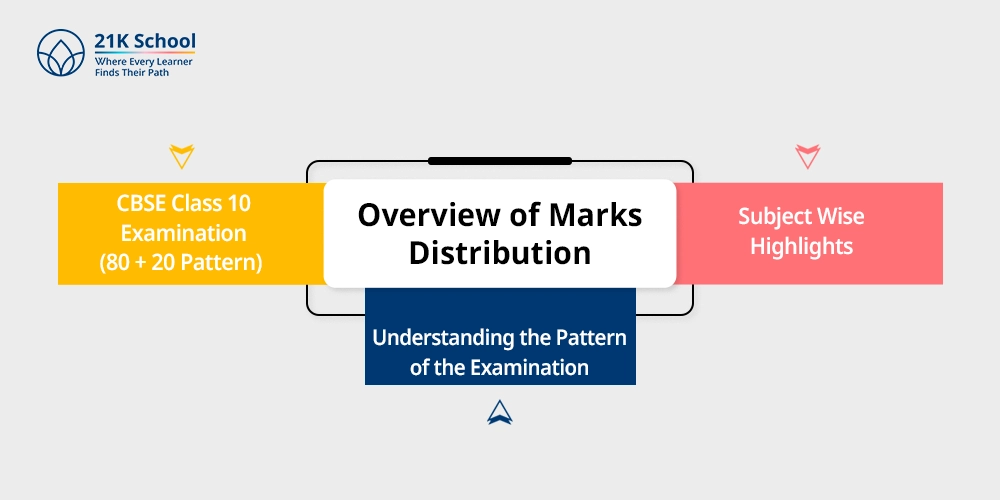
1. CBSE Class 10 Examination (80 + 20 Pattern)
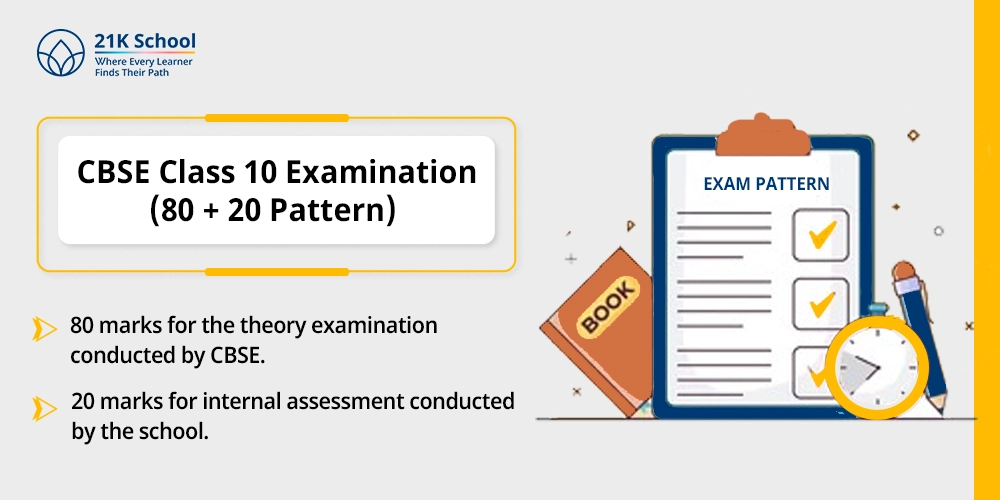
According to the CBSE guidelines, Students are evaluated through a combination of theory examination and internal assessment, with the CBSE grading system applied to the final scores.
In most subjects the total marks are divided into two components:
- 80 marks for the theory examination conducted by CBSE.
- 20 marks for internal assessment conducted by the school.
Internal Assessment consists of:
- Periodic tests during the academic term
- Submission of notebooks for evaluation of regular academic work
- Subject enrichment activities
Students are assessed based on the final exam and their consistent academic work during the school year.
2. Subject Wise Highlights
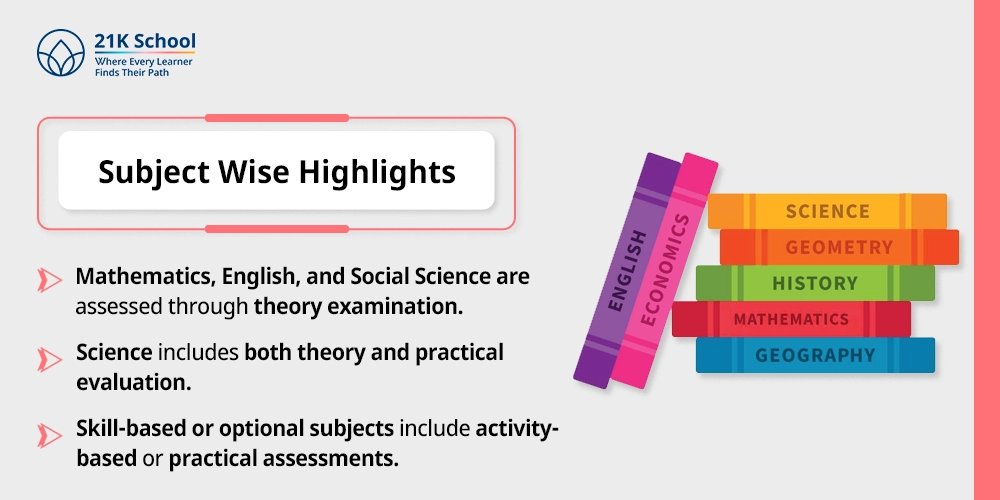
The subjects in CBSE Class 10 are evaluated using different assessment methods.
- Mathematics, English, and Social Science are assessed through theory examination. The internal assessment is carried out by the school.
- Science includes both theory and practical evaluation. Practical marks are recorded based on experiments, record work, and viva conducted during the academic year.
- Skill-based or optional subjects include activity-based or practical assessments as part of the internal evaluation.
Students should understand that the marks structure and assessment method vary for each subject while preparing for the CBSE Class 10 board exam 2026.
3. Understanding the Pattern of the Examination
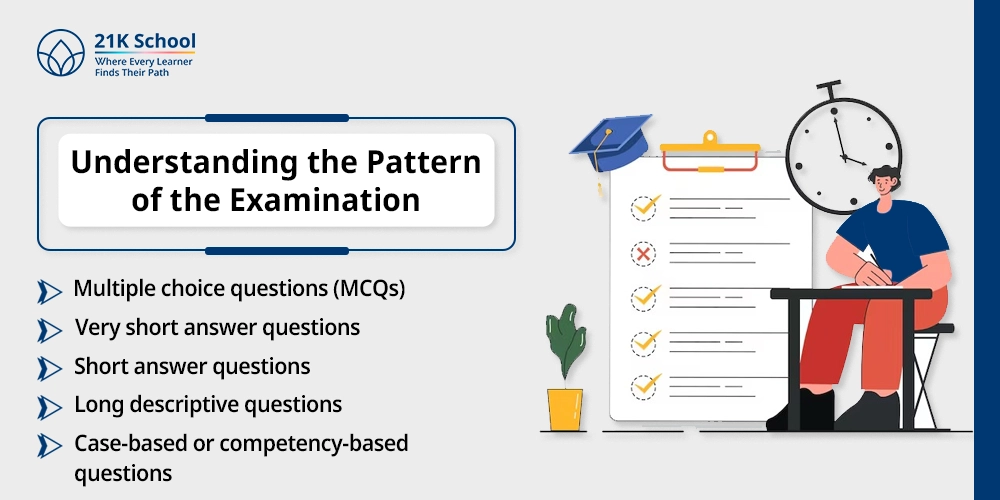
The CBSE Class 10 examination pattern is designed to determine student’s understanding of the subject and their ability to apply concepts they have learned. The theory part of the exam is designed with different types of formats to assess the student’s ability in different ways.
The question paper contains:
- Multiple choice questions (MCQs)
- Very short answer questions
- Short answer questions
- Long descriptive questions
- Case-based or competency-based questions
There is no negative marking in the CBSE board examination.
Language papers are evaluated based on grammar, comprehension, literature, and writing skills.
Passing Marks for Practical Subjects
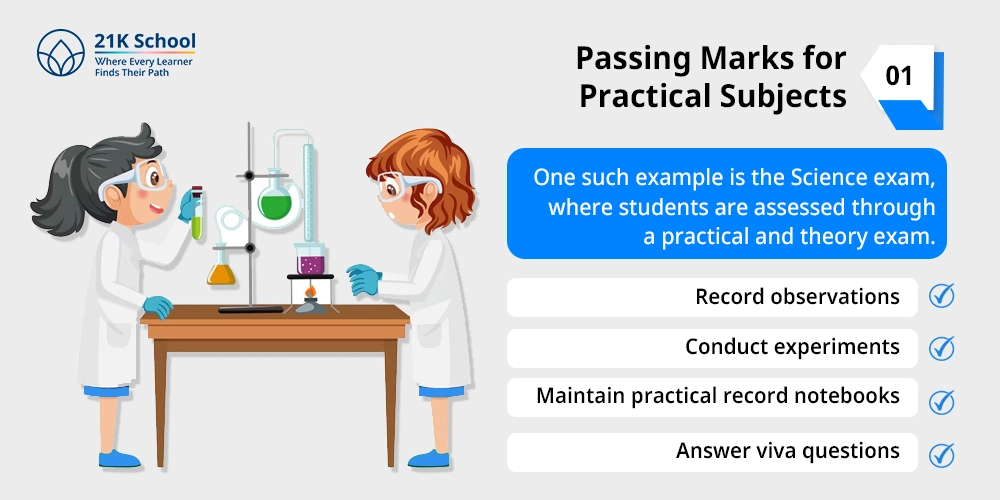
Some subjects in Class 10 have practical and theory components. One such example is the Science exam, where students are assessed through a practical and theory exam. The practical exam is conducted at the school level by subject teachers.
During the practical assessment, students may be required to:
- Record observations
- Conduct experiments
- Maintain practical record notebooks
- Answer viva questions
Passing Marks for Theory Subjects
Subjects like Mathematics, English, and Social Science are assessed on the basis of the theory examination along with internal assessment conducted by the school.
The marks obtained in the theory exam are combined with internal assessment marks to calculate the final subject score.
What Happens If a Student Fails in CBSE Class 10?
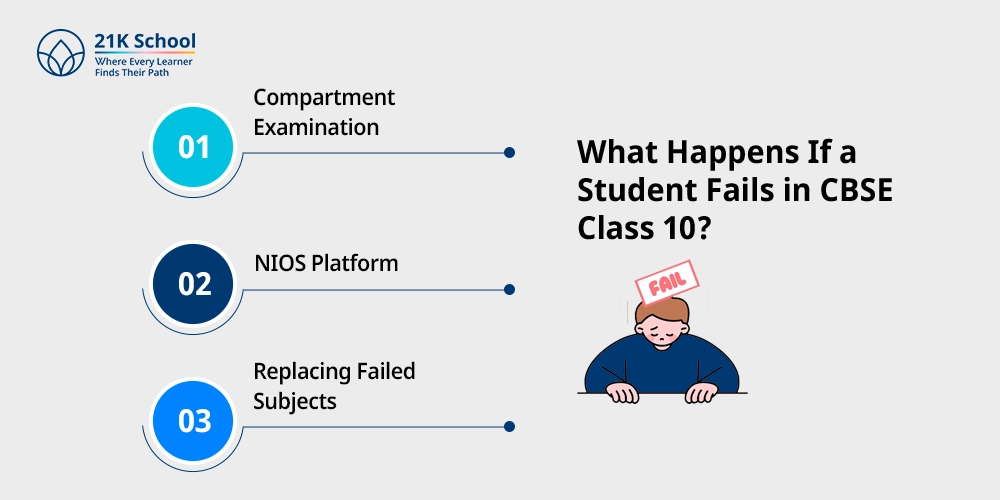
Sometimes students are not able to clear one or more subjects in the CBSE Class 10 board examination. CBSE provides options that help students continue their education without losing an academic year, including the CBSE improvement exam for those who want to retry.
1. Compartment Examination
Students who fail in one or two subjects are allowed to appear for the compartment exam. These exams are usually conducted a few weeks after the CBSE results are announced.
This gives students another opportunity to clear the subject. Once the student clears the exam, the updated marks are reflected in the final marksheet.
2. NIOS Platform
Students can choose to continue their studies through the National Institute of Open Schooling (NIOS). NIOS helps students to complete their secondary education course (Class 10 and Class 12) through flexible learning methods. It is also beneficial for those who require more time to complete their academic studies.
3. Replacing Failed Subjects
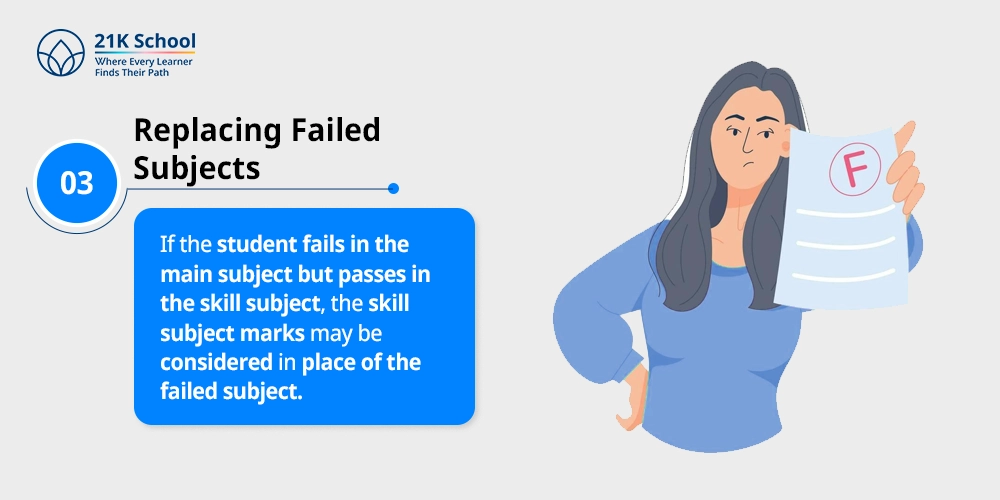
Students can replace a failed subject with a skill subject.
If the student fails in the main subject but passes in the skill subject, the skill subject marks may be considered in place of the failed subject.
This helps students avoid losing a full academic year due to one subject.
Being aware of these options helps students and parents make informed decisions and stay prepared if results do not go as expected.
Does CBSE Give Grace Marks in Class 10?
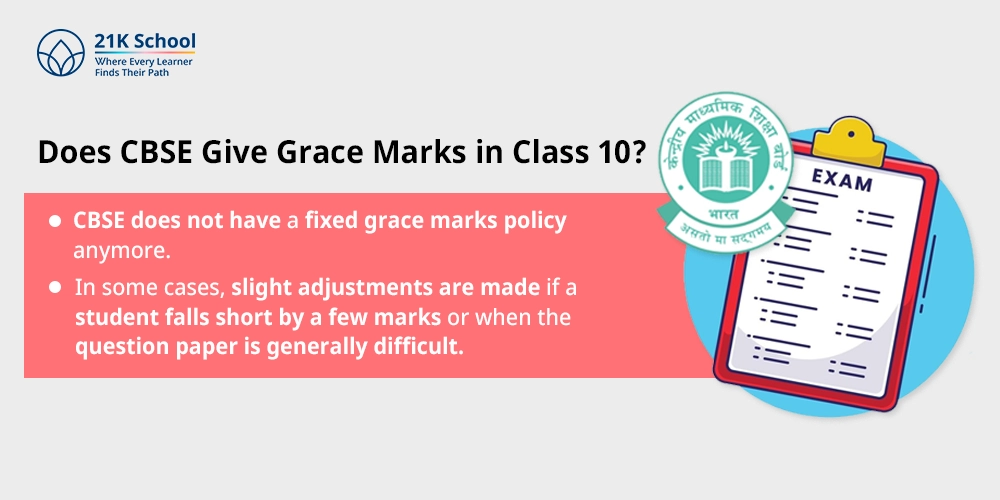
CBSE does not have a fixed grace marks policy anymore – learn more about whether CBSE gives grace marks in the current board cycle. The earlier CBSE moderation system was discontinued by the board in 2017. In some cases, slight adjustments are made if a student falls short by a few marks or when the question paper is generally difficult.
There is no guarantee that grace marks will be awarded by the CBSE board. Therefore, it’s best that students prepare for the exam and understand the syllabus pattern to meet the basic passing marks criteria set by the CBSE Class 10 board exam.
1. Key Tips for Students to Secure Passing Marks
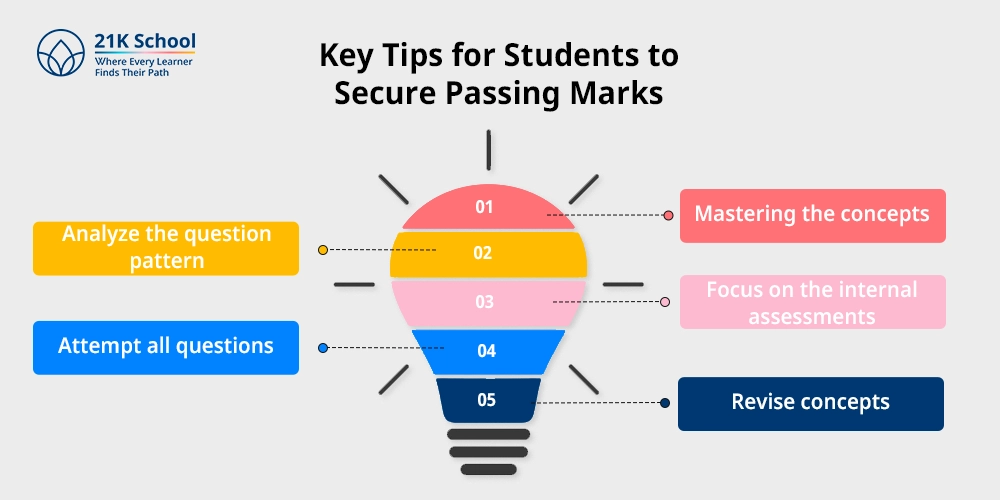
To obtain a minimum passing marks in CBSE Class 10 board exam, students need to thoroughly prepare and regularly revise the concepts to clear the exam rather than just trying to cover the whole syllabus at the last minute.
With the right steps students can easily meet the minimum passing criteria in each subject
Here are some practical tips:
- Mastering the concepts
Focus on understanding concepts instead of memorising them. This helps in answering different types of questions.
- Analyze the question pattern
Practice previous year question papers to get familiar with the exam pattern and question types.
- Focus on the internal assessments
Do not ignore internal assessments. Periodic tests, projects, and notebook work contribute to the final score.
- Attempt all questions
In the examination hall attempt all the questions, even if you are not sure about the answers. Partial answers can still earn marks.
- Revise concepts
Regularly revising concepts can improve in recalling and remembering the answers easily during the examination.
The above steps can help students to improve overall performance and increase the chances of meeting the required passing marks criteria.
Conclusion
For students scoring minimum passing marks in CBSE Class 10 board examination is completely possible if they understand exam pattern and subject-wise mark distribution among the subjects.
According to the rules, students should get a minimum of 33% in order to clear a particular subject. It is calculated on the basis of theoretical and practical examinations.
Knowing these parameters is necessary, however being dedicated to the studies and following an effective schedule helps one to crack the exams.

You may also want to read