

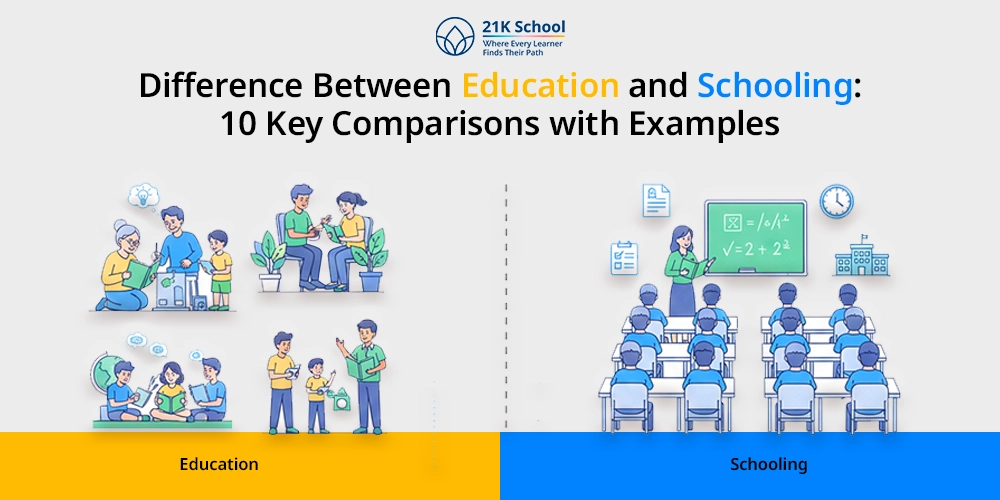
What is education , and what is schooling? Do you also think that both of them are the same?
We can say that education is the means to attain knowledge , skills , values, and beliefs.
While, schooling is the process of getting education by attending schools and other educational institutes.
To know the details of the difference between education and schooling, you should read the article below.
Contents
What is Education?
Education is a lifelong process of learning and self-development. It starts as soon as we are born and continues till we live.
Education doesn’t have to be particularly about school, books, or exams. It can even occur at home, in society, from experience, conversation, observation, or even mistakes.
Education assists individuals in acquiring knowledge, skills, values, attitudes, as well as wisdom.
It educates us on how to think, make good choices, get to know people, and how to lead a responsible life.
Our character is also influenced by education as we get to learn honesty, empathy , cooperation, and respect.
Education, in simple language, entails learning how to live life in a wise and meaningful manner, and not merely passing exams.
What is Schooling?
Schooling is institutionalized learning in schools or colleges.
It follows a set system including a syllabus , a school schedule, rules, trained teachers, and exams.
Schooling normally begins at an age of 3 or 4, and it usually takes a span of some years to get completed.
Schooling is basically meant to offer academic knowledge in areas like mathematics, science, languages, and social studies.
The knowledge of the students is tested and rewarded through exams on successful completion of their studies.
Schooling, unlike education, is time-based, structured, and focused primarily on academic performance.
10 Key Differences Between Education and Schooling
To differentiate education and schooling, we need to look at the table given below and then the well-explained distinctions.
| Basis of Comparison | Education | Schooling |
| Definition | Lifelong process of learning and personal growth | Formal learning in schools and institutions |
| Scope and Nature | Broad and holistic | Limited and structured |
| Learning Environment | Can occur everywhere-home, society, experiences, failures | Mainly in classrooms |
| Purpose and Goals | Overall development of a person | Academic success and certification |
| Teaching and Learning Methods | Learning through experience, observation, and reflection | Classroom teaching and textbooks |
| Evaluation and Assessment | Judged through understanding and behavior in life | Judged through exams and grades |
| Duration | Continues throughout life | Limited to certain years |
| Personal and Social Development | Strong focus on values and character | Mainly focuses on academics |
| Importance | Essential for life; includes professional and personal growth | Important for careers and jobs |
| Examples | Learning life skills, values, problem-solving, etc. | Attending school, appearing for exams, getting degrees |
1. Definition
- Education: Education is a lifetime process that determines the way an individual thinks, acts, and has perception towards life. It does not just stop at books, but it assists with the general development of the person.
- Schooling: This is formal education which occurs in school and college. It is primarily preoccupied with taking courses and acquiring academic knowledge.
2. Scope and Nature
- Education: Education can be seen as a broad means of learning encompassing moral values , life skills , emotional literacy , and social learning . It has an effect on all aspects of life.
- Schooling: Schooling has a bit of a limited scope as it only concerns academics. It still focuses on classroom education .
3. Learning Environment
- Education: Education can be acquired in a variety of contexts, such as the household, the community, or daily life. It continues even without a formal setting.
- Schooling: This is mainly done in classes at the school premises. Learning is done as per predetermined and positive learning environment and routine.
4. Purpose and Goals
- Education: Education is aimed at creating responsible and thoughtful individuals. It not only prepares you for exams, but also for life.
- Schooling: Academic accomplishments and qualification are the primary objectives of schooling. It makes students ready to take exams and advance to the next level.
5. Teaching and Learning Methods
- Education: Education is a process of learning that is gained by experiences, observations, discussions, and reflections. It fosters the ability to think creatively.
- Schooling: Schooling primarily utilizes textbooks, lectures, and formal lessons. Teachers often direct students to learning.
6. Evaluation and Assessment
- Education: Education can be evaluated through behavior and in real life choices. Development occurs beyond what you could notice because of examination.
- Schooling: Schooling assesses students by the help of exams, tests, grades, and assignments. Academic performance is used to judge the different levels of schooling.
7. Duration
- Education: Education is a continuous process because individuals learn through their experiences and adapted behaviors. It does not have any definite start or completion.
- Schooling: Schooling is a given duration of time e.g. school and college years. It ends when formal education is done.
8. Personal and Social Development
- Education: Education puts emphasis on building character, values, emotional intelligence , and social behavior. It aids in making people better human beings.
- Schooling: Schooling pays a bit of attention to personal development and more on academics. It also plays a key role in character building of students by teaching them collaboration , discipline , leadership skills , and much more.
9. Importance
- Education: Education plays a vital role in having a meaningful and accountable life. It assists individuals to adapt and grow in all aspects of life.
- Schooling: Schooling is essential as it provides qualification and career. It supports professional development in individuals.
10. Examples
- Education: Education can include learning how to be honest, to work in a team, solve problems, and learn to be empathetic. Such lessons are based on life experience.
- Schooling: Schooling implies attending classes, taking exams, and graduating. These occur mostly in formal institutions.
Concluding Comments
We hope that this article was a good read to clear your doubts on education and schooling being the same.
For short clarification, education covers everything that includes a child’s development in context of their skills, abilities, and character.
On the other hand, schooling is the formal means of getting education through going to schools, colleges, and universities.
While the differences sustain, we need to realize that both education and schooling is necessary for the overall growth of an individual.

You may also want to read