

Is your child lagging behind due to their less efficient memory retention?
Do they forget lessons that they read just a few days ago? Well, if that is true you should teach and let your child practice some memory enhancement techniques.
This would boost their learning power and confidence while performing in tests.
This article will tell you what these memory enhancement techniques are and some examples of them that are practical for best results.
Contents
- What are Memory Enhancement Techniques?
- 16 Memory Enhancement Techniques
- 1. Mnemonic Devices
- 2. Acronyms and Acrostics
- 3. Visualization and Imagery
- 4. The Method of Loci
- 5. Chunking
- 6. Spaced Repetition
- 7. The Feynman Technique
- 8. Mindfulness Meditation
- 9. Deep Work and Pomodoro Technique
- 10. Strategic Reading and Note-Taking
- 11. Balanced Diet and Hydration
- 12. Yoga and Stretching
- 13. Adequate Sleep Duration
- 14. Relaxation Techniques
- 15. Organized Study Spaces
- 16. Smart Reminders or Flashcards
- To Conclude It
What are Memory Enhancement Techniques?
Memory enhancement techniques are the strategies or habits that are aimed at enhancing the brain’s capacity to store and retrieve information.
They are based on cognitive psychology, neuroscience, and behavioral science, which depends on the mental processes as well as lifestyle.
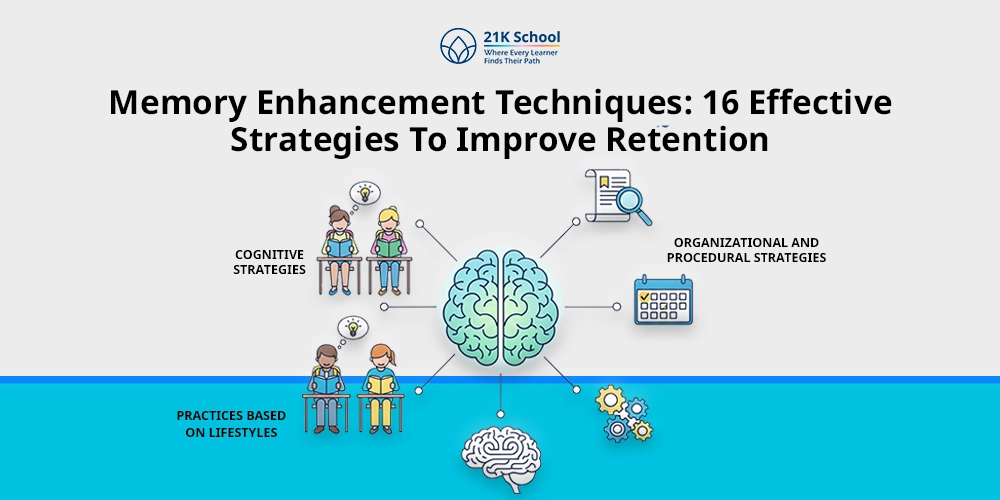
These methods could be mainly divided into three types:
- Cognitive strategies: They involve the use of mnemonics techniques and visualization which are effective in encoding information.
- Organizational and procedural strategies: Such as note taking method using spacing or other strategies.
- Practices based on lifestyles: Such as appropriate sleep, nutrition as well as mindfulness, all of which can positively change neural health.
Memory enhancement techniques are highly reliable on reinforcement of nerve connections, developing confidence, reduced study-stress , and cognitive care.
This can further lead to physical and mental capabilities of advanced and longer learning.
The best thing about them is that the majority of them can be practiced without any special equipment, with consistency, and a proper state of mind.
16 Memory Enhancement Techniques
The following list of memory enhancement techniques are easy to practice and can give real solution to your inefficient memory:
1. Mnemonic Devices
Mnemonics assist in the encoding of complicated or abstract data into patterned remembrances.
Mnemonic may or may not include rhyme, rhythm or clever wording, such that it sounds like musical notes that are easier to remember.
Learning is made easy since they relate new facts with familiar concepts.
They are effective since they provide an important context, which assists your brain to optimally store information.
2. Acronyms and Acrostics
Acronyms are given out to a rule for words.
They have the initial letters of several words intermingled to create a new memorable word, such as HOMES to signify the Great Lakes.
Rather, acrostics make a sentence, e.g. “Try Pulling My Aorta” order of heart valves.
These aids are especially efficient in memorising lists or even full names of organizations like NASA, UNESCO, etc.
3. Visualization and Imagery
Visualization makes the use of the spatial and creative thinking abilities of the brain.
Whenever people are reminded of something, they are likely to recall vivid images more clearly than written or spoken information.
To remember the word ball, say in an exaggerated form, e.g. a large football that appears from your childhood memories.
The stranger or the more humorous the picture, the more it is likely to remain.
The visualization maximizes both recalling and understanding. And thus, it is an efficient learning method for new vocabulary or facts.
For further insights into effective vocabulary-building strategies, you can refer to this article .
4. The Method of Loci
One of the oldest and most effective memory aids is the Method of Loci often referred to as the memory palace method.
We visually keep things that we want to remember in common places like our safe-space of house or a corner you visit everyday.
We thereafter walk to that exact place to access the information and surprisingly many times it works.
This technique uses the spatial-memory capabilities of the brain which is particularly handy with speeches or study information.
5. Chunking
Chunking refers to the process of dividing large bits of information into smaller and manageable bits.
For example, you might have noticed that we learn a phone number like 3698547512 as 369-854-7512, or a very long to-do list as important categories.
Chunking lessens the cognitive load and makes the brain more effective in the storage of complex information.
It is very common in studying or acquiring new life skills .
6. Spaced Repetition
Spaced repetition is a scientifically supported method, which presupposes having a spacing between the collection of information along days for better memory power.
It functions according to the following intervals: after 1 day, after 3 days, after 5 days and after 7 days.
The technique uses the spacing effect, when repeated and separated exposure enhances long-term memory.
Anki or physical flashcards are also good tools which can be used to practice spaced repetition.
7. The Feynman Technique
It is named after physicist Richard Feynman.
This consists of describing a concept using straightforward language to someone who does not understand it.
The steps include learning the material, rephrasing it in simple words, determining the learning gaps , and simplifying again.
This strategy enhances the understanding hence is easier and more precise to remember.
8. Mindfulness Meditation
Mindfulness improves attention while lessening student stress , which are essential in memory establishment.
Meditation stimulates the hippocampus: the part of the brain that is relevant in memory consolidation.
Even 10 minutes a day can make you more attentive and have a clearer mind.
It can make you less distracted so that you concentrate on learning and remember new things effectively.
9. Deep Work and Pomodoro Technique
Attention is a prerequisite for memory.
The deep work approach implies keeping distractions down to a minimum and working in focused shifts.
The Pomodoro Technique is based on the concept of splitting the work into 25-minute sessions with intervals between them to enhance productivity and focus.
Improved attention leads to improved memory encoding and therefore makes such techniques effective for those looking for ways in increasing memory power for students .
10. Strategic Reading and Note-Taking
These active reading strategies include summarization, annotation, questioning, and connecting ideas that make the brain really dig into the content.
Good ways of taking notes involve the Cornell Method, mind-maps , outlining, and color-coding.
With active participation, understanding will be enhanced and learning will be more straightforward during a study-session or revision.
You can also utilize some great revision tips for better academic performance.
11. Balanced Diet and Hydration
The brain needs some nutrients to be in the best working condition.
These highly-nutritious foods are beneficial to the memory as they enhance blood circulation, decrease inflammation, and improve neural health.
These include fatty fish (rich in omega-3s), berries, nuts and seeds, leafy greens, and whole grains.
Apart from this, hydration is also significant. To your surprise, even a slight dehydration may become a hindrance to mood and memory performance.
The amount of water taken daily during the day keeps the brain adequately operating.
12. Yoga and Stretching
Physical exercise enhances the blood flow of the brain and reduces mental-stress.
Yoga has breathing, stretching and mindful breathing-all of which improves mental performance.
Simple stretching exercises between breaks during study help an individual to be alert, thus making learning more effective.
Because breathing and stretching exercises significantly boost mental performance, educators are increasingly recognizing the importance of yoga in schools
13. Adequate Sleep Duration
Sleep is essential in memory consolidation, which sums as conversion of short-term memory to long-term memory.
Deep REM sleep involves the brain in the process of reviewing and organizing the information that was obtained during the day.
Sleep deprivation interferes with this process and has a negative impact on concentration, learning, and recalling.
Before moving ahead find how many hours of sleep is enough for a student .
On an average, an adult should get at least 7-9 hours of sleep to be at the optimal cognitive level.
14. Relaxation Techniques
One of the greatest enemies of memory is stress.
Cortisol is the stress hormone that disrupts the learning process and the recollection.
Some of the effective relaxation techniques are deep breathing, progressive relaxation of muscles, light music, nature walks, or even journaling.
Relaxation can be used in our routine activities to ensure our minds are free and our knowledge is preserved.
15. Organized Study Spaces
Sitting in a positive learning environment or space leads to less distractions and cognitive load.
When the brain does not deal with any problematic stimuli, it can be better prepared to concentrate and memorize the information.
Good study spaces should have adequate lighting, minimal noise, organized materials, and comfortable seating.
It is a small, yet a strong move in the right direction for having better memory.
16. Smart Reminders or Flashcards
Smart reminders or flashcards allow students to set reminders for themselves to review studied content while working or studying.
Apparently, reinforcing the learned information with the use of digital reminders, sticky notes, or flashcard apps is quite beneficial.
Active remembering (through flashcards) helps in enhancing memory capacity greatly.
Online resources also include the functions of spaced repetition, whereas the real flashcards provide the possibility of practical long-term learning.
To Conclude It
Memory power can be built by consistently following memory enhancement techniques listed in the above article.
It can only be possible if a student is truly focused on his growth and wants to succeed in exams or in general.
Starting from the mnemonics, learners should also take care of their mental, physical, emotional,and cognitive health.
Learners should practice mindfulness activities , eat nutritious foods, stay hydrated, sleep well, while also following some great revision tips that boosts memory.

You may also want to read