Does CBSE Fail Students in 12th: Learn the Complete Truth
 Written byAnnapurna SContent Specialist
Last modified: Sep 1, 2026 14 min read
Are you wondering if CBSE fail students in Class 12 if they don't meet the required eligibility criteria?
Yes, the Central Board of Secondary Education does fail students who score less than 33% of marks in the final Class 12 board examination.
So let us understand the minimum marks required to pass the exam and the necessary steps to be taken if the student actually fails in the examination.
Does CBSE fail students in Class 12?
Yes, CBSE does fail students in the Class 12 board examination if they fail to meet the minimum passing marks required to pass. Although the board does use grace marks, lenient marking, and little moderation to help students who missed the required marks.
Now let us highlight some of the passing rules below.
- Students need to secure a minimum of 33% marks in each subject, combining both theory and practical marks.
- The examiners do award grace marks in case a student is short by 1 to 5 marks and has attempted the questions.
- If there are practicals involved with the subject, the minimum marks should be scored both in theory and practical combined.
What are the minimum passing marks in CBSE Class 12?
CBSE Class 12 has the minimum passing marks of 33% in each subject, which has to be obtained separately for the theory and practical/internal component exam. A student has to score.
For instance, science has a typical pattern in which 70 marks are allocated for theory and 30 marks for practical. Those students who do not manage to score the above-mentioned marks may not pass the board examination.
How does CBSE evaluate: Theory vs practical vs internal assessment
The Central Board of Secondary Education evaluates students' performance based on the assessment types mentioned below.
1. Theory exams
There is an 80:20 model in the case of theory examination for subjects such as Mathematics, Social Sciences and languages, where 80 marks are given based on the board theory examination and 20 marks on the basis of internal assessment.
2. Practical exam
The practical test pattern involves a ratio of 70:30 for science subjects that include a practical section in the syllabus, like Physics, Chemistry, and Biology, in which 70 marks are allocated for theory and 30 for practical tests.
3. Internal assessments
There is an internal assessment worth 20 marks, which is conducted through various activities performed by the students during the academic session. The activities include tests, notebook submission, projects, and activities for the development of the subject. The results are a compilation of marks obtained by students on theory, practical, and internal examinations.
Does CBSE actually fail students? What data says
The answer to this is a bit clearer when we look at the overall statistics provided by the CBSE board on the results for the Class 12 board exams every year. In general, the pass percentage for the CBSE board exams in Class 12 is always on the higher side, implying that a majority of students pass the board exams every year.
This does not mean that every student passes the board exams. A small percentage of students are unable to clear the minimum passing marks prescribed by the CBSE, and this might lead to a compartment or a failed result.
CBSE Class 12 pass percentage year-by-year analysis (2020-2025)
The CBSE Class 12 pass percentage from 2020 to 2025 is mentioned below.
- The overall pass rate in 2020 .pdf)was about 88.78%. Exams were disrupted by the COVID-19 pandemic. Due to this, the alternative assessment schemes were introduced, in which Girls scored 92.15% and boys 86.19%
- In 2021, the passing rate increased to 99.37 %. Since the board exams were cancelled, the results depended upon the internal assessments.
- The passing rate in 2022 moderately rose to 92.71%, since the Central Board of Secondary Education introduced A two-term exam format.
- The pass rate dropped to 87.33% in 2023. The board was getting back to pre-pandemic evaluation with a single annual examination format.
- In the year 2024, the passing rate recovered to 87.98% with girls registering 91.52% against boys at 85.12%.
- For the year 2025, the passing percentage increased to 88.39%, with girls achieving 91.64% and boys 85.70%
After the board exams reverted to their usual pattern, the percentage of passes again returned to the 87-89% range.
What can be gathered from the above statistics is that while there is indeed a high probability of passing the CBSE Class 12 board exams, there is still a percentage of students who may not be able to pass one or more subjects, which is why it is important for the student appearing for the board exams to know about the passing rules, internal assessments, etc.
Another interesting trend can be gathered while analysing the statistics for gender differences and different types of schools.
1. Gender-wise and school-type performance analysis
In the CBSE Class 12 exams, girls have been outperforming boys in terms of pass percentage. Similarly, the difference in the performance of students can be observed in various schools that come under the affiliation of the CBSE board. The schools include:
- Jawahar Navodaya Vidyalayas (JNVs)
- Kendriya Vidyalayas (KVs)
- Government schools
- Independent or private schools
Out of all these schools, it has been observed that Jawahar Navodaya Vidyalayas and Kendriya Vidyalayas have the highest pass percentages of students, followed by private Schools. Government schools have lower percentages than all other schools but have been performing better in recent years.
This indicates that though it is tough to clear the CBSE class 12th board examination, most students in different schools have managed to clear it.
But what if students are not lucky enough to clear the examination with enough marks? For students like these, CBSE has come up with some policies that may help them clear the examination without failing.
CBSE grace marks policy for Class 12: Can it save you from failing?
CBSE does provide grace marks, but the policy of providing grace marks is strictly adhered to by the CBSE. The grace marks policy of the CBSE is not such that it provides grace marks to every student.
The main purpose of providing grace marks is to uphold the policy of fair assessment of the student's answer sheet. If the exam is hard for the student, the student may fail by a small number of marks; in that case, the CBSE may provide grace marks to the student to pass the exam in that particular subject.
1. How grace marks work in CBSE Board exams?
CBSE grace marks policy aims at helping students who fall slightly short of qualifying marks. It evaluates the degree of difficulty in the question paper before giving the benefit of grace marks. These marks are few and usually bridge a narrow difference in marks.
Marks are given when a student is close to the qualifying marks of 33%. These are given just to help the student pass the exam and not to improve the marks of the student. That is why many students who have almost failed in the exam qualify in the final CBSE class 12th result.
2. Common myths about grace marks
The common myths about awarding grace marks for students with facts are listed below.
- Myth: CBSE provides a lot of grace marks to students so that they can pass.
Fact: There are very few grace marks, and these are given only to cover a very small distance.
- Myth: All failing students are given grace marks.
Fact: No, grace marks are provided only to the students who are very close to passing marks.
- Myth: All subjects are given grace marks Fact: The decision depends on the evaluation and moderation process for each paper.
If a student is still unable to pass their CBSE Class 12 exams according to CBSE norms, then CBSE provides various options for students to reappear in their exams in a subject through a compartment exam.
What happens if you fail in CBSE Class 12? (Complete breakdown)
Let's understand what a student can do if they fail a subject in the CBSE Class 12 exam.
1. Failed in 1 subject: Compartment exam option
If a student has failed in one subject, then they can appear for a compartment exam.
Important points to know:
- Students can appear for the compartment exam in one subject.
- The compartment exam for the CBSE Class 12 board is conducted after a few months of the results.
- Students can proceed with their college admissions after passing the subject.
2. Failed in 2 subjects: Limited options
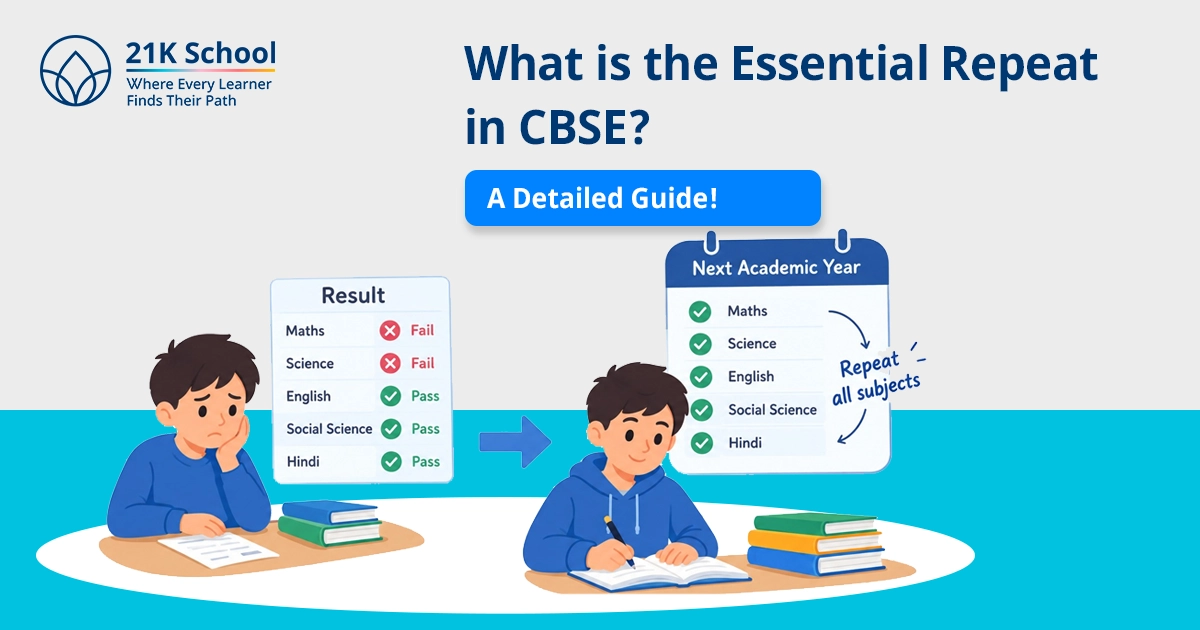
If a student fails in two subjects in the CBSE Class 12 board exam, the student is not eligible for a compartment exam. In such cases, the result is declared as Essential Repeat, meaning the student has to reappear for the examination in the following year.
3. Failed in 3 or more subjects: Full year repeat
If a student has failed in three or more subjects, the compartment option is usually not available for the following case.
- The student has to reappear for the CBSE Class 12 exam the following year.
- They can reappear for the exam as a regular candidate or a private candidate.
- This will provide him or her with more time to study and perform better in the exam.
Understanding CBSE result status codes
Let us understand what the CBSE result status codes are from the points below.
- Pass: The student has passed all the subjects with the minimum passing marks.
- Compartment: Failed in one or more subjects but can give the compartment exams of the CBSE board.
- Essential Repeat: If the candidate has failed in multiple subjects, then they will have to take the CBSE board examination again.
Students can also apply for the verification of the marks if they suspect that there is some error in the evaluation of the marks.
4 alternative education pathways after failing CBSE Class 12
The four alternative educational pathways after failing the CBSE Class 12 exam are mentioned below.
1. Applying to NIOS (National Institute of Open Schooling)
The National Institute of Open Schooling is an educational board that is recognised by the government and offers a flexible form of open schooling to those students who want to study senior secondary education.
NIOS is recognised by many universities and colleges in India. It provides customised exam dates and subjects for students so they can learn at their own pace while preparing for the exams.
2. Appearing as a private candidate in the CBSE Board
Students who fail the CBSE Class 12 exam can also reappear the following year as a private candidate. They can register individually through the CBSE website for private candidates and appear for the exam in the subjects in which they wish to improve. This option allows students to retake the board exam without attending school.
3. Distance learning and open university courses
One more choice available to students is distance learning courses from top universities either online or through correspondence. Certain universities admit students through bridge or foundation courses. Through this process, the student can work on further studies as well as improve their Class 12 grades at the same time.
4. Selecting the vocational and skill-based alternatives
Some students may wish to consider other options such as vocational training and skill-based training rather than the conventional approach. Alternative skills include technical and skill development, diploma courses in a particular field, and industry-specific certification. These courses help students start their careers earlier.
CBSE's best of five rule: Can it prevent failure?
The Best of Five rule of CBSE, in simple terms, means that schools or institutions can use the best five subjects to calculate the percentage for students. It should be noted that it does not alter or change the basic failing marks set by CBSE.
Key points to be noted about the Best of Five rule:
- Students need to attain at least 33% marks in each subject to clear it.
- It is used to calculate percentage only.
- It may be used by some colleges or institutions to admit students.
- It does not delete any failing marks in the student's mark sheet.
The Best of Five rule cannot be used to avoid failing in one subject in the CBSE board exam for Class 12. Students need to secure at least 33% marks in each subject to clear it. But if the student is weak in one subject and has done well in other subjects, then it would help them retain high percentages in college admissions.
3 tips to avoid failing in CBSE Class 12
The top three tips that help to avoid failing in the CBSE Class 12 exam are discussed below.
1. Subject-wise preparation strategies
It has been observed that each subject in CBSE Class 12 has to be prepared differently.
Important tips:
- Students should study NCERT books as most of the questions are taken from them.
- Practice previous year CBSE question papers.
- Spend more time studying subjects in which they are weak.
- Revise important definitions and formulas regularly.
2. Leveraging internal assessment
Students underestimate the value of internal assessment and practical examinations for Class 12.
Key things to remember:
- Internal assessment can carry a high weightage for the final marks obtained in a particular subject.
- Complete all projects, practical files, and assignments on time.
- School tests and practical exams must be taken seriously.
- Internal assessment can play a major role in improving the CBSE Class 12 result.
3. Smart exam-day strategies
Even if students are well-prepared, there are chances that they might lose marks because of improper management in the exam.
Some strategies that are useful on the exam day are:
- Care should be taken to read the question paper properly before starting to attempt the questions.
- Easy questions should be attempted first so that students gain confidence.
- Proper management of time should be done so that all questions are attempted.
- Some minutes should be left at the end to review the answers and make corrections, if needed.
Proper management of time can help students avoid unnecessary mistakes in the board exam.
Conclusion
Does CBSE fail students in 12th? Yes, it does, but only if a student is unable to attain the minimum passing marks set by the CBSE board. To pass the CBSE board exam in 12th, students must attain a minimum of 33% marks in each subject, both in theory and practical, if the subjects are practical subjects.
At the same time, the board offers a number of support systems, such as the facility of grace marks, compartment exams, and re-evaluation, to students who are unable to attain the passing marks. The pass percentage of students in the CBSE board exam in 12th is always on the higher side, indicating that students are passing the exam with confidence by attaining the passing marks set by the CBSE board
Frequently asked questions
6 questions
Does CBSE fail a student in Class 12?
Yes, a student can fail in Class 12 under the CBSE board if the student is unable to secure a minimum percentage of 33% in a specific subject.
What is the minimum passing criteria for CBSE Class 12?
The minimum passing criteria for students under the CBSE board in Class 12 is to score a minimum percentage of 33% in a specific subject.
What happens if I fail in more than one subject?
If a student fails in one or two subjects, they can appear in the compartment exam held by CBSE. If a student fails in three or more subjects, then they can reappear for the board exam the following year.
Can I apply for re-evaluation?
Yes. Students can apply for revaluation or verification of marks after the declaration of results.
Do I have to retake my practicals if I fail in the theory subject?
In most cases, if a student has passed the practical exam but failed in the theory exam, the marks of the practical exam are carried forward when the student reappears in the theory exam.
How many attempts are allowed to take the CBSE board exam?
The student can retake the CBSE 12th board exam as a private student if he/she has failed in the exam. The CBSE gives the student the opportunity to retake the exam in the following year.
About the author
Annapurna S
Content Specialist
Annapurna is an Education Content Specialist at 21K School, India’s first accredited fully online K-12 School with more than 20,000 learners across 78+ countries. She holds a Bachelor’s degree in Electronics and Communication Engineering that helps her structure information logically and structure technical concepts for an understandable educational content. With more than 3 years of experience at 21K School, a fully accredited institute- Cambridge International (IA702) and Pearson Edexcel (94883), Annapurna specialises in creation of the learner-centric resources for school-age students. Annapurna’s every article is based on the official resources and focuses on Cambridge/Edexcel, and CBSE curriculum frameworks. Annapurna’s content helps guardians, and learners to navigate through the modern online education system.
Every 21K School guide is written by our education team and reviewed by a subject facilitator before publishing.
Exploring a CBSE-pathway online school?
Talk to an advisor about 2026–27 admissions — no obligation.
Talk to an advisorComments
No comments yet — be the first to share your thoughts or ask a question.