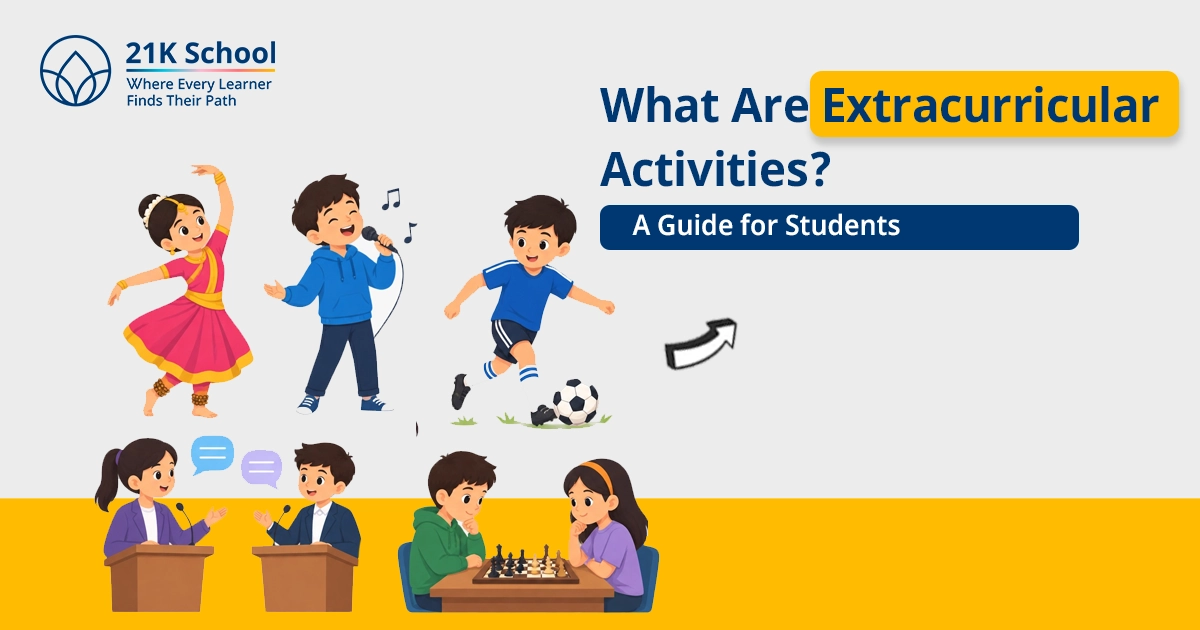
What Are Extracurricular Activities? A Guide for Students
 Written byRahul PalContent Specialist
Last modified: Sep 15, 2026 13 min read
What is so good about school life other than reading out of books?
Extracurricular activities give students an opportunity to engage in sporting activities, music, dance, art, debate, clubs, among other activities outside the classroom.
Not only do they make the learning process enjoyable, but they also assist students in building their confidence, creativity, teamwork, communication, leadership and time management.
This enables the students to discover what attracts them, experiment and learn to reinforce this both inside and outside the classroom.
What are extracurricular activities?
Extracurricular activities are those activities in which the students are engaged besides the normal classroom work. These are sports, music, dance, art, debates, drama, school clubs, competitions, and community activities.
Such activities will give the students an opportunity to discover their fields of interest and other skills besides academic ones.
They are also able to enhance confidence, communication, teamwork, creativity, leadership and time management. Such activities can make school life enjoyable, and the students will also be able to know their strengths by taking part in such activities.
15 extracurricular activities for overall growth
Through extracurricular activities, students become interested in matters and achieve confidence, creativity, teamwork, communication, leadership and physical fitness among other skills that are not taught in classrooms.
1. Swimming
Swimming is a sport that keeps students in good health, develops power, balance, coordination and stamina.
It also instils water safety, discipline and confidence, and so is an excellent physical development and fitness activity.
2. Football/soccer
In fact, football is known to enable students to be more fit, have better coordination, teamwork and decision-making.
Regular play also aids children in learning to follow the rules, work with fellow teammates, as well as handling competition and working towards achieving common goals.
3. Martial arts/karate
Physical abilities, flexibility, balance, and coordination grow with karate and martial arts.
The regular training also inculcates discipline, patience, self-control, respect and confidence and makes the students focused during the entire training.
4. Dance
Music and artistic movement of the body are dance. It helps enhance flexibility, coordination, balance, rhythm and confidence and provides students with a fun way to express themselves and keeps them active.
5. Yoga club
Through breathing exercises and controlled movements, yoga helps students gain flexibility, body awareness, balance and focus.
One may also encourage relaxation, patience, attention, and increased awareness of their bodies by simply practising on a regular basis as well.
6. Debate club
Debate clubs assist students in reading, systematising their ideas, as well as in expressing their opinion in quite an articulate manner.
These criteria they possess are good talking, hearing, thinking, self-confidence, and a good attitude towards other opinions.
7. Chess club
Playing chess assists students in thinking and planning, recognising patterns and finding solutions.
The continual exercising can enhance attention, tolerance, critical thinking, decision-making and learning not to make any mistakes.
8. Coding groups/hackathons
The coding groups teach students programming via projects, issues and problem-solving.
They promote critical thinking and creativity, collaboration, and digital literacy and enable students to create simple websites, games, or apps.
9. Math leagues
Math Leagues provide students with a chance to learn to solve mathematical problems as a team or individually, which can be rather difficult.
They can improve logical thinking, calculating, problem-solving, accuracy and confidence and can make mathematics interesting.
10. Model United Nations (MUN)
The MUN provides students with a chance to represent countries, discuss global issues, and suggest ways of resolving these issues.
It develops research, oratory, collaboration, negotiation, management and interaction skills and develops global awareness.
11. Theater/drama club
The activities in drama include role-play, stage performances, storytelling and acting.
They can enhance communication, creativity, confidence, teamwork, expression of emotion and speaking in front of people in students and arouse them to learn about other personalities.
12. Music (Band/choir)
Other music activities like bands and choirs are used to teach the students rhythm, listening, performance and musical skills.
Teamwork, discipline, confidence, coordination, and appreciation of various kinds of music are also promoted in group practice.
13. Photography/graphic design
Photography and graphic design will stimulate students to develop their visual imagination through the utilisation of cameras, software, design and even editing programs.
Improved in these activities are observation, imagination, technical skills, detailing and visual communication.
14. Student council/government
Student councils give students the power to be responsible, represent their peers, be organised, and participate in school decision-making.
They help in developing leadership skills, communication skills, teamwork skills, decision-making skills, responsibility skills, and organisational skills.
15. Community service/volunteering
Community service can also assist students to render service to people, animals or various local causes through the help of meaningful activities.
It educates about sympathy, responsibility, working together, being socially conscious and how the actions of a single person might be useful to others.
What is the purpose of extracurricular activities?
Co-curricular activities also enable students to learn not only from textbooks, but also to follow their interests, get practical experience and meaningful experiences outside the academic field.
1. Learning beyond textbooks
Extra-curricular activities can also offer students useful activities, which might not be offered by classroom studies.
Sports, projects, clubs and competitions enable them to use knowledge, make decisions, solve problems, as well as handle real-life situations.
2. Exploring personal interests
Students will have the opportunity to experiment with different activities and find out what they prefer to do or are good at.
Sports, music, art, technology, among other interests, should be given a go, and this will guarantee that they will find their talents and learn hobbies.
3. Development of practical and social skills
The frequent presence will aid the students in being trained in teamwork, communication, leadership, problem-solving, confidence and cooperation.
It also assists them in sharing roles as well as valuing others to work with their peers at school or in their teamwork and groups.
4. Participating outside academics
Extracurricular activities allowed students a relaxation time, yet engaged them in beneficial activities.
Competitions and volunteering are some of the opportunities to participate, communicate, develop and acquire new skills.
Extracurricular activities for different age groups
The correct extracurricular activity is based on the age of the child, his or her interests, talents and level of development. As the students grow, they will have the opportunity to engage in professional activities which will be of interest to them and their future perspectives.
1. Activities for preschoolers
Basic tasks, including drawing, colouring, music, dancing, telling stories, swimming, crafts, puzzles, and yoga and movement games, can be helpful to preschoolers.
These activities must be based on fun and exploration as well as the development of creativity, communication, coordination, confidence and simple socialisation skills.
2. Activities for primary school students
Primary school students have an opportunity to play football, swimming, chess, art, dance, music, drama and code/storytelling and science/math clubs.
Children not only get exposed to things that they are interested in, but team spirit, creativity, communication, coordination, concentration and simple problem-solving skills are developed as well.
3. Activities for middle school students
Middle school students are able to engage in activities such as debate, robotics, coding, sports, photography, acting, music, chess, oratorical speech and community service.
With such activities, students can acquire some interests other than building confidence, teamwork, leadership, communication, creativity and practical knowledge.
4. Activities for high school students
High school students are provided with an opportunity to attend the Model United Nations, governance, sports, upper-level coding, research clubs, entrepreneurship, volunteering, journalism, theatre, and music.
Through these activities, leadership, communication, commitment, teamwork, critical thinking and skills that are helpful in higher education and careers are developed.
Why are extracurricular activities important?
Extracurricular activities allow students to acquire skills, which might not be continually offered through classroom learning. They assist in physical, social, emotional, creative and personal development and allow the students to follow their interests.
1. Develops confidence
Participation in competitions, performances, sports or group activities will assist the students to rehearse their skills and assure them that they will not be apprehensive.
It may take time to establish trust and self-confidence, but it will help them succeed and improve student engagement.
2. Improves communication
Debates, drama, music and group projects are activities that involve the use of group and individual speaking, listening, presenting ideas and working together.
Regular involvement may enhance verbal as well as non-verbal communication.
3. Builds teamwork
Students are required to work with other students in sports, clubs, music groups and community activities.
They get to know how to distribute and share roles, respect others, be helpful to their teammates and work towards a goal.
4. Encourages leadership
Students are also empowered to make decisions and be responsible through these student councils, team sports, clubs and volunteering.
These experiences may make one a leader, organiser, problem solver, and accountable in real life.
5. Supports physical fitness
Yoga, sports, swimming, dance, and martial arts encourage unremitting movement.
They are able to enhance strength, flexibility, balance, coordination, stamina, as well as physical fitness, and decrease sedentary time.
6. Develops creativity
Students have opportunities in various kinds of expression of ideas through art, music, photography, theatre, dance and design.
These types of interaction promote innovation, experimentation, novelty and innovative problem-solving ideas.
Benefits of extracurricular activities for students
Extracurricular activities assist the student in areas other than academics as they are involved in other activities like sports, arts, clubs, competitions, teamwork and other hands-on activities.
1. Personal development
Extracurricular activities assist students to be more confident, responsible and independent.
Trying something new and solving problems can make them see what they are good at, know how to behave with self-control and develop a positive attitude.
2. Social development
Group activities will ensure that the students have numerous interactions with other individuals.
They are aware of how to communicate, how to cooperate, how to share responsibility, and how to respect the opinions of others; they know how to build positive relations with classmates and build peer learning.
3. Physical development
Sports, Swimming, Dance, yoga, and martial arts promote regular body movement. They can build on their strength, flexibility, balance, coordination, endurance and fitness in addition to encouraging the students to pursue active lifestyles.
4. Emotional development
Safe places to feel emotions, cope with failures, have successes and failures and develop a strong-willed attitude are extracurricular activities. Affirming involvement may assist students to cope with feelings and gain more confidence in themselves.
5. Leadership development
The student councils, sports teams, clubs and volunteering activities allow the students to be responsible and make decisions. Planning, organising, communicating, problem-solving and supporting others help them to develop leadership.
Key differences between extracurricular activities and classroom work
Interests and practical skills are generated through co-curricular activities, whereas classroom activities are predominantly linked with academic knowledge, concepts and course material.
A decomposition of the difference between extracurricular activities and classroom work is given below.
| Aspect | Extracurricular Activities | Classroom Work |
|---|---|---|
| Purpose | Learns his preferences and working skills, originality and personal development. | Grows and builds academic skills and knowledge of curriculum subjects. |
| Learning Focus | Concentrates on sports, arts, music, clubs and volunteering activities. | Majors in such areas as mathematics, science, languages and social studies. |
| Learning Style | Typically includes experience-based, hands-on, creative and interactive learning. | Principally, lessons, discussions, assignments, reading, writing and problem-solving. |
| Skills Developed | Grows in terms of collaboration, leadership, communication, creativity, self-confidence and time management. | Improves knowledge of the subjects, critical thinking, writing, reading and solving academic problems. |
| Assessment | Generally participation, performance, improvement or achievement based. | Grows and builds academic skills and knowledge of curriculum subjects. |
Difference between extracurricular and co-curricular activities
Both extracurricular and co-curricular activities help to grow the students; the difference between the two is mostly based on how attached to the academic curriculum they are.
| Aspect | Extracurricular Activities | Co-Curricular Activities |
|---|---|---|
| Meaning | The practices of staffing and obtaining activities not involved in normal education. | Activities related to classroom learning or in its support. |
| Main Purpose | Develops his/her interests, talents, self-confidence, and life skills. | Improves academic concepts and tests the concepts in the classroom. |
| Connection with Curriculum | Typically outside of the programmed school curriculum. | Related to learning outcomes and topics. |
| Examples | Football, dancing, swimming, music, photography, volunteering and martial arts. | Discussions, science shows along with quizzes, science competitions and subject-based projects. |
| Skills Developed | Develops collaboration, management, inventive thinking, self-confidence, health and social abilities. | Acquires communication skills, subject knowledge, critical thinking, problem-solving and practical knowledge. |
Conclusion
Extracurricular activities also give the student the opportunity to fiddle around with their areas of interest and acquire other skills, which are not possible in the classroom environment.
People can gain confidence, develop communication, develop teamwork, develop creativity, develop leadership and become personally developed through sports, music, arts, clubs, debates, coding, volunteering and others.
The appropriate activity will be based on the age, interests, skills and time that a student possesses. The involvement must be fun and must be well balanced with school, sleep and other needs.
Frequently asked questions
12 questions
Is extracurricular a hobby?
An extracurricular activity can be a hobby, which is normally an organised activity but non-normal classroom activities or sporting, music, debate or volunteering.
What can I put in my extracurricular activities?
They may include sports, music, dancing, art, debate, coding, clubs, competitions, volunteer work, leadership and community service which you have been engaged in.
Why do extracurriculars matter for college?
Extracurriculars show colleges that students are interested and have gained skills and interests other than academics. They will be in a position to emphasise leadership, teamwork, commitment, creative endeavours, initiative and community involvement.
What are the benefits of extracurricular activities?
Extracurricular activities will also allow students to develop confidence, communication, teamwork, creativity, leadership, time management, social and physical fitness, in addition to allowing them to do what they enjoy.
What are some extracurricular activities for preschoolers?
The right kind of activities are swimming, dancing, music, drawing, storytelling, crafts, yoga, simple sports, gardening, and games of movement that would satisfy their developmental needs and age.
How do I choose the right extracurricular activity?
Consideration of the age, interests, capability of the student, personality, schedule and pleasure. They ought to be left to trial with different activities since it may be used to find out what they really like.
What are extracurricular activities for students?
Extracurricular activities are those activities that the students engage in besides the normal school subjects, such as sports, clubs, music, arts, debate, code-writing, competition, volunteering, among others.
What are extracurricular activities in school?
School extracurricular activities are activities over and above the usual lessons, e.g., sports teams, music teams, art teams, debate teams, drama and coding teams, student councils and community service.
What is the difference between extracurricular and co-curricular activities?
Extracurricular activities are usually an addition to the normal school classes, but co-curricular activities are in relation to the school curriculum and are helpful in classroom teaching.
How many extracurricular activities should a student do?
There is no exact figure. Students will select the activities that they prefer and do not influence their studies, sleeping and personal time.
Can extracurricular activities improve academic performance?
Yes, balanced participation could indeed contribute to the ability to focus on time, confidence, discipline, and problem-solving skills that could subsequently be of benefit in academic performance.
Which extracurricular activities help develop leadership skills?
Student council, team sports, debate, MUN, volunteering and school club programs involve activities where the students are provided with an opportunity to make decisions, take responsibility and collaborate.
About the author
Rahul Pal
Content Specialist
Rahul Pal is an Education Content Specialist at 21K School- India’s fully accredited online school recognised by the Cambridge International (IA702) and Pearson Edexcel (94883). His graduation from Journalism and Mass Communication from Swami Vivekananda University gives him a strong foundation in factual reporting, source verification, and investigative research. With around 2 years of experience at 21K School, he has written extensively for the CGPA conversion guides, marking schemes, and Indian and International boards (IGCSE, GCSE, and A-Levels). His articles are highly relevant for the guardians looking to guide their learners for board exam preparation across 78+ countries. All Rahul’s content is reviewed by the school’s academic team to ensure alignment with the latest board guidelines and latest notifications from the official resources
Every 21K School guide is written by our education team and reviewed by a subject facilitator before publishing.
Exploring a CBSE-pathway online school?
Talk to an advisor about 2026–27 admissions — no obligation.
Talk to an advisorComments
No comments yet — be the first to share your thoughts or ask a question.