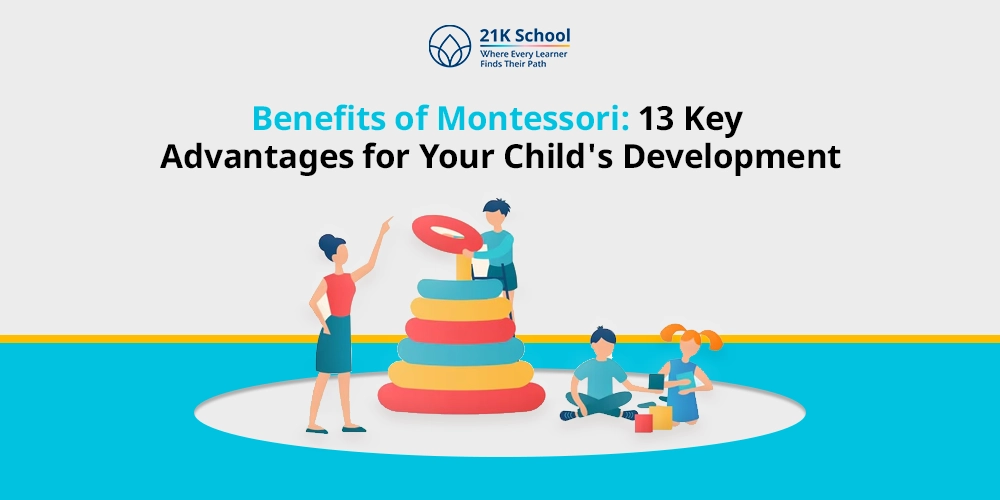
Benefits of Montessori: 13 Key Advantages for Your Child's Development
 Written byAnshu KumariContent Specialist
Last modified: 22 Aug 2026 8 min read
If you wonder why some parents enroll their children in Montessori education, this article might help you find the reasons.
Montessori education has been a novel approach that previously got the attention of parents and kids because of the fascinating resources and toys placed in the classroom.
It was realized later that these toys were to promote deeper interests of young learners leading to self-exploration and curiosity.
Apart from these benefits, people also noticed the better cognitive development of children and their improved critical thinking skills.
What is Montessori?
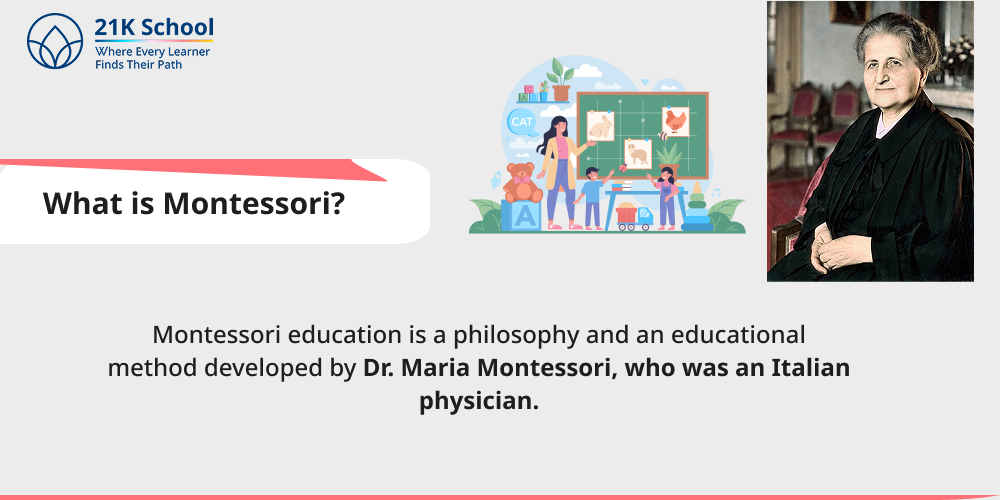
Montessori education is a philosophy and an educational method developed by Dr. Maria Montessori, who was an Italian physician.
It is based on scientific observations of children and their natural ways of learning.
The Montessori method focused on individual learning through hands-on activities self-directed learning, mixed-age classroom, and a well-prepared environment to enable exploration.
Montessori education focuses on the holistic development of a child including academic, social, emotional, and physical growth.
Children learn on the basis of their choices of lessons, methods, and even materials that are placed in open cupboards and are accessible to everyone.
In case a student needs guidance or any kind of help, teachers assist them and play their role as facilitators instead of instructors.
The main objective of Montessori education includes making students masters of the learned concepts through self-discipline and self-motivation rather than putting emphasis on marks or grades.
13 benefits of Montessori
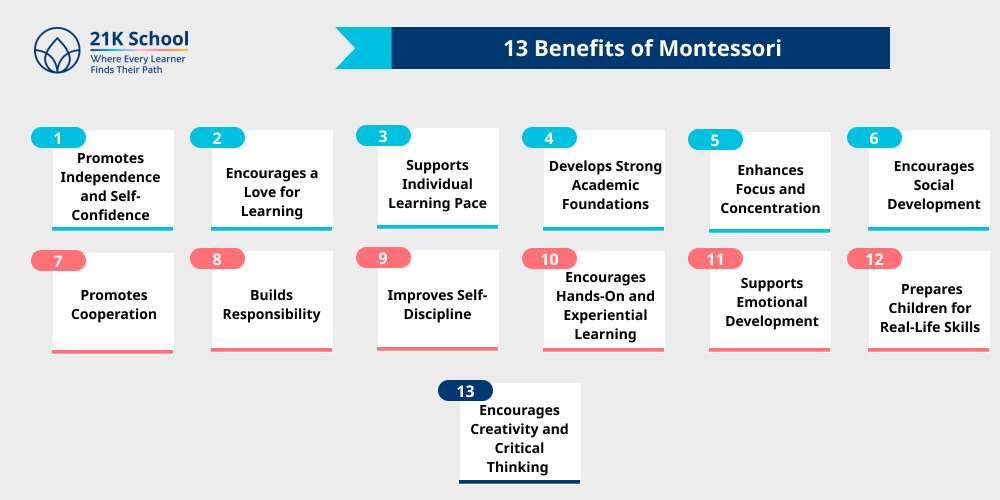
Montessori offers the following advantages to students:
1. Promotes independence and self-confidence
One of the primary benefits of Montessori is that children learn to be independent from an early age as they decide and execute their learning processes by themselves.
Students are also taught life skills that include dressing themselves, cleaning up, and organizing their materials at a tender age.
These experiences make the children become more self-confident and capable of looking after themselves.
When they complete tasks on their own, they develop a belief in themselves and become self-reliant.
2. Encourages a love for learning
Montessori education promotes real love for learning because children are given a chance to learn things that interest them.
Since there is least pressure to compete with others, learning happens in the best pace which makes the experience more enjoyable.
In Montessori, educators understand the value of self-realization and the improvement that comes from within. This attitude shifts the motive from scoring marks in tests to developing lifelong learning habits in students.
3. Supports individual learning pace
Montessori respects and understands that every child has their own learning pace.
Unlike in other traditional classrooms, where all the students are supposed to follow the same pace, Montessori students are allowed to move to the next level only when they are ready.
This kind of flexible learning removes unnecessary competition among learners and establish a supportive environment.
Each kid gets enough time to understand concepts deeply. This is possible because advanced students can continue their next level of learning while weaker students are provided with the needed assisstence without any judgement.
4. Develops strong academic foundations
Montessori forms the base of learning by teaching basics of subjects like mathematics, science, english, hindi, and others.
Students can get better in their childhood education only when they have strong foundation of basics, thus leading to understanding more complex concepts.
Children work with physical items to understand mathematical operations.
Such a practical approach helps students understand complicated concepts better, ensuring better retention for a longer period.
5. Enhances focus and concentration
Montessori classrooms boost concentration by providing children with uninterrupted work hours.
Students are able to spend more time on engaging learning activities leading to improved attention span and perseverance.
A calm and peaceful setting in Montessori classrooms also enhances the ability to focus on studies.
With time, children learn to be attentive, which will assist them in their educational success and in their future work experience.
6. Encourages social development
Social development is a key element of Montessori education.
Mixed-age classes enable the younger students to learn with the older students, and the older students to develop empathy and leadership skills.
This natural social interaction aids children to develop communication skills , respect for others, and a sense of community.
Students cooperate with each other and help others, which leads to the development of a positive social environment, as opposed to competition.
7. Promotes cooperation
Montessori emphasizes on the idea of cooperation rather than competition.
Children are encouraged to cooperate and share resources, and to support each other.
This culture of teamwork and respect is provided by the collaborative learning approach.
Students learn that achievement is not only about the ability to excel, but also about community growth and knowledge.
They learn that cooperative skills are the key to healthy relationships and stability in the future workplace.
8. Builds responsibility
Montessori philosophy also cultivates responsibility by teaching children to care for themselves and their environment.
They clean up after themselves, organize their working space, and even maintain a classroom routine after the playful activities without any assistance.
These practices enable children to learn faster the impacts of their actions and teach them to be accountable.
Such an early exposure to hold accountability make them a responsible individual in later periods of life who know what they are doing and why.
9. Improves self-discipline
Montessori education is entirely based on self-discipline and control.
Students are exposed to an environment where their actions lead to natural consequences that they might be proud of or repent.
The freedom which is given to students also teach them their limits which are required for their personal growth.
This is why despite least external pressure to act right, Montessori students are driven by internal control and self-regulation.
10. Encourages hands-on and experiential learning
Montessori education belives that students learn best through experiences and hands-on learning.
Children acquire knowledge through action and experimentation with materials.
This experiential approach of learning that makes learning more interesting and significant.
It also accommodates different learning styles, especially kinesthetic learning.
This makes children actively engaged in their education, thus, developing better insight into the concepts along with acquiring problem-solving skills.
11. Supports emotional development
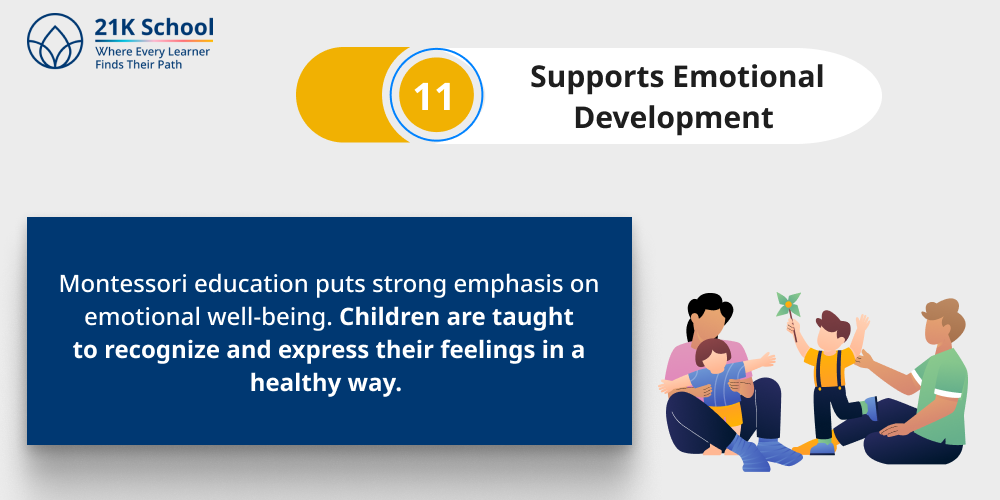
Montessori education puts strong emphasis on emotional well-being. Children are taught to recognize and express their feelings in a healthy way.
Emotional intelligence and empathy develop naturally in learners due to the supportive and respectful atmosphere in Montessori classrooms.
Teachers guide children in resolving conflicts peacefully, which fosters mutual understanding and respect for others' point of views.
This can lead to emotional stability and self-awareness in the long run.
12. Prepares children for real-life skills
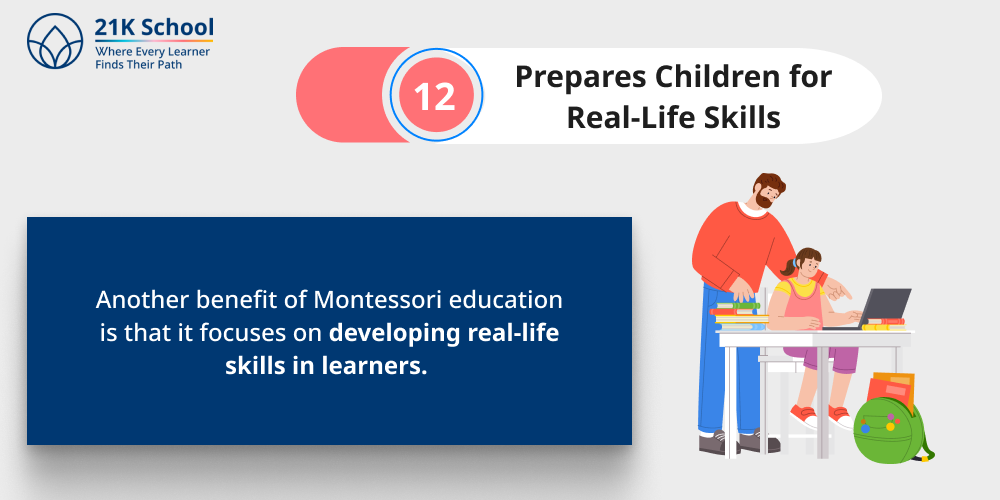
Another benefit of Montessori education is that it focuses on developing real-life skills in learners.
Children learn to cook, clean, take care of themselves, and time-management while they study in Montessori classrooms.
These chores make them self-dependent and confident to face any challenge in their life ahead.
Encourages creativity and critical thinking
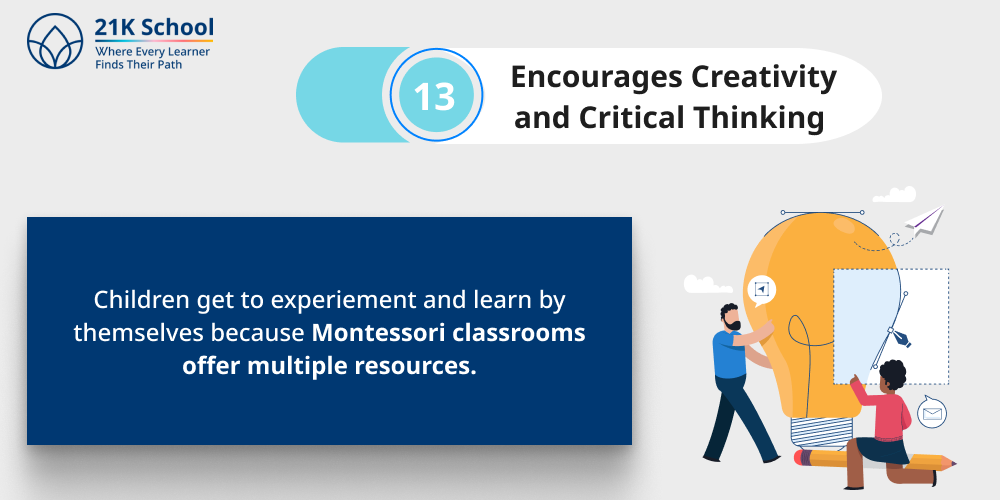
Children get to experiement and learn by themselves because Montessori classrooms offer multiple resources. This boosts the creativity and critical thinking of learners.
They are free to ask questions from teachers which encourages their thinking abilities.
But instead of giving answers directly, teachers allow students to find their answers by themselves while they guide them to find those answers.
To conclude it all
Montessori is an approach to education where kids are motivated to explore by themselves.
It is based on the principle that each kid has a natural instinct and desire for learning that naturally guides them toward success.
In addition to improving academic achievement of learners, Montessori education also emphasizes personality development that promotes lifelong learning for them.
The hands-on activities and mixed-age classrooms build empathy, emotional intelligence, teamwork, and a sense of respect for each other.
These activities also provide opportunities for developing critical thinking and creativity among learners.
Frequently asked questions
9 questions
Is Montessori education better than traditional education?
Montessori education and traditional education are different concepts that work best when implemented together. Traditional education usually focuses on standardized exams and curriculum, while Montessori is based on child-directed learning and holistic growth.
How does Montessori education support independence?
Montessori education supports independence by allowing children to make choices that enable them to complete tasks on their own and take control of their own learning.
At what age is Montessori education most effective?
There is no defined effective age for Montessori education, but the age of 2.5-3 to 6 children are most common in it.
How does Montessori help with academic skills?
Montessori helps with academic skills by allowing learners to explore topics of interest at their own pace and level of understanding.
Are Montessori schools suitable for all children?
Though Montessori schools cater to multiple learning styles and conduct mixed-age classrooms, they might be unable to serve students who like external control or indulgence of teachers.
What type of child benefits from Montessori?
Children who are inetrnally motivated and dsiciplined to learn can get the most benefits from Montessori.
Who is known as the Indian Montessori?
The Indian Montessori is Tarabai Modak.
How do children benefit from Montessori?
Children benefit from Montessori by developing confidence, social abilities, independence, emotional intelligence, a love for learning and academic skills.
What are the 5 great lessons in Montessori?
The following are the 5 great lessons in Montessori: The Coming of the Universe and the Earth The Coming of Life The Coming of Human Beings The Story of Writing The Story of Numbers
About the author
Anshu Kumari
Content Specialist
Anshu Kumari is an Education Content Specialist at 21K School- a fully accredited institute- Cambridge International (IA702) and Pearson Edexcel (94883). She focuses on the in-depth research and creation of the well-drafted guides on NIOS admission, Indian Education Policy, and competitive exam preparation. With around 2 years of experience at 21K School, her psychology background informs her approach to the education content and hence focuses on creating guides to address the real anxieties of the guardians. She writes well-researched articles on competitive exam timelines, stream selection, and board choices by referring to the official resources. All Anshu’s content pieces are fact-checked against the board and primary government official resources and is dedicatedly reviewed by the school’s academic team.
Every 21K School guide is written by our education team and reviewed by a subject facilitator before publishing.
Exploring a CBSE-pathway online school?
Talk to an advisor about 2026–27 admissions — no obligation.
Talk to an advisorComments
No comments yet — be the first to share your thoughts or ask a question.