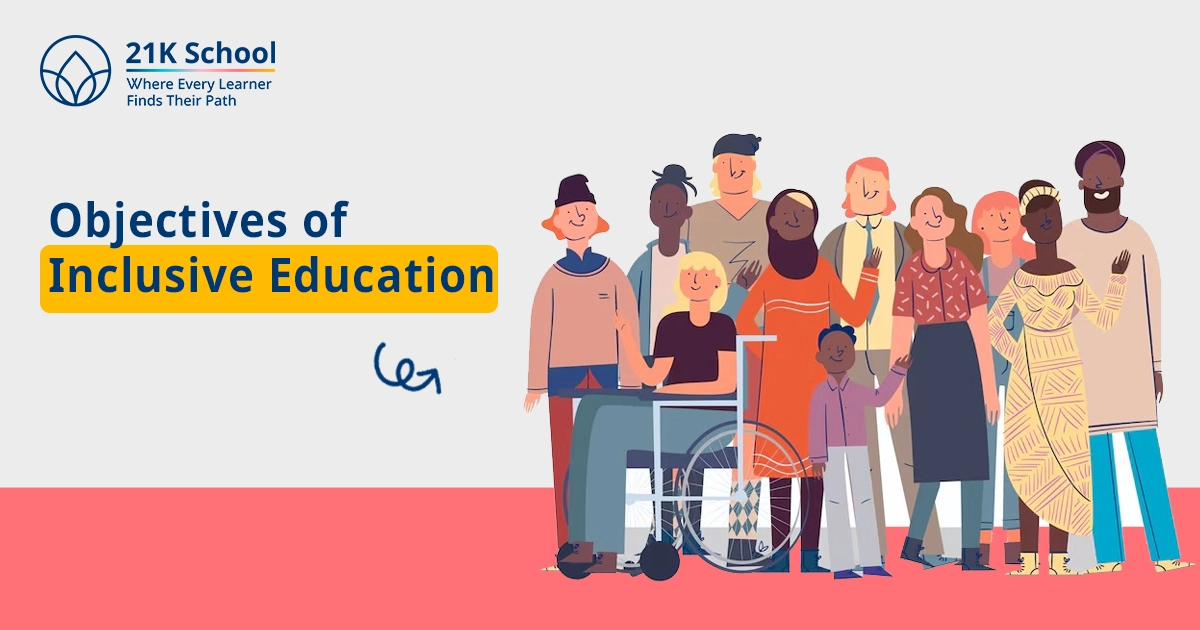
Top 10 Objectives of Inclusive Education: Every Student Must Know!
 Written byAnnapurna SContent Specialist
Last modified: Sep 2, 2026 8 min read
Did you know that children with abilities, disabilities, and those from backward communities lack access to education?
Systems like inclusive education educate all students regardless of abilities, disabilities, and their backgrounds. It bridges the gap between mainstream classroom education and aims to provide equitable learning opportunities for diverse student abilities.
So let us look at some of the objectives of inclusive education and how it offers equality and dignity to every child.
What is inclusive education?
Inclusive education means all children learn together in one single classroom irrespective of their abilities, disabilities, and diverse backgrounds. It provides equal educational opportunities so that no child is excluded from the learning process. Therefore, every child should feel valued, respected and included.
Main objectives of inclusive education
The main objectives of inclusive education are mentioned below.
1. Ensuring equal access to education for all
Students from various abilities, disabilities, and backgrounds have equal access to education in one classroom, as stated by UNESCO. It aims to provide equal learning opportunities for students to learn together in the same educational environment without exclusion.
Inclusive learning creates a collaborative learning environment by
- Providing individualised care in a diverse setting
- Supplying assistive devices
- Offering learning materials in accessible languages and formats.
- Creating learner-friendly classrooms
2. Eliminating discrimination in education and social exclusion
Discrimination remains one of the biggest barriers to education around the world. The main objective of inclusive education is to eliminate discrimination in classrooms and reduce social exclusion in schools through policies and promote social integration.
Inclusive education reduces exclusion by
- Promotes social inclusion
- Eliminates educational barriers
- Guarantees fairness
- Prioritise underrepresented group
Inclusive education believes in providing equity and fairness. This fosters mutual understanding among students and teachers.
In order to overcome further discrimination, community-based programs should be encouraged to unlearn discrimination deeply ingrained in the younger minds.
3. Protecting and promoting the rights of children with disabilities
Inclusive education aims to protect and promote the rights of children with disabilities. Education is a fundamental right, including the right to quality education for children with disabilities. Every child, irrespective of their abilities, disabilities, or sensory capabilities, has a chance at receiving equal learning opportunities.
Inclusive education protects the rights of children by ensuring:
- Zero tolerance for discrimination and exclusion
- Ensuring equal and accessible educational opportunities
- Training educators to meet the needs of diversity
- Offering accommodation according to individual requirements.
- Providing support services and assistive technology devices whenever needed.
- Promoting dignity and equality, and respect for every child.
Disability does not define potential. It is all about believing in them and giving them equal chances to discover their true potential to succeed in an inclusive environment.
4. Developing social consciousness and empathy
Inclusive education encourages active listening and empathy in students to connect with their peers. When students interact with their peers hailing from diverse backgrounds, they naturally develop a better understanding and start to appreciate different perspectives.
Inclusive education aims to promote social consciousness by
- Developing empathy and emotional intelligence.
- Minimising stereotypes and prejudices.
- Fostering kindness, respect, and cooperation.
- Improving communication, teamwork, and social skills.
Those students who start learning in an inclusive environment are more likely to become open-minded adults. They imbibe the knowledge and mindset to see abilities rather than limitations.
5. Identification and development of skills
Inclusive education focuses on identifying and nurturing the strengths of each learner. Instead of labelling students by limitations, it focuses on skill development in education.
Inclusive education identifies and develops skills by
- Early identification of learning difficulties
- Cognitive and academic growth
- Real-world preparation
- Encouraging creativity and innovation.
- Supporting academic and non-academic talents
- Develop social and communication skills.
While some may be good at arts, others may be in science, or may have a huge passion for sports. Inclusive learning is a medium of learning for all students to explore, identify, and develop their skills.
6. Addressing diverse learning needs of every student
Each student learns at their own pace. The goal of inclusive education is to meet the varying abilities of all students. It seeks to help learners according to their individual needs in order to motivate them to reach their maximum potential.
Teachers use different strategies, such as
- Differentiated Instruction & Universal Design for Learning
- Customizable curriculum
- Visual and activity-based learning
- Personalised support plans
- Collaborative teaching models
- Assistive technology
- Nurture social and emotional development.
This strategy allows students with disabilities, slow learners, and linguistic and cultural diversity to participate and excel in the academic curriculum.
7. Preparing students for real-world challenges
The world outside the school is raw and different from the ideal world of the school. Students commute, collaborate, and communicate socially in the real world.
Inclusive education helps students cope with the challenges of the real world by
- Critical and analytical thinking
- Building confidence and independence
- Enhancing collaboration and communication.
- Developing empathy and social skills.
- Building resilience and adaptability
- Mirrors real-world experience
Students who study in a diverse learning environment tend to develop resilience, work with people with different backgrounds, and navigate community life. This enables students to experience life outside the school and go through the uncertainties of life.
8. Improving the overall quality of education
Inclusive education improves the quality of learning for students. It encourages teachers to create inclusive environments where every student can learn. It also creates an effective classroom learning environment for students.
Especially when schools adopt inclusive methods, they focus on
- Personalised pedagogies
- Encourage a creative and flexible teaching environment.
- Positive and supportive inclusive classroom
- Improve learning outcomes of students.
Teachers use innovative and personalised techniques of imparting knowledge to the students based on their core strengths. Classroom lectures are converted into interactive sessions, and learning outcomes are improved simultaneously.
9. Contributing to national development and social justice
Inclusive education helps to build a society where everyone gets a fair chance at learning and contributes to economic growth and social development. It focuses on promoting progress and development of the nation and social justice.
If every child has equal learning opportunities:
- Creates equality and justice.
- Breaks the cycle of poverty by educating the people.
- Fosters the ideals of democracy and social responsibility.
- Eliminates social discrimination and inequality.
- Nurtures competent, responsible, and confident citizens.
- Creating skilled and responsible citizens
10. Empowering parents and community stakeholders
Inclusive education realises that learning does not happen only in classrooms. The participation of parents, families, and other members of the community is key to creating an inclusive environment where the children learn socially, emotionally, and academically. Involvement of these stakeholders in the educational process helps create a strong connection between the schools and their communities.
The inclusion process enables parents and communities to:
- Facilitate awareness programs concerning inclusion.
- Foster collaboration between parents, schools, and the community.
- Foster shared decision-making in the education of a child.
- Create networks for support and resource sharing.
- Ensure active participation of parents in the education process.
A parent plays a supporting role in a student’s life by providing an enabling environment, enhancing the student's self-esteem, and personally working with educators and counsellors to find the next steps forward.
Communities that are aware of inclusive learning help to minimise stigmatisation and discrimination.
Conclusion
Inclusive education is an educational system whose goals include ensuring all learners, whether disabled or not, regardless of their learning capabilities and speed, are provided with equal opportunities for education. Inclusive education is an indication of the increasing need for making sure that all children are provided with an enabling environment for their participation.
A school that embraces inclusivity creates an educational setting that respects, values, and appreciates diversity, empathy, and respect. Learners are not judged by any difficulty that they might be going through but are rather made to appreciate themselves and learn along with other learners in an inclusive environment.
Frequently asked questions
5 questions
What is the main goal of inclusive education?
The main goal of inclusive education is to ensure equal opportunities for all children to receive quality education irrespective of their backgrounds, disability, and community.
How is inclusive education beneficial for the learning outcomes of the students?
Inclusive education is beneficial for the overall learning outcomes of the students as it provides personalised learning and skills.
How does inclusive education help students with special needs?
Inclusive education offers multiple advantages for students with disabilities, including high academic performance, effective socialisation, and better communication skills. Children with disabilities learn and develop better when they learn in classrooms along with other students.
How does it empower teachers?
Teachers are empowered through autonomy, less work, and relevant training that allows them to direct their classrooms effectively and creatively.
What are some of the social objectives of inclusive education?
Some of the social objectives of inclusive education include social integration, diversity and acceptance, removing barriers, real-world preparation, empathy and compassion,
About the author
Annapurna S
Content Specialist
Annapurna is an Education Content Specialist at 21K School, India’s first accredited fully online K-12 School with more than 20,000 learners across 78+ countries. She holds a Bachelor’s degree in Electronics and Communication Engineering that helps her structure information logically and structure technical concepts for an understandable educational content. With more than 3 years of experience at 21K School, a fully accredited institute- Cambridge International (IA702) and Pearson Edexcel (94883), Annapurna specialises in creation of the learner-centric resources for school-age students. Annapurna’s every article is based on the official resources and focuses on Cambridge/Edexcel, and CBSE curriculum frameworks. Annapurna’s content helps guardians, and learners to navigate through the modern online education system.
Every 21K School guide is written by our education team and reviewed by a subject facilitator before publishing.
Exploring a CBSE-pathway online school?
Talk to an advisor about 2026–27 admissions — no obligation.
Talk to an advisorComments
No comments yet — be the first to share your thoughts or ask a question.