Child-Centered Curriculum: Meaning, Principles, Benefits, Importance, and More!
 Written byAnnapurna SContent Specialist
Last modified: 23 Jul 2026 9 min read
Are you worried about selecting the right type of curriculum for your child’s overall growth during their academic years?
Many parents feel confused when it comes to selecting the right educational approach for their young child. Fortunately, approaches like the child-centred curriculum prioritise personalised learning for students.
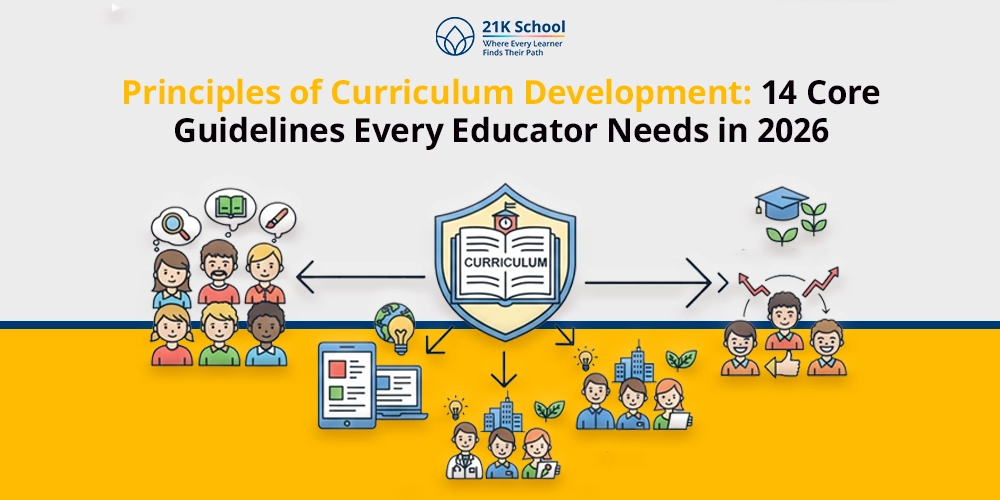
A child-centred curriculum shifts the focus from traditional teacher-led learning to modern learner-led learning. It is based on different principles and offers a set of benefits to the budding learners.
Let us dive deep into the world of the child-centred curriculum, starting with what it is all about and other important aspects.
What is a child-centered curriculum?
A child-centred curriculum is an educational approach that prioritises personalised learning, rather than teacher–led instruction.
Teachers act as facilitators by creating an environment that encourages and supports creativity, critical thinking, and cognitive development.
Children are equal participants in the learning journey. They follow their instincts, explore new ideas, work on projects, collaborate with peers, and learn through real-life examples.
4 principles of child-centered curriculum
The four principles of a child-centred curriculum are active learning and participation, individualisation and differentiation, focus on interests and needs, and a child-centred environment, as explained below:
1. Active learning and participation
Active learning and participation are central principles of a child-centred curriculum. Instead of children passively listening to lessons, they actively participate in the classroom. This principle promotes curiosity, independence, and deeper understanding.
This principle gives children a sense of choice and ownership by developing critical thinking, communication skills, creativity, and collaboration.
2. Individualisation and differentiation
Individualisation and differentiation are two integral parts of this curriculum because no two children learn in the same way. Elements like proficiency level, mode of learning, and pace vary significantly.
Individualisation helps children to progress at a pace that matches their readiness. Differentiation uses varied teaching strategies, resources, and activities so all students can understand the same core concept.
3. Focus on interests and needs
A key principle of a child-centred curriculum is to recognise the interests, strengths, and learning needs. It involves curating a curriculum based on what children enjoy or are curious about, which naturally draws their attention.
This principle focuses on meeting individual learning needs. When schools pay attention to both interests and needs, the children feel valued as individuals rather than being treated as part of a uniform group.
When teachers understand an individual's pace, interests, and needs, education becomes inclusive, effective, and rewarding.
4. Child-centered environment
A child-centred environment caters to individual learning needs, overall development, and space to grow. It emphasises the importance of a supportive and inclusive atmosphere that encourages participation, expression, and awareness in learning.
Teachers create an environment in which children are encouraged to ask questions, express their thoughts, and make mistakes without fear. This builds confidence and helps students develop a positive attitude toward learning.
5 key aspects of a child-centered curriculum
The top 5 key aspects of a child-centred curriculum are active learning, holistic growth, teacher as facilitator, learner interest, and flexible environment, as detailed below
1. Active learning
Learning becomes more efficient when children participate in the process. Rather than just listening to instructions, children learn by actively participating in activities such as playing, conducting experiments, role-playing, storytelling, sensory tasks, and problem-solving exercises. For instance, block building can help them understand space, whereas simple science projects can sharpen their observational skills.
2. Holistic growth
A child-centred curriculum supports holistic development by designing learning activities that address cognitive, physical, emotional, social, artistic, and moral growth. Thinking abilities are developed through questioning, physical skills through activities and crafts, empathy through cooperation, and creativity through art and music.
3. Teacher as facilitator
The role of the teacher is not limited to imparting information; rather, they are mentors who facilitate learning. They assess the development of skills, supply appropriate materials, pose questions, and motivate the child to discover the answers on their own.
4. Learner interest
Lessons are designed to incorporate children's interests so they can better relate to what is being taught. This approach improves engagement and understanding. For instance, a student interested in science may be drawn to experiments, while one fond of stories may engage more in language-based activities.
5. Flexible environment
The setting within the classroom should be secure, flexible, and challenging for learners. This consists of reading nooks, art centres, collaborative spaces, instructional tools, and samples of learners’ works. Children will be able to freely engage in their thoughts, work together with other learners, and work on their shortcomings.
Benefits of child-centered curriculum
The benefits of a child-centred curriculum include fostering active learning, boosting critical thinking and problem solving, enhances social and emotional growth, and others mentioned below:
1. Fosters active learning
Children learn by doing rather than only listening. Through hands-on tasks, projects, discussions, and exploration, students understand concepts more deeply and retain information for longer periods. Active participation also keeps learning enjoyable and engaging.
2. Boosts critical thinking and problem-solving
Child–centred learning encourages children to ask questions, analyse problems, and come up with their own answers. This enables them to enhance their reasoning skills and decision-making abilities, which prove beneficial in academic and real-life situations.
3. Enhances social and emotional growth
The involvement of children in group activities and role-playing enables them to develop communication skills and teamwork. Additionally, it fosters their self-esteem, empathy, emotional awareness, and resilience.
4. Supports personalised learning pace
Every child learns differently. Some may need extra time, while others are ready for advanced challenges. A child-centred curriculum allows learners to progress at a pace that suits their readiness level, reducing pressure and improving confidence.
5. Increases motivation and engagement
When lessons connect with student interests, learning becomes more relevant and enjoyable. Children are more likely to stay focused, participate actively, and develop a genuine interest in learning.
6. Encourages independence and responsibility
Choices are usually provided to students in regard to their activities, projects, and ways of learning. Through doing so, students will feel accountable for their success.
4 roles of teachers in child-centered curriculum
The four important roles of teachers in a child-centred curriculum are facilitator of learning, observer and mentor, environment designer, and promoter of active participation, as explained below:
1. Facilitator of learning
Teachers act as facilitators who guide students as they explore ideas and build understanding through experience. They ask open-ended questions, provide learning resources, and encourage inquiry instead of giving every answer directly. This helps children develop critical thinking, independence, and problem-solving skills.
2. Observer and mentor
A child-centred teacher carefully observes student progress, behaviour, interests, and learning patterns. These observations help identify strengths as well as areas where extra support is needed. Teachers then provide personalised feedback, encouragement, and mentoring so that each learner can progress with confidence.
3. Learning environment designer
Teachers create friendly, adaptable, and engaging learning environments. The teacher selects appropriate teaching materials, organises group space, and plans appropriate activities according to the age and development level of children. Teachers also relate classroom teachings to everyday life.
4. Promoter of active participation
Educators motivate children to articulate their views, raise questions, work with other classmates, and take ownership of their learning process. They create an environment that makes children free and secure in expressing themselves and drawing lessons from their mistakes.
How schools can choose child-centered education?
Schools can choose child-centred education by transforming the role of teachers, introducing active learning methods, and other key pointers like:
1. Transform the role of teachers
The first step is shifting away from passive lecturing to active learning. In a child-centred classroom, teachers extensively guide students to explore, discuss, and develop problem-solving skills. This helps children feel heard, valued, and more involved in the learning process.
2. Introduce active learning methods
Schools should replace passive instruction with hands-on learning, storytelling, projects, inquiry-based tasks, experiments, and play-based activities, especially in the early years of education. These methods improve engagement, curiosity, and understanding.
3. Create flexible learning spaces
A child-centred school should provide classrooms that are safe, joyful, and adaptable. Spaces designed for group work, reading, creativity, and movement encourage collaboration and exploration.
4. Personalise learning experiences
Schools should use varied teaching strategies, differentiated tasks, and personalised support to meet individual learning needs. This ensures that children are not forced into a rigid one-size-fits-all structure.
Why parents choose child-centered education?
Parents choose child-centred education due to its key offerings like tailored learning and pace, holistic development, higher engagement and others mentioned below:
1. Tailored learning and pace
Parents prefer an educational approach where learning is adapted to each child's pace, ability, and interests. This reduces unnecessary pressure and allows children to understand concepts more comfortably and effectively.
2. Focus on holistic development
Child-centred education supports overall growth by balancing academic learning with emotional, social, physical, and creative development, helping children become well-rounded individuals.
3. Higher engagement and interest in learning
Interactive and activity-based learning keeps children curious and involved. Parents value this as it makes learning enjoyable rather than stressful or monotonous.
4. Development of critical thinking and independence
Children are encouraged to ask questions, solve problems, and make decisions. This helps them become independent thinkers rather than passive learners.
5. Strong social and emotional skills
Through collaboration and interaction, children develop communication skills, empathy, teamwork, and emotional resilience, which are essential for real-life situations.
6. Better understanding and long-term retention
Students learn effectively through experience and active participation, which helps them grasp concepts deeply and retain information for a longer time, beyond rote memorisation.
Conclusion
A child-centred curriculum is relevant in today's physical and online classrooms. Children require academic, creative and cognitive skills.
Schools and parents appreciate the value of educational systems that are adaptable, stimulating, and tailored. This helps students to learn from exploration, collaboration, and development at their own pace.
The child-centred curriculum is an approach to learning that focuses on the needs, abilities, and learning styles of children. This blog outlines the principles and benefits of a child-centred curriculum to help you make an informed decision before choosing the right curriculum.
Frequently asked questions
5 questions
Why is a child-centred curriculum important?
A child-centred curriculum focuses on a child's learning needs, encourages active learning, and helps students develop cognitive skills.
What are the main features of a child-centred curriculum?
The main features of a child-centred curriculum include hands-on learning, flexible curriculum, and teachers acting as facilitators for students to promote cognitive, social and emotional development.
Is a child-centred curriculum suitable for all age groups?
The child-centred curriculum is suitable for all age groups, provided it is adapted to all developmental stages
How do schools assess progress in a child-centred curriculum?
Schools usually assess the progress in a child-centred curriculum by by observing students' day-to-day activities, monitoring their participation in projects, and providing continuous support at every stage.
How is a child-centred curriculum different from traditional teaching?
The child-centred curriculum shifts the process of learning from traditional teaching methods to focusing on the individual child's needs, interests, and learning pace.
About the author
Annapurna S
Content Specialist
Annapurna is an Education Content Specialist at 21K School, India’s first accredited fully online K-12 School with more than 20,000 learners across 78+ countries. She holds a Bachelor’s degree in Electronics and Communication Engineering that helps her structure information logically and structure technical concepts for an understandable educational content. With more than 3 years of experience at 21K School, a fully accredited institute- Cambridge International (IA702) and Pearson Edexcel (94883), Annapurna specialises in creation of the learner-centric resources for school-age students. Annapurna’s every article is based on the official resources and focuses on Cambridge/Edexcel, and CBSE curriculum frameworks. Annapurna’s content helps guardians, and learners to navigate through the modern online education system.
Every 21K School guide is written by our education team and reviewed by a subject facilitator before publishing.
Exploring a CBSE-pathway online school?
Talk to an advisor about 2026–27 admissions — no obligation.
Talk to an advisorComments
No comments yet — be the first to share your thoughts or ask a question.