CBSE Class 10 Total Marks 500 or 600? Full Marks Structure Explained
 Written byAnshu KumariContent Specialist
Last modified: 20 Oct 2026 17 min read
The Central Board of Secondary Education Class 10 board examination is a crossroads issue for many learners and parents regarding the marking format of the examination and whether the total marks are 500 or 600.
CBSE Class 10 Board Exam is a very important exam for learners. This exam is the first board exam for learners. Millions of learners appear for this exam every year.
There is confusion in the minds of learners and parents about CBSE Class 10 total marks, passing marks and marks calculation.
This guide explains everything learners need to know about CBSE Class 10 total marks, passing marks and marks calculation.
CBSE Class 10 total marks 500 or 600?
CBSE Class 10 is the standard where the test is administered, and the learners are allowed to take the test in five major subjects, each having a mark limit of 100 marks. Thus, the sum of the five subjects will be 500. It is noteworthy that CBSE typically takes into account the marks of the five subjects as the best to calculate the percentage. Generally, learners take 5 subjects, and their final scores are out of 500.
Nevertheless, there are schools with the choice of having an extra sixth subject like Information Technology or Artificial Intelligence. Assuming that the student will write the examination in six subjects, the best 5 subjects' scores are taken into consideration, thus enabling learners to excel in their subjects of interest.
CBSE Class 10 subject-wise marks distribution (80+20 pattern)
Each subject in Class 10, except the additional skill-based subjects (if taken), follows an 80-20 pattern of marks distribution, thus making a total of 100 marks for each subject.
The 80 marks belong to theory-based final exams, and 20 marks are for internal tests, including practicals, periodic tests, notebook submission, and portfolio.
Note: The subject Science has a greater proportion for internal assessments (40 marks) as it is a practical-approach subject.
The total marks to be scored to at least pass the final examination are 33% of both 80 marks (in theory) and 20 marks (in internal assessments).
1. The five core subjects
Learners, in Class 10, usually have to take a minimum of five core or main subjects. These subjects are English, Mathematics, Science, Social Science, and a second language, such as Hindi (Course A or B).
Learners can score a maximum of 100 marks in each core subject, and the final scores in these five core subjects largely decide the stream (arts, commerce, and science) that they would take in Class 11th.
Core subjects play an important role in developing linguistic skills, analytical skills and scientific thinking of learners. Usually, the marks of these five subjects are mainly considered while calculating the results or percentage of the board examination.
Therefore, learners have to take the preparation of these subjects very seriously.
2. Theory examination (80 marks)
CBSE Class 10 examinations are normally 80 marks each subject (theory test). This is a written test administered by the board and tests the subject based on the knowledge, concepts and problem-solving ability of the learners.
Depending on the types of questions, the test can be tailored to include different types of questions, such as multiple-choice questions (MCQ), short answer questions and long answer questions. In recent years, competency-based questions have also been a problem in CBSE exams.
The overall marks of the learners are determined by much of this 80-mark test. Thus, reading the syllabus thoroughly, exercising and doing question papers of past years is of great importance to learners.
It is possible to score well in this section with proper preparation.
3. Internal assessment (20 marks)
CBSE Class 10 has 20 marks of Internal Assessment on each subject, which is assessed by the school. This assessment usually involves periodical exams, submission of notebooks, enrichment of the subject activities and work.
Internal assessment is a valuable tool for evaluating the learners ‘ studies and involvement in the classes during the entire year. Through this, teachers can regularly monitor the performance of the learners and suggest improvements if necessary.
Many times, learners can get better marks in this section relatively easily compared to the board exams if they study regularly and complete projects and assignments on time.
Therefore, internal assessment should be taken equally seriously, as it plays a significant role in increasing the total marks.
It can be easily understood from the table.
| Subject | Theory marks | Internal marks | Total |
|---|---|---|---|
| English | 80 | 20 | 100 |
| Hindi (Course A or B) | 80 | 20 | 100 |
| Mathematics | 80 | 20 | 100 |
| Science | 60 | 40 | 100 |
| Social Science | 80 | 20 | 100 |
| Additional Subject | Varies | Varies | 100 |
When does CBSE Class 10 total marks become 600? The sixth subject explained
In the CBSE Board Class 10 examinations, learners usually take the exam in five main subjects, having a total of 500 marks. In some cases, learners can opt for an additional sixth subject, which is generally skill-based.
Then the total number of subjects becomes six, and the total marks can be 600, as each subject carries 100 marks. This additional subject is usually given as a skill-based or optional subject.
Many learners take this subject to learn new skills and get an edge to perform better in the final results. However, there are certain rules in calculating the results of the board examination.
Note down the important points given below about the sixth subject.
1. What is the CBSE Class 10 additional subject?
CBSE Class 10 additional subject is the sixth subject that is optional for learners to take along with the main five subjects. These subjects are about practical skills and knowledge that would act as a vocational subject for learners in a later period.
Some of these subjects could be Computer Applications, Home Science, Information Technology, Artificial Intelligence, or Painting. Taking additional subjects allows learners to get a better idea of their area of interest.
So it is not only for increasing marks, but also an important opportunity for skill development.
2. Does the sixth subject count in your percentage?
In CBSE Class 10, the marks of the best five subjects are usually considered for calculating the percentage. That is, if you take the exam in six subjects, the board usually uses the five highest-marked subjects for calculating the percentage. So, the sixth subject might or might not be included in your final results based on your performance in that subject.
Learners mostly take a sixth subject to push their final percentage and score better. In situations where you have failed or have lower marks in the 5 core subjects, the marks of the sixth subject act as your saviour and let you pass.
3. Can you fail the additional subject and still pass?
Yes, you can pass the final exams even if you have failed in your additional subject. This is because the total scores from the 5 main subjects are enough for scoring passing marks in Class 10. This is how CBSE is inclined a lot towards the major five subjects.
When the child scores the minimum passing marks in all those five subjects, then the results of the additional one (if scored lower) will not necessarily impact the passing status of the child.
But if you have failed in both, that is, in one of the core subjects and the additional subject, you won't have the marks of the latter to let you pass. This is why you should take all subjects seriously and study diligently for the final board exams.
CBSE best of five rule: How it works and why it benefits you
The best of five rule in CBSE Class 10 suggests that when a learner takes an additional subject, thus making the total subjects six, their final scores will be a result of the best five marks in respective subjects.
This rule supports learners to either enhance their overall performance in Class 10 or get passing marks to get promoted to Class 11.
1. What are the best of five rules?
In CBSE Class 10, learners have 5 major subjects and one minor subject. If the learners fail in any of the major subjects or get fewer marks than the minor subject, then the minor subject replaces the major subject.
As a result, the subject with the lowest marks is dropped to boost the total percentage. This rule is especially useful for those learners who are relatively weak in one subject. Therefore, many learners consider taking optional subjects as a safe option.
2. Step-by-step: How to calculate your CBSE 10th percentage
Calculating the percentage of CBSE Class 10 is very easy if the Best of Five Rule is used.
First, the marks of all the subjects of the student have to be written down.
Then, out of those marks, the five subjects in which the highest marks have been obtained have to be selected.
Then, the marks of these five subjects have to be added.
The percentage can be obtained by dividing the total marks by 500 and multiplying by 100.
Percentage = (Total marks in best 5 subjects / 500) x 100
For example, if the total marks of five subjects are 425,
then the percentage will be( 425 / 500) x 100 = 85%.
3. Does CBSE officially declare percentage?
CBSE follows a grading system that shows grades and grade points to reduce excessive competition among learners, instead of declaring the final percentage scored.
Therefore, the marks and grades for each subject are given in the mark sheet, but the total percentage is not mentioned separately.
Many times, schools, colleges or educational institutions themselves calculate the percentage based on the marks (best of five subjects' marks) of the learners.
Learners can also easily calculate their final percentage by dividing the total of 5 best subjects' marks by 500 and then multiplying it by 100. Therefore, even if CBSE does not officially announce the percentage, it is possible to easily calculate it based on the marks.
CBSE 10th grading system 2025-26: Grades, CGPA, and what they mean
CBSE has a 9-point grading system, designed accurately to reward marks to learners. These grades are at times referred to as CGPA (Cumulative Grade Point Average), which is the overall performance of the learners.
With this type of grading system, learners are not merely graded in terms of marks, but also their overall performance in studies.
Below are the important parts of the CBSE Class 10 grading system.
1. The 9-point grading scale
In the CBSE Class 10 examination, the marks of the learners are converted according to the grade system.
In this scale, A1 grade is given to those who get marks between 91 and 100. A2 grade is given to those who get marks between 81 and 90, and B1 grade is given to those who get marks between 71 and 80.
Similarly, B2 grade is given to those who get marks between 61 and 70. C1 grade is given to those who get marks between 51 and 60, and C2 grade is given to those who get marks between 41 and 50.
D grade is given to those who get marks between 33 and 40, which is the lowest weight in the section. A student who gets marks below 33 is considered a failure.
This grading system helps in understanding the performance of the learners in a simple way and divides the difference in different marks into a specific category.
It can be easily understood from the table.
| Mark Range | Grade | Grade point | Performance |
|---|---|---|---|
| 91 – 100 | A1 | 10 | Outstanding |
| 81 – 90 | A2 | 9 | Excellent |
| 71 – 80 | B1 | 8 | Very Good |
| 61 – 70 | B2 | 7 | Good |
| 51- 60 | C1 | 6 | Fair |
| 41 – 50 | C2 | 5 | Above Average |
| 33 – 40 | D | 4 | Avarage |
| 21 – 33 | E1 | - | Failed (Needs Improvement) |
| 00 – 20 | E2 | - | Failed(Needs Improvement) |
2. How to calculate CGPA
CGPA or Cumulative Grade Point Average is the average of the grade points of a student in all the subjects. Each grade has a specific grade point assigned to it, such as 10 for A1, 9 for A2, 8 for B1, etc.
To calculate CGPA,
First, add the grade points of all the subjects.
9+9+10+10+10 =48
Then divide by the total number of subjects to get the CGPA.
CGPA = 48/5 =9.6
Using this CGPA, the overall academic performance of the student can be easily understood.
Although CGPA is not always mentioned directly in the CBSE results, many schools and educational institutions use it.
3. What is an A1 grade in CBSE 10th?
A1 grade in CBSE Class 10 means that the student has performed extremely well in a particular subject. A1 grade is given when learners score between 91 and 100 in a particular subject.
Learners who score an A1 grade usually understand the concept of the subject very well and are able to answer almost all the questions correctly in the examination.
Getting an A1 grade in the board examination is an important achievement for many learners, as it is considered proof of their academic prowess.
Even higher educational institutions consider learners with an A1 grade as toppers and diligent students, thus giving them admission. This is why learners aim to achieve an A1 grade in all major subjects and shine in their respective futures.
4. Grades for non-academic subjects
In CBSE Class 10, grades are also given for non-academic subjects or co-curricular subjects like Work Education, Discipline, Art Education and Health & Physical Education, along with academic subjects.
The grades follow a 5-point grading criteria, where A, B, C, D, and E are grades given on the basis of the individual performance of each learner. These grades help in assessing the overall development of the student.
Although these grades play an important role in the student’s report card, they are often excluded from the percentage calculation process. Through these subjects, learners can improve their creativity, physical skills and social skills along with their studies.
CBSE Class 10 passing criteria and marks: Points you must know
The passing marks distribution can be easily understood from the table below.
There are certain rules and criteria for passing the CBSE Class 10 board examination. These rules play a vital role in determining the final board exam results.
In CBSE Class 10 board exams, CBSE values the marks of both theory tests and internal assessments for evaluating learners.
This means learners have to score a certain minimum number of marks in each subject to pass Class 10 board exams and get promoted to Class 11.
Therefore, it is important for learners to perform well in the school’s internal assessment as well as the board exams.
1. Minimum marks to pass
Learners have to score a minimum of 33% marks individually in both theory exams and internal tests to pass the CBSE Class 10 examination. Since the total marks in each subject are 100, the 33% criteria should satisfy the total scores.
The theory consists of 80 marks, and that of internal evaluations has 20 marks. The scores of internal exams increase the overall total marks in each subject.
| Subject | Full marks | Pass marks (%) |
|---|---|---|
| Every subject | 100 | 33% |
| Theory marks | 80 | 33% of 80= 26.4 (overall 27) |
| Internal assessment | 20 | 33% of 20= 6.6 (overall 7) |
This pattern of marks is applicable for all subjects except for science, which has a distribution of 60 marks (theory) and 40 marks (internal assessments or practicals), and additional subjects whose marks distribution varies.
2. What happens if you fail one subject?
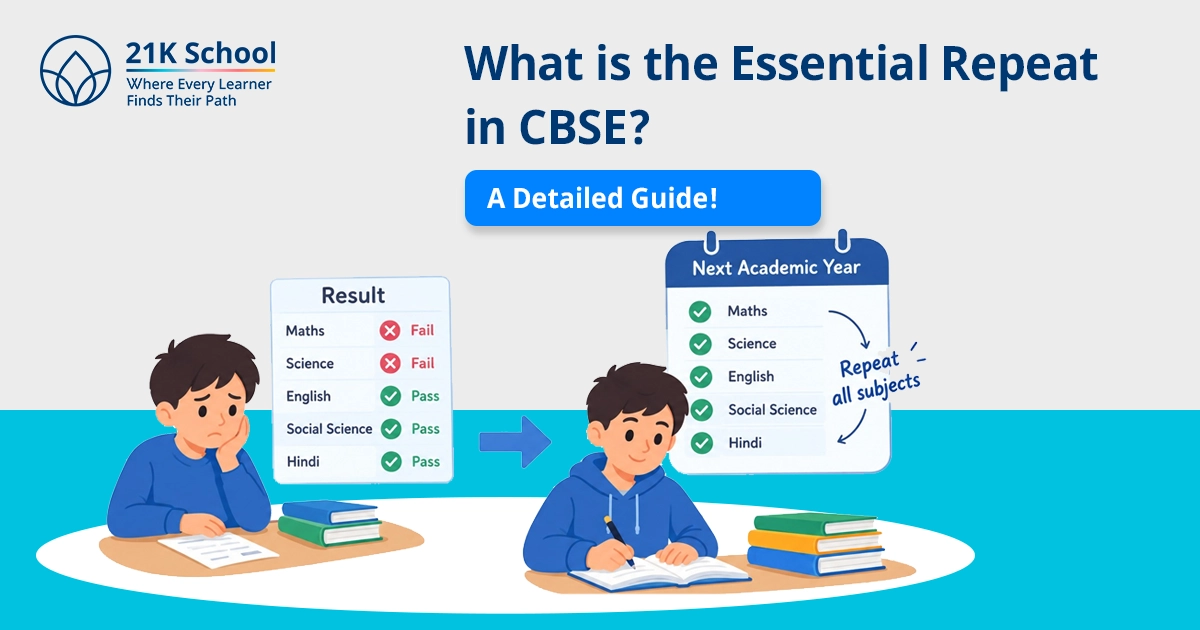
If a student fails a subject in the CBSE Class 10 exam, they are left with a few options that can benefit them and let them pass without wasting their academic year.
Firstly, if you fail in one core subject and have taken an additional subject in Class 10, your additional subjects’ marks will replace your failed subject’s marks automatically.
Secondly, if your failed subject is your additional subject, you still have your passing marks from all 5 main subjects.
But, in case a learner fails in more than one subject, the board usually allows the learner to take the compartment exam so that they can retake the exam in that particular subject.
It can be easily understood from the table below.
| Situation | What could happen |
|---|---|
| Fail one or two subjects | There is an opportunity to take a compartment exam |
| Fail one main subject but good marks in additional subject | The failed subject is replaced by an additional subject |
3. No pass/fail label on marksheet
Pass or fail is not written directly in the CBSE Class 10 marksheet. Instead, the marks and grades for each subject are mentioned. This helps to understand the results of the learners but does not directly use the word fail.
The aim of this system is to reduce the stress of the learners and present their performance in a positive way. Learners can easily understand whether they have passed or not by looking at their marks and grades.
An example table is given below.
| Subject | Number | Grade |
|---|---|---|
| English | 85 | A2 |
| Mathematics | 95 | A1 |
| Science | 97 | A1 |
| Social Science | 74 | B1 |
| Language | 80 | A2 |
Concluding comments
CBSE Class 10 aggregate marks are about 500 marks, as the learners are likely to be taking five major topics, each having 100 marks.
Some learners take an extra subject that is skill-based to use it in the final results. If a learner passes in this additional subject and fails in one of the main subjects, the scores of the former might save the learner from failing and repeating the whole academic year.
Knowledge of such a marking system can avoid misunderstanding among learners as well as their parents and focus on academic performance.
Frequently asked questions
7 questions
Is CBSE Class 10 total marks 500 or 600?
CBSE Class 10 total marks are generally 500. But when a student does an extra subject, then his/her total marks are 600.
How many subjects are there in CBSE Class 10?
Generally, CBSE Class 10 has five main subjects, namely English, a second language, Mathematics, Science and Social Science. Some schools also have the option of taking an additional subject.
What are the passing marks in CBSE Class 10?
The passing marks in CBSE Class 10 in each subject are 33%. This mark is calculated by combining theory tests and internal assessment.
Do CBSE Class 10 results include internal assessment marks?
Yes, there are 20 marks of internal assessment in the total marks in the CBSE Class 10 examination. These 20 marks are collaboratively defined by periodic tests, project work, submitting a notebook, among others.
Can optional subject marks replace those of a failed subject in CBSE Class 10?
Yes, in CBSE Class 10, optional subject marks can replace a failed subject. If a student fails in a main subject and gets fewer marks, then the optional subject replaces the main subject.
How to get 600 marks in 10th class?
If a student takes the exam in every subject and gets full marks in every subject, the total marks can be 600.
What does the CBSE board follow: the best of 4 or 5?
CBSE Class 10 usually follows the guidelines as per the best of five. This means the CBSE Class 10 results calculate the final percentage based on the top five subjects' marks.
About the author
Anshu Kumari
Content Specialist
Anshu Kumari is an Education Content Specialist at 21K School- a fully accredited institute- Cambridge International (IA702) and Pearson Edexcel (94883). She focuses on the in-depth research and creation of the well-drafted guides on NIOS admission, Indian Education Policy, and competitive exam preparation. With around 2 years of experience at 21K School, her psychology background informs her approach to the education content and hence focuses on creating guides to address the real anxieties of the guardians. She writes well-researched articles on competitive exam timelines, stream selection, and board choices by referring to the official resources. All Anshu’s content pieces are fact-checked against the board and primary government official resources and is dedicatedly reviewed by the school’s academic team.
Every 21K School guide is written by our education team and reviewed by a subject facilitator before publishing.
Exploring a CBSE-pathway online school?
Talk to an advisor about 2026–27 admissions — no obligation.
Talk to an advisorComments
No comments yet — be the first to share your thoughts or ask a question.