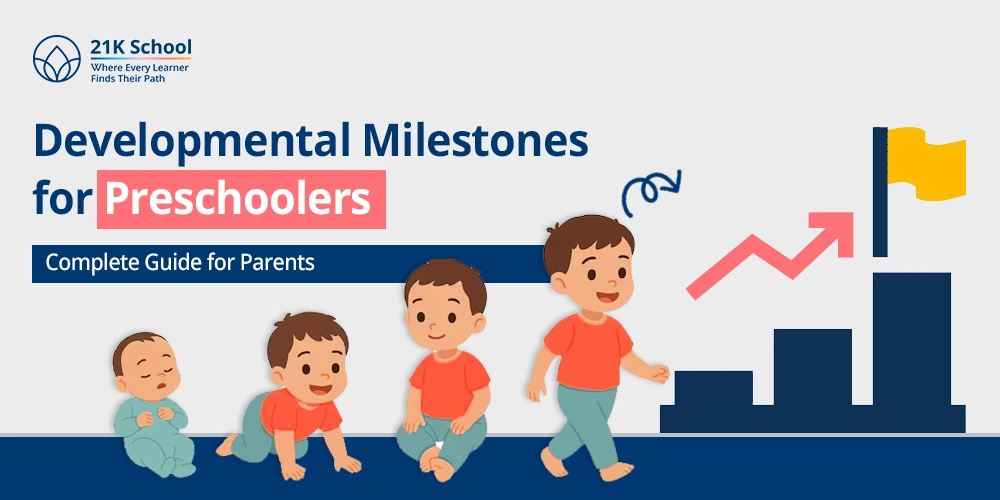
Developmental Milestones for Preschoolers: Complete Guide for Parents
 Written byRahul PalContent Specialist
Last modified: 27 Aug 2026 6 min read
Have you ever thought about what the developmental milestones are for preschoolers?
Preschool is a highly significant stage of development in which children acquire very significant physical, cognitive, language, social and emotional skills.
Developmental milestones would enable parents, teachers and caregivers to be aware of a child’s development as per their age. Follow-up of such milestones will help identify developmental delays at an early stage and consequently avert the presence of delays.
The knowledge of preschool developmental milestones also assists in building nurturing learning environments which promote healthy development, confidence, independence and school readiness.
What are developmental milestones for preschoolers?
Preschool development milestones are skills and abilities that are age-related and that children should have mastered by the age of 3-5 years.
These milestones are used to measure healthy development in the physical, cognitive, language, social, emotional and self-help domains to help track progress in the development of a child by parents and teachers.
1. Developmental milestones at 3 years
Gross and Fine Motor Skills
Children at the age of three years can run, jump, walk up and down the stairs alternately, kick a ball and pedal a tricycle.
Their fine motor skills are also more developed as they draw simple shapes and are able to draw better by using child-safe scissors or crayons to stack blocks.
Language Skills
When children are three years old, they speak short sentences that consist of three to four words; they can easily ask questions and can follow instructions that involve two steps and are familiar with the names of common objects.
Their vocabulary is also increasing rapidly; besides, their ability to communicate their needs, emotions and their day-to-day experiences is also increasing.
Thinking and Learning
Children will begin to recognise colours, shapes and numbers as they will classify things into their sizes or types.
They also embrace pretend play, are able to solve simple puzzles, remember familiar stories, are able to stick to simple routines and demonstrate early curiosity, imagination and problem-solving skills.
Social Behaviour
Children at this age love to play with other children, share and tend to imitate adults and indicate affection to family members. Through play, they are able to learn to cooperate, take their turns and have a feel of simple social rules.
Cognitive Development
Three-year-olds get enhanced memory, attention and reasoning skills. Counting, matching, sequencing and recognition of familiar people and objects are taught to them. Their imaginations are enhanced through storytelling, pretend play and exploration every day.
2. Developmental milestones at 4 years
Gross and Fine Motor Skills
Children who are four years old are able to walk and hop on one leg, play with a bounced ball, climb and be steadier. Fine motor skills develop when they are able to attract people with simple features, copy simple letters, and cut with more accuracy with scissors.
Language Skills
Children will use longer and better articulated sentences, and they will be able to explain and describe events, simple stories and become able to answer questions without any hesitation.
They develop vocabulary and have the ability to share ideas, feelings, and experiences and understand more complex instructions.
Thinking and Learning
Four-year-olds are familiar with letters and are able to count properly, have the simplest basic ideas about time and are able to complete slightly more challenging puzzles.
They pose numerous questions, they love to play with their imaginations, and they are starting to figure out the cause-and-effect correlation in the circumstances that are present in their surroundings.
Social Behaviour
Children become more compliant during group activities; they befriend and get to know how to share and work in a team.
They become empathetic, classroom-conforming, including role-playing, and they are taught to handle their emotions more effectively in their interaction with others.
Cognitive Development
At the age of four, children are enhanced in terms of attention, memory and reasoning.
They learn to discern trends, groupings, comprehend simple comparisons and draw logical conclusions as they are increasingly assertive about thinking and making decisions independently.
3. Developmental milestones at 5 years
Gross and Fine Motor Skills
Five-year-olds can demonstrate improvement in their balance, coordination and strength by skipping, hopping and throwing in the right way.
Their fine motor skills also develop, and they get acquainted with writing letters, drawing detailed pictures, putting on clothes by pressing buttons and handling objects in the classroom with much confidence.
Language Skills
Children speak fluently and use full sentences; they comprehend elaborate orders, and feel comfortable engaging in a conversation.
They already have graphic stories, know a wide variety of letters and sounds and have early reading and writing skills by the time they get into primary school.
Thinking and Learning
The five-year-olds count without any doubts, know numbers and letters, have some basic mathematical knowledge and problem-solving skills as it applies to their age.
They follow instructions step by step, they retain the information and are interested and show curiosity, observing, posing questions and learning things themselves.
Social Behaviour
Children learn to work with peers, rules and regulations, to be compliant on their own part, deal with minor disagreements and establish long-term friendships.
They appreciate fairness, they will hear other individuals, and they will not be afraid to be involved in group conversation, games and fun learning activities in the classroom.
Cognitive Development
Skills at the advanced level of thinking involve planning, decision-making, sequence identification and simple logical relationships, which are at an advanced level among five-year-olds.
They are more focused, memorised, inventive, and prepared to learn sequentially in primary school.
Conclusion
The development milestones can assist parents, teachers and caregivers to become acquainted with the way preschoolers grow and learn during their early years.
It is easier to track these milestones and assist in healthy physical, cognitive, language, social, and emotional development as well as detect any concerns at an earlier stage.
All children develop differently, but with a positive and supportive environment, activities, nutritious food, and emotional support, slow development will be promoted.
Knowledge about the milestones of preschool development contributes to enabling children to have a solid base of lifelong learning and future achievements.
Frequently asked questions
5 questions
What are developmental milestones for preschoolers?
Age-specific skills known as developmental milestones that preschoolers acquire between the ages of 3 and 5 years are in the areas of physical, language, cognitive, social and emotional development.
What age is considered preschool?
Usually, pre-school is defined as a section of children aged 3-5 before they are able to enter into seeking schooling in the primary school.
What are the five areas of preschool development?
These are the five major areas: physical development, cognitive development, language and communication development, social development and emotional development.
How can parents support preschool development?
Encouraging play, frequent reading, healthy nutrition, routine, encouraging socialisation, and a positive learning environment are ways that parents can help in the development.
What are common signs of developmental delays in preschoolers?
The typical symptoms are speech delays, motor clumsiness or inability to be coordinated, ineffectiveness of socialisation, inability to follow simple instructions, inability to maintain eye contact, or inability to develop age-relevant skills.
About the author
Rahul Pal
Content Specialist
Rahul Pal is an Education Content Specialist at 21K School- India’s fully accredited online school recognised by the Cambridge International (IA702) and Pearson Edexcel (94883). His graduation from Journalism and Mass Communication from Swami Vivekananda University gives him a strong foundation in factual reporting, source verification, and investigative research. With around 2 years of experience at 21K School, he has written extensively for the CGPA conversion guides, marking schemes, and Indian and International boards (IGCSE, GCSE, and A-Levels). His articles are highly relevant for the guardians looking to guide their learners for board exam preparation across 78+ countries. All Rahul’s content is reviewed by the school’s academic team to ensure alignment with the latest board guidelines and latest notifications from the official resources
Every 21K School guide is written by our education team and reviewed by a subject facilitator before publishing.
Exploring a CBSE-pathway online school?
Talk to an advisor about 2026–27 admissions — no obligation.
Talk to an advisorComments
No comments yet — be the first to share your thoughts or ask a question.