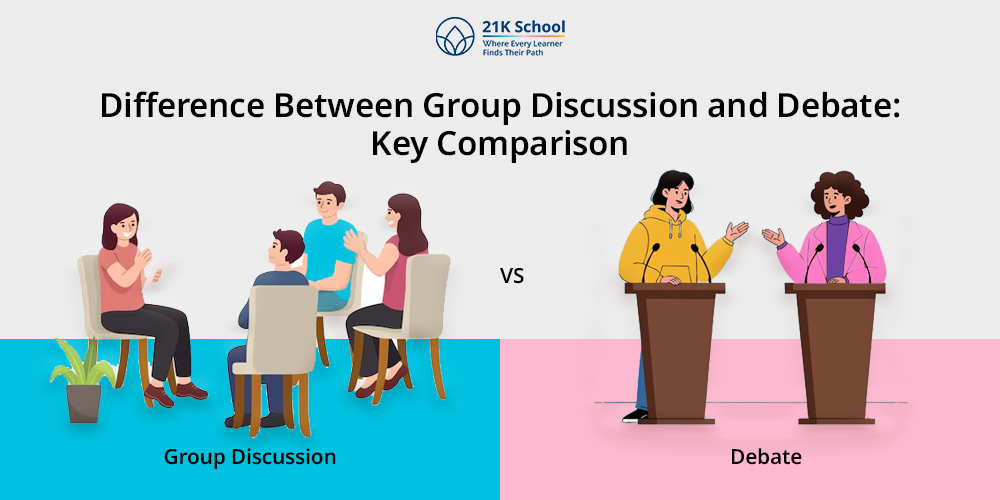
Difference Between Group Discussion and Debate: A Comparative Guide
 Written byAnkita SinghaContent Specialist
Last modified: 23 Oct 2026 7 min read
Communication is a foundation of learning and to enhance it, children from a young age participate in different activities.
Activities such as group discussion and debate are some of the ideal ways conducted by educational institutions.
However, both may look similar but have various differences. Understanding the difference between group discussion and debate is helpful in improving academic growth and communication skills.
Mentioned below is a comparison between group discussion and debate. Also explore how it contributes to students’ learning.
What Is a Group Discussion (GD)?
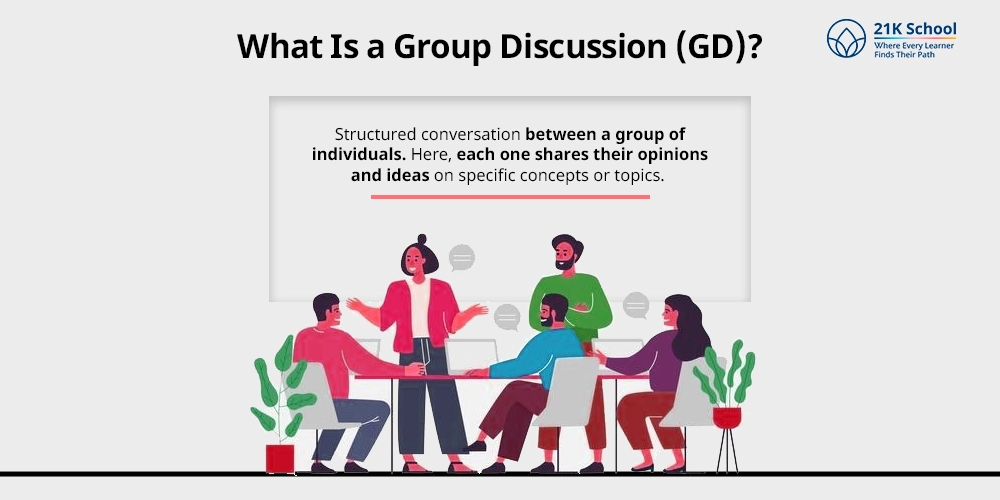
Group discussion also known as GD in short. Structured conversation between a group of individuals. Here, each one shares their opinions and ideas on specific concepts or topics.
Group discussions providing information, analysing each other’s thoughts, and concluding results.
The approach is used to fulfill both academic and professional needs like interviews.
In academics, facilitators help to improve communication skills and professionally recruiters evaluate candidate’s skills.
What Is a Debate?
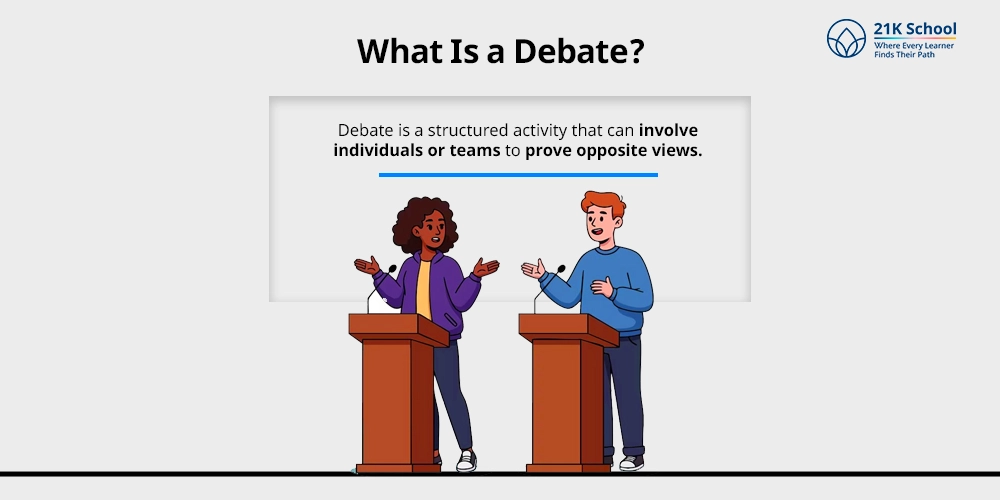
Debate is a structured activity that can involve individuals or teams to prove opposite views.
The main objective of debate is to convince the audience, opponents and judges that their facts, logics and point of view is more accurate and reliable.
Debates are majorly conducted in places like schools, colleges, interviews, and political settings.
Group Discussion vs Debate: 10 Key Differences
Mentioned table is a comparison between group discussion and debate:
| S No. | Aspects | Group Discussion | Debate |
|---|---|---|---|
| 1. | Meaning | Group discussion is an open-ended discussion between various participants to share and analyse ideas on a particular topic. | Debate is a formal argument between two opposing sides presenting contrasting viewpoints on a common topic. |
| 2. | Goal | The goal of group discussion is to exchange ideas, explore perspectives, and arrive at a collective understanding or solution. | The goal of debate is to convince the audience or judges that one side's opinion is correct. |
| 3. | Structure | Group discussions are flexible, interactive, and less rule-bound. | Debates are structured with fixed turns, time limits, and rules. |
| 4. | Nature | It is collaborative and analytical in nature. | It is competitive and argumentative in nature. |
| 5. | Approach | Group discussion encourages students in consensus-building and teamwork. | While debate encourages assertiveness and persuasive reasoning. |
| 6. | Outcome | It focuses on shared conclusions or broader understanding. | Debate focuses on the results in a winning or losing side. |
| 7. | Number of Participants | The number of participants in group discussions are around 4 to 10. | In debate 2 or more speakers per side (individuals or teams). |
| 8. | Tone | Here, the tone is polite, respectful, inclusive, and each individual shares their opinion without chaos. | While in debate the tone is assertive, passionate, and confrontational at times. |
| 9. | Evaluation Criteria | Evaluation criteria used in group discussion are communication, teamwork, analytical ability, and listening skills. | In debate, evaluation criteria used are logic, evidence, clarity, and ability to counter arguments. |
| 10. | Moderator's Role | Roles in group discussion include facilitating discussion, observing, and evaluating. | In debate, the role includes controlling time, enforces rules, and ensures fairness. |
1. Meaning
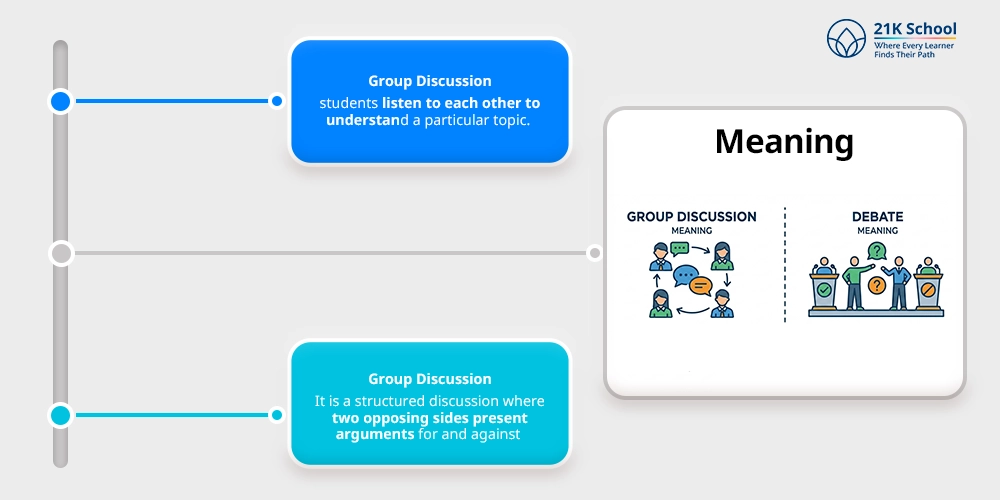
Group Discussion: It is effective because of its exchanging of ideas and concepts. Here students listen to each other to understand a particular topic.
Debate: The debate is a structured discussion where two opposing sides present arguments for and against a specific topic in front of people.
2. Goal
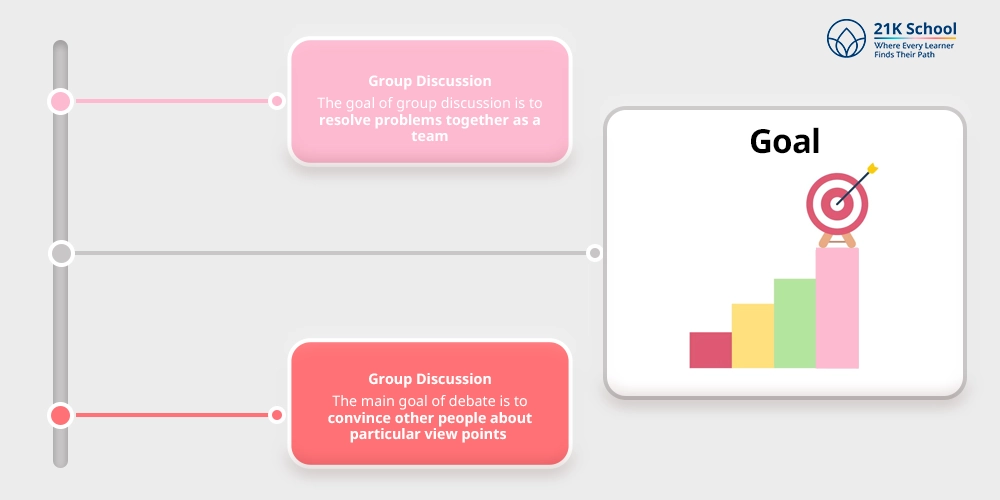
Group Discussion: The goal of group discussion is to resolve problems together as a team to learn in a better environment.
Debate: The main goal of debate is to convince other people about particular view points through researched facts and data.
3. Structure
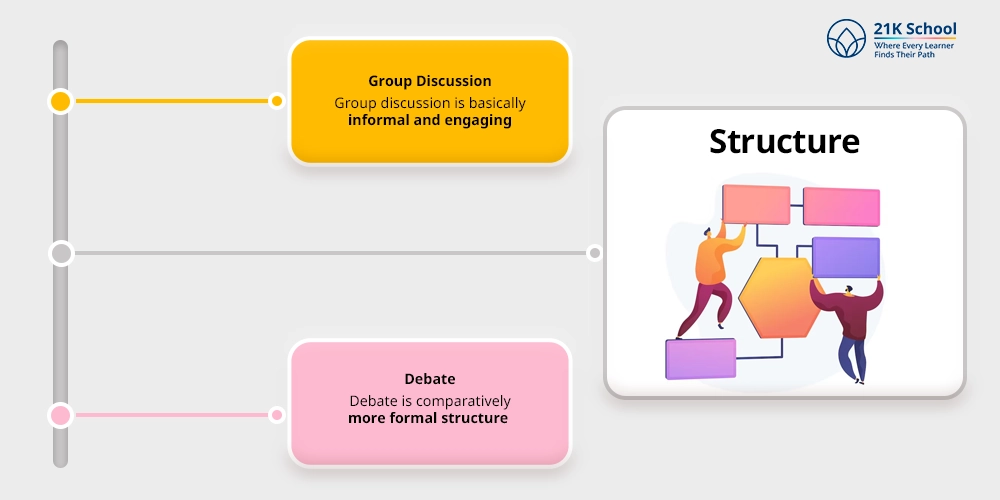
Group Discussion: The structure of group discussion is basically informal and engaging where anyone can share their opinion without any limitations.
Debate: Debate is comparatively more formal structure and sequenced by the organiser to and ensure a good flow of opening statement mid and conclusion.
4. Nature
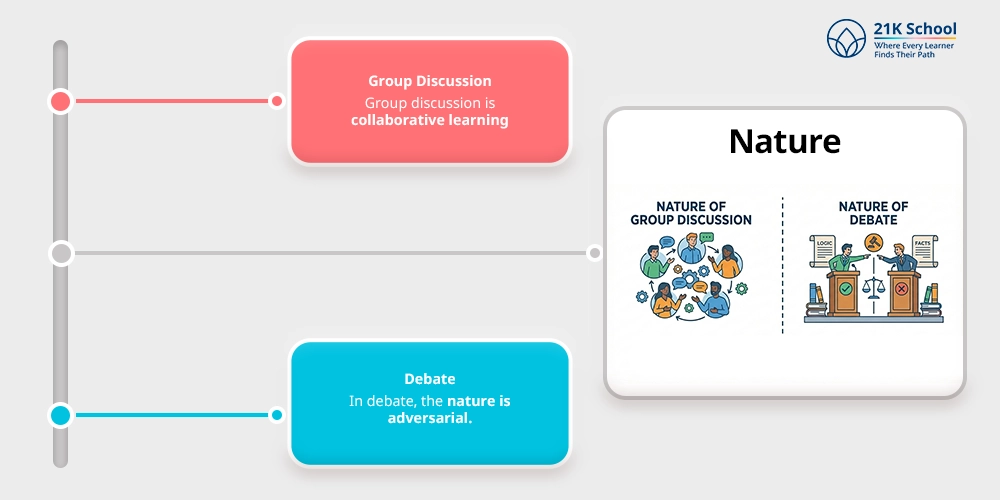
Group Discussion: Group discussion is collaborative learning where each individual is able to participate anytime.
Debate: In debate, the nature is adversarial. Each team tries to explain their part with logic and facts for justification.
5. Approach
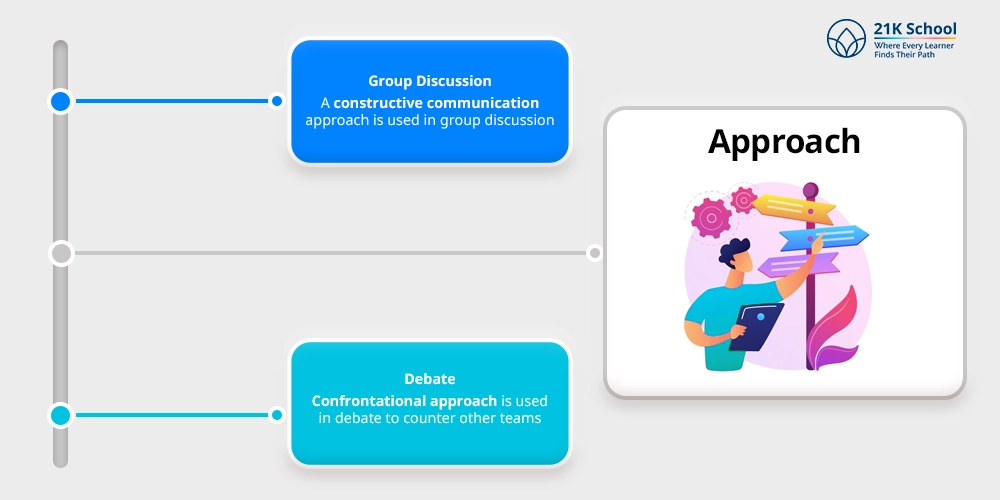
Group Discussion: A constructive communication approach is used in group discussion where candidates work on each other’s ideas.
Debate: Confrontational approach is used in debate to counter other teams.
6. Outcome
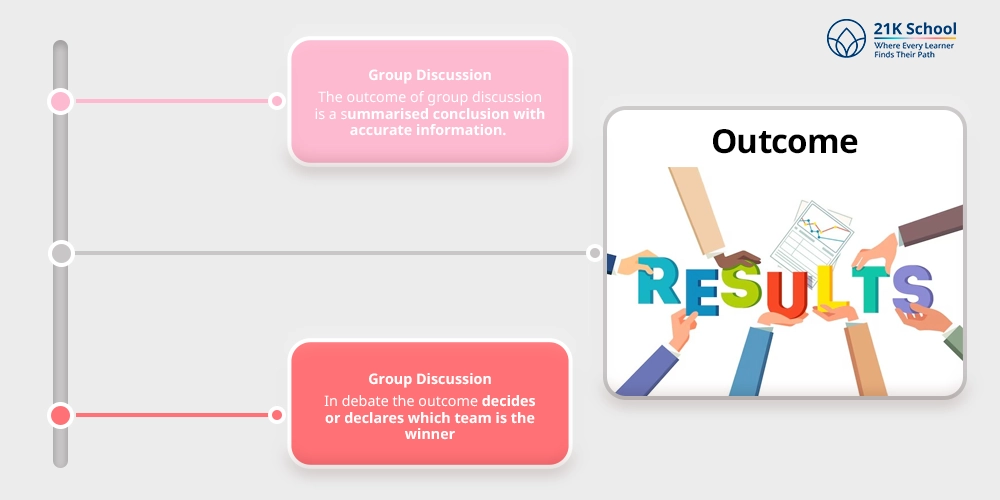
Group Discussion: The outcome of group discussion is a summarised conclusion with accurate information.
Debate: In debate the outcome decides or declares which team is the winner through the judges decision, audience vote and conclusion.
7. Number of Participants
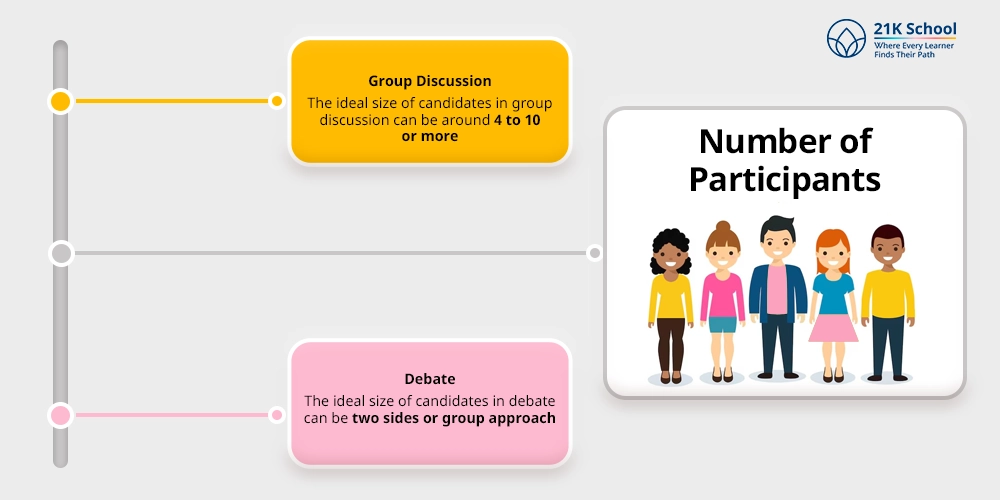
Group Discussion: The ideal size of candidates in group discussion can be around 4 to 10 or more.
Debate: The ideal size of candidates in debate can be two sides or group approach.
8. Tone
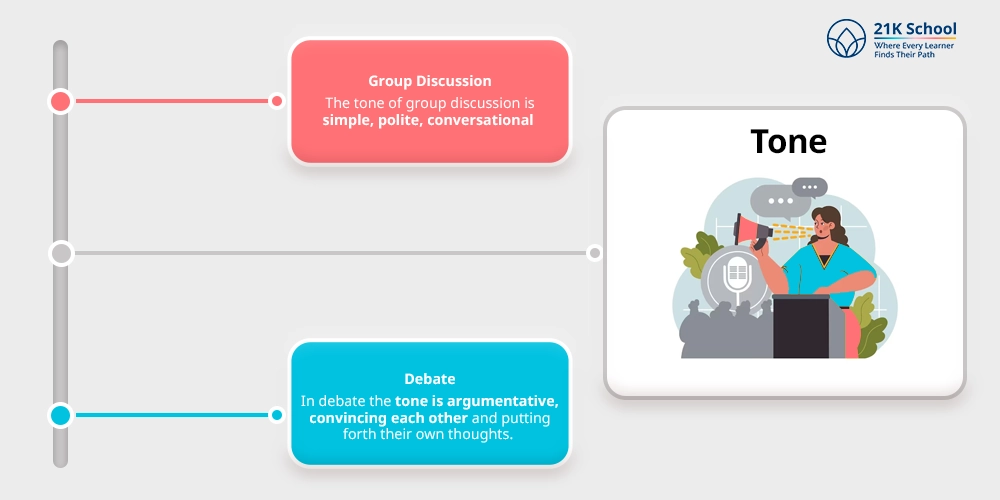
Group Discussion: The tone of group discussion is simple, polite, conversational and learning based.
Debate: In debate the tone is argumentative, convincing each other and putting forth their own thoughts.
9. Evaluation Criteria
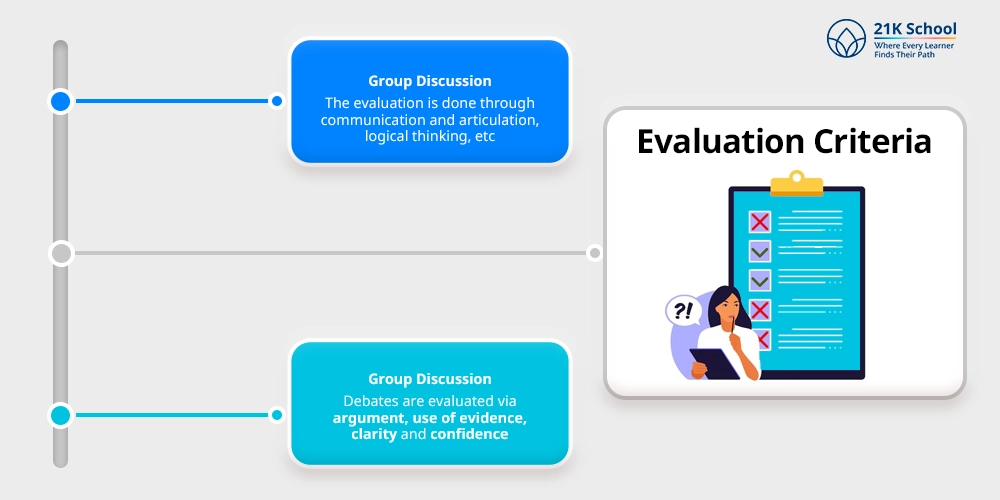
Group Discussion: Here, the evaluation is done through communication and articulation, logical thinking , teamwork and leadership etc.
Debate: Debates are evaluated via argument, use of evidence, clarity and confidence.
10. Moderator's Role
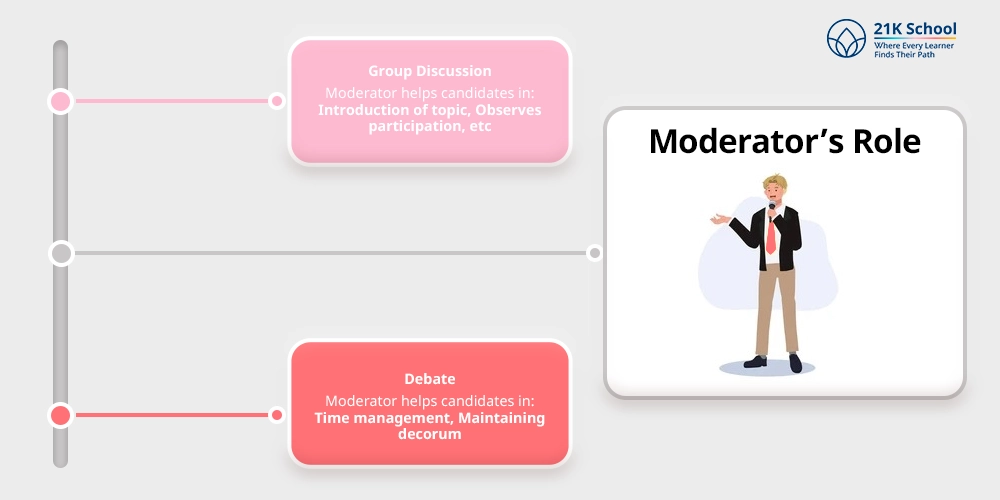
Group Discussion: Moderator helps candidates in:
- Introduction of topic
- Observes participation
- Summarise the discussion.
Debate:
Moderator helps candidates in:
- Time management
- Maintaining decorum
- Winner declaration.
Conclusion
Group discussion and debate are both important for learners to improve their communication and other skills.
The above mentioned top 10 points in table and detailed description on difference between group discussion and debate helps in understanding their right use.
As a parent or facilitator, effective implementation of these approaches reduces classroom learning challenges and ensures future growth.
In the end, mastering group discussion for cooperation and exploration and debate for persuasion and competition bring clarity in mind.
Frequently asked questions
8 questions
What is an example of a group discussion?
One of the common examples of group discussion is 3 to 5 people discussing and analysing each other's opinion on different concepts. For example, modern education or technology in learning etc.
What is the purpose of a group discussion?
Sharing information, unique ideas and guiding each other in difficult concepts is the main purpose of a group discussion between people. In this way one can improve 21st century skills.
What is the role of students in debate?
By researching topics, arguing to prove their side and conclude with informative and logical answers debate is an amazing opportunity for learners.
How do group discussions help students?
Group discussions are ideal activities for students through which they learn critical thinking, communication, and teamwork skills by understanding diverse perspectives.
What are the rules of group discussion and debate?
Group discussion and debate are two different things includes key rule like: active listening. Respectful communication. Allowing equal participation.
Can a group discussion turn into a debate?
Yes, a group discussion turns into a debate if candidates shift from discussion to argument and debate on favour and against.
Which is more important for interviews, GD or debate?
GD and debate are both essential aspects for interviews. A more preferable one is group discussions. This is because it represents individuals' thoughts and approaches. For example, their skills like teamwork, communication, and leadership abilities.
What are the similarities between group discussion and debate?
Some common similarities between group discussion and debate are: Intellectual Exchange: Both need participants to share information and ideas. Skill Development: Both group discussion and debate improve skills like logical reasoning, and communication skills, problem solving etc. Active Listening: Both approaches require active listening.
About the author
Ankita Singha
Content Specialist
Ankita Singha is an Education Content Specialist at 21K School, India’s first accredited fully online K-12 School. She focuses on the in-depth research and creation of the well-drafted guides on early childhood education, school admission processes, and CBSE/ICSE curriculum guidance. With more than 2 years of experience at 21K School, a fully accredited institute- Cambridge International (IA702) and Pearson Edexcel (94883), Ankita works closely with the school’s curriculum heads and academic coordinators. Ankita’s every article reflects on the official board guidelines, practical realities, and current policies of online education in 78+ countries. Ankita’s content has helped thousands of parents in understanding the topics like RTE eligibility, NIOS pathways, and age-appropriate admission criteria.
Every 21K School guide is written by our education team and reviewed by a subject facilitator before publishing.
Exploring a CBSE-pathway online school?
Talk to an advisor about 2026–27 admissions — no obligation.
Talk to an advisorComments
No comments yet — be the first to share your thoughts or ask a question.