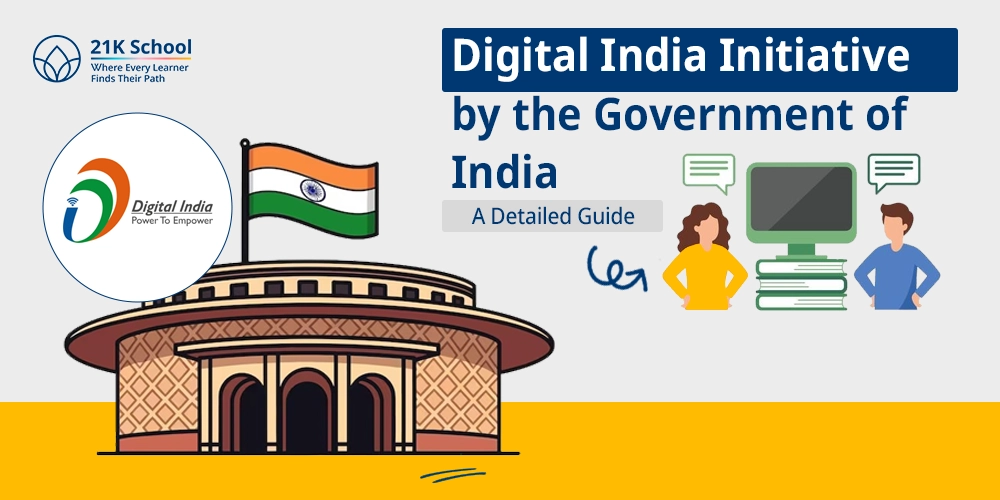
Digital India Initiative by the Government of India: A Detailed Guide
 Written byRahul PalContent Specialist
Last modified: 26 Oct 2026 11 min read
Ever wondered how India is becoming a smarter, faster and more connected nation due to technology?
Digital India Initiative is an initiative programme that has been used by the Government of India to make the country a digitally empowered society and a knowledge-based economy.
The effort will enhance governance and transparency and increase access to technology through the support of online public services, digital infrastructure and digital literacy.
It has transformed other sectors like the education sector, health sector, banking and government services and has made government services more convenient, efficient and accessible to the citizens in urban and rural India.
What is the digital India initiative by the government of India?
Digital India Initiative is one of the flagship projects that were initiated by the Government of India to make the country an empowered digital society and a digital knowledge economy.
It was announced by the Government of India in 2014, and released on 1 July 2015, by Narendra Modi at the Indira Gandhi Indoor Stadium. The program will increase digital infrastructure, increase access to the internet for more people, enhance digital literacy and digitise government services.
Digital India has made education, health, banking, governance, and public services more accessible to citizens both in urban and rural India by providing more accessible and transparent programmes such as DigiLocker, UMANG, BHIM UPI, BharatNet and Common Service Centres (CSCs).
5 objectives of the digital India initiative
Digital India Initiative has great goals which seek to enhance governance, exposure to digital technologies, and technological empowerment in India.
1. Digitally empowered society
Aiming to make every citizen digitally empowered and accessible to online services and technologies is one of the main goals of the Digital India Initiative.
It promotes the utilisation of the Internet, more access to information, and people’s access to technology in education, communications and daily life.
2. Improve digital infrastructure
The project also aims to increase the digital capacity of India by increasing broadband coverage, extending mobile network coverage and increasing reliable internet services.
Developed substantial digital infrastructure will enable citizens, business people and government institutions to have the fruits of digital communication and online services in rural and urban areas.
3. Deliver government services electronically
Digital India aims to enable the provision of government services to be offered digitally, over the Internet, as a way to reduce the amount of paperwork and also provide efficiency.
Services, including identity checks, health, education, payment of taxes and other welfare programmes, can be accessed by the citizens in a more convenient way than ever before, resulting in more transparency, accessibility and quicker service delivery.
4. Promote digital literacy
One of the key goals of the initiative should be to make the citizens digitally literate, i.e., to ensure that they are equipped with the necessary digital skills to be able to use computers, smartphones and the internet effectively.
Digital literacy provides individuals with confidence to utilise online education, online banking services, online government services and employment.
5. Encourage digital inclusion
The program will centre on ensuring that all segments of society, remote communities, women, elderly citizens and the poor benefit from digital technologies.
Digital India eradicates inequality in access to information, government services, education and economic opportunities.
Top 5 benefits of the digital India initiative
Some of the positive impacts of the Digital India Initiative on the people in the country have been better governance, connectivity, provision of digital services, and technology-based services, among others.
1. Improves digital governance
Digital India will enhance good governance in which citizens would be able to access the services of the government through secure online systems.
It also minimises the paperwork, encourages transparency, enhances the speed with which the services are provided and makes administration more efficient, rendering the services provided by the government more available, accountable and friendly to the people.
2. Expands internet connectivity
The project enhances internet connectivity as it expands broadband and mobile networks in the country.
Programs like the BharatNet are tailored towards the rural and remote communities to enable more people to utilise digital services, online learning, health services and government information.
3. Promotes digital literacy
Digital India enables individuals to gain the digital skills required through a number of literacy programmes and training.
Enhanced digital literacy will help individuals to use digital services, online payments, study online, and use government portals without fear or insecurity in their daily lives.
4. Enhances online education
It aids online learning programs by providing online learning platforms, virtual classes and learning resources to students and teachers.
DIKSHA and SWAYAM are such programmes that can deliver high-quality education, flexibility, and inclusivity to Indian learners.
5. Strengthens digital payments
Digital India has increased the adoption of UPI, Bhim and Aadhaar-enabled payment services and other secure digital payment systems.
These systems are optimising cashless payments, financial inclusiveness, convenience and ease of quick, transparent and safe financial transactions.
5 common challenges of the digital India initiative
Nonetheless, the Digital India Initiative has already been experiencing some challenges that affect effective implementation and digitalisation of the country.
1. Digital divide
Among the major issues is the digital divide between the rural and urban regions.
The internet, digital devices and technology are not yet ubiquitous in all remote regions and do not provide equal access to online education, medical treatment, and government services, as well as economic opportunities.
2. Cybersecurity threats
As digital use increases, the risk of cybersecurity issues has increased, such as hacking, phishing, identity theft and data breaches.
The safety of the personal data of citizens and the enhancement of online security policies are crucial in upholding trust in online services.
3. Low digital literacy
The digital skills required to avail the online services to many citizens, especially the rural, less fortunate communities, are not in place.
Low levels of digital literacy lower engagement in e-governance, digital banking, online education, and other technology-based projects.
4. Internet accessibility issues
Despite the heightened level of internet connectivity, the majority of locations continue to be typified by low internet connectivity speed, patchy network coverage and unreliable broadband services.
Such problems of access contribute to restricting the usefulness of online resources and state services.
5. Infrastructure gaps
The need to establish and sustain robust digital infrastructure in a big and diverse country might be a challenge.
The lack of technology resources, poor broadband connections, and digital facilities can slow down the rate of implementation and effectiveness of Digital India programs.
Top 5 major achievements of the digital India initiative
The Digital India Initiative has proved miracles in raising the number of digital services, the connectivity and the pace at which technology is being embraced in the nation.
1. Growth of UPI
Among the greatest success stories of Digital India is the booming success of Unified Payments Interface (UPI).
It has changed the face of online payments by making it quick, secure and cashless, thus allowing access to financial services by individuals, corporations and stores around the country.
2. Increase in internet users
Digital India has given a substantial boost in the rate of penetration of the internet through the boosting of broadband-net and mobile-connections.
The internet has made the services of online education, healthcare, banking, e-commerce and government services available to millions of citizens, including rural citizens.
3. Expansion of common service centres (CSCs)
The program has increased the network of the rural Common Service Centres (CSCs).
These centres take the digital government services, financial services, healthcare and education, among other programmes of government welfare, much closer to the localities of its citizens.
4. Growth of DigiLocker users
Digital India has been urging citizens to adopt DigiLocker, which has helped them to store and access important documents with ease over the internet.
It has minimised paperwork; verification of documents has been made easier, and accessing educational certificates, identity documents and licences has been made easier.
5. Rise of e-governance services
The initiative has enhanced e-Governance in that many services in the government have been available online.
This has made accessing certificates, tax and welfare schemes, healthcare and public services much easier and more efficient for citizens in addition to creating a higher level of transparency.
7 digital literacy programs in India
India has launched various digital literacy programmes in order to enhance digital capabilities, expand access to technologies and also to bring inclusive digital empowerment in India.
1. Pradhan Mantri gramin digital sakshata Abhiyan (PMGDISHA)
Launched in 2017 by the Ministry of Electronics and Information Technology (MeitY), PMGDISHA aims to provide at least one digital device to a rural household with eligibility. The programme discusses the basics of computer use, internet use, making payments online, email use and access to online government services, which promotes digital inclusion in rural India.
2. National Digital Literacy Mission (NDLM)
The National Digital Literacy Mission (NDLM) was launched in 2014 with the intention of imparting fundamental digital literacy to Indians.
It is also sensitive to the development of digital literacy, including computer literacy, integration of the internet, e-mailing and internet safety, to such an extent that people are not scared to use digital technologies to study, work and conduct their daily routines.
3. Digital Saksharta Abhiyan (DISHA)
Digital Saksharta Abhiyan (DISHA) is an initiative launched to enhance the digital literacy of citizens, especially those with limited access to technology.
The programme offers computer literacy, internet, electronic communications, online services, etc in such a way that individuals can experience good use of digital devices in learning, financial services and government services.
4. National institute of electronics and information technology (NIELIT) provides digital literacy courses
Digital literacy courses have been recognised by the National Institute of Electronics and Information Technology (NIELIT), including the Course on Computer Concepts (CCC) and the Basic Computer Course (BCC).
The courses culminate in practical computer skills, online communication, online access, and office software that enhance the online competence and diversity in the exploitation of the students.
5. Digital literacy innovations of common service centres (CSCs)
Common Service Centres (CSCs) provide community-based digital literacy, digital services and training in rural locations.
They train citizens in the use of computers, the internet, online payments, online government facilities and financial inclusion, which assist in closing the digital divide as well as rendering technology available to the underserved communities throughout India.
6. CBSE and state boards Information Technology (IT) literacy programme
Most of the CBSE, as well as State Boards, have incorporated Information Technology in the school curriculum in an effort to equip students with computer-like skills.
These classes include computer literacy, computer fundamentals, internet safety, Office applications and safe use of technology, which will provide students with a basis to continue their studies, work in the digital age, as well as careers in which technology is essential.
7. DIKSHA (Digital infrastructure of knowledge sharing)
DIKSHA is a virtual learning platform and was introduced by the Ministry of Education in 2017 to teachers and students.
It offers online textbooks, online tutoring courses, teacher educator courses, testing/evaluation and multilingual education resources and encourages technology-based teaching, lifelong learning and better educational results in India.
Conclusion
The Digital India Initiative has a revolutionary impact in speeding up the digital transformation in India through enhancing connectivity, increasing the digital infrastructure, and rendering government services more accessible.
It has made a difference in the lives of millions of citizens in the country by offering programs to enhance digital literacy, online governance, digital payments and technology-based education.
Though there are still other risks like cybersecurity and disparity in infrastructure and the digital divide that are still being felt, the existing investments and innovations will transform India into a digitally empowered and inclusive country.
Frequently asked questions
5 questions
What is the Digital India Initiative?
Digital India Initiative is a flagship project started by the Government of India as of 1 July 2015 to transform the digital society and knowledge economy of the country by improving the digital infrastructure, digital services, and digital literacy.
Who launched the Digital India Initiative?
The Digital India Initiative was officially launched by Narendra Modi on 1 July 2015 at the Indira Gandhi Indoor Stadium.
What are the objectives of Digital India?
The major targets of Digital India are to develop a digitally empowered community, enhance digital infrastructure, avail government services in an electronic form, enhance digital literacy, and digital inclusion of urban centres and rural India.
What are the nine pillars of Digital India?
There are nine pillars in Digital India that consist of Broadband Highways, Universal Access to Mobile Connectivity, Public Internet Access Programme, e-Governance, e-Kranti, Information for All, Electronics Manufacturing, IT for Jobs and Early Harvest Programmes.
What are the benefits of the Digital India Initiative?
The initiative enables greater digital governance, improves internet access, improves digital literacy, boosts online education, improves access to government services, and promotes inclusive socio-economic development across the country.
About the author
Rahul Pal
Content Specialist
Rahul Pal is an Education Content Specialist at 21K School- India’s fully accredited online school recognised by the Cambridge International (IA702) and Pearson Edexcel (94883). His graduation from Journalism and Mass Communication from Swami Vivekananda University gives him a strong foundation in factual reporting, source verification, and investigative research. With around 2 years of experience at 21K School, he has written extensively for the CGPA conversion guides, marking schemes, and Indian and International boards (IGCSE, GCSE, and A-Levels). His articles are highly relevant for the guardians looking to guide their learners for board exam preparation across 78+ countries. All Rahul’s content is reviewed by the school’s academic team to ensure alignment with the latest board guidelines and latest notifications from the official resources
Every 21K School guide is written by our education team and reviewed by a subject facilitator before publishing.
Exploring a CBSE-pathway online school?
Talk to an advisor about 2026–27 admissions — no obligation.
Talk to an advisorComments
No comments yet — be the first to share your thoughts or ask a question.