How to Go Abroad for Studies After 12th from India: Everything You Need to Know
 Written byRahul PalContent Specialist
Last modified: 17 Sep 2026 6 min read
Are you dreaming of studying abroad after 12th but don’t know how to begin?
Having completed Class 12, the life ambition of many Indian students who wish to study in a foreign country is to receive quality education, exposure to the world and career opportunities.
This goal may be attained through proper planning, the right selection of courses and proper preparation. Starting with making the right country and university choice and passing the eligibility check, applying to get a scholarship and getting a student visa, all such steps are key.
Awareness of the entire admission process will help students make discerning decisions and will enable them to commence the process of learning in the global world without fear.
Can Indian students study abroad after 12th?
Yes, Indian students can study abroad after they have passed Class 12 as long as they can meet the specifications of the university and the country they are going to study in.
The majority of them presuppose that one needs to have successfully completed the higher secondary level of education and meet minimum academic requirements.
This includes English language proficiency by IELTS, TOEFL or PTE Academic test and providing supporting documents such as academic transcripts, original passport and Statement of Purpose (SOP).
A portion of the courses can also entail an entrance examination, which involves the SAT, ACT, UCAT or the LNATA.
The undergraduate courses of most other countries, including the USA, Canada, the UK, Australia, Germany and Ireland, among others, can be studied by Indian students through planning and doing so in time.
How to go abroad for studies after 12th from India: 12 easy steps
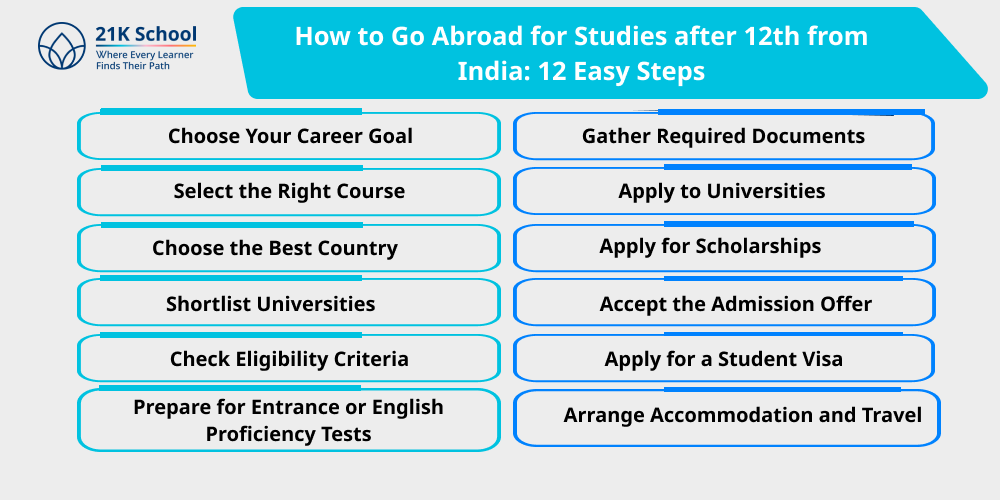
It is a very planned process which involves a lot of preparation, studying and making informed decisions to achieve success in your career and academic dreams during Class 12.
Step 1: Choose your career goal
Decide what you would like to do over the long-term and then select a course or university. Having an understanding of yourself and your career goals will help you make a wise academic decision and choose the programmes that will prove useful to your future career.
Step 2: Select the right course
Choose a course which fits your academic interests and your areas of strength and career aspirations. Research the contents of the research course, qualifications,alification and market demand, and after that, define whether or not you are going to take a specific course.
Step 3: Choose the best country
Some of the criteria that will be used to compare countries to determine which country to pursue your goals include tuition and cost of living, quality of education, visa policy, employment prospects, safety and post-study employment prospects.
Step 4: Shortlist universities
Find research universities that are most preferred to study and then rank them, accredit them, compare university costs to other university costs, student needs, scholarships, the university facilities and university outcomes after the university and then make your final shortlist.
Step 5: Check eligibility criteria
Analyse the eligibility criteria of both universities, including academic entry level, course-related criteria, fluency in English, admission exams and the like, so that you are sure that you meet all the eligibility requirements before you apply.
Step 6: Prepare for entrance or English proficiency tests
Pass and complete the necessary exams like IELTS, TOEFL, PTE Academic, SAT or ACT according to the course or study being pursued, the university and the admissions requirements of the destination country.
Step 7: Gather required documents
Based on the needs of the various countries, prepare the required number of documents, including academic transcripts, passport, Statement of Purpose (SOP), Letters of Recommendation (where applicable), English test scores, financial documents and passport-sized photographs.
Step 8: Apply to universities
Do not rush application forms, delivery of all the necessary documents, the application fee where applicable, and make sure that your applications are in before the official admissions dates.
Step 9: Apply for scholarships and financial aid
One way of making education more affordable is through research merit, research need, government and university scholarships. Apply early to the scholarship and ensure that all the supporting documents are filled in as per the requirements.
Step 10: Accept the admission offer
After getting the offers of admission, compare the Universities and accept the most suitable one. Confirm your enrolment by paying the necessary deposit and going through the enrolment process at the university.
Step 11: Apply for a student visa
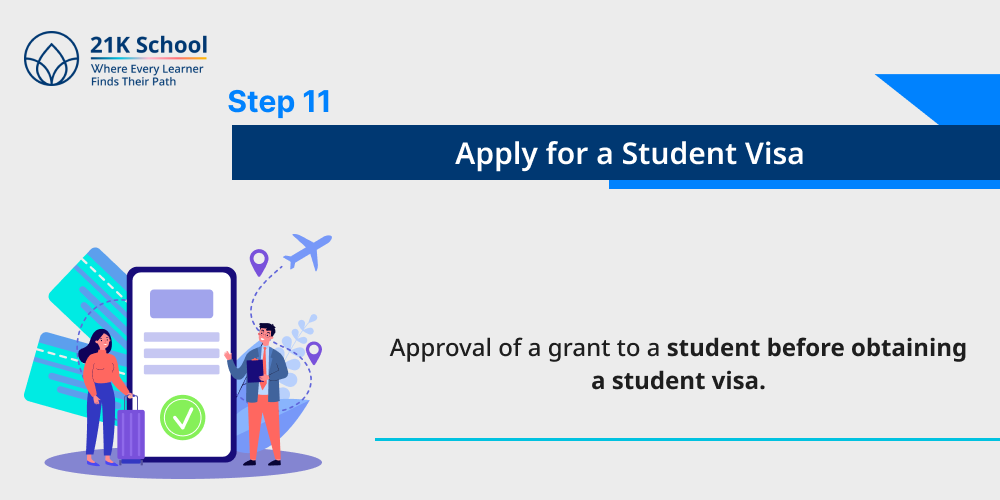
Approval of a grant to a student before obtaining a student visa. Finalise and send all the necessary paperwork, undergo biometrics or interviews as needed and comply with immigration policies of your host country.
Step 12: Arrange accommodation and travel
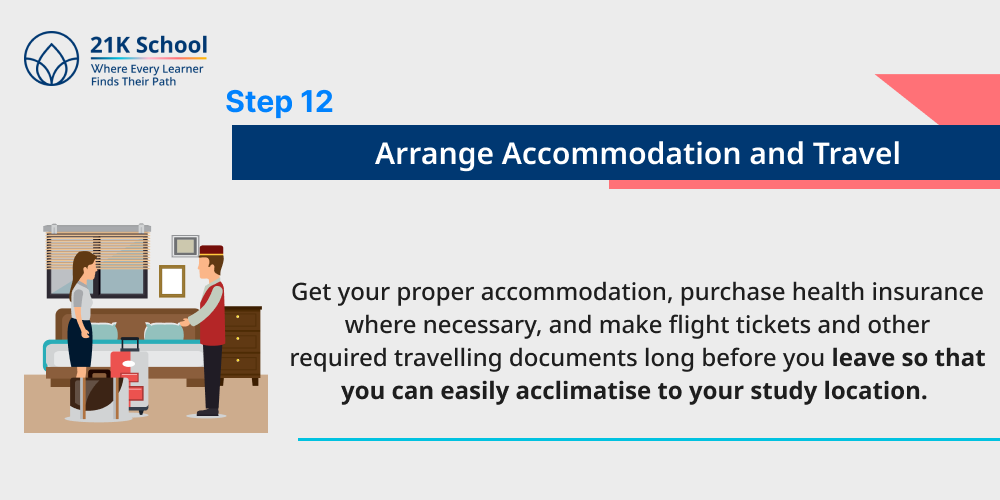
Get your proper accommodation, purchase health insurance where necessary, and make flight tickets and other required travelling documents long before you leave so that you can easily acclimatise to your study location.
Conclusion
Upon completion of 12th, studying abroad in India will enable students to have a good education and international exposure with good career prospects. But this can be done by thorough planning; selecting the right course and university, fulfilling the eligibility criteria, training to enter exams, getting a scholarship, and a student visa.
The awareness of all the steps involved in the application process and early preparations enables students to achieve their goals of higher education in another country and build a successful global career.
Frequently asked questions
5 questions
Can I study abroad after 12th from India?
Indian students are free to come and study abroad with Class 12, provided that they satisfy the admission, academic, language and visa requirements of the university and the country that he/she wants to study in.
Which country is best to study abroad after 12th?
The USA, Canada, the UK, Australia, Germany, Ireland and New Zealand are other popular destinations. The favourite country is subject to your course, budget, career objectives, and whether you like to study in that environment.
What exams are required to study abroad after 12th?
Depending on the course and university, students might be required to have IELTS, TOEFL, PTE Academic, SAT, ACT, UCAT or LNAT. The requirements of different countries and programmes are different.
How much does it cost to study abroad after 12th?
The overall price will vary according to the nation, college and the course. It is generally made up of tuition, housing, living costs, health insurance, travel, and visa.
Can I study abroad without IELTS?
Yes, some institutions do accept TOEFL, PTE Academic, Duolingo English Test or even a record of already-studied English (as an alternative to IELTS).
About the author
Rahul Pal
Content Specialist
Rahul Pal is an Education Content Specialist at 21K School- India’s fully accredited online school recognised by the Cambridge International (IA702) and Pearson Edexcel (94883). His graduation from Journalism and Mass Communication from Swami Vivekananda University gives him a strong foundation in factual reporting, source verification, and investigative research. With around 2 years of experience at 21K School, he has written extensively for the CGPA conversion guides, marking schemes, and Indian and International boards (IGCSE, GCSE, and A-Levels). His articles are highly relevant for the guardians looking to guide their learners for board exam preparation across 78+ countries. All Rahul’s content is reviewed by the school’s academic team to ensure alignment with the latest board guidelines and latest notifications from the official resources
Every 21K School guide is written by our education team and reviewed by a subject facilitator before publishing.
Exploring a CBSE-pathway online school?
Talk to an advisor about 2026–27 admissions — no obligation.
Talk to an advisorComments
No comments yet — be the first to share your thoughts or ask a question.