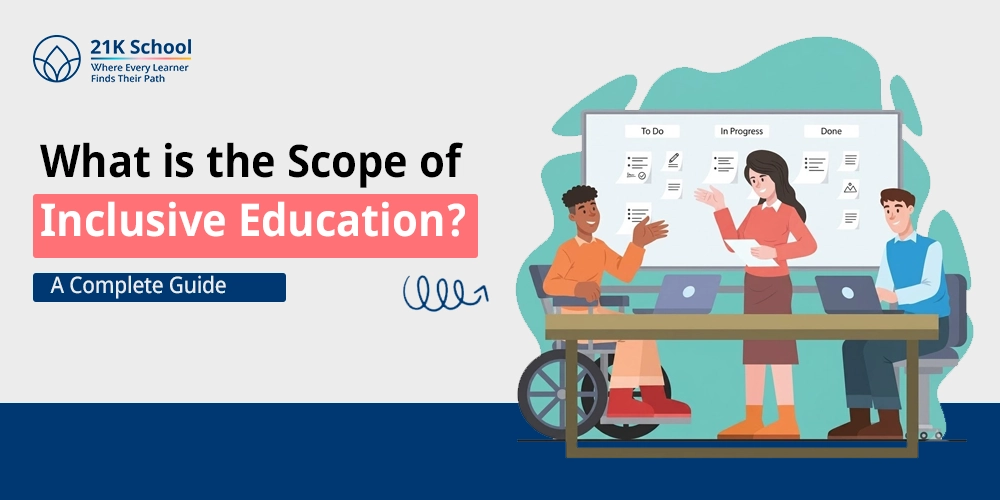
What Is the Scope of Inclusive Education? A Complete Guide
 Written byAnshu KumariContent Specialist
Last modified: 26 Aug 2026 8 min read
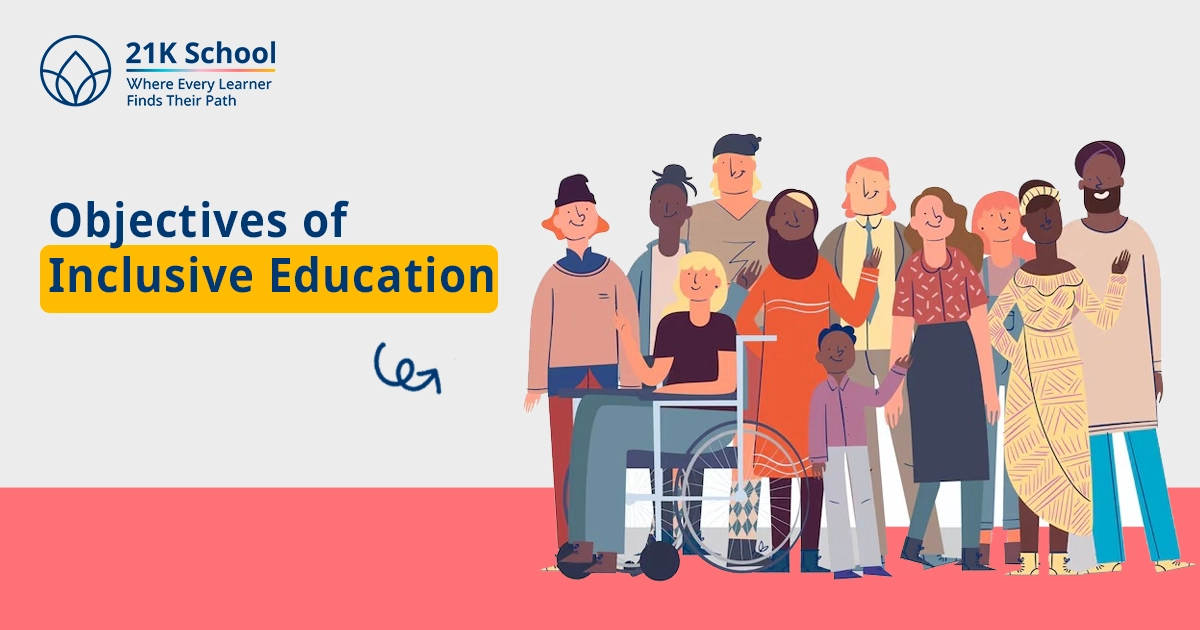
When education is organised with all kinds of children in society in mind, the education that is organised is called inclusive education.
In this education system, all types of children, such as mentally challenged children, children with physical challenges, and other special needs children, have the opportunity to receive education together.
This education system is even more important in India because people of many religions and many languages live together here. As a result, children develop a friendly attitude towards everyone.
To understand how this approach works in practice, it is important to explore the key aspects that define the scope of inclusive education.
What is inclusive education?
Inclusive education means that in the education system, all students are provided with education in the same place.
Here, all students are meant to include normal children, children with special needs, and children with intellectual disabilities.
The aim of this education system is to educate everyone well. In this education system, education is provided to every child. There is no discrimination between them, and they are considered equal.
Importance of inclusive education
The importance of an inclusive education system is immense. In this education system, every child with special needs is given full opportunities according to their abilities, disabilities, and needs.
1. Promotes equality
The main goal of this education system is to treat all types of students in society equally and provide education to everyone. No child should be deprived of mainstream education.
In this approach, no matter the physical, mental, social, linguistic or any other disability of the child, they have the right to education. This education system promotes equality. Here, everyone gets education as an equal.
2. Development of skills
In this inclusive education, all types of children are educated together in one place. Not all children are equally intelligent, and not all have knowledge of everything. Here, everyone shares knowledge with others, which increases their knowledge.
Many students gain knowledge on various subjects. Physically disabled children build confidence within themselves.
Everyone helps each other, which builds their relationship and self-confidence increases, and they become more aware.
3. Builds an inclusive society
In the inclusive education system, all students are treated equally. Students from different religious and linguistic backgrounds learn together. In this education system, the physically disabled, rich and poor children are treated equally.
As a result, the attitude of the students towards everyone is equal. They behave with compassion towards each other. The bond of friendship between them is strengthened.
This education system also makes society an inclusive society because here all types of children grow up together.
4. Economic benefits
In this approach, teaching is adapted to meet diverse learning needs, and students pay more attention to their studies.
There is a system of education for all types of children, so everyone gets quality education, which makes them capable.
Therefore, everyone helps others in the workplace. Even those with physical challenges join the workforce, which provides many economic benefits to their families.
The importance of education is immense in the economic development of a country.
5. Development of society
Since this education system provides education to everyone, an educated society is created.
In this education system, everyone is treated equally, so there is less discrimination among students.
As almost everyone is educated and joins the workforce, it makes society economically strong.
5 key aspects defining the scope of inclusive education
In this education system, all students have equal rights. Here, along with education, a student is made aware of their responsibilities.
1. Equal access to education
The main aspect of this education system is that education is given through integration and socialisation.
Through integration and socialisation, a good understanding and relationship is developed between children with special needs and normal children.
The aim of this education system is to promote education for all. Here, everyone is taught equally.
2. Inclusion of children with disabilities
In this approach, everyone is given equal opportunities in education. Every type of child, including physically disabled and financially weaker students, is taught in the same place as normal students.
Here, teachers have to explain and teach in a way that students can understand. This increases the morale of physically disabled students.
3. Cultural and linguistic diversity
Here, children of different language speakers get their education from the same place. Students of all cultures get an education with equal rights in this education system.
As a result, linguistic or cultural discrimination is not observed among students. All students get an education by mixing with everyone.
4. Inclusion of socio-economically disadvantaged students
This education system provides equal rights to education to all. In this education system, children of rich and poor people sit in the same place and get education in the same way.
As a result, children of poor society become interested in education. Here, unity is created among them due to the fact that all types of children get education in the same place.
5. Teacher training and professional development
In this model, the role of teachers is very high, and they have to be very skilled. Here, all types of learners are educated, so teachers need to have knowledge about various kinds of children.
In particular, they have to gain knowledge about physically challenged students. They need continuous professional development to support diverse learners. They have to treat students well.
4 benefits of inclusive education
In this education system, students get a lot of benefits. Since students are kept away from discriminatory practices, their morale increases.
1. Increased confidence
Here, the students get to know each other very well because they are gaining education in the same place.
Students with special needs also get motivated when they see themselves getting an education with normal students. They start trusting themselves. All the students respect and honour each other. This increases the confidence of the students.
2. Professional growth
In this education system, different types of students study together, so students are aware of different cultures and languages. Students do group projects here, which helps them in teamwork in their professional life.
Since they have to mix with everyone and adapt to everyone’s opinions to gain an education. They develop good relationships with each other, which helps them in their professional life. They are aware of their responsibilities.
3. Enhanced collaborative learning
One of the benefits of this method of education is that a diverse range of students are educated here, so they are aware of each other’s cultures and languages. This helps them to do group work.
When students undertake group projects or group-wise learning, their cultural and language skills come in very handy. A good understanding is created between them, which helps them to succeed in their group projects.
4. Academic improvement
This teaching method helps the students in their academics. Since there are all types of students here, the teachers have to teach in a way that makes it easier for the students to understand. When students understand any topic better, they gain good knowledge.
Therefore, the knowledge stays in their minds for a long time and helps a lot during the exams.
Since all the students have to get their education from the same place, a good relationship is created between them, which helps them academically.
2 challenges of inclusive education
Although students benefit greatly from an inclusive education system, some challenges can be observed.
1. Inadequate infrastructure
For this education system, the school infrastructure has to be improved a lot. Here, all types of students get education from the same place, so the school infrastructure has to be improved by keeping an eye on everyone.
There is a lack of good labs and libraries in the school; they have to be improved. Now in this digital era, institutions have to arrange digital classrooms for the students.
Since physically disabled students study here, this structure has to be made considering them.
2. Lack of trained teachers
Teachers need to be more skilled to provide inclusive education. In this education system, all students are taught in one place with equal rights. Therefore, teachers should teach in a way suited to the students so that the students can understand easily.
Keeping in mind the students with special needs, teachers should teach in their own way so that they can understand easily. Since India is a country of different cultures and languages, teachers here need to be aware of other cultures and languages.
Conclusion
The main goal of an inclusive education system is to spread education among all. This education system is designed so that everyone can get an education equally. Here, students have to get an education with everyone.
No distinction is made between any students here so that they do not face or practice discrimination. Normal, physically disabled, rich, poor, all types of students are provided with education at the same time and equally. Here, teachers also have to manage everyone
About the author
Anshu Kumari
Content Specialist
Anshu Kumari is an Education Content Specialist at 21K School- a fully accredited institute- Cambridge International (IA702) and Pearson Edexcel (94883). She focuses on the in-depth research and creation of the well-drafted guides on NIOS admission, Indian Education Policy, and competitive exam preparation. With around 2 years of experience at 21K School, her psychology background informs her approach to the education content and hence focuses on creating guides to address the real anxieties of the guardians. She writes well-researched articles on competitive exam timelines, stream selection, and board choices by referring to the official resources. All Anshu’s content pieces are fact-checked against the board and primary government official resources and is dedicatedly reviewed by the school’s academic team.
Every 21K School guide is written by our education team and reviewed by a subject facilitator before publishing.
Exploring a CBSE-pathway online school?
Talk to an advisor about 2026–27 admissions — no obligation.
Talk to an advisorComments
No comments yet — be the first to share your thoughts or ask a question.