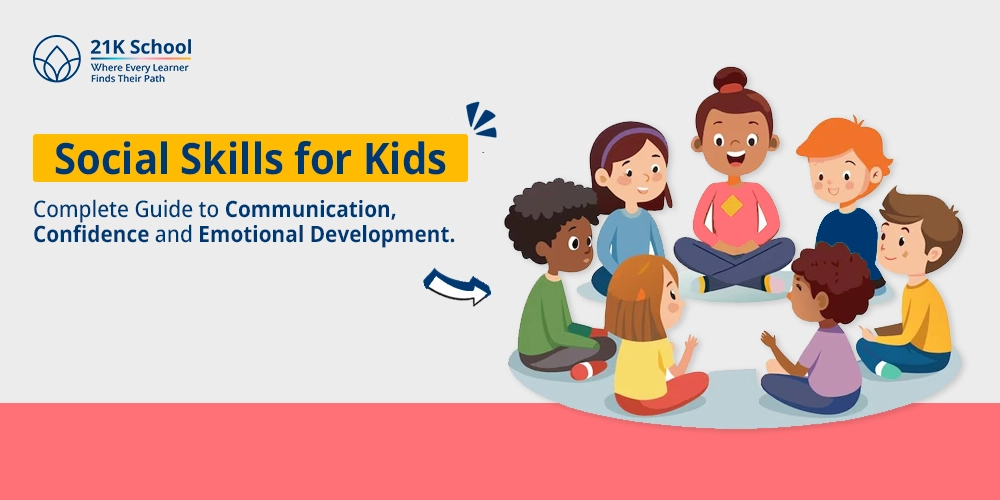
Social Skills for Kids: Complete Guide to Communication, Confidence and Emotional Development
 Written byAnshu KumariContent Specialist
Last modified: 25 Aug 2026 12 min read
A social skill is any competence facilitating interaction and communication with others where social rules and relations are created, communicated, and changed in verbal and nonverbal ways. Children acquire social skills from society.
Social skills help children academically, emotionally, and in the future. In this digital age, social skills are even more important because now many children are increasingly dependent on digital screens.
As a result, kids have moved away from face-to-face communication. Children have to rely on interaction, observation, communication, reading, school, and society to develop social skills.
So, let us now explore some fun and effective social skills activities and games designed for different age groups.
What are social skills for kids?
Social skills are the abilities that children use to communicate and interact with each other both verbally and non-verbally through gestures and body language.
All these social skills are acquired by children from the behaviour, speech, and movement of people in society. All these social skills teach children to communicate with each other.
The importance of social skills in building a child’s mental and self-confidence is immense.
5 importance of social skills for kids
Social skills are of immense importance in the growth of a child because a child is not born knowing social norms. Children learn their speech and behaviour from their family and society.
1. Improves academic success
Socially competent children often tend to pay better attention to their studies. Students who are socially competent listen to the teacher’s lectures attentively in class. They can easily adapt to teachers and friends.
Socially competent children clear their doubts by asking the teacher in class and enjoy studying in groups.
They talk to each other and become aware of their communication skills. By mixing with students from different societies, they become aware of the culture of other societies.
2. Builds healthy relationships
Social skills play an important role in the formation of friendships in children. Through social skills, children respect each other, which helps them develop good relationships and helps them a lot in their academic life.
As a result, if students do not understand a topic after listening to the teacher’s lecture in class, they understand it later from their friends. Children study in groups, so they become aware of teamwork.
3. Enhances communication skills
Socially skilled children can easily blend in with their peers. When a child is socially skilled, they speak very patiently and well so that they do not say anything wrong. Children speak with respect to teachers.
Good communication reduces mistakes and helps peers understand them. Children with social skills know where to talk to whom and how.
That student is always alert so that no mistake is made, and even if they make a mistake while speaking, they can easily correct it. Communication skills help a lot in future academic life and the professional life of the student.
4. Promotes confidence and independence
Socially competent children can easily adapt to any society. When children are socially competent, their work is less likely to be wrong. Those students can easily blend in with their peers.
Socially competent children do not depend on their peers to solve any problem. These students know how to solve problems, so they try to solve them themselves. This increases their confidence.
5. Reduces behavioural problems
Children's behaviour is influenced by their environment and experiences. Children from a good family and society have good behaviour.
A socially competent child knows how to behave with whom. These skills help children maintain mental health.
Socially competent children have good aspects like respect for their elders, speaking, and following rules.
Due to good behaviour, they can easily establish good relationships with their elders. This education teaches children how to express their feelings.
Top 10 social skills for kids
It is very important for every child to acquire education on social skills. If those children are proficient in social skills, they will benefit a lot in their educational life as well as in their working life.
1. Communication
Communication is one of the most important social skills. The better a child’s communication skills, the stronger their relationship with others will be.
To improve communication skills, children should talk well with their superiors and listen carefully to others. These communication skills play a very important role in a child’s education as well as in their work life.
Children improve their communication skills by doing group studies in their class. They feel comfortable asking teachers questions.
2. Empathy
Empathy lets a person figure out another’s ideas and feelings. Empathetic children always come forward to help others.
This is very important because when a child is in trouble, others come to his side with empathy.
This strengthens the friendship between them. In professional life, everyone has to work within a team, so if a teammate has a problem, the other has to do that work with empathy.
3. Cooperation & teamwork
Children learn in groups in school, so they are now aware of social skills. Studying in groups teaches them to cooperate with each other.
Since they learn in groups, everyone has to respect each other’s opinions. Students have to work responsibly.
Group studies improve their relationships with each other. Group-wise education increases the students’ confidence and leadership skills.
4. Sharing & turn-taking
Being fine with sharing toys or food helps children greatly while making and maintaining new friends.
Research in developmental Psychology shows that kids who are only a couple of years old show signs of wanting to share with other people.
Turn-taking conversation is a situation where one child speaks while the other listens attentively.
Turn-taking increases children’s patience. When a child listens attentively to another, it increases their confidence.
As a result, differences between them are reduced, and friendships are strengthened.
5. Active listening
Active listening is the skill of closely following what another person is conveying. Active listeners are held in high esteem in the workplace because they pay attention to others and are respectful.
Children who listen attentively will see their communication skills grow and help them understand each other better.
When a student listens attentively to a teacher’s lecture, that student can understand the entire topic better. Listening skills help children increase their patience.
6. Respect and good manners
Central to being respectful is having an idea of when to react or start a discussion.
When in a meeting, letting another person talk without interrupting is crucial to showing respect for another.
Socially skilled children know very well who to respect and how to respect others. Politeness usually comes from society.
When children respect each other, their relationships will be good, which helps them in their education. Good behaviour improves a child’s personality.
7. Self-regulation & emotional control
Self-regulated children can control their emotions, which helps them stay away from conflicts with each other.
Children often become angry and frustrated. It helps them reduce this anger or frustration.
When children can control themselves, they become more focused on their academic studies.
8. Conflict resolution
Conflict resolution teaches children to respect each other. Conflict resolution is of immense importance in building good friendships among them.
Problems can arise in friendships, but this conflict resolution skill teaches them to try to solve the problem instead of fighting over it.
As a result of this skill, children learn to forget their differences and solve problems. This skill reduces aggressive behaviour in children.
9. Following directions
Following directions is an important part of a child’s life. Children have to learn to follow directions. If the teacher gives a task in class, it has to be completed according to the instructions. This skill helps children maintain discipline in the class.
If a child wants to achieve good results, this skill is mandatory. Children have to take responsibility for themselves and follow these instructions.
This skill shapes the mindset of a child. Following directions helps children a lot in their later life.
10. Respecting boundaries
Each child must respect each other. Each must be aware of respect. Respect here means prioritising the personal space and privacy of others.
Each student has different privacy and behavioural needs. Not everyone’s style of speaking is the same.
Therefore, everyone has to look at their personal boundaries. Understanding boundaries helps in building good relationships. As a result, respect and esteem for each other increase.
10 fun social skills activities & games for kids
Children learn through various types of play. Through all these games, children gain knowledge with joy. Children learn patience, attention, problem-solving skills, teamwork, and communication.
1 activities for younger children (Ages 3-6)
1.1 Emotion Charades
Emotional charades is a game of acting. In this game, one person is chosen from a group of children to act.
In this fun activity, children recognise and name emotions, like happy, sad, angry, etc. The rest have to guess the child’s acting by watching that child.
This develops emotional awareness in children. This fun activity increases children’s ability to recognise and understand emotions. Children learn about empathy through this game.
1.2 Roll the Ball
In the game of Roll the Ball, children have to sit in a circle and play. In this game, there is a ball, and the ball is played by rolling it upwards. Children are asked to say various things like month, colour, name, etc.
The child who gets the ball has to say it, and then the ball has to be rolled towards the others. In this way, children gain the ability to concentrate and pay attention. Children also learn to give each other a chance.
1.3 Compliment Circle
Compliment Circle is a game where children sit in a circle. Here, each child has to say something nice about the friend sitting next to them. This game teaches children to think positively about others. It develops good thoughts in children.
Good friendly behaviour is developed among children. Since children learn to think well of others, it makes them kind and increases communication skills.
1.4 Puppet Shows
Children can learn through acting by creating stories using puppets. Here, children try to understand the perspective of others. Children learn to share friendships and solve problems.
Through this game, children increase their creative thinking skills. Children’s communication skills also improve.
1.5 Simon Says
The game of Simon Says is played in a group. One person from the group is chosen as “Simon.” Simon gives an instruction to the others, and they must listen carefully and follow that instruction. Anyone who fails to follow the instruction is eliminated.
For example, when Simon says, “touch your nose,” the others must follow the instruction and touch their noses.
Anyone who doesn’t touch their nose is eliminated. This game basically improves children’s listening skills and helps them make quick decisions.
2. Activities for older children (Ages 7-12)
2.1 Cooperative Board Games
Cooperative board games like Hoot Owl Hoot. In this game, everyone enjoys the fun together. In this game, they cooperate with each other. In this game, children’s problem-solving skills improve.
In this game, there are rules; children have to follow those rules and play, which increases children’s ability to obey.
2.2 Would You Rather?
In this game, children are given two options, from which they have to choose one and answer it. It is a fun and simple game. It supports higher-order thinking and makes a great tool for the classroom.
It teaches students to think deeply and express their opinions. Children’s ability to listen patiently to others increases. As a result, children’s respect for others and communication skills increase.
2.3 Friendship Bracelet Making
Children make friendship bracelets as a symbol of friendship. This strengthens the bond between them.
Friends learn to live together; there is no conflict between them. It teaches children to cooperate with each other. Creative work deepens social bonds.
2.4 Community Garden Project
In the Community Garden Project, children plant trees together. As a result, children become aware of their own sense of responsibility. By watering and regularly caring for the trees, children learn patience and cooperation.
Since this project has to be done within a group of children, children learn to get along with everyone here and become aware of teamwork.
2.5 Improvisational Storytelling
In this game, children have to tell a story from within the group, and each one has to add some part to the story.
Here, each child adds a part to continue the story after the others have finished telling it. Stories help to explain emotions.
It implements behavioural learning. When a child listens to a story, they remember the story for a long time. This later helps in their personal life.
Through stories, children easily understand examples. Social behaviour is learned through stories. How to behave and talk to whom is explained through stories.
Conclusion
Children usually acquire social skills from society. This is one of the most important foundations of children’s lives.
Children learn communication and behaviour from family and society. When a child is socially competent, they solve any problem on their own.
From here, students become aware of teamwork. Their communication skills increase. They become sympathetic towards each other.
Frequently asked questions
5 questions
Why are social skills important in childhood?
Social skills help children with their communication skills, confidence, emotional development, and education.
How can parents teach social skills at home?
Parents encourage their children by talking to them, arranging playtime for them, and encouraging good behaviour.
What activities improve children's social skills?
Activities essential for improving children's social skills include parent play, board games, and team sports.
What causes poor social skills in children?
The reason why children's social skills are poor is due to less interaction with parents and more time spent behind screens.
Does too much screen time negatively impact social skill development?
Yes, too much screen time has a negative impact on social skill development. As a result, communication skills deteriorate, attention span decreases, and behaviour deteriorates.
About the author
Anshu Kumari
Content Specialist
Anshu Kumari is an Education Content Specialist at 21K School- a fully accredited institute- Cambridge International (IA702) and Pearson Edexcel (94883). She focuses on the in-depth research and creation of the well-drafted guides on NIOS admission, Indian Education Policy, and competitive exam preparation. With around 2 years of experience at 21K School, her psychology background informs her approach to the education content and hence focuses on creating guides to address the real anxieties of the guardians. She writes well-researched articles on competitive exam timelines, stream selection, and board choices by referring to the official resources. All Anshu’s content pieces are fact-checked against the board and primary government official resources and is dedicatedly reviewed by the school’s academic team.
Every 21K School guide is written by our education team and reviewed by a subject facilitator before publishing.
Exploring a CBSE-pathway online school?
Talk to an advisor about 2026–27 admissions — no obligation.
Talk to an advisorComments
No comments yet — be the first to share your thoughts or ask a question.