Talent vs Skill: Explore the 15 Key Difference
 Written byAnkita SinghaContent Specialist
Last modified: 2 Sep 2026 8 min read
Do you know the difference between talent and skill?
To become successful, learners need to focus on their talents and skills. Talent is a natural ability, while skill can be picked up to become efficient.
Many people often believe that both talent and skill are the same. That’s not true. There are some key points which make both terms different from each other.
The combination of both talent and skill also helps students achieve academic excellence and career growth.
What is talent?
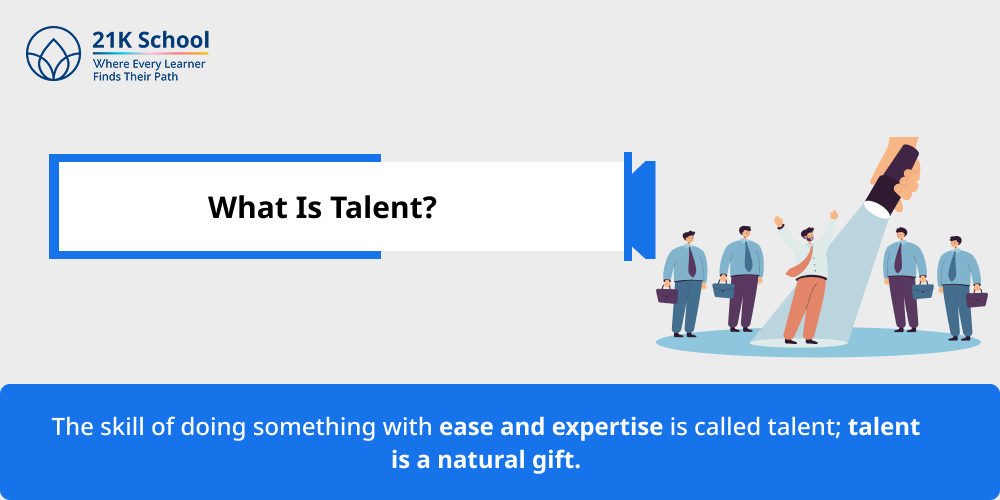
The skill of doing something with ease and expertise is called talent; talent is a natural gift.
It is an inborn ability that causes one to have an inclination to perform specific tasks or activities easily. It can be anything from academic tasks to sports and music.
Each individual has different talents which need to be nurtured to get the maximum benefit in future.
What is skill?
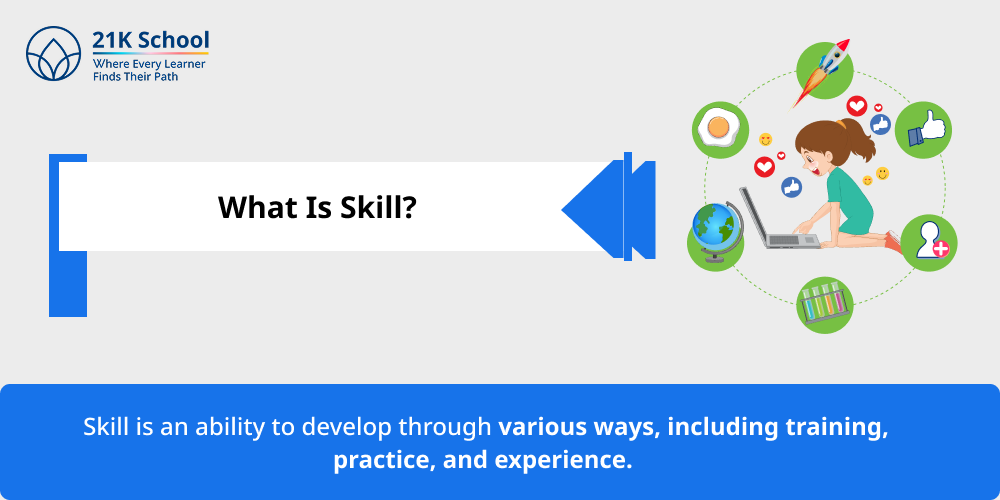
Skill is an ability to develop through various ways, including training, practice, and experience.
Learners need to focus on future-ready skills to become efficient in academics and jobs. Remember, a skilled learner always becomes more successful in life.
Talent vs skill: 15 key differences
Both talent and skill development are different. The difference between talent and skill is given below.
| S.No. | Particulars | Talent | Skill |
|---|---|---|---|
| 1. | Meaning | It is a natural ability or aptitude that a person is born with. | It is a learned ability developed through training, practice, and experience. |
| 2. | Origin | Inborn and inherited | Acquired |
| 3. | Acquisition | Present naturally | Develop over time |
| 4. | Characteristics | Comes effortlessly by birth | Require continuous practice |
| 5. | Development | Practice to reach full potential | Systematically developed through structured learning . |
| 6. | Training Requirement | Don’t require formal training. | Requires formal training. |
| 7. | Effort Needed | Less effort required | More effort required |
| 8. | Improvement | Improved through exposure and practice. | Improved through regular practice and experience. |
| 9. | Availability | Not everyone possesses the same talents. | Almost anyone can develop a skill. |
| 10. | Speed of Learning | Natural talent | Depends on effort and practice |
| 11. | Dependence on Practice | Practice is still needed. | High practice is required. |
| 12. | Career Impact | Useful for specific fields | Ideal for professional growth |
| 13. | Recognition | Often noticed early | Earned through performance |
| 14. | Sustainability | May fade if not nurtured or used | Strengthens with continuous use |
| 15. | Example | Singing, drawing, or dancing | Coding learning instruments |
1. Meaning
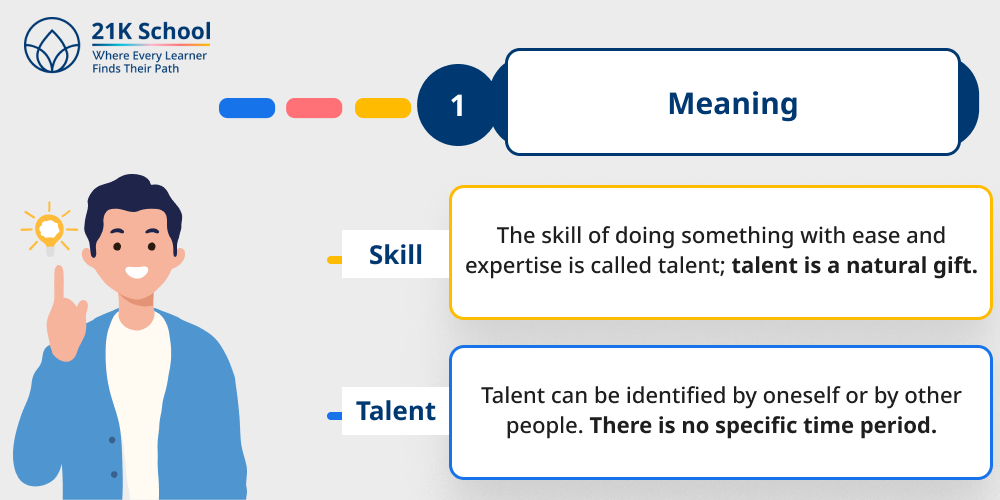
The skill of doing something with ease and expertise is called talent; talent is a natural gift. Skill is the ability to perform certain tasks effectively through learning and practice.
Talent can be identified by oneself or by other people. There is no specific time period. Learners can identify it at any age, from a young age to an older age. But skill may vary because it is not inherited. Skill can be developed anytime, as per academic or personal needs.
2. Origin
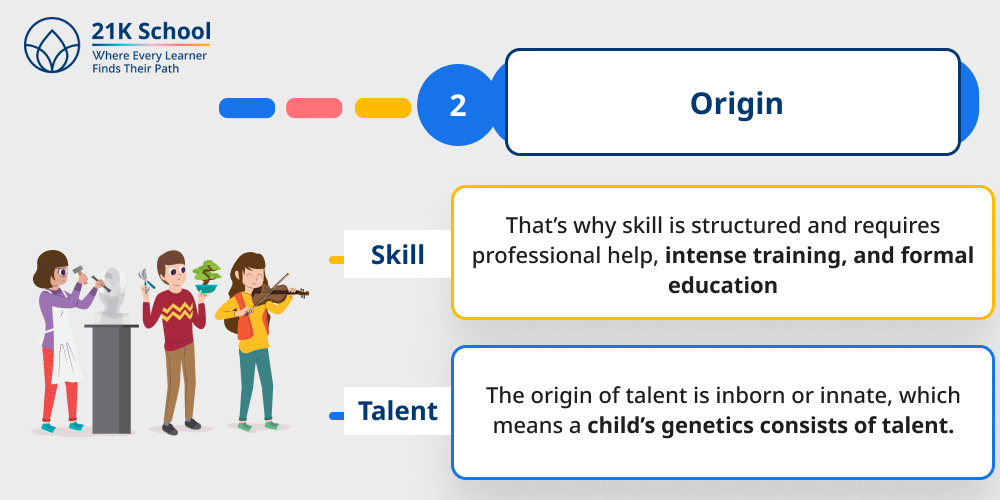
The origin of talent is inborn or innate, which means a child’s genetics consists of talent. For example, the talent of singing, dancing, or mimicking. But skill is not inborn. It is developed over time through learning and experience.
That’s why skill is structured and requires professional help, intense training, and formal education to become effective. So, we can say talent is the foundation, and skill helps to reach the next level.
3. Acquisition
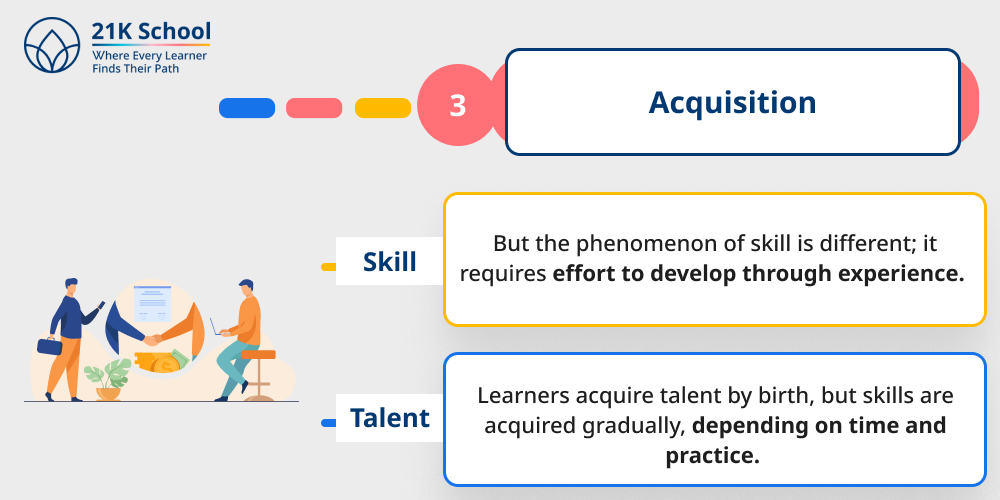
Learners acquire talent by birth, but skills are acquired gradually, depending on time and practice. Remember, naturally acquired talent can come at any time.
But the phenomenon of skill is different; it requires effort to develop through experience.
4. Characteristics
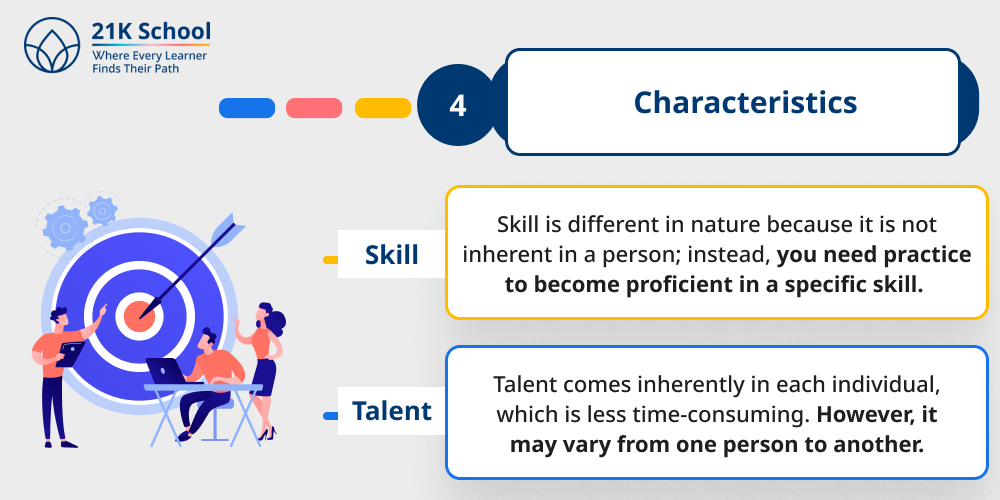
Talent comes inherently in each individual, which is less time-consuming. However, it may vary from one person to another. This means that each learner carries different talents at different levels.
Skill is different in nature because it is not inherent in a person; instead, you need practice to become proficient in a specific skill. It is highly flexible as per the learners' desires.
5. Development
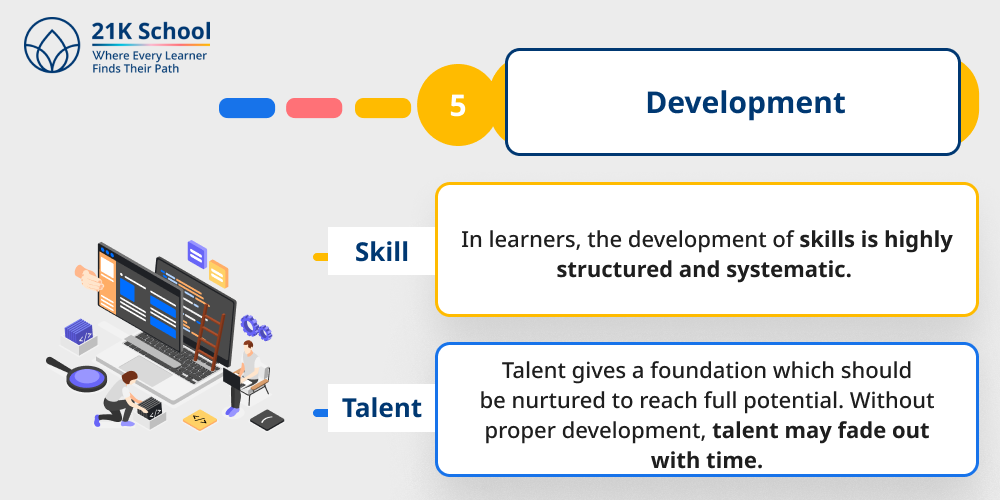
In learners, the development of skills is highly structured and systematic.
Talent gives a foundation which should be nurtured to reach full potential. Without proper development, talent may fade out with time.
6. Training requirement
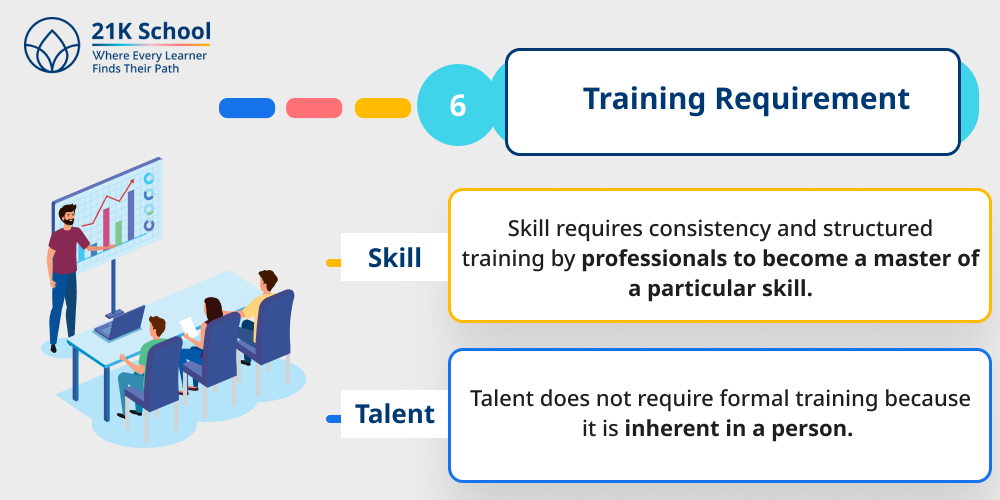
In learners’ lives, training helps boost performance. Using the right amount of training provides a better outcome. Talent does not require formal training because it is inherent in a person.
Skill requires consistency and structured training by professionals to become a master of a particular skill.
7. Effort needed
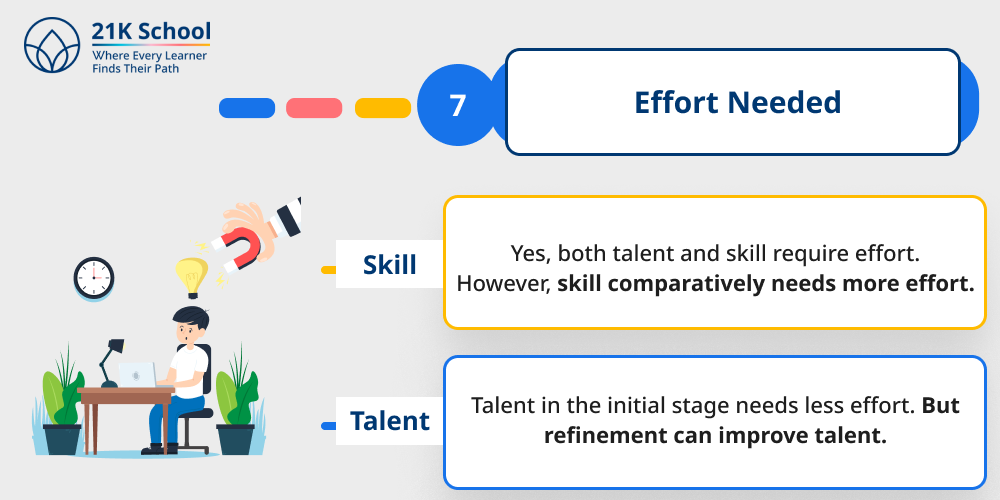
Yes, both talent and skill require effort. However, skill comparatively needs more effort.
Talent in the initial stage needs less effort. But refinement can improve talent. In skill, more effort gives a great level of expertise.
8. Improvement
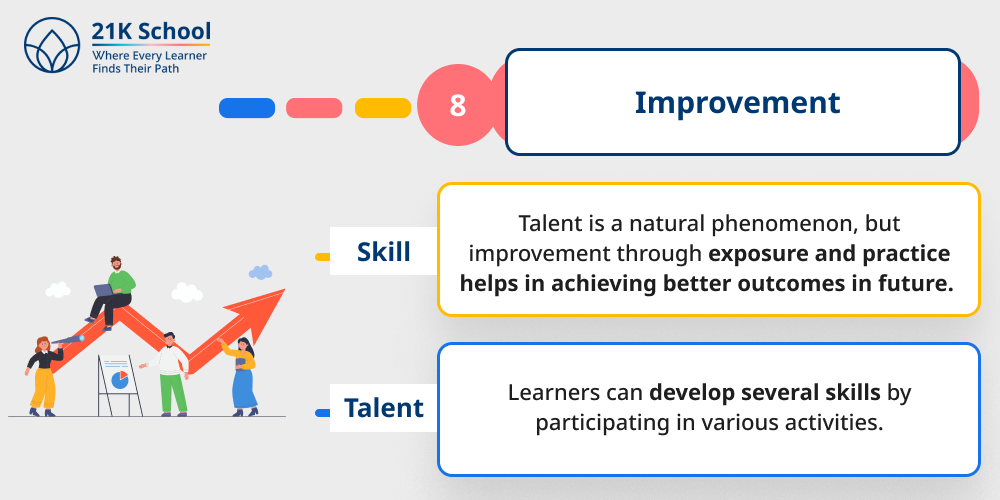
Improvement is beneficial for both talent and skill. Talent is a natural phenomenon, but improvement through exposure and practice helps in achieving better outcomes in future.
Learners can develop several skills by participating in various activities. It can be improved in various ways, including:
- Continuous learning
- Repetition
- Gaining experience
9. Availability
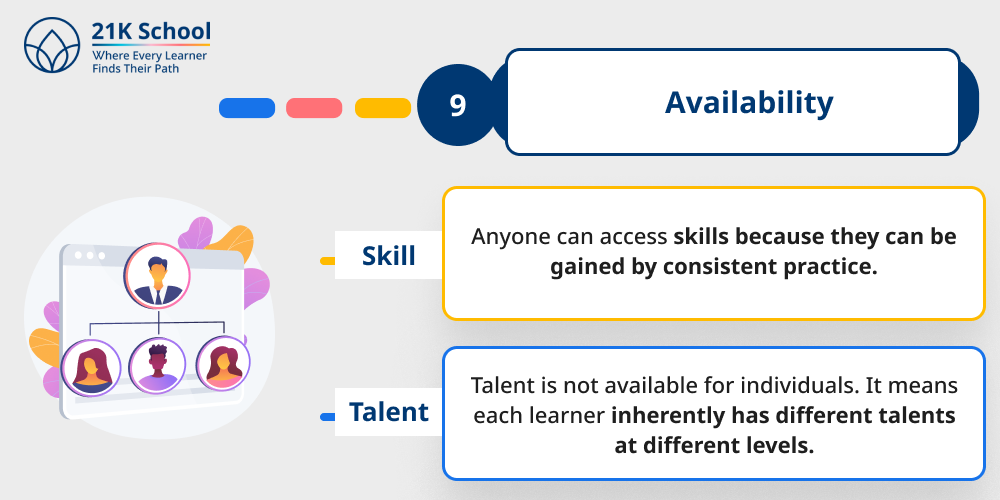
Talent is not available for individuals. It means each learner inherently has different talents at different levels. This difference makes them unique and helps them possess abilities in different areas.
Anyone can access skills because they can be gained by consistent practice. For example, graphic design, coding, and programming are common technical skills.
10. Speed of learning
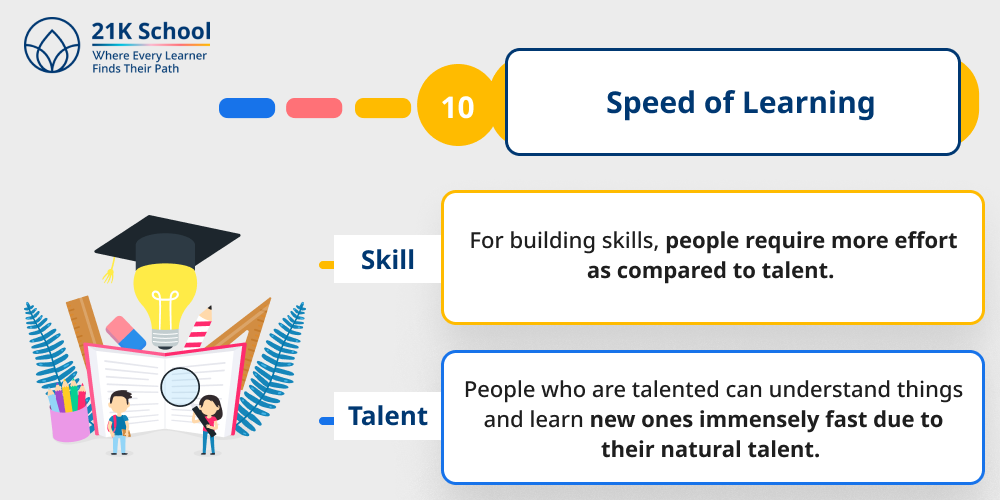
People who are talented can understand things and learn new ones immensely fast due to their natural talent.
For building skills, people require more effort as compared to talent. That’s why time management and planning are highly recommended to master specific skills.
11. Dependence on practice
Talent mainly has an inborn talent and a natural giftedness which you are born with. Skill needs more practice than talent.
But talent can’t be chosen. It is nature’s gift that comes inherently. However, nurturing can give benefits in the long run.
12. Career impact
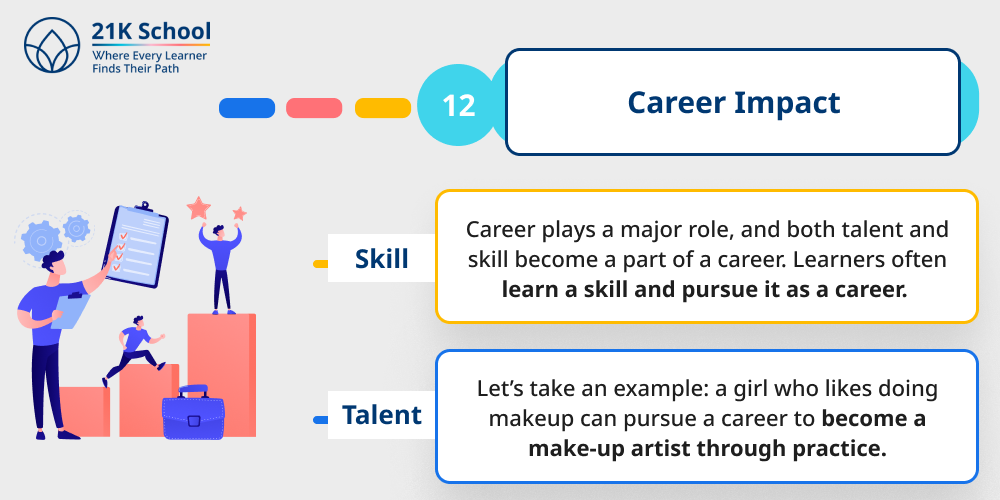
Career plays a major role, and both talent and skill become a part of a career. Learners often learn a skill and pursue it as a career.
Talent is also useful for a career in a specific field.
Let’s take an example: a girl who likes doing makeup can pursue a career to become a make-up artist through practice. It helps in professional growth and popularity.
13. Recognition
Talent is easily recognised by family, friends, facilitators, or random people. This is because talent makes each individual different from the others.
Each individual can build several skills to become competitive in the real world. That’s why it needs time to be recognised by people.
14. Sustainability
Talent often fades out if it is not nurtured by individuals. To do so, it’s important to practice and get enough exposure. But skill works in a different way where learners give time and effort to practice skill development through dedication.
15. Example
A learner’s talent in singing can improve through practice to become a professional vocalist in future and become successful.
While building a skill like leadership, individuals need to work on team projects and group study to understand how leaders manage everything.
Conclusion
Both talent and skill are two approaches which determine success in students’ lives. To become successful, focusing on both together can be beneficial for learners.
Students with natural talent can improve their ability through nurturing. However, both terms are hand in hand. It means combining talent and skill gives extraordinary outcomes.
Explore how to learn a new skill to fulfil realistic goals.
Frequently asked questions
8 questions
Is it better to be talented or skilled?
Both talent and skill help learners to grow in their desired domains. However, through practice, learners can become proficient.
What is the difference between talent and skill?
One of the key differences between talent and skill is: Talent is difficult to measure, while skill is easy to measure.
How do talent and skill work together?
Talent in students' work is a foundation which requires nurturing. This means students can accelerate their talent, which helps in the development of skills faster than usual.
Suggest an example of talent?
A child's voice is melodious by birth. It is a gifted talent.
Suggest an example of a skill in students?
A child learns to become a good singer by practising different notes.
Why are skills important, not just talent?
Learners can master desired skills anytime and anywhere to take advantage in academics, jobs, or an internship. Talent is natural. It can be useful for your future objectives.
How to identify your talent?
Learners can identify their talent by participating in different activities, tasks, and exposure to the real world.
Can talent exist without skill?
Yes, talent can exist without skill.
About the author
Ankita Singha
Content Specialist
Ankita Singha is an Education Content Specialist at 21K School, India’s first accredited fully online K-12 School. She focuses on the in-depth research and creation of the well-drafted guides on early childhood education, school admission processes, and CBSE/ICSE curriculum guidance. With more than 2 years of experience at 21K School, a fully accredited institute- Cambridge International (IA702) and Pearson Edexcel (94883), Ankita works closely with the school’s curriculum heads and academic coordinators. Ankita’s every article reflects on the official board guidelines, practical realities, and current policies of online education in 78+ countries. Ankita’s content has helped thousands of parents in understanding the topics like RTE eligibility, NIOS pathways, and age-appropriate admission criteria.
Every 21K School guide is written by our education team and reviewed by a subject facilitator before publishing.
Exploring a CBSE-pathway online school?
Talk to an advisor about 2026–27 admissions — no obligation.
Talk to an advisorComments
No comments yet — be the first to share your thoughts or ask a question.