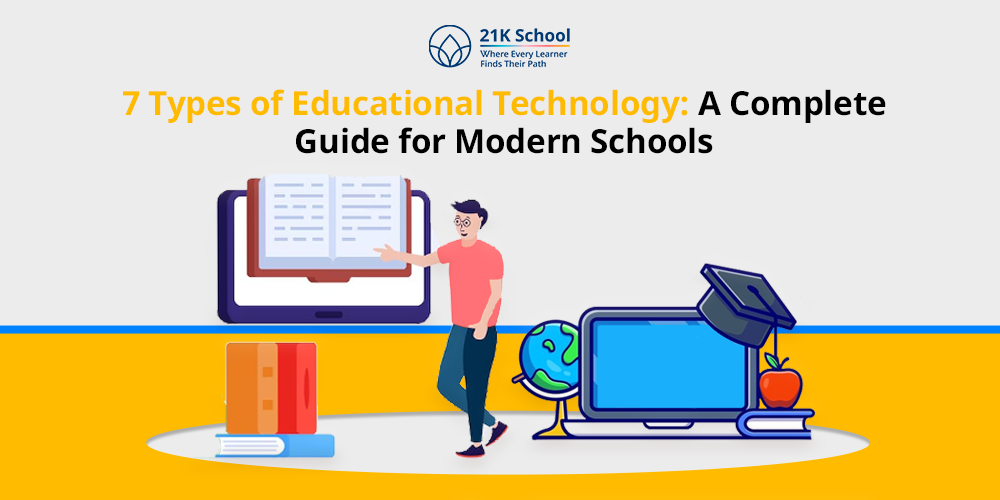
7 Types of Educational Technology: A Complete Guide for Modern Schools
 Written byAnnapurna SContent Specialist
Last modified: 8 Sep 2026 5 min read
In traditional classroom settings learners opt for physical school, classroom, and books. But with time our way of learning has changed.
Now, learners are interacting with different types of educational technology which aims to promote learning experiences.
But, do you know what the different types of educational technology are?
To understand in detail this blog includes different types of educational technology.
What is educational technology?
Educational technology is an integration of computing devices, such as computers and software applications, for teaching and learning methods.
This is different from other traditional approaches, which use books and classroom lectures.
Educational technology offers flexible options for learners. They can learn at their own pace, and facilitators can use different learning techniques to break down complex topics.
7 types of educational technology
There are different types of educational technology. Each type is different and helpful for quality education.
1. Learning Management Systems (LMS)
A Learning Management System (LMS) refers to a system used to manage learning content in a structured manner. This means facilitators use the LMS to deliver content, and learners use it to access learning content.
Technology in education is useful for structured learning because the content is divided into modules.
It is an ideal system which provides assessments like various quizzes and assignments. It is often used to track learners’ progress and enhance communication.
For example:
2. Instructional software and educational apps
Instructional software is highly recommended due to its features like interactive, personalised, and accessible methods. Facilitators and learners use these applications for interactive learning.
Instructional technology helps learners to simplify the learning process through pictures, interactive simulations, and tutorials.
Nearpod and PhET Interactive Simulations offer users a simplified explanation of theories and complex concepts.
There are various other tools like Quizlet which provide immediate responses. In this way, learners can study at their own pace.
3. Immersive technologies
Immersive technology is another type of educational technology which creates a virtual world. Here, learners learn through interaction.
This technology is ideal for practical and visual learning. Devices like VR (virtual reality) and AR (augmented reality) are some common examples.
In this way, a learner can consider VR technology to explore:
- Historic Sites
- Conduct Experiments
- Study Different Subjects
Through practical applications and visualisation learners understand each concept in detail without physical work.
4. Interactive classroom technology
Interactive classroom technologies refer to the digital tools used in the classroom to make the classroom experience more interactive and engaging. Interactive classroom technologies facilitate the interaction between the facilitator and the learners in real-time.
Some common devices such as
- Smart Boards
- Digital Display Systems
- Learner Response Systems
The facilitator can use the mentioned devices to explain different concepts and receive immediate feedback from learners in their classroom learning.
This kind of technology helps in the improvement of attention in class. It also explains complex ideas through visuals, aiding comprehension.
5. Adaptive learning platforms
Adaptive learning platforms are designed to support each learner’s learning needs and level of progress. These platforms use data to determine the performance of the learners and adjust content delivery accordingly.
Unlike conventional methods, adaptive learning offers personalised experiences to learners. It helps them to learn without barriers.
It offers extra opportunities to learners for practice, while others can dive into advanced concepts. Some common examples are:
- DreamBox Learning
- Knewton Alta.
6. Assistive tools
Assistive tools include various products and equipment useful for educational purposes. It helps learners with physical, sensory, or cognitive differences.
There are various features of assistive tools like:
- Text-to-speech
- Speech-to-text
- Screen readers
These tools are ideal to assist in reading, writing, or understanding the concepts. One of the advantages of these tools is that learners engage with their learning materials effectively.
Educational Software like:
- Kurzweil 3000
- Microsoft Immersive Reader
Assistive technologies provides equal learning opportunities to all learners
7. Communication and collaboration tools
Communication and collaboration tools help learners and educators in communicating and sharing ideas together.
Communication and collaboration tools are highly beneficial in virtual and blended learning setups.
Learners can participate in discussions, collaborate on activities, and communicate with facilitators. This quick collaboration method is ideal for quality learning.
There are different types of media, for example messaging, video calling, and collaboration platforms.
Examples of communication and collaboration tools are:
- Microsoft Teams
- Zoom
- Google Meet
These tools are highly useful for teamwork and effective communication. It improves both academic and professional environments.
Conclusion
Technology in education becomes a necessity in the 21st century. For example, implementation of technology in the classroom is ideal to promote good marks.
Today modern education provides benefits like flexible, interactive, and accessible. So that each learner learns at their own pace and style.
Understanding different types of educational technology encourages facilitators, parents, and learners to promote learning engaging and meaningful.
Frequently asked questions
5 questions
What are some of the commonly used educational technologies?
The most commonly used educational technologies are using tools. It includes Canvas LMS and Google Classroom, interactive whiteboards, etc.
How does educational technology improve learning?
Educational technology improves learning by providing: Personalised learning paths Increasing learner engagement via inclusive and interactive tools Enabling effective collaboration
Is educational technology feasible for all learners?
Educational technology is not yet accessible to all learners.
What are the benefits of using educational technology?
Some of the key benefits of educational technology are: Personalised Learning Increased Engagement Enhanced Accessibility
Can educational technology replace traditional classrooms?
No. Educational technology can't completely replace traditional classroom learning.
About the author
Annapurna S
Content Specialist
Annapurna is an Education Content Specialist at 21K School, India’s first accredited fully online K-12 School with more than 20,000 learners across 78+ countries. She holds a Bachelor’s degree in Electronics and Communication Engineering that helps her structure information logically and structure technical concepts for an understandable educational content. With more than 3 years of experience at 21K School, a fully accredited institute- Cambridge International (IA702) and Pearson Edexcel (94883), Annapurna specialises in creation of the learner-centric resources for school-age students. Annapurna’s every article is based on the official resources and focuses on Cambridge/Edexcel, and CBSE curriculum frameworks. Annapurna’s content helps guardians, and learners to navigate through the modern online education system.
Every 21K School guide is written by our education team and reviewed by a subject facilitator before publishing.
Exploring a CBSE-pathway online school?
Talk to an advisor about 2026–27 admissions — no obligation.
Talk to an advisorComments
No comments yet — be the first to share your thoughts or ask a question.