What Is Senior Secondary Education? Complete Guide to Class 11 & 12 Education System
 Written byAnkita SinghaContent Specialist
Last modified: 25 Aug 2026 21 min read
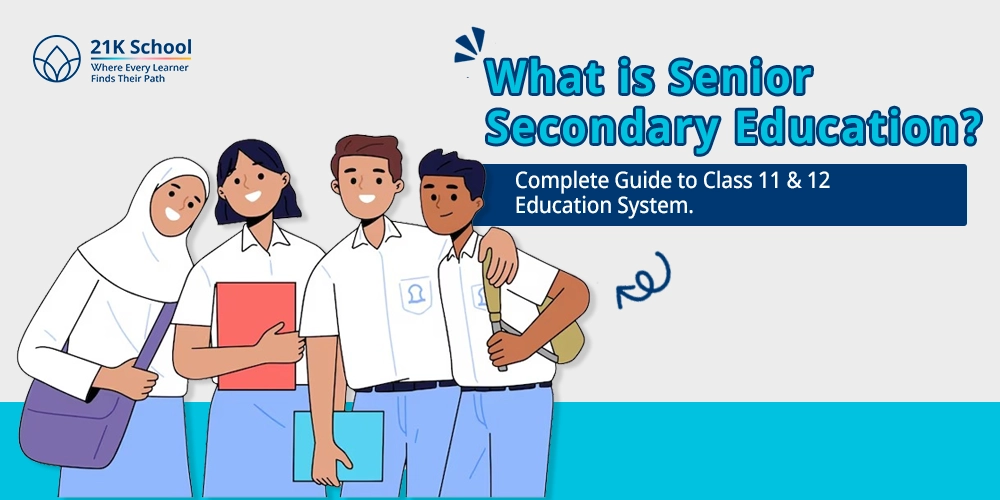
Senior secondary education is where a student passes their Class 12 education. There are two classes in this senior secondary education: Class 11 and Class 12.
Here, students can study in any stream of their choice, but sometimes the stream chosen by the student depends on the secondary number.
The students’ further higher education depends on senior secondary. Students progress towards their careers and prepare their future plans from here.
This is an elaborate guide which will equip students and parents with the right vision of secondary education.
What is Senior Secondary education?
The senior secondary education system starts after the completion of secondary education. The next two years after the completion of secondary school are senior secondary. This is where students prepare for their careers.
The students’ future goals are formed during this senior secondary. After senior secondary, students appear for competitive exams like NEET and JEE for higher education in the future.
7 objectives of Senior Secondary education
Only after passing senior secondary can students take admission in colleges for higher education.
Some of its important objectives are discussed below.
1. Academic specialisation
Students acquire better knowledge in senior secondary on the subjects they studied up to secondary. There are basically 4 streams in senior secondary. Out of these 4 streams, students get education in any stream according to their interest.
These streams are Science, Commerce, Arts and Vocational. The future plans of the students are made in the senior secondary. Here, the students gain deep knowledge of every subject in this stream.
2. Career preparation
While studying in senior secondary, a student starts preparing for their career. Since students study in a particular stream, they are aware of their future career.
Many times, teachers help students choose their careers because a teacher is aware of the strengths and weaknesses of the student.
Here, since students gain in-depth knowledge about the subject, it becomes beneficial for them in higher education in the future, and their confidence increases further.
3. Skill development
At this stage, emphasis is placed on developing various important skills in students. Such as analytical thinking, problem-solving, communication skills and time management.
Students gain practical experience through projects, presentations and teamwork.
These activities help them increase their creativity. Digital skills are acquired through the use of technology in the modern education system.
As a result, students become better prepared for their future academic life and workplace.
4. Personal growth
Senior secondary education not only provides academic information and knowledge, but it is also significant in moulding the personality of the students. At this stage, they develop a feeling of independence, responsibility and decision-making capacity.
In this process, students mature mentally. They are therefore prepared to deal with various temptations in life.
5. Higher education readiness
The other important role of senior secondary education is to prepare students for higher education. The grades and the experience gained at this level are significant in college or university admission.
Learners are taught subject knowledge that will enable them to pass various entrance exams. Furthermore, they are also introduced to the environment of higher learning by conducting research work, presentations and projects.
Owing to this, they can easily adapt to college studies. This stage is highly important in the way the students will be dealt with in the future.
6. Holistic development
Pupils in senior secondary school not only learn, but grow mentally, socially and emotionally by engaging in different co-curricular activities like sports, cultural programs, debate and seminars.
These activities also help in providing leadership qualities, teamwork skills and communication skills to students.
They also acquire other valuable skills in life such as responsibility, discipline and time management. As a result, senior secondary education will have a significant role in the overall development of the personality of the student.
7. Application of knowledge and technology
At the senior secondary level, not only do students learn the theoretical aspect of the knowledge, but also how to apply the knowledge practically. In this aspect, the students are provided with practical experience through laboratory practicals, projects, and research-based activities.
These technologies make the learning process of students easier, faster and more interesting. The proper use of technology helps students acquire new skills and prepares them to succeed in the technology-based world of the future.
4 main streams available in Senior Secondary education
While in secondary school, every student has to study the same subjects given by the board; in senior secondary, students can choose the stream of their choice. There are mainly 4 streams here: Science, Arts, Commerce, and Vocational.
1. Science stream
The science stream is the most important and popular stream in senior secondary. Students choose this stream because it offers a wide range of medical, technical and science-based subjects to pursue a career.
The main subjects of the science stream are Physics, Chemistry, Mathematics, Biology and Computer Science. These subjects enhance the problem-solving and logical thinking skills of the student.
2. Commerce stream
Commerce Stream mainly provides education about business, economics, and financial management. This stream is usually chosen by students who want to build a career in business, banking, accounting or economics in the future.
The main subjects here include accountancy, business education and economics. In many cases, mathematics or entrepreneurship is also taught.
By studying commerce, students gain knowledge about business management, financial planning and market management.
Students from this stream get the opportunity to become chartered accountants, company secretaries, bankers, finance managers or entrepreneurs.
3. Arts stream
In the Arts stream, students usually study subjects like Sociology, History, Language, etc. Students gain deep knowledge in these subjects. Students gain a lot of knowledge about the past.
By studying arts, students can also pursue careers in journalism, law, civil service, teaching, social work or media. In many cases, this stream also plays an important role in developing creativity and critical thinking.
Therefore, this stream is very suitable for those who want to work in social and humanistic subjects.
4. Vocational stream
Vocational Stream is an education system that mainly emphasises skills and practical knowledge. The aim of this stream is to teach students specific professional skills so that they can quickly enter the workforce.
Vocational education includes practical training and internship opportunities along with theoretical education. As a result, students can gain real work experience. This stream helps students to become self-reliant and develop into skilled workers.
Therefore, vocational education is an important option for those who want to get employment opportunities quickly by learning hands-on work.
Learning and curriculum in Senior Secondary education
In senior secondary, students have the freedom to choose subjects based on their interests.
1. Core subjects
Core Subjects are those subjects that are very important in senior secondary education and are taught as compulsory in many cases. Generally, English or a language subject is compulsory in almost all boards.
These subjects help students strengthen their basic knowledge and academic foundation. Through core subjects, students acquire communication skills, analytical skills and depth of knowledge.
2. Elective subjects
Elective Subjects are subjects that students can choose according to their interests, skills and future career goals. At the senior secondary level, students choose these subjects according to different streams.
For example, students in the science department can choose physics, chemistry or biology, while students in the commerce department can study accountancy or business.
By choosing elective subjects, students get the opportunity to gain in-depth knowledge of a particular subject. This increases their interest in studies and helps them plan their future career.
3. Practical learning
Practical Learning is an important part of senior secondary education. In this, students learn to understand the subjects not only through theoretical knowledge, but also through practical experience.
In science subjects, various concepts are clearly explained through laboratory experiments. Many subjects require projects, presentations and research-based work. As a result, students acquire problem-solving, analytical thinking and observation skills.
Practical Learning familiarises students with real-life situations and makes their learning process more effective. This method helps students increase their confidence and practical skills.
4. Board examination
Board Examination is the most important assessment method of senior secondary education. Many education boards also include practical tests along with theory tests.
Students prepare for the board examination for a long time, and it is considered an important step in their future educational career.
The results of this board examination often play an important role in the future of a student in higher education. Only after passing this board exam can students apply for college admission for higher education.
3 top examinations and evaluation systems in secondary education
The examination and assessment system in senior secondary education is very important to assess the academic progress, understanding of the subject matter and skills of the students.
This integrated assessment system prepares students for higher education and future careers.
1. Internal assessment
Internal assessment usually includes class tests, assignments, projects and presentations. Internal assessment helps in identifying the weaknesses of students and creating opportunities for improvement.
In many education boards, the marks of this assessment are counted as a part of the total marks in the board examination. Therefore, it plays an important role in the overall results of students.
2. Theory examination
The main exam of senior secondary is the theory exam. This exam is used to assess the knowledge of the student. The final result of the student depends on this exam.
At the senior secondary level, these examinations are usually subject-based, and questions are based on the syllabus. The question paper may contain various types of questions, such as objective, short answer and descriptive questions.
The examination assesses the knowledge, analytical skills and conceptual understanding of the subject matter. The theoretical examination is usually considered the main part of the board examination.
3. Practical examination
Practical exams are mainly conducted for subjects where practical knowledge is important, such as science or technology-related subjects.
In this exam, students have to conduct various experiments in the laboratory and record results based on their observations. Practical exams assess the students’ practical skills, observational skills and ability to understand the testing method.
Practical exams help to verify the students’ deep understanding of the subject. The marks of practical exams are usually counted as an important part of the total marks. As a result, students can acquire practical skills as well as theoretical knowledge.
Secondary education vs Senior Secondary education
In secondary education, all students study the same compulsory subjects, while senior secondary students can choose a stream based on their interests. There are also some other differences which are discussed below.
| Aspect | Secondary Education | Senior Secondary Education |
|---|---|---|
| Class Level | Class 9 and Class 10. | Class 11 and Class 12. |
| Subject Choice | Most subjects are compulsory. | Students can choose a stream. |
| Depth of Learning | Basic level. | Greater depth and specialisation. |
| Examination System | A board examination is conducted at the end of Class 10. | A board examination is conducted at the end of Class 12. |
| Main Objective | Build a strong academic foundation. | Prepare students for higher education and future careers. |
| Age Group | 14-16 years old. | 16-18 years old. |
1. Class level
Secondary education consists of two classes, Class 9 and Class 10. To get admission to secondary, students have to pass Upper Primary. Here, students acquire knowledge of a specific subject in a little more detail than in Upper Primary.
During this period, students start preparing for the first major board exams. The board exams that are held at the end of Class 10 play an important role in determining the academic progress of students.
Therefore, Secondary Education creates a strong foundation for students for their subsequent higher education.
Senior Secondary Education usually consists of Class 11 and Class 12 and is considered the last stage of school education. At this stage, students take more advanced and specialised education after completing the secondary level.
Senior Secondary education consists of two classes, Class 11 and Class 12. To get admission in Senior Secondary, students have to pass a secondary exam. Here, students acquire knowledge of a specific subject in more detail than in secondary.
Here, students choose a specific stream to study according to their future goals. These two years are an important preparation time for students for higher education and professional life.
Therefore, Senior Secondary Education is an important step for the future educational life of students.
2. Subject choice
In Secondary Education, most subjects are usually compulsory and almost all students study the same subjects. For example, mathematics, science, social science and literature are usually prescribed for everyone at this level.
Through this approach, students get a general idea of various subjects. This experience helps them in choosing subjects later in senior secondary.
In Senior Secondary Education, students get the opportunity to choose subjects according to their interests, skills and future career goals. They usually choose one of the Science, Commerce or Arts streams.
This freedom of choice of subjects gives students the opportunity to study in depth in a particular field. As a result, they get a clear idea about their future profession.
Therefore, subject selection at this stage is very important for future higher education and career planning.
3. Depth of learning
Secondary education generally prepares students for higher education, so students are provided with basic-level education in various subjects. Here, a student's educational foundation is built.
Students learn about the basic rules, concepts and theories of various subjects.
In Senior Secondary, students get the opportunity to study a specific subject in detail. In many cases, practical work, research projects and analytical studies are also included.
At this stage, subjects are directly related to higher education. As a result, students develop a deep understanding of the subject. This deep knowledge helps a lot in future college or university studies.
4. Examination system
In Secondary Education, the board examination is usually held at the end of Class 10. This examination is considered the first major academic assessment of the students. The board examination is an overall evaluation of the two years of studies of the students.
It includes written tests on various subjects, and in many cases, there may also be practical tests.
The results of this examination help the students to decide which stream they will choose in the future. Therefore, the Class 10 board examination is an important step in the educational life of the students.
Board exams are held at the end of Class 12 in Senior Secondary Education, which is very important for students. The results of this exam play a big role in getting admission to colleges or universities. It includes practical tests on many subjects along with theory tests.
Through this exam, the subject-wise knowledge, analytical skills and understanding of the students are evaluated. The results of the board exams are considered an important criterion for future higher education and career.
5. Main objective
The main objective of Secondary Education is to build a strong academic foundation for students. At this stage, basic concepts and knowledge of various subjects are provided. Emphasis is placed on improving the analytical skills, reasoning and learning skills of students.
At this stage, they acquire general knowledge about various subjects. Through this, they are prepared for future studies. Therefore, Secondary Education plays an important role in building the foundation of students’ educational life.
The main objective of Senior Secondary Education is to prepare students for higher education and future careers. During this time, students learn to set future goals.
In addition, various skills such as analytical skills, research skills and problem-solving skills are also developed. This stage is very important for the future life of students.
6. Age group
The ages of Secondary Education students are between 14 and 16. At this stage, proper education and guidance help them in making future decisions. Various school activities help them in increasing their confidence and social skills.
Students take admission in senior secondary after passing secondary. The average age of a student in senior secondary school is around 16to18 years. Students become responsible for themselves and become more mature while studying in senior secondary.
They choose the stream according to their interest and study accordingly. At this stage, they develop a sense of responsibility, self-confidence and goal-setting ability. They also start preparing for higher education.
6 importance of Senior Secondary education
Senior secondary is very important for a student. From here, the student’s next journey starts. The student’s idea about his career is formed. The student can choose the stream of his choice, which helps him in higher education or a career in his later life.
1. Foundation for career choice
Senior secondary education lays an important foundation for students to choose their future careers. During senior secondary, students gain clarity about their subject interests.
Students studying science pursue higher education in medical, technical, or science subjects and build a career in the future.
Commerce students pursue higher education in business management or accounting and build a career in accounting or management.
Arts students pursue journalism or history and build a career as journalists or in other jobs.
2. Eligibility for higher studies
After passing the senior secondary board examination, students get the opportunity to get admission to a university or college. The academic results of this level often play an important role in college admission.
The results of Class 12 are very important for admission to good universities. In addition, this level of education is essential for admission to various professional courses such as engineering, medical, management, etc.
3. Competitive exam preparation
Students are generally aware of competitive exams from senior secondary. From here, a student starts preparing for competitive exams.
Senior secondary helps students in preparing for competitive exams. From senior secondary, students participate in various central and state-level competitive exams.
For example, students prepare for exams such as JEE (engineering) and NEET (medicine). The curriculum at the senior secondary level is, in many cases, similar to the syllabus of these exams.
4. Personality development
While studying in senior secondary, the responsibility of the student increases. A student has to feel a lot more responsible in terms of education because from here the student starts moving towards their career.
The importance of senior secondary is very high in terms of the personality development of the student. Here, the understanding of the student increases from before. In addition, teamwork, leadership qualities, and communication skills are developed.
These skills are very useful in higher education and a career in the future. As a result, senior secondary education helps in shaping the overall personality of a student.
5. Skill enhancement
In senior secondary, learners are afforded an opportunity to learn many practical and professional skills. Computer education, project work, laboratory work and vocational subjects are frequently found in many schools at this level.
These activities teach students to solve real-life problems. Through this, their analytical skills, creativity and technical skills are enhanced. In addition, students can acquire new skills according to their interests.
6. Social and economic impact
Senior secondary helps students to increase their knowledge and skills. This education plays an important role in society. From senior secondary, a student becomes aware of their career.
After passing higher secondary education, the student pursues higher education, from which he joins professional life, which has an impact on the economy of the society.
From here, a student becomes aware of his own desires and learns to understand his responsibilities.
Role of teachers in Senior Secondary education
The importance of teachers in senior secondary school is immense because a teacher is aware of the interests of the student. At this stage, teachers not only impart textbook knowledge, but also help students understand the subject in depth.
They make learning easier and more interesting through various examples, practicals and discussions. In addition, teachers can give guidance to students about their career plans.
Teachers identify the strengths and weaknesses of students and suggest ways to improve.
1. Academic facilitation
The main responsibility of teachers at the senior secondary level is to help students clearly understand subject-based knowledge. Since the topics are relatively deep and complex at this stage, teachers have to use effective teaching methods.
They make the lessons easy and interesting through examples, discussions, presentations and practical activities. As a result, students can understand the topics better and can also be prepared for exams.
Teachers identify the problems or weaknesses of the students and provide additional support to solve them. Therefore, teachers act as important facilitators for the academic success of students.
2. Skill development
The other significance of teachers at the senior secondary level is to enable the learners to acquire different skills. They help students to think critically, problem-solve, and analyse.
Practical knowledge is gained by the students in various forms of projects, presentations, group discussions and laboratory work. These sorts of activities also boost the creativity and confidence of students.
3. Mentorship
Teachers act as guides for students. Teachers consider the students’ studies and give feedback. If students do not understand something, they go to the teachers and clear their doubts.
They support students to achieve good results in the field of education. A teacher is aware of the strengths and weaknesses of the student, so it is beneficial for teachers to analyse the student.
4. Communication
In senior secondary, students are aware of their own responsibilities. Teachers here encourage students to communicate with each other. This improves students’ communication skills.
In addition, a positive relationship between teachers and students improves the learning environment. These communication skills are very important in future education and careers.
5. Adaptability
The current education system is undergoing rapid changes, so teachers also have to adapt to the new situation.
In senior secondary education, teachers adapt themselves to modern teaching methods, technology and new curricula.
They use digital tools, online resources and smart classrooms to improve the learning experience of students. As a result, students get an idea of modern technology and are interested in learning.
6. Continuous learning
A good teacher always tries to learn something new. Teachers in senior secondary education need to improve their knowledge and skills regularly.
They can learn about new teaching techniques by participating in various training, workshops and seminars.
Through this, they can keep themselves updated with the modern education system. By using new knowledge and experience, they are able to teach students more effectively.
Career opportunities after Senior Secondary education
A student’s career starts from the moment they pass senior secondary school. While studying in senior secondary, the student becomes aware of their career.
Career opportunities that are available after senior secondary education for science students include: engineering, medicine, research, information technology, biotechnology, pharmacy, environmental science and other emerging technology-based careers.
Students who study commerce in senior secondary school go on to study accounting, finance, and chartered accountancy during higher education.
Students who study arts go on to study history, languages, and journalism in higher education and move towards a career.
Students who study vocational courses acquire various skill-based education in the future.
Conclusion
Senior Secondary Education is a very important stage in the educational life of students. From senior secondary, a student’s future preparation starts. Here, students gain in-depth knowledge about the subject.
Students are also informed about competitive exams from here because later, if they want to take admission in medical or engineering, the selection is done through competitive exams.
Frequently asked questions
7 questions
What age group comes under senior secondary education?
After passing secondary school, students are admitted to senior secondary school. The average age of a student in senior secondary school is 16 to 18. However, this age group is sometimes different for dropout students.
What streams are available in senior secondary education?
Senior Secondary contains 4 streams. Students can read any stream of their choice. These streams are science, commerce, arts, and vocational.
Can students change streams after Class 11?
Yes, students can change streams after Class 11, but it depends on the school. Many times, schools do not allow students to change streams.
Is vocational education part of senior secondary education?
Yes, Vocational Education is a part of Senior Secondary. After studying in this stream, students acquire especially skill-based knowledge. This helps a lot in higher education and the student's career.
What happens after completing senior secondary education?
After completing senior secondary education, students take admission in college for higher education.
What is level 7 education in India?
Level 7 education in India is equivalent to postgraduate/master's level education under India's National Skills Qualifications Framework (NSQF).
What is a senior secondary certificate of education?
Senior Secondary Certificate is the pass certificate obtained from the board after passing the final examination.
About the author
Ankita Singha
Content Specialist
Ankita Singha is an Education Content Specialist at 21K School, India’s first accredited fully online K-12 School. She focuses on the in-depth research and creation of the well-drafted guides on early childhood education, school admission processes, and CBSE/ICSE curriculum guidance. With more than 2 years of experience at 21K School, a fully accredited institute- Cambridge International (IA702) and Pearson Edexcel (94883), Ankita works closely with the school’s curriculum heads and academic coordinators. Ankita’s every article reflects on the official board guidelines, practical realities, and current policies of online education in 78+ countries. Ankita’s content has helped thousands of parents in understanding the topics like RTE eligibility, NIOS pathways, and age-appropriate admission criteria.
Every 21K School guide is written by our education team and reviewed by a subject facilitator before publishing.
Exploring a CBSE-pathway online school?
Talk to an advisor about 2026–27 admissions — no obligation.
Talk to an advisorComments
No comments yet — be the first to share your thoughts or ask a question.