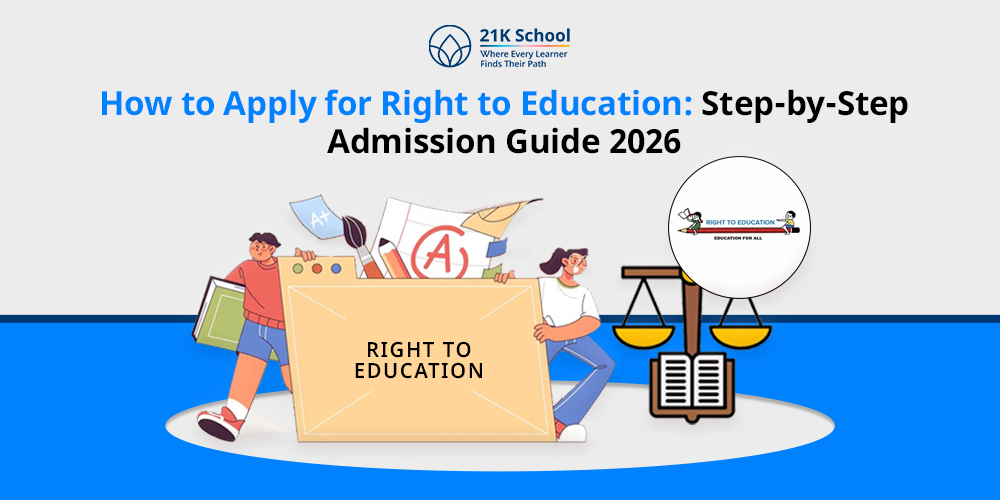
How to Apply for Right to Education: Step-by-Step Admission Guide 2026
 Written byAnkita SinghaContent Specialist
Last modified: Jul 31, 2026 11 min read
The Right to Education (RTE) Act in India is a popular yet essential way through which needy children get the opportunity of free education.
Today, many parents from economically weaker sections struggle to secure admission for their children in schools because of factors like financial crisis. For those parents the Right to Education (RTE) Act in India is an opportunity to get quality education .
However, getting a child admitted is not an easy task. It requires patience and understanding how to apply for the Right to Education. To know everything in detail, let’s begin with what the Act means.
What is the right to education act?
The Right to Education Act is a legislation to make education a basic right. It supports Article 21A. The aim of the RTE Act is to provide free and compulsory education to students between the age group of 6 to 14 years.
Though the Right to Education Act was brought into application in 2010, it was approved a year ago in 2009.
According to the RTE Act, private schools should offer a reservation of 25% seats for learners who have low social or economical status.
Apart from this, schools should provide all basic facilities to learners, and maintain proper pupil-teacher ratio and infrastructure.
Under this act, learners can not be expelled until they pass class 8.
How to apply for right to education: Step-by-step admission process
You can apply for your child's admission directly through RTE admission portals by following the blueprint given below:
1. Visit the official portal
You can start by visiting the official Right to Education portal of your particular state. This is because each state has their own platform.
The state-wise portal offer information related to:
- Admission notifications
- Application forms
- List of participating schools
- Eligibility guidelines
- Result announcements
2. Registration
The next step is parent registration to the official website. This registration often requires some details like:
- Parent or guardian name
- Mobile number
- Email ID (optional)
- Address details
After that parent is able to generate their personal login credentials or an application ID. It consists of a registration number used to track application status.
3. Fill application form
After successfully registering, parents need to fill out the RTE application form online on the official website.
Parent should read the entire application for filling accurate information such as:
- Child Details: Full name, date of birth, gender, and Aadhaar number (if available).
- Parent Details: Parent or guardian name, occupation, and Income details.
- Address Information: Residential address, ward or district, nearby school preferences
4. Select schools
The fourth and most important step is to select the right schools in the application.
Most application forms allow 3-5 schools preferences. Remember to prefer interested schools as your first priority. Choosing is more convenient for parents.
5. Upload documents
After filling the application form, upload all the supporting documents required for verification of the application.
Common documents include passport-size photograph, birth certificate of the child, Aadhaar cards (of both parents and kid), residence proof, income certificate, caste certificate (if applicable).
Before final submission, ensure that these documents are correct, and match the required font size and format.
6. Submit and print
Review all the entered details properly and then submit the RTE application form. You may please save a print out of this form for future use.
Who can apply for right to education admission?
Under Right To Education Act many students get Admission to schools to get quality education in their foundational stage. It supports students who cannot afford private school for learning .
The RTE seats are reserved for economically weaker and socially disadvantaged groups. Given below is a detailed list:
1. Category-wise eligibility RTE education
- EWS
EWS stands for Economically Weaker Section. The families whose income falls below state-determined limits qualify under this category.
The objective of RTE is to provide high quality education to low-income families (EWS). An income certificate issued by government authorities is required for Right To Education.
- SC/ST
SC/ST stands for Scheduled Castes (SC) and Scheduled Tribes (ST) children who are eligible for the RTE Act .
The objective is to help communities who historically faced disadvantaged to provide equal opportunities in education. A valid caste certificate issued by the government is required to apply for Right To Education.
2. Disadvantaged groups
To support socially ignored children and promote inclusive education , the RTE Act offered free education to the following:
- Children with disabilities
- Orphaned children
- Children of single parents
- Children affected by HIV
- Children from marginalized communities
4 benefits of applying under right to education
The Right to Education offers benefits to students from the Economically Weaker Section and Socially Disadvantaged Groups
Some key benefits of applying under Right To Education are:
1. Free books and uniforms
Under the Right To Education Act students get free education . This means they don’t have to pay tuition fees for elementary school.
Free books and uniforms are provided by the schools to directly reduce financial burden on the families.
2. Access to quality private schools
With the help of the RTE Act, children of disadvantaged groups can learn in private schools and access its advanced facilities.
This act enabled the learners to study with modern teaching methods , advanced learning resources, extracurricular activities , and better infrastructure.
3. Equal learning opportunities
All learners are welcomed and taught in similar conditions to foster equal opportunities of learning.
In this way, they get to learn about social cohesion, equality in education , and mutual respect among each other.
4. Recognition and curriculum
When you register in schools through RTE, you will get to study in well-recognized schools having a standardised curriculum and infrastructure.
The recognition certificate is given by RTE, and educators need to follow the necessary guidelines suggested by it.
When does the right to education admission process start?
The admission for Right to Education starts in the starting months of the year based on each state's policies.
During this period, the official website of RTE notifies with application start date, last date for submission, list of participating schools, and eligibility requirements.
Parents whose children are eligible can fill the applications online through state-specific RTE official portals by tracking admission dates and preparing all the documents in advance.
Documents required for right to education admission
There are various documents crucial to apply for Right to Education admission such as:
- Child's Birth Certificate to check the age is valid or not. It usually takes 3-4 years for nursery admission.
- For address proof Aadhaar card, Ration Card, Voter ID, Electricity Bill, Water Bill, or Registered Rent Agreement.
- For the Economically Weaker Section (EWS) category, an Income Certificate, is necessary.
- SC/ST/OBC (Non-Creamy Layer) or disadvantaged groups need Caste/Category Certificate to claim benefits of RTE Act.
- Both child and parent Aadhaar cards.
- 2 to 3 recent passport size photographs of the child.
- Disability Certificate, issued by the competent authority (if applicable).
- Transfer Certificate is optional (if applicable).
How the right to education school selection process works?
Childs Right to Admission in Schools is applicable for children to provide elementary education age 6 to 14. To understand in detail let’s go through how the Right to Education school selection process works.
1. School mapping system
The Right to Education (RTE) school admissions are conducted online. Parents need to choose state-specific portals.
While filling the form school mapping system is important which helps in choosing the distance between the child's residence and the school location.
2. Lottery system
When the number of applications surpass the number of reserved seats, learners are selected by lottery systems.
3. Transparency in selection
The RTE admission process is designed to showcase the transparency in selection of schools.
Even for selection through the lottery, the process is conducted online to maintain transparency and build trust by ensuring admissions are conducted without bias.
What to do after your child is selected for right to education?
To ensure your child's seat in your selected school, you should first check if the list includes your kid's name on the official RTE portal.
Then you should download the allotment letter from the official website of RTE and verify school details after paying a small visit.
You should then gather all the needed documents such as birth certificate, residence proof, income/caste certificates, and photographs. Submit them before the deadline to complete the admission process in that particular school.
Make sure you receive a written acknowledgement from the office for future reference. After successful admission, students get materials like uniforms and books free of cost.
4 common mistakes to avoid while applying for the right to education
Applications play a major role in admission through the RTE Act. However, there are many applications rejected due to minor mistakes.
Some common mistakes individual should avoid are:
1. Incorrect personal details
Parents filling incorrect personal details can lead to rejection of the application. For example, if a parent enters the wrong date of birth of a child.
Avoid incorrect personal details and recheck after completing the RTE application.
2. Uploading wrong documents
Parents often upload wrong documents while filling the application form can impact the selection of a child.
Document swap, miss placed, or blur are some common mistakes parents should avoid while uploading.
3. Missing deadlines
Parents often miss deadlines and delayed applications are directly rejected by the authority. So, regularly check the opening and closing deadline of application and make sure to apply early to avoid last-minute issues.
4. Selecting schools far from home
Selecting a school far from home is a challenge especially for parents. Instead prioritise neighborhood schools to increase the chances to get desired school.
4 tips for parents applying for right to education
Parents who want their kids to study under RTE Act and get free education should follow the given tips to avoid any last minute struggles:
1. Apply early
If your child is eligible, check state-specific portals regularly and apply early.
This helps parents to avoid last-minute delays that can lead to missed applications. Early applications can ensure admission even if faced with:
- Website server issues
- Incomplete document uploads
- Errors in the application form
2. Prepare documents in advance
Parents must prepare documents in advance to avoid any challenges while filling the form. For example:
- Child's birth certificate
- Aadhaar card
- Residence proof
- Income certificate
- Caste certificate
3. Choose nearby schools
While filling the form parents get an opportunity to choose the number of schools according to their priority. Selection of nearby schools can be beneficial for children.
4. Track application status regularly
After submitting the RTE application, parents need to check its status regularly to ensure that they don’t miss out on important notifications or deadlines.
Final thoughts
The Right to Education Act is beneficial for all learners and families who come from disadvantaged sections of the society.
It ensures free education for learners till class 8, which means their elementary education can easily be completed.
If as a parent you feel confused on how to apply for Right To Education and enroll your kids in quality private schools, you can refer to the steps mentioned in the above piece.
We hope this article provides you with all the necessary information and enables advanced learning for your children.
Frequently asked questions
9 questions
Is there any age limit for RTE admission?
Yes, the RTE Act offers free education for learners between 6 to 14 of age and 25% seat allotment for weaker sections of society.
Can private schools deny admission to RTE students?
Due to the RTE Act, private schools cannot deny admission of RTE learners and should offer 25% seats for economically and socially disadvantaged groups.
Is RTE admission available every year?
Yes, the RTE admission is available every year for students. It mainly starts between January and March.
What should parents do if their child is not selected in RTE?
If your kid fails to secure a seat under the RTE, first identify the reason and then appeal to the designated officer within the stipulated time. You can go to higher courts if there is any ignorance or violation of RTE.
How to apply for RTE in Karnataka?
To apply for the Right to Education (RTE) quota in Karnataka, follow the given steps: visit the portal registration fill application select schools submit and print lottery result
What are the criteria for the Right to Education (RTE)?
The criteria for the Right to Education (RTE) in India guarantees free schooling for children aged 6-14. The Act ensures zero fees, equal access to education and support for under privileged students.
What is the date of RTE form 2026 in Maharashtra?
The RTE Maharashtra admission form expected date for 2026 is 17 February 2026(Start Date) and 10 March 2026 (Last Date).
What if an RTE application is rejected?
If an RTE application is rejected, check the reasons mentioned in the rejection letter and documentation errors or location issues.
How does the RTE lottery system work?
The lottery system is a random selection process in RTE in which many schools use to allocate reserved seats. The objective of the lottery system is to eliminate bias, it often feels like a game of chance.
About the author
Ankita Singha
Content Specialist
Ankita Singha is an Education Content Specialist at 21K School, India’s first accredited fully online K-12 School. She focuses on the in-depth research and creation of the well-drafted guides on early childhood education, school admission processes, and CBSE/ICSE curriculum guidance. With more than 2 years of experience at 21K School, a fully accredited institute- Cambridge International (IA702) and Pearson Edexcel (94883), Ankita works closely with the school’s curriculum heads and academic coordinators. Ankita’s every article reflects on the official board guidelines, practical realities, and current policies of online education in 78+ countries. Ankita’s content has helped thousands of parents in understanding the topics like RTE eligibility, NIOS pathways, and age-appropriate admission criteria.
Every 21K School guide is written by our education team and reviewed by a subject facilitator before publishing.
Exploring a CBSE-pathway online school?
Talk to an advisor about 2026–27 admissions — no obligation.
Talk to an advisorComments
No comments yet — be the first to share your thoughts or ask a question.