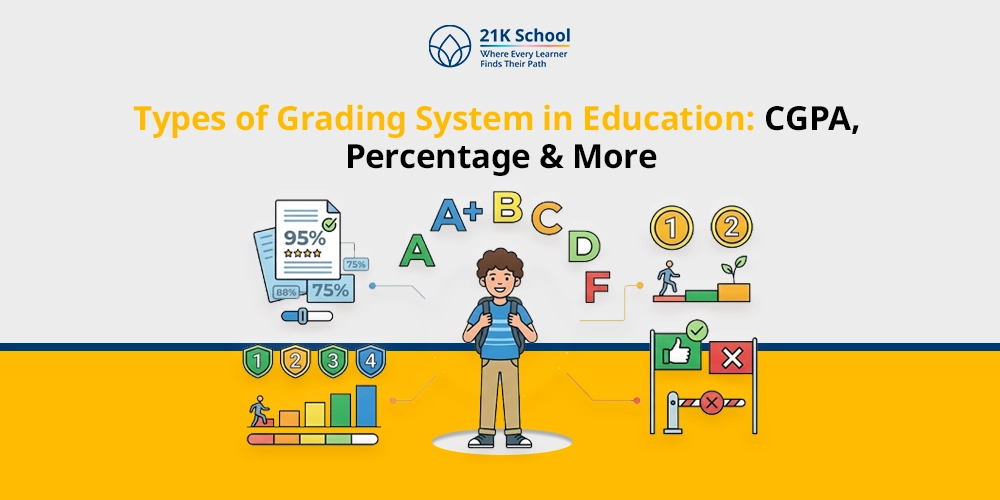
Types of Grading System in Education: CGPA, Percentage & More
 Written byAnkita SinghaContent Specialist
Last modified: Jul 31, 2026 6 min read
In today’s education system, students are graded based on their performance and marks. However, there is not one way of grading.
For years, different institutions use different types of grading systems that ensure students are getting fair results. If you are curious about knowing more this is the right place.
To understand the grading system in detail, one needs to go through its types. Here, you will know the different types of grading system and how students are actually evaluated through it.
What is the grading system?
The grading system is a pre-designed process which helps teachers to evaluate and share student's academic growth through reports. The grading system is quantitative in nature.
The main objective is to measure results, track progress, provide feedback, and support academic decisions. Some common examples are tests, projects, and assignments.
The grading system is important to understand the marks achieved by candidates.
10 popular types of grading system in education
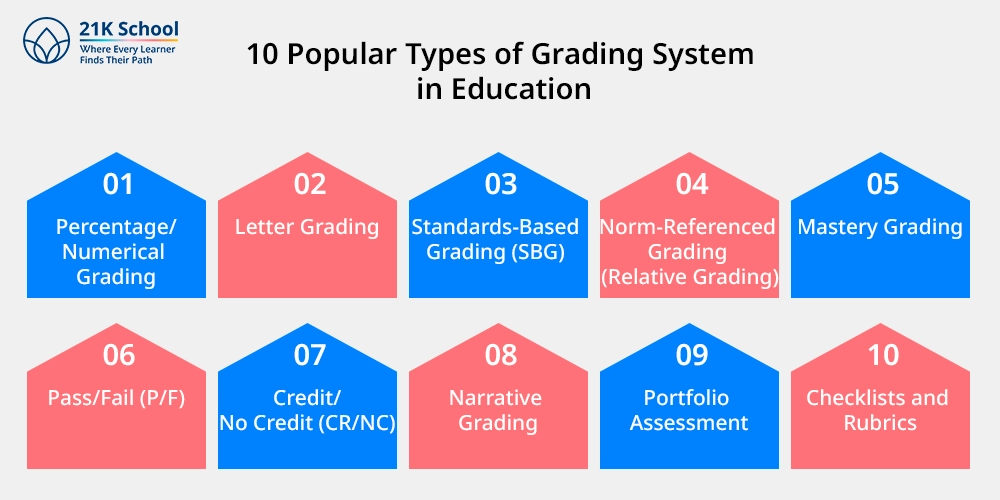
Check out the top 10 different types of grading system in education in detailed:
1. Percentage/numerical grading
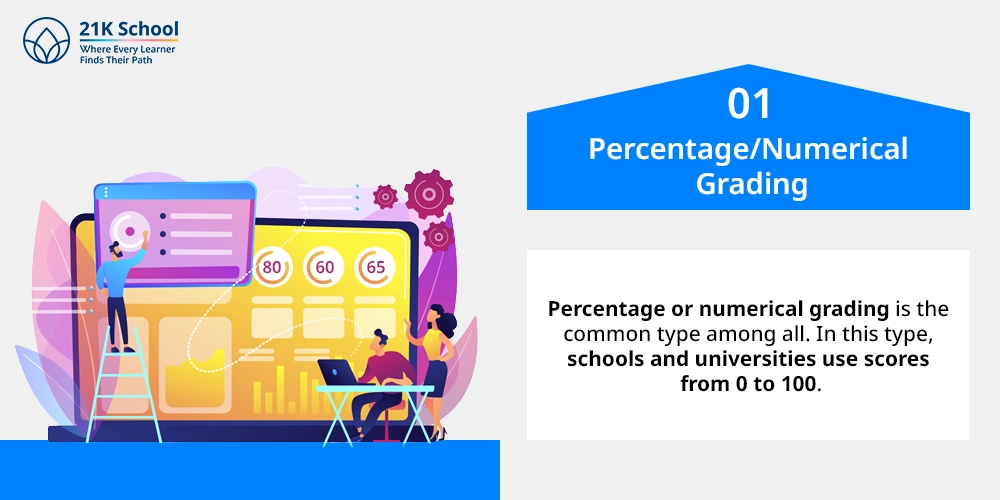
Percentage or numerical grading is the common type among all. In this type, schools and universities use scores from 0 to 100.
For example, 90 to 100%: Excellent or 60 to 75%: Average.
Advantages:
- It is a popular type that is easy to understand and calculate without obstacles.
- Teachers can precisely compare the information.
- Percentage/numerical grading are used in examinations, competitive assessments etc.
2. Letter grading
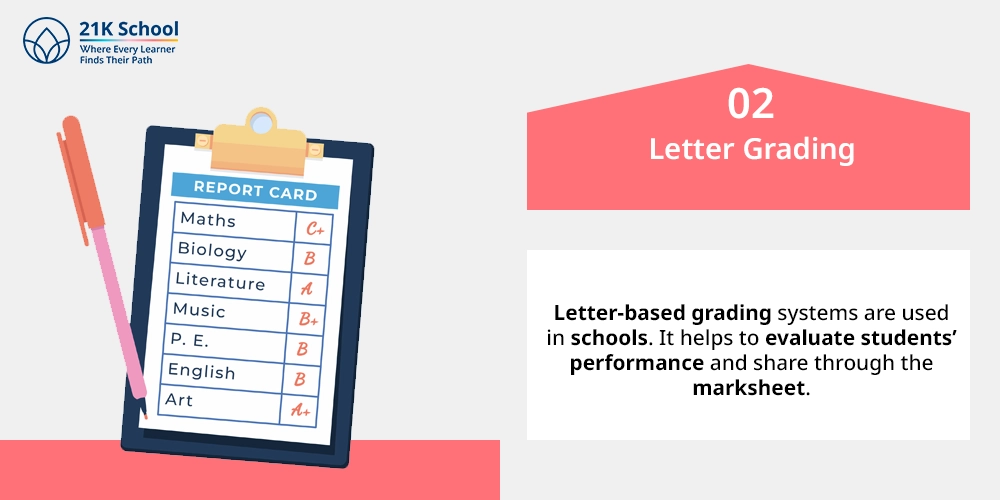
Letter-based grading systems are used in schools. It helps to evaluate students’ performance and share through the marksheet.
In the letter grading system "A" is the highest and "F" is the lowest among all. This shows how well a student performs in a particular examination.
Advantages:
- The grading type is simple and standardised which makes it efficient to use.
- It also reduces students pressure compared to exact marks.
- The letter-based grading system is widely accepted by a lot of universities.
3. Standards-based grading (SBG)
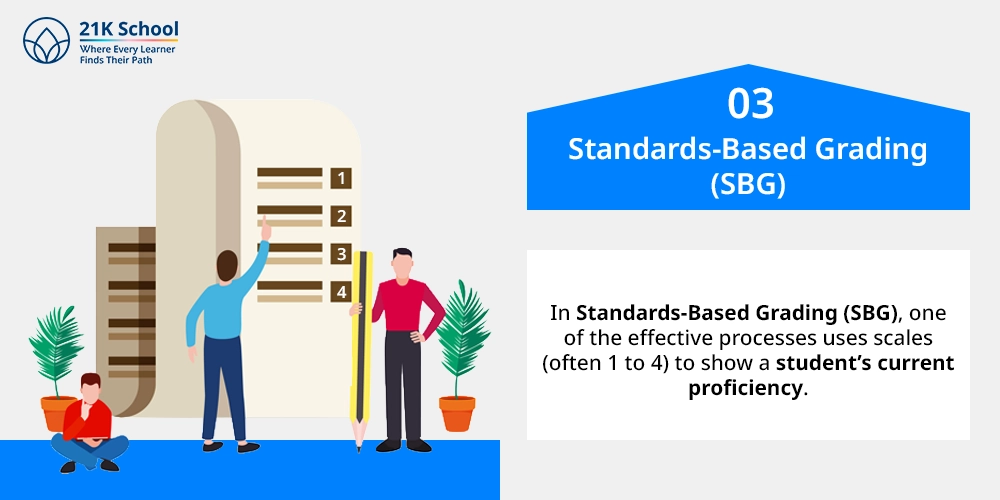
In Standards-Based Grading (SBG), one of the effective processes uses scales (often 1 to 4) to show a student’s current proficiency.
In simple words, SBG focuses on what students know, what they can do, and what they are still learning.
Advantages:
- Clear learning goals
- Encourages mastery of concepts
- Supports personalised learning
4. Norm-referenced grading (Relative grading)
Norm-referenced grading is also known as relative grading in which students’ performances are measured and compared with each other.
For example:
- The top 10% receive A grades in examinations.
- The middle group receive B or C grades.
Advantages:
- Norm-referenced grading is a useful process for students’ competitive exams.
- It helps teachers in easily ranking and selection.
5. Mastery grading
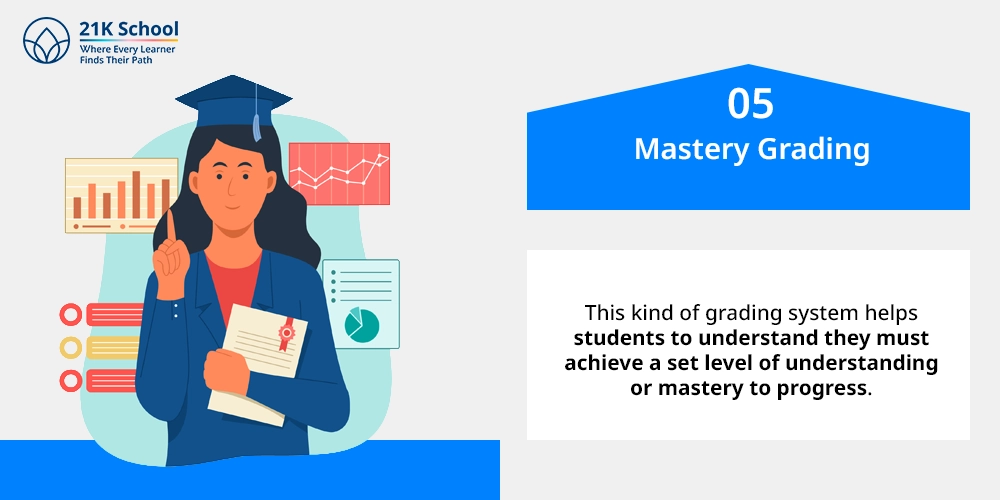
This kind of grading system helps students to understand they must achieve a set level of understanding or mastery to progress.
Here, the key principle of mastery grading is learning over speed.
Advantages:
- Mastery grading encourages students for deep understanding.
- The system allows students to actively engage because they control their speed.
6. Pass/fail (P/F)
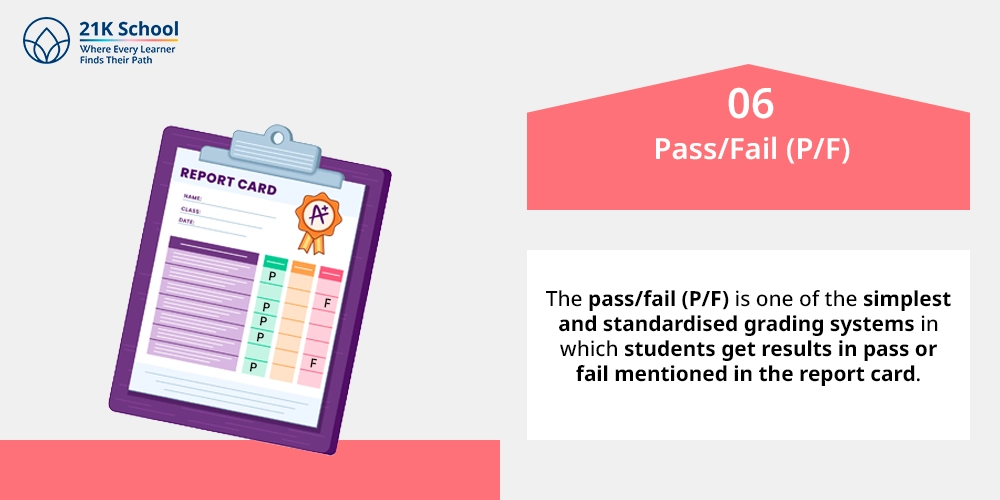
The pass/fail (P/F) is one of the simplest and standardised grading systems in which students get results in pass or fail mentioned in the report card.
It is popular because no ranking or numbers are used to represent the report.
Advantages:
- The pass/fail grading system helps in reducing academic stress.
- Students get encouraged exploration and risk-taking.
- Here, students mainly focus on the completion rather than competition.
7. Credit/no credit (CR/NC)
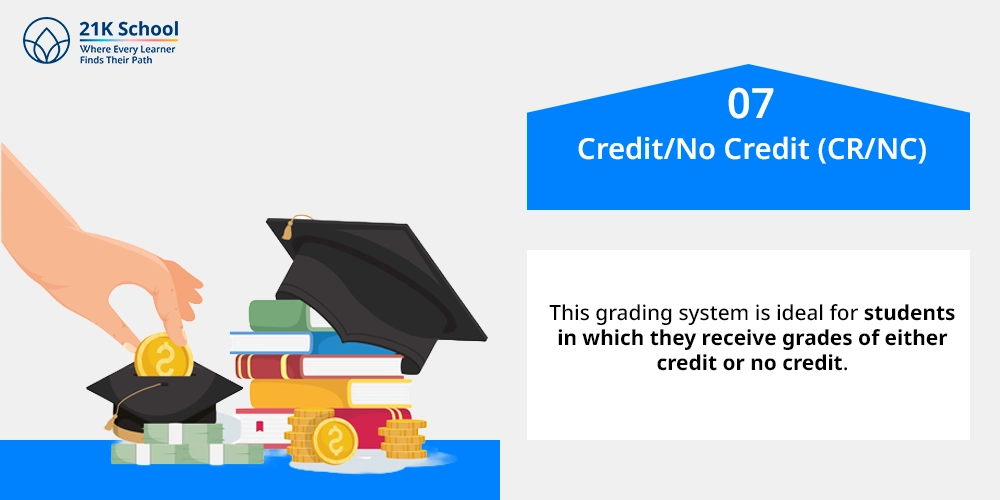
This grading system is ideal for students in which they receive grades of either credit or no credit.
The credit simply means pass and no credit means fail. In this way students can understand their academic performance.
Advantages:
- Supports skill-based education
- Encourages participation in electives
- Minimises grade anxiety
8. Narrative grading
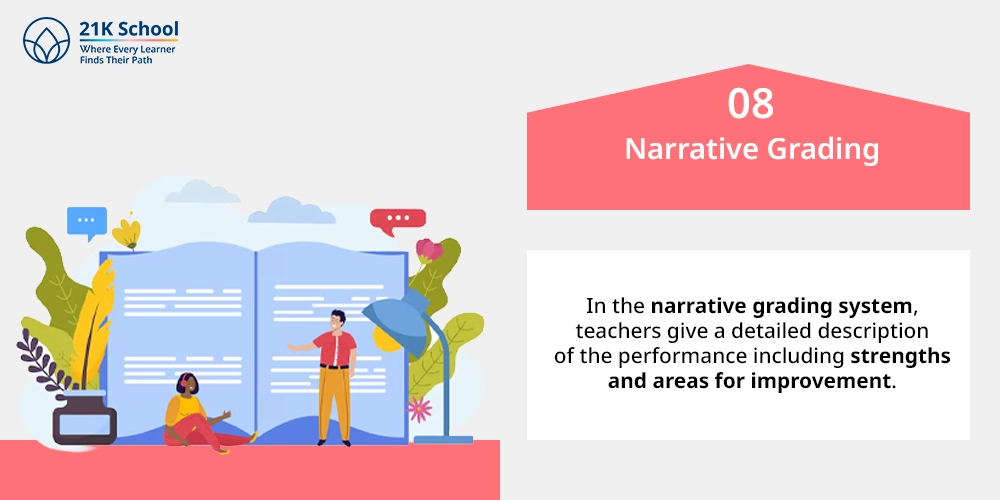
In the narrative grading system, teachers give a detailed description of the performance including strengths and areas for improvement.
Advantages:
- The narrative grading offers highly personalised feedback.
- Narrative grading is ideal to support students in both emotional and social development.
9. Portfolio assessment

In the portfolio assessment, teachers collect students’ work such as projects, assignments, creative work, and reflections to evaluate or calculate their grades.
Advantages:
- For students’ long-term growth, it is an effective type of grading system.
- It helps in self-reflection and supports skill-based learning.
10. Checklists and rubrics
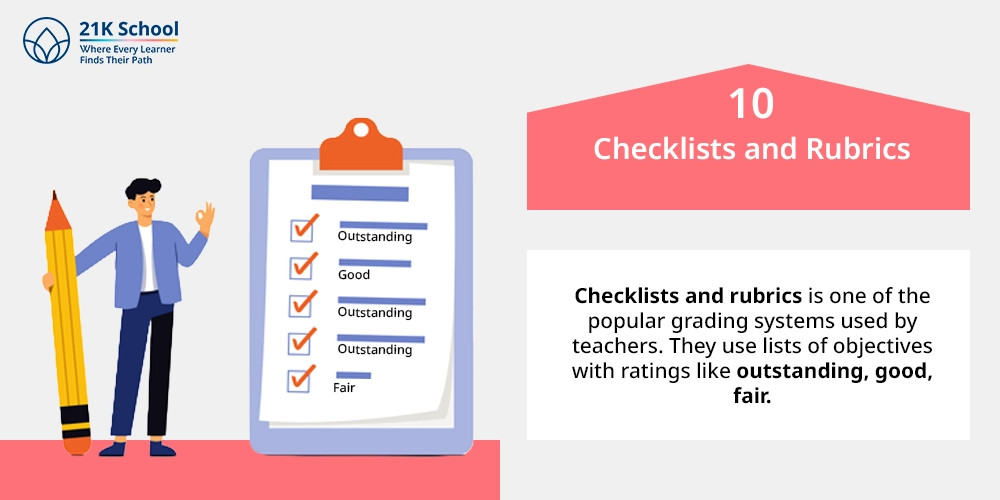
Checklists and rubrics is one of the popular grading systems used by teachers. They use lists of objectives with ratings like outstanding, good, fair.
It works on predefined criteria to assess specific skills or tasks.
Advantages:
- It offers transparent assessment for students’ academic growth.
- Students get fair and consistent grading to work on feedback.
- It also improves student understanding of expectations.
Conclusion
Grading is a crucial part of today’s education system which gives students an opportunity to understand the strengths, weaknesses, and areas for improvement.
The above-mentioned types of grading systems help school, teachers, and students to assess overall performance to encourage development. However, each institute prefers as per their needs.
Hope, discovering these tools helped to understand the way of measuring academic performance of students.
Frequently asked questions
8 questions
Does CBSE still use CGPA in 2025?
Yes. For class 10, CBSE primarily uses CGPA. The grade points from 1-10 are assigned to subjects based on mark ranges. For example, 91-100 is a 10/A1 grade.
What is the main difference between GPA and CGPA?
One of the main differences between GPA and CGPA is the time frame. GPA shows recent performance while CGPA shows long-term achievement.
What are absolute and relative grading?
Absolute grading is a predetermined, fixed standards or cut-off points for example, 80%, 72%. While relative grading compares performance with classmates for example, Rima scored top 10% of the class.
How is grading done in CBSE Class 10?
In CBSE class 10th, grading is done by allotting grade points besides each subject and these grade points are added and lastly divided by five to get the CGPA.
What is scale 4 grading system?
The scale 4 grading system calculates a student's average performance in U.S. education. A = 4 points B = 3 points C = 2 points D = 1 points F = 0 points
What is the scale 10 grading system?
A 10-point grading scale converts numerical marks into letter grades and numerical grade points used in many Indian universities. These are approximate ranges from the relative grading system. O (Outstanding): 10 points (90-100%) A+ (Excellent): 9 points (80-89%) A (Very Good): 8 points (70-79%) B+ (Good): 7 points (60-69%) C (Average): 5 points (50-59%) P (Pass): 4 points (40-49%) F (Fail): 0 points (Below 40%)
What is a 9 point grading system?
A 9 points scale is present in which A to E grades are given (such as A1, A2, till E). Here, A1 responds to 91-100 marks (grade 10) and E means fail.
Which grade is 70%?
In India, according to the CBSE grading system 61 to 70% represents B2.
About the author
Ankita Singha
Content Specialist
Ankita Singha is an Education Content Specialist at 21K School, India’s first accredited fully online K-12 School. She focuses on the in-depth research and creation of the well-drafted guides on early childhood education, school admission processes, and CBSE/ICSE curriculum guidance. With more than 2 years of experience at 21K School, a fully accredited institute- Cambridge International (IA702) and Pearson Edexcel (94883), Ankita works closely with the school’s curriculum heads and academic coordinators. Ankita’s every article reflects on the official board guidelines, practical realities, and current policies of online education in 78+ countries. Ankita’s content has helped thousands of parents in understanding the topics like RTE eligibility, NIOS pathways, and age-appropriate admission criteria.
Every 21K School guide is written by our education team and reviewed by a subject facilitator before publishing.
Exploring a CBSE-pathway online school?
Talk to an advisor about 2026–27 admissions — no obligation.
Talk to an advisorComments
No comments yet — be the first to share your thoughts or ask a question.