

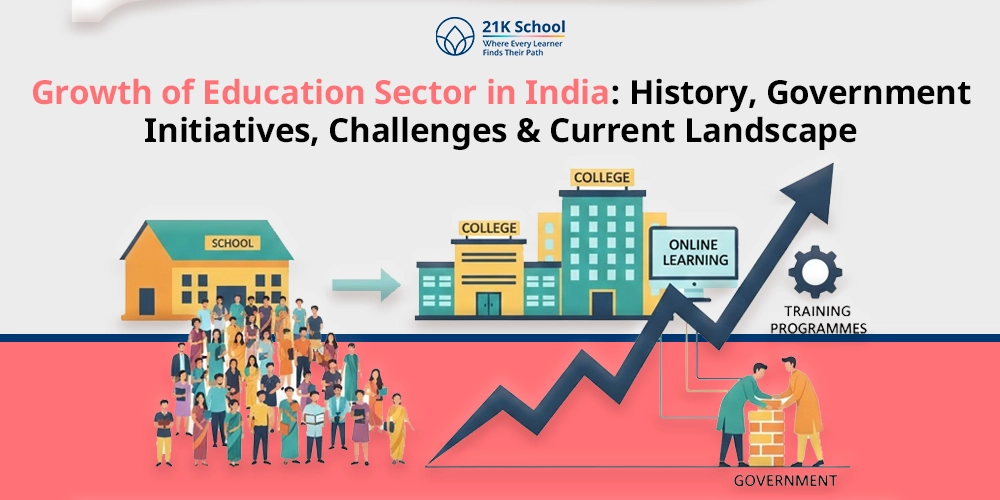
The Indian education sector has grown exponentially in the last several decades due to population growth, the rising number of people who require high-quality education and the active efforts by the government.
The learning environment has changed as the number of schools, colleges, online learning , and training programmes increased.
This growth has also been increased by technological innovations and policy changes as well as active involvement by the private sector, which has made education more accessible, inclusive, globally oriented and workforce-responsive.
Contents
History of the Education Sector in India
1. Ancient Education System (Gurukuls, Nalanda, Takshashila)
The ancient education structure in India was that of the Gurukul model, in which pupils stayed with their instructors and got a rounded education .
Studies were centred around philosophy, mathematics, science, medicine, art, morality and life skills. Scholars all over the world came to such renowned centres as Nalanda and Takshashila.
The learning was focused on discipline , morals, critical thinking, and practical knowledge in general, personal and intellectual growth.
2. Education During the Colonial Period
The British occupancy changed the Indian system of education to the western form of education. The English language was adopted as the main language of instruction and subjects such as science, law and administration were prioritised.
Although this period brought educational institutions and higher education institutions, it marginalised the traditional education systems. Education was largely designed for the colonial administration and a good number of people could not access education and disparities in access to education.
3. Post-independence Reforms and Expansion (1947-2000)
The process of development and improvement in the education system in India began after the year 1947, when India gained its independence. The reforms the government made were oriented towards the improvement of literacy, primary education, which had to be universal and higher education, which had to be encouraged.
The establishments like IITs, UGC and NCERT were established. The 1947 to 2000 involved an increase in school enrolment, the introduction of technical schools and the policy of equity and access was the foundation of modern education in India.
Current Landscape of the Indian Education Sector
The Indian education sector is one of the largest sectors in the globe, and there are more than 24.8 crore students in schools, colleges and vocational institutions. It is an amalgamation of both private schools and public schools and offers education in different languages, different curriculum such as CBSE, ICSE and state boards .
The latest tendencies consist of the creation of focus on digital education, development of professional competency, and employability as a result of governmental choices, including the National Education Policy (NEP) 2020 . In this regard, inclusive and multicultural education , as well as the application of technologies, are obligatory.
1. Growth in Privatisation
There is an rapid rate of growth of the private institutions in India, and they offer more educational options and are of higher quality.
They encourage innovation and competition, but can be expensive, which creates challenges of affordability and fair accessibility, especially in rural and poor regions.
2. NEP 2020
The National Education Policy 2020 promotes interdisciplinary learning and also promotes decisions made based on holistic development, the development of skills and critical thinking.
It lays emphasis on early childhood learning, flexible education , postsecondary training, and assimilation of technologies, in which it aims to put students in a better place in comparison to college education, career and lifelong learning .
3. Digital Learning and Edtech Platforms
Edtech platforms provide accessible and interactive education through online courses and interactive applications provided by Edtech and digital learning platforms, and virtual learning classrooms.
They also enable personalised learning, overcome geographical boundaries and are becoming a permanent feature of modern Indian education, which has been hastened by the COVID-19 pandemic.
4. Focus on Skill Development
Education is centred on skills to be able to increase employability and practice. Vocational training, coding, entrepreneurship and problem-solving programmes provide students with the appropriate skills in the real world.
This aligns educational opportunities with the industry needs and prepares the learners for any career opportunity.
Government Initiatives to Promote Education in India
The Indian government has launched numerous programmes to enhance the quality, accessibility and inclusiveness of education, with the chief emphasis on literacy, skills, early childhood education , online learning and affordability and equal opportunity to all students. The initiatives that are meant to promote education in India are the following.
1. Right to Education (RTE) Act
The RTE Act passed in 2009, has advanced education as a basic right of children between the ages of 6 and 14 years. It entails free and compulsory education, quality standards and accessibility of equal access to the disadvantaged segments.
The act is meant to assist in reducing the dropout rate, increasing the enrolment rate and providing inclusive and student-centred learning opportunities all over India.
2. National Education Policy (NEP) 2020
NEP 2020 is premised on the ambition to revamp the Indian education system through the provision of multidisciplinary learning that is holistic, capable of critical thinking and creativity. It deals with early childhood education, flexible education, vocational training and integration of technology in education .
NEP focuses on equitable access, competency and lifelong learning that would prepare students with higher education, job and global challenges.
3. Samagra Shiksha Abhiyan
Samagra Shiksha Abhiyan includes elementary, secondary education, which is combined with senior secondary education, in order to promote learning.
It targets inclusive education and quality education, teacher training, development and digital literacy of infrastructure. The programme will give equal opportunities to all children, especially those from a disadvantaged background, to narrow gaps in enrollment, retention, and other overall educational levels.
4. Vidya Pravesh
Vidya Pravesh is a programme of early childhood education that is aimed at preparing children aged 3-6 to be able to attend formal school. It targets the aspects of activity-based learning , basic literacy, numeracy and socio-emotional development.
The programme provides a secure transition to primary education, which promotes holistic development and preparation in lifelong learning.
5. Skill India Movement
As part of the Skill India Movement, the mission of the organisation is to train and impart vocational skills to its young population with industry-related skills via apprenticeship and entrepreneurship.
It improves employability, innovation and self-reliance. The initiative can fill the gap between education and employment, which will satisfy the needs of the workforce and help young people to achieve success in different fields.
Challenges Facing the Education Sector
The Indian education sector has faced so many challenges, among them being poor infrastructure, insufficiency of teachers, high dropout rates, unequal access and digital divide, which prevent quality learning and equal opportunities. These are the issues in the education sector.
1. Poor Infrastructure
In India, particularly in rural schools, there is a shortage of adequate infrastructure in terms of inadequate classrooms, libraries, laboratories, and toilets.
This affects the education standards, student involvement and retention. Inadequate resources and learning conditions will hamper the ability of the student to concentrate, denying chances of holistic growth.
2. Lack of Teacher Training
There is a challenge of insufficiently trained teachers. Most teachers do not have contemporary pedagogic abilities, classroom instruction methods, and awareness of online tools.
This impacts the quality of teaching, learning outcomes, as well as student engagement and continuous professional development and teacher capacity-building programmes are necessary.
3. Dropping Rates
Dropout rate remains high, especially among girls and the marginalised communities.
The socioeconomic causes include the premature withdrawal, child labour, commutative distance to the school, racial issues in the school , and the child not being interested in the school. This limits lifelong learning and inequity in society.
4. Unequal Access to Education
Accessibility is not equally distributed in quality education in India, and the rural, tribal, and poor Indians tend to have low representation.
Gender differences, language differences and regional differences are also not favourable to equity, as not all children have equal opportunities and resources to learning.
5. Digital Divide
Online education has played a central role in the digital divide, where a number of students lack access to devices, the Internet, or digital resources.
Such unequal distribution is highly applicable to rural and low-income areas and is a limitation to e-learning as it contributes to educational disparities.
Conclusion
In India, the education sector has undergone a tremendous transformation since the days of Gurukuls to the new modern technology-oriented education system.
Access to and quality of education and focus on skill development have been increased by government reforms, policy efforts such as NEP 2020, and the development of the private sector.
However, such challenges as infrastructure gaps, teacher shortages, school drop-outs, and digital inequality remain. These are the issues which will be central in creating a globally competitive, equitable, and inclusive education system.

You may also want to read