


You may be glancing at the results of entrance exams, test scores or a comparison of scores, but you must know how rankings work.
A percentile is used in place of a percentage since most competitive exams are used to rank students in different sessions in a fair manner
Being aware of the percentiles gives students a clue of how they normally perform against others, and assists them in making the right decisions as per their achievement in school.
This article will teach you all the percentiles and their meaning, how to calculate them, their uses and their differences from percentages.
Contents
What is a Percentile?
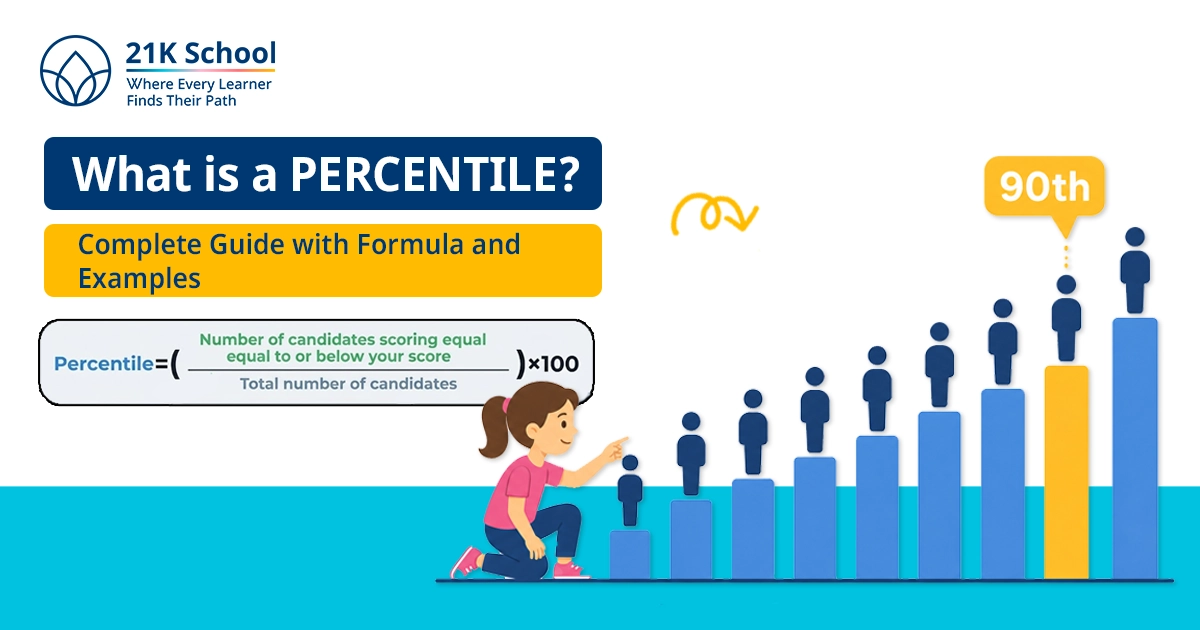
A percentile is a statistical figure or number that indicates the position of a score within a group of scores. It represents the percentage of applicants who received a test or exam score that is equal to or less than some score.
The performance of a student compared to the other students will be seen in a percentile rather than a percentage, which is the marks attained out of the total marks.
In competitive examinations such as JEE Main, NEET, CAT, CUET and other entrance examinations, percentiles are used in order to rank the applicants fairly as long as the examinations are given in different sessions.
How a Percentile is Calculated?
A percentile shows how a candidate performed compared with other candidates who took the same examination. It is used to indicate the percentage of the candidates who have the same or lower score than a certain score.
- The most common formula that is used to calculate the percentile is:
Percentile=(Number of candidates scoring equal to or below your score/Total number of candidates)×100
- Example:
Assume that there were 1,000 students taking an exam and 920 scored the same or less than you.
Percentile = (920 ÷ 1,000) × 100 = 92
Your 92 percentile indicates that you not only scored high, but also higher than 92% of all the applicants who had to take the exam.
Steps to Calculate Percentile:
Step 1: Arrange the Scores
Arrange all the scores (from smallest to largest); this makes it easy to describe a certain location of a given score in the data.
Step 2: Find the Rank
Determine the value of the number, which cannot be greater than the score, whose percentile you would like to know. This number represents the score’s rank.
Step 3: Apply the Formula
To determine the percentile value, use the following percentile formula:
Percentile=(Number of candidates scoring equal to or below your score/Total number of candidates)×100
Step 4: Interpret the Result
The percentile calculated gives the percentage of the values that are equal to or less than the given score.
An example is that when a student is in the 85th percentile, he or she has scored higher than or the same as 85% of students who took the test.
Percentage Calculator:-
A percentage calculator would help you work out percentages of marks, discounts, profit and loss, interest, and many other typical mathematical operations within a very short time.
It enables you to get the percentage of a number, calculate percentage increase or decrease and get the percentage of one number in terms of another.
Uses of Percentile
Percentiles are also used in education , healthcare, business and research in order to perform an effective comparison of performance, analyse data and make informed decisions.
1. Academics
The use of percentiles is common in schools, colleges and universities to make comparisons on the performance of students with how their peers perform. Instead of showing the marks earned, the percentile indicates a rank of a student in the entire group.
This will help the learning institutions to fairly compare academic outcomes and isolate students who are performing well academically.
2. Competitive Exams
Percentiles have been used in ranking the candidates in competitive exams in comparison to the level of their performance against the raw marks.
This is a way of fair comparison, particularly where exams are carried out in different sessions or more than one session, with different degrees of difficulty.
2.1 JEE Main
JEE Main merit list is prepared by the National Testing Agency (NTA) using percentiles . As JEE Main takes place in various sessions with varying degrees of difficulty, the National Testing Agency (NTA) does not use raw marks, but normalised percentile marks (NTA Score).
This is to make sure that candidates in all shifts get rated on the same scale before preparing the All India Rank (AIR). This normalised percentile is taken to decide on admission to NITs, IIITs, GFTIs and entitlement to JEE Advanced.
2.2 NEET
NEET is mostly based on the All India Rank (AIR), but the cut-off is based on percentile. To qualify to take the examination, candidates are required to attain the required percentile to be eligible to take the test as per their category.
2.3 CAT
Common Admission Test (CAT) is a test in which the percentile marks are utilised to filter out or select the students to receive admission in IIM and other management schools of business.
A higher percentile can hugely enhance the chances of getting interview calls from great business schools.
2.4 CUET
In the case of examinations in shifts, normalisation in the Common University Entrance Test (CUET) is done using the percentile.
This helps the universities to create equality in the selection of candidates and also come up with a merit list to be able to conduct admissions.
3. Healthcare Sector
Percentiles are commonly used in the medical profession in the regulation of physical growth and development.
Doctors use percentile charts to assess how a child is developing in terms of height, weight, body mass index (BMI) and head circumference compared to kids of the same age and gender and identify the normal patterns of development and any potential health concerns.
4. Business and Data Analysis
Large datasets are also analysed using percentiles, and performance by businesses and by researchers is compared using percentiles.
They could help to evaluate the productivity of the employees, customer satisfaction, sales, income distribution and trends in the market, and thus interpretation of the data and decision-making can be more efficient.
Difference Between Percentile and Percentage
Although the two are both applied in the measurement of performance, the definitions of percentage and percentile vary; the way the two are calculated and applied in academics and competition exams also differ.
| Basis | Percentile | Percentage |
| Definition | Measures the relative position of a candidate within the same group. | Gives the marks achieved against the total marks as a percentage of 100. |
| Purpose | A comparison of the performance of a candidate with that of other candidates. | Used to find out what you have scored in a test or exam. |
| Calculation | Depending on the number of candidates who scored equal to or less than a score. | Calculated by dividing obtained marks by total marks and multiplying it by 100. |
| Dependence | Relies on the results of all the candidates in the exam. | It only depends on the scores that the individual gets. |
| Use in Exams | Popular in JEE Main, CAT, NEET, CUET and competitive exams. | Typically utilised in college, school and university examinations. |
| Example | 95 percentile means that you are above 95 of the total number of candidates doing the test. | 95 is the passing mark for an exam with 95 out of 100 marks. |
Advantages of Percentile
The percentiles are applicable in interpreting and comparing scores and results of large groups of individuals based on percentiles since they provide useful information about their performance relative to others.
1. Easy Comparison of Marks
The percentiles make it easy to compare the students who have done well since they are ranked among other students. This assists in determining the overall performance as opposed to using raw marks exclusively.
2. Shows Relative Performance
Unlike percentages, percentiles are used as a measure of the performance of the candidate compared to other test takers. They provide a more accurate clue of the position of a student in the entire group.
3. Useful for Large Datasets
The use of percentiles is effective in examining performance in big tests with thousands of participants. They make ranking easy and assist institutions in comparing outcomes within different test periods.
4. Widely Applicable
The use of percentiles is popular in education, sports, competitive exams, healthcare, research and statistics. They aid in making comparisons of performance, growth, and information dispersion in different fields.
5. Less Affected by Extreme Values
Percentiles accentuate the rank of a score as compared to other scoring points rather than a very high or low score. This makes them a viable benchmark for making performance ratings in a group.
Limitations of Percentile
Although percentile is a good measure of performance, it also has its weaknesses that can affect the significance of examination results.
1. Don’t Show Exact Marks
A percentile does not mean anything beyond the relative position of a candidate in comparison to others. Neither does it show the actual marks or the grade achieved in the exam.
2. Can Be Confusing to Interpret
Percentiles and percentages are commonly mixed up by many students. A high percentage signifies relative performance as opposed to the percentage of the marks attained in the test.
3. Dependent on Other Candidates’ Performance
A candidate’s score is given as percentiles of people who took the test. Therefore, the same marks can yield different percentiles across tests or timeframes.
4. Don’t Reflect Data Spread
Percentiles will show the position of a candidate but will not show the distribution of the scores. They are not able to describe the difference between high and low performers.
5. Require Accurate Data for Calculation
Percentile is computed using complete and accurate data of all the candidates. Inaccuracy and reliability of the final percentile may be restricted by missing parts of data or errors.
Common Misconceptions About Percentiles
Many students have a misunderstanding of percentile, which makes them misinterpret their exam scores, rankings and performance. It is significant to comprehend these myths.
1. Percentile and Percentage Are the Same
Most students who are not sure about percentile and percentage believe they are equivalent.
A percentile is the relative performance of a candidate in comparison to the rest of the candidates in the test, whilst a percentage is the number of marks a candidate has gained out of the number of marks to be taken in the test.
2. Higher Marks Always Mean a Higher Percentile
When you get more points, that does not necessarily increase your percentile. Where the competitive exams are conducted in more than one session, the level of difficulty, together with the general score of the candidates, influences the end percentage in normalisation
3. A 100 Percentile Means 100% Marks
A 100 percentile does not mean that a candidate has obtained the maximum marks. It simply indicates that the candidate scored higher or equally with the rest of the candidates in the examination.
4. Percentiles Are Based Only on Individual Marks
The percentile is not dependent on the score of an individual. It is based on the performance of all the candidates, thereby providing relative ranking but not total marks.
5. The Same Marks Always Give the Same Percentile
The same marks can mean the same percentile in the other sittings of the exam or can mean a different year of the exam.
Combinations of overall, normalisation of the candidates during the exams, in combination with the difficulty of the exams, are factors which affect the final percentile score.
Conclusion
The use of percentiles is a good measure of a candidate’s performance in relation to other people as opposed to measuring only by marks. They are prevalent in competitive tests, in learning tests as well as in statistical testing to form equal ranking among the multitude of people.
Learning how to calculate and interpret percentiles gives the student the capability to compare his or her results, as well as assess his or her performance in an accurate way, and make effective academic decisions.
It is, too, however, important to understand the difference between a percentile and a percentage so as not to mix them up.
