


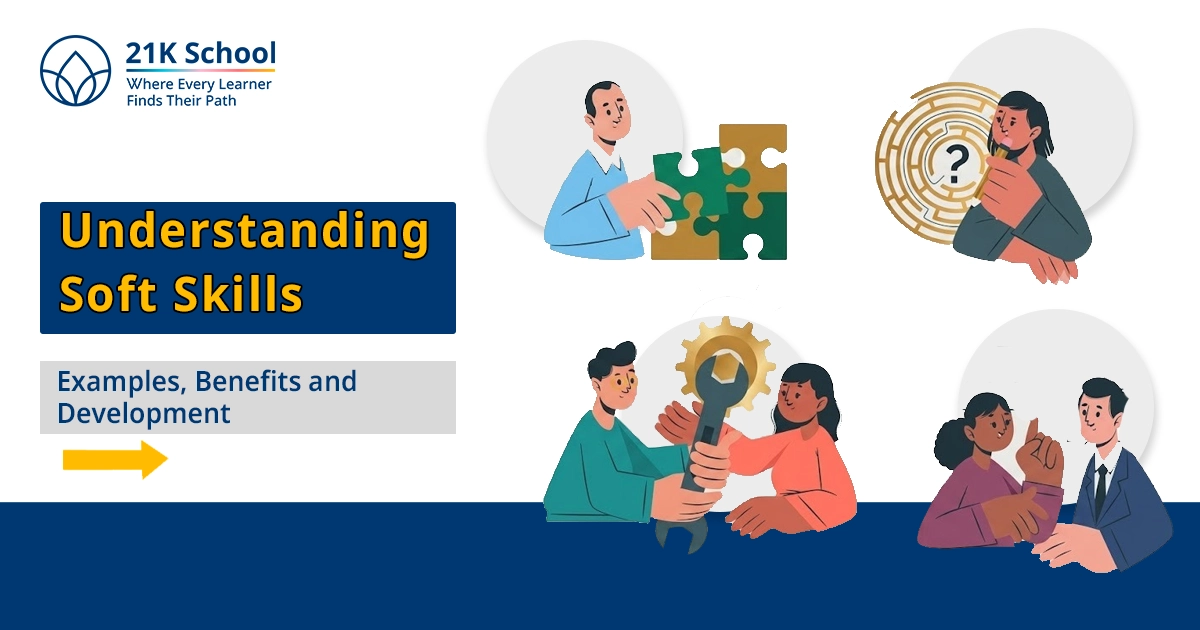
Do you know why soft skills are essential in today’s modern world?
Soft skills have an impact on the way individuals interact, cooperate, resolve issues, and address various circumstances. They are used in scholarly, employment and everyday life since they dictate how individuals interact with others and take responsibility.
The ability to work as a team, communicate, be flexible, be a leader, have emotional intelligence , time management and others can enhance the performance of students
This will also contribute towards developing soft skills which will help people become more confident, flexible and ready to confront any personal and professional challenges whenever they come up in future.
Contents
What are Soft Skills?
Soft skills are individual and social skills , which affect the way people converse, act, work with each other and react to various circumstances. They are not concerned with technical expertise and professional ability but with how one thinks about relationships, duties, emotions and sufferings.
These competencies will assist a person to collaborate efficiently within a group and perform under various circumstances, express his/her concepts coherently and intelligently and ensure good working relationships, both professional and personal.
They are applicable during schooling, work and in everyday life and might be trained and exercised through daily experience.
Top 5 Importance of Soft Skills
The manner in which individuals interact, associate with others, handle responsibilities and grow both in school and at their workplaces is determined by soft skills. The importance of soft skills is due to the following reasons.
1. Improves Communication
People are made understandable and able to listen to what others are saying using soft skills. It means that effective communication decreases misunderstandings, enables an open conversation and eases the way of sharing ideas and information.
2. Builds Strong Relationships
Interpersonal skills help in comprehension, respect and relationships that help people relate to other people.
Good relationships lead to trust and the ability to work interdependently, communicate easily and deal with each other in good terms under various circumstances.
3. Supports Teamwork
Soft skills assist individuals to work with team members who might have varying ideas, personalities and working styles. They promote co-operation, division of roles, listening and striving towards a common goal.
4. Develops Confidence
Soft skills may be trained to help people feel more comfortable communicating, decision-making, and interacting with other people. The feeling of trust will make people active, share their views, and assume new positions.
5. Supports Career Growth
Employers love those who are able to communicate effectively, cooperate with others, deal with challenges and adjust to workplace changes.
Good soft skills are therefore able to work to enhance performance at the workplace and may result in career development.
Top 10 Examples of Soft Skills
The skills will be applicable in helping the students communicate, learn, relate, work in a team and endure everyday academic stresses.
1. Communication Skills
With proper communication, the students would be at ease giving their ideas during the discussion sessions in classes, during presentations, and group projects.
It also means listening attentively, posing the necessary questions, and making suitable responses to help students connect more with teachers, their peers, and others.
2. Teamwork Skills
Working in groups, sports teams, and in-class projects give students the opportunity to work with other individuals.
Sharing responsibility, listening to different perspectives, pro-pro classmates, and equal contribution can make a more productive and better team environment.
3. Problem-Solving Skills
Students will be more likely to seek answers to something instead of memorising, which is facilitated by schoolwork.
Sharing a problem and thinking over possible solutions, locating methods of problem solving , and selecting the most suitable option encourages students to think on their own and be prepared to deal with challenges.
4. Critical Thinking Skills
Critical thinking skills help students to doubt information, compare opinions and differentiate between facts and opinions.
Critical thinking is particularly useful in lesson analysis, answering complicated questions, evaluating information and drawing valid conclusions.
5. Adaptability Skills
Re-alignment of the students may be necessary immediately after the change of the teachers, time, curriculum , as well as teaching or academic needs are involved.
This will help them feel comfortable and productive when in an unfamiliar situation since they will be able to be open to new experiences and change to new ways of doing things when necessary.
6. Leadership Skills
Leadership can be acquired by assuming leadership of a group project, a school activity, or a group of fellow students.
They also help to foster an environment that helps the students to be self-directed and make their own decisions, organise roles and assist others in achieving a common goal.
7. Time Management Skills
Homework, examinations, after-school tasks and personal duties should be coupled with smart time management skills .
Priorities at work, planning, avoiding procrastination and finishing the work earlier than planned can assist students in being more organised and decrease stress at school at the last minute.
8. Emotional Intelligence
Knowledge of individual feelings and how other individuals are performing may boost the social life of students.
Emotional intelligence promotes patience, empathy , self-control and considerate treatment and therefore a more convenient path to manage stress, conflicts, friendship and boisterous behaviour in the classroom.
9. Creative Thinking Skills
Creative thought provokes students to have bizarre thoughts and solve common problems in a different way.
It can be manifested as writing, artwork, projects, experiments, presentations, or innovative solutions, and the students will be able to come up with original solutions instead of relying solely on traditional solutions.
10. Conflict Resolution Skills
There may be conflict among peers, friends, and workmates working on a project due to numerous reasons.
Being able to listen calmly, understand opposing opinions, articulate their problems in an acceptable way and reach a solution that is acceptable to both parties can assist students in resolving their differences.
How to Develop Soft Skills?
Practice, meaningful interaction, directions, and opportunities to practice them in real life can be used to develop soft skills.
1. Practise Communication
Talk, demonstrate, do group tasks and discuss; feel comfortable sharing ideas. How to listen, how to listen without interruption, how to learn to speak and look straight at others and how to be considerate.
2. Workshops and Training Programs
The organisation of the skills is through teamwork , communication, leadership and problem-solving skills, which are exercised through workshops and training programs.
Activities, role plays, group work and practical activities can assist in making the learning more interactive and effective.
3. Learn to Accept Feedback
Positive criticism will allow you to identify trends and areas of improvement.
Listen to the suggestions of the teachers, mentors, colleagues or peers without becoming defensive and use their observations to make sure you make certain changes to your behaviour.
4. Improve Time Management
Begin by making a list of key tasks and determining which tasks should be attended to.
Through effective scheduling, deadlines and avoidance of procrastination, it is possible to learn to do everything step by step and thereby get more organised and easily balance various things.
5. Mentoring and Coaching
They can be guided or coached by a coach or mentor based on his or her experience, and the strengths and weaknesses can be identified.
Conversations and practical tips, as well as positive feedback, can be common and assist the learners with a better idea of how to develop their interpersonal and professional skills.
6. Learn from Real-Life Experiences
In daily life, soft skills such as group work, volunteering, internships, extracurricular activities and work experiences are good.
This enables people to communicate, solve problems, be entrusted with tasks, deal with conflicts, and know what is really happening by the outcomes.
Top 5 Benefits of Soft Skills
Such soft skills can be practised to assist students to manage their studies, establish relationships, engage, and be ready for both academic and professional life.
1. Improves Confidence
Effective communication and relationship skills can enable students to be more at ease sharing their ideas in the classroom.
Confidence will help them to speak, stand, make presentations, ask questions, be proactive and meet new challenges in academics.
2. Strengthens Relationships
Students are in direct interaction with teachers, peers, friends and other group members on a daily basis.
Communication skills like empathy, active listening and respect assist them in getting to know people, trusting them, working with them better, and even having good relationships with them.
3. Enhances Productivity
Problem-solving skills , management and organisation assist students to manage their academics better.
They will no longer need to stress about assignments and waste time worrying about them; they will be able to prioritise them, read them, not procrastinate and complete schoolwork on time.
4. Improves Team Performance
Not only in group work but also in the classroom, students will be obligated to work in groups, where other students might have different ideas and work methods.
The soft skills facilitate cooperation, responsibility, participation, and respectful dialogues, which contribute towards better results of the whole group.
5. Supports Career Development
Soft skills can be introduced to students in school and college, where they will be equipped for the working environments in future.
Interviews, internships, professional relationships, and future job-related tasks can be easier to cope with through communication, teamwork, adaptability, leadership and problem-solving skills.
Soft Skills vs Hard Skills
The two distinctions between soft and hard skills are associated with their focus, the way they are learned, their application and their judgment. Whereas soft skills define the way one interacts and operates with others, hard skills look at particular technical knowledge and skills.
| Basis | Soft Skills | Hard Skills |
| Meaning | Individual and interpersonal skills that determine the way an individual acts and relates with others. | Skills and competencies to carry out a certain task. |
| Focus | Practice communication, behaviour, relationships and personal effectiveness. | Focus on technical, procedure-based, and task-specific skills. |
| Learning Method | Generally learned through practice, experience, communication and feedback. | Mostly gained with training, courses and on-the-job training. |
| Assessment | Performance, behaviour, feedback and observation are often used to evaluate them. | Typically evaluated in the form of a test, a working experience, exams or certification. |
| Application | Applicable to various topics, workplaces, relationships and in our daily lives. | Generally applied to specific topics, occupations, jobs or technical processes. |
| Examples | Teamwork, adaptability and emotional intelligence, communication, and leadership. | Coding, accounting, data analysis, programming and foreign language. |
5 Common Challenges in Developing Soft Skills
Soft skills cannot be learned quickly because they are garnered through practice, and students may meet a variety of challenges during the process of developing soft skills.
1. Lack of Confidence
Some students are not willing to communicate, to run the discussion and share their ideas due to the fear of making an error.
This may cripple the art of communication, leadership and other human relationship skills.
2. Poor Communication
The students might feel that they are not able to communicate or to hear others. Lack of practice in communication may result in confusion and a lack of understanding of classroom conversations, presentations, and group work.
3. Difficulty Working in Teams
Group activities have problems due to differences in opinion, personalities and working style.
The other students may not be in a position to share out the responsibilities, to compromise, or work with other people to complete projects and tasks.
4. Resistance to Feedback
In cases where other students inform students on what they should do better, then students are not comfortable.
Individualising feedback might rob them of the chance to determine areas of weakness and make the appropriate change to be even bigger and better at what they are doing.
5. Difficulty Managing Emotions
In other cases, academic stress, conflict and stressful situations might affect students at an emotional level.
Communication and relationships, decision-making, and the ability to react calmly can be influenced by frustration, anxiety, or anger, which may make it harder to respond calmly.
Top 6 Soft Skills Activities for Students
Activities can provide students with a chance to communicate, collaborate, provide leadership, be creative and solve problems in interesting ways.
1. Group Discussions
Choose an age-related topic, and have students share their opinion with the group.
The exercise promotes active listening , communication, confidence, disagreeing respectfully, and willingness to listen to another opinion.
2. Role-Playing
Students are able to simulate a classroom conflict, job interview, a customer encounter or a team discussion.
The role-playing assists in empathising, communication, decision-making and reacting to different situations sufficiently.
3. Group Projects
Give students an assignment in which they are required to collaborate with each other and divide the assignments.
The task completion aspect promotes cooperation, planning, accountability, communication and problem-solving, as well as educating the students on how to work together to achieve a common objective.
4. Public Speaking
Ask students to deliver short speeches, presentations or stories concerning places.
Confidence, vocabulary, body language, structure of ideas and effective communication when in the presence of others can be practised over time and improved.
5. Puzzle Activities
Students are challenged to think and find different solutions through logic games, puzzles, riddles, and problems to be solved.
When done individually or in groups, such activities are capable of developing critical thinking, creativity, patience, decision-making, and teamwork.
6. Leadership Activities
Provide students with some classroom activities, moderation opportunities, organisation of an activity, a small group leader or a small responsibility in a small project.
These will instil initiative, decision-making, responsibility, communication, as well as confidence in handling responsibilities.
Conclusion
Soft skills are crucial in the academic, personal and future career growth of students. Teamwork, communication, leadership, adaptability, and problem-solving are a few of the skills that enable students to overcome challenges, build positive relationships and interact.
These skills can be acquired by practising frequently, in a classroom setting, through group work, feedback, and life experiences.
The young nurturing of soft skills enables the students to be prepared to perform their jobs effectively and become mature, confident, responsible and well-rounded citizens.
