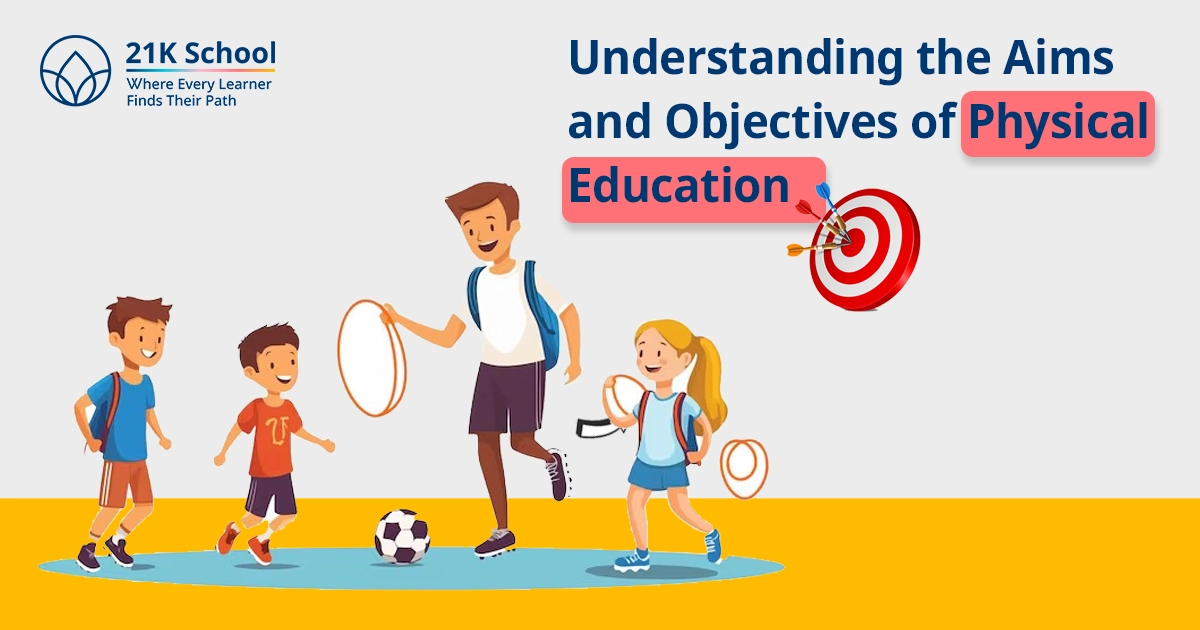
Understanding the Aims and Objectives of Physical Education
 Written byRahul PalContent Specialist
Last modified: Sep 2, 2026 9 min read
Do you know what the aims and objectives of physical education are?
Physical education is all about the physical, mental, emotional and social well-being of the students, achieved through taking regular physical exercises, sport and fitness programmes.
Physical education plays a crucial role in encouraging healthy lifelong lifestyles, physical health, cooperation and discipline.
It is also a method of instilling confidence, leadership and sportsmanship amongst the students, and this contributes to the character building of the student and prepares them to live a healthy and active life.
What is the aim of physical education?
Physical education is targeted at the overall improvement of people by enhancing their physical fitness, mental stability and emotional stability as well as social skills by undertaking regular physical exercises and sports.
It also promotes a healthy lifestyle, instils discipline, teaches teamwork and leadership to the students, and equips the students to lead active, balanced and productive lives as productive members of society.
As per Thomas Wood:
"Physical Education must have an aim as broad as education itself and as noble and inspiring as human life."
As per J.F. Williams:
"Physical education should aim to provide skilled leadership, adequate facilities and ample time for the individual and the groups to participate in activities that are physically wholesome, mentally stimulating and socially sound."
What are the objectives of physical education?
Physical, mental, emotional and social development of the student altogether and the lifelong fitness and health of students are the purposes of physical education.
1. Physical development
Under physical education, the strength, flexibility, endurance, balance and co-ordination are improved, and the foundation of such is regular physical activities and sports.
It induces healthy growth and physical fitness and helps students to take up an active life that can reduce the chances of obesity and lifestyle diseases.
2. Mental development
Physical activities increase attention, memory, ability to think and problem-solving ability. Exercise also helps lower stress levels, increase self-esteem and improve psychological health, allowing the student to study and live a better life in school and the real world.
3. Emotional development
Physical education will allow students to get rid of stress, manage emotions and become strong. Engaging in sports teaches patience, self-control, confidence and how to take success and failure in a positive and balanced manner.
4. Social development
Team sport and group work promote communication, respect and collaboration with each other.
By becoming involved in physical activities with each other, students know how to socialise with all people, embrace diversity, resolve conflicts and develop healthy relationships.
5. Character development
Physical education inculcates honesty, responsibility, perseverance, integrity and respect towards rules.
The students are being informed about the virtue of dedication, hard work and ethical behaviour, and the students are being empowered to become strong characters that will help them in their lives.
6. Promotes discipline
Discipline taught to students encompasses following orders of a game, respect for coaches, exercise and time management.
They are desirable habits and make one more responsible, time-conscious, committed and self-disciplined, a practice that can be applied in both studies and personal life.
7. Builds sportsmanship
Physical education teaches students to respect the opponent, lose and win gracefully in a game, play at the level and encourage their teammates.
These qualities result in sporting teamwork, humility and attitude on and off the field.
Aims and objectives of adaptive physical education
Adaptive physical education is to help cultivate the physical, social and emotional skills of the students based on the principles of inclusive, individualised, and accessible learning opportunities.
1. Physical rehabilitation
Physical activities that are specifically designed are useful in enhancing mobility, posture, flexibility, muscle strength and functional movement.
Adaptive physical education has been associated with rehabilitation as it helps students in recuperating or living with physical impairment, and encourages routine physical activities and well-being.
2. Social and communication skills
Team and group games and collaborative tasks assist students to communicate effectively, cooperate with co-workers, resolve conflicts and become leaders.
Such experiences enhance socialisation and also assist the students to form meaningful relationships within and outside the school.
3. Emotional growth
Adaptive physical education is useful in making the students confident, strong, patient and emotionally stable.
The individual successes and physical challenges conquered boost self-esteem and help learners to be positive towards learning and life.
4. Health and wellness
Adaptive physical education promotes physical activity, wellness and physical health.
It also helps in improving heart and blood circulation, muscle tone, flexibility, and mind, as well as reducing the inclination of sedentary problems and lifestyle illnesses.
5. Recreation and leisure
Adaptive physical education also encourages students to be involved in sports, recreation and leisure activities, which they are capable of doing.
These interests formed result in physical activity throughout their lifetime, socialisation, relaxation, and better quality of life outside the classroom.
Top 5 importance of physical education
Physical education is quite essential in raising healthy, confident and responsible individuals who will help in their overall growth and well-being.
1. Holistic development
Physical education enhances the overall development of students by optimising their physical fitness level, mental and emotional stability, as well as social skills.
It fosters balanced growth and development, making learners confident, responsible, healthy and well-rounded individuals who might easily overcome challenges in their day-to-day lives.
2. Enhance motivation
In sports and other physical activities, the students get more motivated, self-assured, and ready to pursue their personal goals.
It creates a good attitude, builds endurance and encourages the learners to improve academically, in sports and other aspects of life.
3. Better classroom concentration
Exercise aids in blood circulation to the brain, which aids in concentration, memory and thinking.
Students will be more attentive, focused and productive in classes, which determines academic outcomes and their overall learning.
4. Reduce lifestyle diseases
Physical education helps to promote healthy living and regular physical exercise that help to avoid obesity, diabetes, hypertension and other lifestyle-related illnesses.
An early initiation of exercise serves to maintain good physical health over the long-term perspective, and reduces the future risk of health conditions.
5. Boost social inclusion and equality
Physical education will enable students from diverse backgrounds to play as a team, which will make them more equal and work as a team, respecting and understanding each other.
It assists in building holistic learning communities wherein all the students feel viable, accepted and motivated to participate.
Top 5 benefits of physical education
Physical education possesses numerous benefits that increase physical fitness, self-improvement and socialisation among students, making them more mature.
1. Develops teamwork
Teamwork is promoted in physical education. It enhances communication, group work, respect towards each other, and decision-making, and students can reach similar objectives, establish good relations and cooperate to comprehend the necessity of collaboration.
2. Builds self-confidence
Involving in regular physical activities aids students in fighting challenges, accomplishing personal objectives, as well as enhancing their skills.
Sports increase self-esteem and confidence and encourage students to be active in academics and extracurricular activities.
3. Promotes discipline and responsibility
Physical exercise would render a student obedient, respectful to the coaches and teammates, and enjoy doing a lot.
These disciplines will help instil discipline, accountability, responsibility and commitment, which can help in both academic and personal life.
4. Encourages healthy lifestyle habits
Physical education will take place to teach the students to be active, eat and practice healthy daily lives.
These practices will minimise the chances of being overweight and contracting lifestyle diseases, and enhance physical and psychological health with time.
5. Improves motor skills and coordination
Running, jumping, throwing and balancing will improve coordination, agility, flexibility and body control.
The students can perform the daily activities efficiently; in addition, they can enhance their performance in various sports and physical activities through good motor skills.
What is the difference between aims and objectives in education?
Both terms are closely related, i.e., they have similarities in aims and objectives, but the terms vary in purpose, scope and targets of learning. Their main characteristic is that they have huge disparities, as shown in the table below.
| Basis | Aims | Objectives |
|---|---|---|
| Meaning | The general education outcomes that identify general learning and long-term success of the students. | Clear learning goals of specific measurable skills, knowledge and behaviours that students have learnt. |
| Purpose | Provide broad guidance and orientation of the learning process and the curriculum. | Set personal goals towards meeting the larger educational goals in an effective manner. |
| Scope | Combine the entire learning and overall development of the learners. | Simply pay attention to particular learning activities, skills or quantifiable learning outcomes. |
| Time Frame | Acquired over a long term of gradual learning and exercising. | Acquired during classes, courses, subjects, or personal educational programmes. |
| Focus | Concentrate on the personality, character and integrated development of the students in the learning process. | Focus on the systematic acquisition of specific skills, abilities and academic knowledge. |
Conclusion
The goals and objectives of physical education are to achieve the following: physical fitness, mental fitness, emotional stability, and interpersonal skills among students.
It promotes a good way of life, discipline, teamwork and sportsmanship, besides aiding in building personalities. These regular physical activities will make the students healthier, confident and better equipped to live a balanced and active life.
Frequently asked questions
6 questions
What are the aims and objectives of physical education?
The physical education goals are to enhance overall development, and the objectives are to achieve fitness, capabilities, discipline and good health
What is the main aim of physical education?
The main goal is to ensure physically, mentally, emotionally and socially healthy individuals with the assistance of regular physical exercises.
What are the objectives of physical education?
The aims of these are to make people fit, motor, disciplined, team players, sportspersons and healthy people in general.
Why is physical education important in schools?
It encourages fitness, health, teamwork, confidence, discipline and improved academic performance amongst students.
How does physical education contribute to students' overall development?
It supports the physical, mental, emotional and social well-being of students to produce healthy, confident, disciplined and responsible students.
What are career options in physical education?
Physical education teacher, sports coach, fitness trainer, sports psychologist, physiotherapist, sports manager and athletic trainer are the career opportunities in physical education.
About the author
Rahul Pal
Content Specialist
Rahul Pal is an Education Content Specialist at 21K School- India’s fully accredited online school recognised by the Cambridge International (IA702) and Pearson Edexcel (94883). His graduation from Journalism and Mass Communication from Swami Vivekananda University gives him a strong foundation in factual reporting, source verification, and investigative research. With around 2 years of experience at 21K School, he has written extensively for the CGPA conversion guides, marking schemes, and Indian and International boards (IGCSE, GCSE, and A-Levels). His articles are highly relevant for the guardians looking to guide their learners for board exam preparation across 78+ countries. All Rahul’s content is reviewed by the school’s academic team to ensure alignment with the latest board guidelines and latest notifications from the official resources
Every 21K School guide is written by our education team and reviewed by a subject facilitator before publishing.
Exploring a CBSE-pathway online school?
Talk to an advisor about 2026–27 admissions — no obligation.
Talk to an advisorComments
No comments yet — be the first to share your thoughts or ask a question.