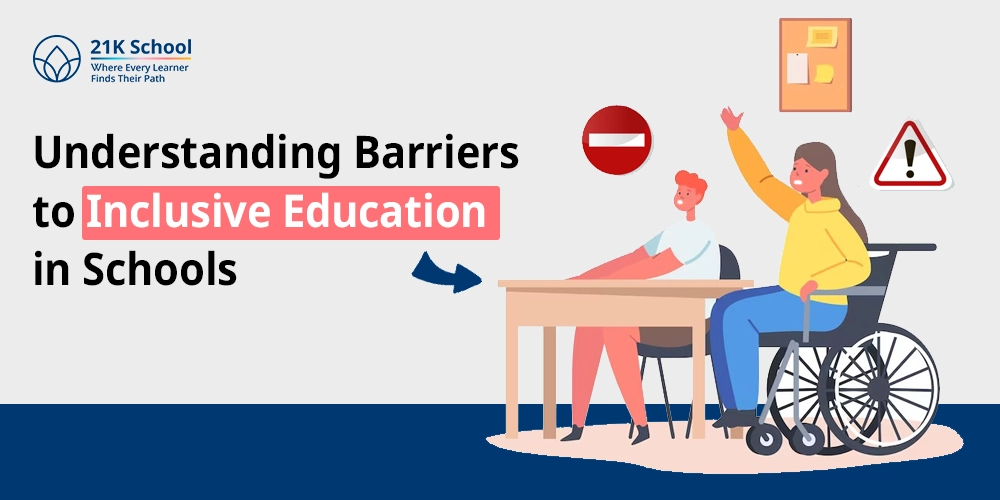
Understanding Barriers to Inclusive Education in Schools
 Written byAnshu KumariContent Specialist
Last modified: Oct 23, 2026 8 min read
Inclusive education is a blessing where learners from different backgrounds come together to learn, play, and live life freely.
Methods like inclusive education offer equal opportunity to each learner. They can receive a better education and understand the best way to live in society.
However, sometimes the implementation of inclusive education is a challenging task. There are various barriers people need to deal with.
Let’s understand some key barriers to inclusive education and how to overcome them.
What is inclusive education?
Inclusive education means all students are provided with education in the same place and also provided with appropriate support, teaching methods, and resources so that every student can learn effectively.
Here, all students mean normal children, children with special needs, and children with mental problems. The aim of this education system is to educate everyone well.
10 barriers to inclusive education
Inclusive education simply means that all children learn together in the same place.
Children from different languages and cultures, rich and poor children, normal and physically challenged children all learn together.
However, some barriers to inclusive education can still be observed.
1. Attitudinal barriers
It refers to the attitude of the people regarding the concept of inclusive education. It is a great hindrance in the path of the dream of education for all. They believe it is not important to interact with people with disabilities.
They think that such children do not have the right to study with normal people. Not only the attitude of normal people, but sometimes disabled people also hesitate to study with others in a normal classroom setting.
Disabled individuals do not get a chance to prove themselves. Society ignores them on the basis that they do not have the skills to complete work or tasks.
Many times, non-disabled people have a fear in their mind that they may say something wrong to disabled people, which may hurt them.
So they always try to live away from such people. Disabled individuals are bullied by others, which prevents them from going to school.
Sometimes children do not accept disabled children in their school or classroom. It is a great barrier to their education.
2. Lack of teacher training
Teachers need to be more skilled to provide inclusive education. In this education system, all students are taught with equal rights.
Therefore, teachers should teach in a way suited to the students so that the students can understand easily.
Since India is a country of different cultures and languages, teachers here need to be aware of other cultures and languages.
Teachers’ training, abilities, and attitudes can be major limitations for inclusive education.
The teachers are not trained adequately to teach children with special needs. The training of staff at all levels is often not adequate.
At present, training for teachers is fragmented, uncoordinated and inadequate in a segregated manner. So, all teachers do not have proper skills and positive attitudes towards learners with special needs.
3. Inadequate infrastructure
In this education system, the school infrastructure has to be improved a lot. Here, all types of students get education from the same place, so the school infrastructure has to be improved by keeping an eye on everyone.
There is a lack of good labs and libraries in the school; they have to be improved. Now in this digital era, institutions have to arrange digital classrooms for the students.
Since physically disabled students study here, this structure has to be made considering them.
The lack of wheelchair ramps in school buildings, playgrounds and public transportation is a main difficulty identified by several students with disabilities when going to school and public places.
4. Limited resources
Undoubtedly, most school structures do not respond to this requirement. There is also a lack of facilities or assistive technology to aid children with a particular type of difficulty.
Assistive technology means the products and the services designed to meet the particular needs of people with disabilities, allowing them to build up their abilities and meaningfully participate in the affairs of their home, school, work and community.
Adequate funding is a necessity for inclusion, and yet it is rare. Schools often lack adequate facilities, qualified and properly-trained teachers and other staff members, educational materials and general support.
5. Rigid curriculum and assessment systems
In any education system, the curriculum is one of the major obstacles or tools to facilitate the development of a more inclusive system. In our country, the curriculum is unable to meet the needs of a wide range of learners.
Sometimes, the curriculum is centrally designed and rigid.
This leaves less flexibility in learning for local adaptations or for facilitators to experiment and try out new methods.
6. Large class sizes
One of the problems of an inclusive education system is that the classrooms are large. As a result, it is not possible for a teacher to explain to all the students separately.
Due to the large classroom, the students’ attention is less on the teacher’s lecture because the teacher cannot take feedback from each student separately.
It is difficult for students with poor hearing to listen to the lecture. When the classroom is small, it is easier for teachers to teach, as well as to understand the students and clear the doubts.
7. Social barriers
It means various social factors create problems in the path of inclusive education. The education system of our country is poorly organised. Adequate opportunities are not given to people, especially people with disabilities, to develop themselves.
Sometimes people do not want their children to study with disabled children. They think it will have a bad impact on their mind. So this is also a barrier to the process of inclusion.
Running a school for disabled students is not an easy task. A lot of funds are needed. Material resources needed to carry out inclusive education are not available. It is important to make adequate arrangements for the material.
8. Cultural barriers
Culture means norms, ideas, and beliefs of a particular society. Sometimes these act as a hurdle in the way of education for people with disabilities.
Sometimes some groups may believe there is no need to send children to school. Each group has different values.
So they want a separate institution for their children, especially disabled children. Every culture has its own language. So disabled children who belong to tribal classes have different ways of living and language styles.
It is a great problem for them to study with others in the normal setting of school. Some students are expected to learn while being taught in a language that is new and, in some cases, unfamiliar to them. This is obviously a significant barrier to successful learning.
9. Policy and systemic barriers
Every country must have a proper law on inclusive education.
Implementation of inclusive education policies varies across regions. That’s why gaps may exist due to reasons like:
- Administrative challenges
- Financial challenges
- Social challenges
The government should pay special attention to this education system. For this education system, schools should be of better quality, especially government schools.
To improve its education system, the government should appoint adequately budgeted and specially trained teachers.
If the government makes a reservation for some school, it should monitor how effectively these reservations are implemented.
There is also no accurate picture of the number of learners excluded from the school system due to a lack of coordination within many systems.
Moreover, there are different types of schools such as private, government and public schools, which are contributing to inequality by offering different levels of facilities and support.
10. Economic barriers
The economy is one of the main barriers to education. There is a lot of cost behind the education of the student. In the field of education, it costs a lot of money for each field, from buying books.
In this education system, the children of poor families have to face many difficulties in adapting to the children of rich families.
Poor families do not allow their children to study because they cannot afford transport facilities and study equipment.
Moreover, schools in rural areas also receive fewer government facilities.
Conclusion
Inclusive education is an important way to build an equitable and just education system, but various obstacles still exist in its path.
However, if all the problems in this education system are solved, this education system can be improved a lot.
Problems like a lack of teacher training, financial conditions, making classrooms smaller, and improving infrastructure should be solved by parents, teachers and the government together.
Frequently asked questions
6 questions
What are the main barriers to inclusive education?
The main barriers include a lack of teachers' training, good infrastructure, adequate resources, as well as special attention from the government, and financial problems of the family.
Why is teacher training important for inclusive education?
Teacher training is important because here students of all kinds study together. There are students from different cultures and languages, and teachers have to deal with all of them. Without proper training, it is not possible for teachers to deal with all of them.
What role does society play in inclusive education?
Society plays an essential role in promoting inclusive education. They help by providing a positive learning environment, good attitudes, and behaviours.
Are there specific barriers in India?
Yes. Some barriers are still visible in India. For example: The RTE Act's implementation gaps Caste-based discrimination The rural-urban divide To overcome these challenges,the government needs to pay special attention.
How can schools overcome barriers to inclusive education?
To remove barriers to inclusive education, infrastructure for students must be improved, teachers must be adequately trained, and classrooms must be made smaller.
Is inclusive education beneficial for students without disabilities?
Yes, inclusive education is beneficial for everyone because here students learn together with everyone. As a result, differences among students are removed, and compassion and humanity increase.
About the author
Anshu Kumari
Content Specialist
Anshu Kumari is an Education Content Specialist at 21K School- a fully accredited institute- Cambridge International (IA702) and Pearson Edexcel (94883). She focuses on the in-depth research and creation of the well-drafted guides on NIOS admission, Indian Education Policy, and competitive exam preparation. With around 2 years of experience at 21K School, her psychology background informs her approach to the education content and hence focuses on creating guides to address the real anxieties of the guardians. She writes well-researched articles on competitive exam timelines, stream selection, and board choices by referring to the official resources. All Anshu’s content pieces are fact-checked against the board and primary government official resources and is dedicatedly reviewed by the school’s academic team.
Every 21K School guide is written by our education team and reviewed by a subject facilitator before publishing.
Exploring a CBSE-pathway online school?
Talk to an advisor about 2026–27 admissions — no obligation.
Talk to an advisorComments
No comments yet — be the first to share your thoughts or ask a question.