Emotional Intelligence and Social Skills: What Students Should Know
 Written byRahul PalContent Specialist
Last modified: Sep 9, 2026 16 min read
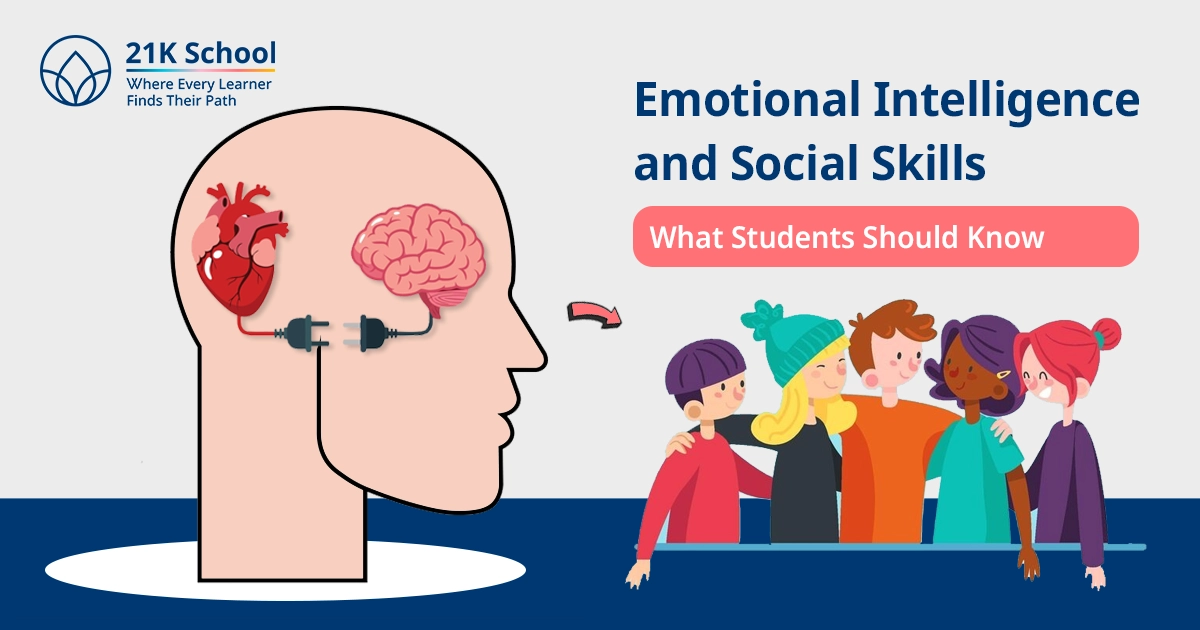
Emotional intelligence social skills play a significant role by helping students navigate relationships, interact well and respond to other situations in society in a proper manner.
These skills may help students feel more comfortable expressing themselves to others, learn how to deal with emotions, learn how to be a team player, solve conflicts, and have meaningful relationships when it comes to them.
With well-developed social and emotional skills, confidence, empathy, leadership and positive behaviour will be helped, and the students will be able to perform better both in the classroom and in their daily interactions.
What are emotional intelligence social skills or social skills in emotional intelligence
The skills that would help students learn to communicate with others properly are the set of emotional intelligence social skills as they learn to manage their emotions.
They are making choices about how to act, form relationships, work and react to various social situations in a proper manner through emotional awareness and communication.
Emotional intelligence social skills comprise active listening, empathy, communication and conflict management, teamwork, cooperation and relationship management. The competencies assist one to have good relationships and interactions.
Models and theories of emotional intelligence social skills
Several theories of emotional intelligence elucidate how people interpret, respond and utilise emotions to create good interactions and relationships.
1. Goleman's model (Mixed model)
This is among the greatest models of emotional intelligence that has been used widely in both the popular and workplace environment and was coined by a psychologist known as Daniel Goleman and popularised in his 1995 book of the same title, Emotional Intelligence.
Five essential elements are recognised by the model: self-awareness, self-regulation, motivation, empathy and social skills. It is referred to as a mixed model since it is a blend of emotional skills with personality and social skills.
2. Mayer-salovey model (Ability model)
Two psychologists, John D. Mayer and Peter Salovey, created this model and introduced it in 1990, explaining emotional intelligence as a set of skills associated with cognitive abilities, and not character traits.
It is subdivided into four branches: perceiving emotions, utilising emotions to aid one's thinking, understanding emotions, and controlling emotions.
3. Bar-on model
The model was formulated by a psychologist known as Reuven Bar-On and was initially introduced in 1997; it refers to emotional intelligence as emotional-social intelligence.
It is a composite of the emotional and social skills of interrelationship in five general areas: intrapersonal skills, interpersonal skills, adaptability, stress control, and overall mood.
It is particularly applicable to social skills of emotional intelligence as it is a direct correlation of emotional and social functioning.
4. Trait EI model
Trait Emotional Intelligence Model, created by the psychologist K. V. Petrides, was actually developed in the early 2000s; however, the concept of trait EI and the mechanism of its measurements were created in the year 2001.
It regards emotional intelligence as being composed of personality traits, emotional self-perceptions, and contrasts it to cognitive abilities.
They consist of assertiveness, optimism, empathy, emotional expression and adaptability and are normally evaluated through self-reporting questions.
5 key components of emotional intelligence
The five major components make up emotional intelligence that help individuals to understand emotional reactions, the way to respond to them, associate with others and develop healthier relationships.
1. Self-awareness
Self-awareness is the ability to know and understand your emotions, thoughts, strengths and weaknesses.
It would help the students to identify the impact of their emotions on their behaviour, choices, relationships and reactions to be more conscious in their reactions to different situations.
2. Self-regulation
The capability to control and regulate emotions, thoughts and behaviours is called self-regulation.
It helps individuals to be serene in tense situations, not to respond impractically, cope with frustration and think over their reactions instead of following the initial emotions to make decisions.
3. Motivation
Motivation is that inner motivation that makes people strive to set objectives, stay focused, have determination and attain the desired results.
It enables people to be committed, positive-minded, react to failures and continue working towards personal growth and professional development.
4. Empathy
Empathy is the art of understanding and discerning the feelings, emotions and perspectives of a fellow man.
It allows children to be sensitive, empathetic, enjoy other perspectives, cultivate trust and more significant, meaningful relationships with others.
5. Social skills
Social skills are those skills that are necessary to communicate well, be a good listener, be able to cooperate with others, solve conflicts and establish good relationships with people.
They assist people to become team players, to speak out, to comprehend social contexts and to have healthy relationships.
9 examples of emotional intelligence social skills
Emotional intelligence social skills aid people to communicate, to know others, to manage relationships and build good relations on personal, academic and employment levels.
1. Communication
The skill of communicating thoughts, feelings, and ideas properly and considering the views and feelings of others is called proper communication.
It helps students avoid errors in understanding, and it can be applied in order to develop better relationships.
2. Active listening
Active listening means the power of being able to listen to someone and not talking in between.
It involves interpreting their message, noting their emotions, asking them the right questions and acting on them.
3. Empathy and understanding
Empathy is the ability to feel, observe and sense how another individual feels, experiences and what his/her stance is.
It would be useful in teaching students to be more sympathetic, emotional, and to relate more closely with other individuals.
4. Conflict resolution
Conflict resolution in problem-solving is a peaceful and respectful solution to a conflict.
It involves learning to put yourself in the other person's shoes, control emotions, finding what to hold on to and attempting to find a balance in which a solution can be mutually arrived at.
5. Cooperation and teamwork
A healthy endeavour is teamwork and cooperation, which involves getting along with people to realise some common interests.
These skills should include the ability to communicate, be flexible, considerate of various ideas, responsible and ready to assist other team members.
6. Building relationships
Relationship building refers to establishing trust, knowing and good relationships with others.
It demands a large amount of communication, empathy, respect, trustworthiness and capacity to understand and act in response to the emotional needs of others.
7. Managing emotions in social situations
The ability to be aware of, and to control feelings in, interpersonal communication is called controlling emotions in social situations/managing emotions.
It assists students to be calm, articulate and overcome stressful or difficult interactions.
8. Reading social cues
Observation of facial expression, body language, voice tone, gestures and other behavioural cues are some of the social cues observed during reading.
The attitudes that other people might experience are known thanks to knowledge of such cues and enable individuals to know them.
9. Respecting others
Respect also entails not being disrespectful and valuing other individuals and their emotions, views, limits and dreams.
It helps to create an inclusive environment, develop understanding, and trust in relationships.
6 importance of emotional intelligence social skills
Emotional intelligence and social skills have a role to play in the development of positive interactions, effective communication, emotional awareness and healthy relationships amidst daily, school and professional interactions.
1. Improve communication
Through social skills and emotional intelligence, students are able to express themselves and articulate their thoughts and feelings and learn to understand other students.
This will minimise confusion, improve the free flow of information, and prevent people from talking at a higher volume.
2. Build stronger relationships
The skills will assist in learning how to manage emotions, empathise, be respectful during communication, and establish trust.
This enables them to build better, healthier and more meaningful relationships with other people.
3. Conflict resolution
Emotional intelligence assists one in controlling their emotions in the case of a dispute, and it also makes them comprehend other points of view.
This will enable the issues to be talked over in a more constructive manner, find some ground and work out the differences positively.
4. Encourage teamwork
Social skills are closely related and help individuals to work together, communicate, concentrate on other ideas and support fellow members of the team.
These skills would facilitate teamwork and work towards a shared goal.
5. Improve decision-making
Self-awareness of how you feel can also help individuals to reason how their feelings and others can affect decisions.
This will promote the decision-making process as opposed to impulsive decision-making.
6. Develop empathy
Social skills that are facilitated by emotional intelligence help in detecting the feelings of other people and perceiving others.
Compassion, respect, emotional support, and enhanced social interactions are encouraged by empathy.
Emotional intelligence vs social intelligence
Emotional intelligence and social intelligence are similar yet emphasise different skills. Emotional intelligence is largely related to the comprehension and management of emotions compared to social intelligence, which is related to adjustment to social circumstances.
| Basis | Emotional Intelligence | Social Intelligence |
|---|---|---|
| Meaning | Skills in analysing, managing and utilising emotions. | The skill to communicate with others, to cope in social environments. |
| Main Focus | Pay attention to feelings and emotional responses. | Concentrates on social situations, relationships and persons. |
| Key Skills | Self-control, self-observation, interpersonal skills, drive, and compassion. | Relationship Management, Adaptability, Social awareness, Cooperation and Communication. |
| Primary Purpose | Maintains or controls individuals and makes them act in a certain manner. | Assists people to deal with social circumstances and establish healthy relationships. |
| Communication | Assists people in exchanging emotions and speaking out in an efficient way. | Helps individuals to interact based on different social situations. |
| Conflict Management | Deals with emotional responses to conflicts. | Helps individuals learn to have a different perspective of the other points of view and be able to come up with the right social |
| Example | Calming down and keeping anger at bay in an argument. | Understanding the situation and coming up with the right judgment on how to solve the conflict. |
Top 6 benefits of emotional intelligence social skills
These strengths assist one in coping with problems and responding to changing circumstances, making mindful decisions and experiencing that feeling of confidence in personal, academic and workplace settings.
1. Better adaptability
The emotional intelligence and social skills equip an individual with the capability to adapt to new individuals, environments, expectations and situations.
They get trained to be flexible in new and emerging situations and are able to cope with emotional reactions and the situation and respond positively to new situations that are unfamiliar or unforeseen.
2. Improved problem-solving
The intelligent perception of emotions and paradoxical views help people solve problems in a friendly and dispassionate manner.
With a sense of emotional intelligence, it will be more tempting to reason, be creative and think over alternatives, as it will be less challenging to address issues and become productive.
3. Stronger decision-making
The concept of emotional intelligence will also come in handy during the identification of the influence of emotions even before making critical decisions.
They will be able to analyze situations, they will not take their decisions quickly and they will make more reasonable and appropriate choices because they will be able to monitor their emotions, they will be able to think about other people.
4. Better leadership potential
Emotional intelligence and social skills help them to be competent leaders who can effectively communicate, understand the team members, manage conflicts and provide emotional support.
The skills encourage trust, co-operation, motivation and good relationships in a team.
5. Increased resilience
Emotional intelligence will also enable people to know how to handle and cope with emotions in any circumstances.
It may assist people in establishing good relationships, addressing challenging circumstances, breaking bad habits, becoming motivated and tackling problems with much confidence.
6. Greater social confidence
The emotional intelligence growth and social skills will help individuals feel slightly more relaxed to express themselves, exchange their ideas and opinions, meet new individuals, and be socially active.
A touch of emotions and communicative ability would also come in handy in diminishing those hesitations and also instilling confidence.
6 common challenges in developing emotional intelligence social skills
Emotional intelligence and social skills may take time and practice to be acquired. Individuals are subjected to emotional, communication and social challenges which might make the consistency of the application of these skills complex.
1. Difficulty identifying emotions
Some may not be able to recognise their emotions, name their emotions, or even understand how they feel.
This can make it difficult to control emotional reactions and unsuitable responses to different social events.
2. Poor communication
It may be difficult to do so effectively in terms of clarity of thoughts, feelings and opinions because of poor communication skills.
Listening or hearing people also has problems, as people may not listen or understand other people properly, which may cause misunderstanding and influence their relations.
3. Fear of social interaction
It might be difficult to communicate and interact with other people as individuals are afraid of being with other people or feel shy or uncomfortable around other people.
This can restrict the practice of social skills and the building of confidence by interacting with others routinely.
4. Difficulty managing stress
Stress can have an effect on emotional control, concentration, communication and behaviour.
When overwhelmed, people can either act on the spur of the moment or become unresponsive or unable to interact in a social way, making social interactions difficult.
5. Not suitable for everyone
Individuals do not have similar personalities, experiences, communication styles, and emotional needs.
Therefore, the identical approach to developing social skills of emotional intelligence may not be as efficient with all people and may need to be adapted on an individual level.
6. Difficulty resolving conflicts
There are people who might have problems staying calm in a dispute or perceiving the point of view of someone.
Defensive behaviour, poor communication and failure to find positive solutions to conflicts can be results of a lack of coping.
6 activities to improve emotional intelligence and social skills
Practical examples can help individuals build emotional awareness, communication, empathy, teamwork skills and problem-solving skills and provide them with an opportunity to practice social skills.
1. Role-playing activities
Role-playing gives a person an opportunity to practice various behaviours they may be faced with in society, a way to solve conflicts, express emotions or respond to emotional criticism.
It aids in building compassion, communication, emotion control and confidence to deal with difficult interactions.
2. Group discussions
Group discussions enable one to speak up, to listen and to speak in a respectful way.
They facilitate the training of active listening, teamwork, kindness, confidence and adequate responding when communicating.
3. Storytelling
Storytelling may assist one to expound on feelings, viewpoints and social experiences using characters and experiences.
Storytelling creates the feeling of empathy, emotional intelligence, communication, imagination and thinking about the way different people would respond to the situation.
4. Reflection journals
Reflection journals help one to think about how he or she feels, responds, experiences and reacts to others.
Self-reflection can help enhance self-awareness, emotional control, as well as knowledge of strengths and areas of improvement.
5. Problem-solving activities
Problem-solving activities assist individuals in solving challenging situations and coming up with other solutions.
They learn to give critical thought, communicate, work together, display emotional control and understand the various perspectives in making decisions.
6. Peer feedback
Peer feedback offers the individual an opportunity to receive constructive opinions about his/her communication, behaviour and teamwork.
It encourages being conscientious, willing to be corrected and empathetic, and having the ability to receive feedback with honour.
Conclusion
Emotional intelligence and social skills are powerful variable that impacts successful communication, good relationships, teamwork and personal growth.
Along with self-awareness, self-regulation, empathy and communication, individuals are able to better manage emotions, know others and negotiate social situations and do so by developing self-awareness, self-regulation, empathy and communicative skills.
The ability of these skills can be trained through frequent practice, and this can be done in the form of group discussions, role-playing, storytelling, and reflection that will help the student achieve success in academic, personal and professional life.
Frequently asked questions
9 questions
What are emotional intelligence and social skills?
Emotional intelligence can be described as the capability of recognising and controlling emotions; social skills assist the person to communicate, to co-operate, to develop relationships and to associate with other people in a suitable way.
What are the five social skills of emotional intelligence?
Self-awareness, self-regulation, motivation, empathy and social skills are the five valuable dimensions of emotional intelligence. Both of them assist people in comprehending feelings and dealing with interpersonal relationships.
Why are emotional intelligence and social skills important?
The reason why they are important is that they improve communication, increase relationships, facilitate teamwork, improve empathy, aid in conflict resolution, and help people control their emotions in different social situations.
How can students improve their emotional intelligence?
Self-reflection, emotional comprehension, active listening, empathy, reaction management, group activity and feedback are the ways in which students can enhance their emotional intelligence.
What is an example of emotional intelligence in social situations?
Emotional intelligence can also be applied in a social context where someone you are in conflict with is calm by listening to the person and putting yourself in his/her position and acting in an honourable way instead of being angry.
Can emotional intelligence and social skills be learned?
Admittedly, emotional intelligence and social skills can also be trained with the help of training that will be conducted regularly. These are the abilities that could be trained with the help of role-play, group discussion, reflection, teamwork, and positive feedback.
How to improve social skills and emotional intelligence?
Improve social skills and emotional intelligence by: actively listening, talking effectively, understanding emotions, learning to be empathic, dealing with stress, being involved socially, solving conflicts in a non-stressful manner and reviewing your interactions.
How does empathy improve social skills?
Empathy helps others understand how others experience life, teaches people how to communicate, be active listeners, and build trust and relationships.
What activities can improve emotional intelligence and social skills?
The competency is achieved through role-plays, group discussions, storytelling, reflective journals, problem-solving exercises and peer feedback.
About the author
Rahul Pal
Content Specialist
Rahul Pal is an Education Content Specialist at 21K School- India’s fully accredited online school recognised by the Cambridge International (IA702) and Pearson Edexcel (94883). His graduation from Journalism and Mass Communication from Swami Vivekananda University gives him a strong foundation in factual reporting, source verification, and investigative research. With around 2 years of experience at 21K School, he has written extensively for the CGPA conversion guides, marking schemes, and Indian and International boards (IGCSE, GCSE, and A-Levels). His articles are highly relevant for the guardians looking to guide their learners for board exam preparation across 78+ countries. All Rahul’s content is reviewed by the school’s academic team to ensure alignment with the latest board guidelines and latest notifications from the official resources
Every 21K School guide is written by our education team and reviewed by a subject facilitator before publishing.
Exploring a CBSE-pathway online school?
Talk to an advisor about 2026–27 admissions — no obligation.
Talk to an advisorComments
No comments yet — be the first to share your thoughts or ask a question.