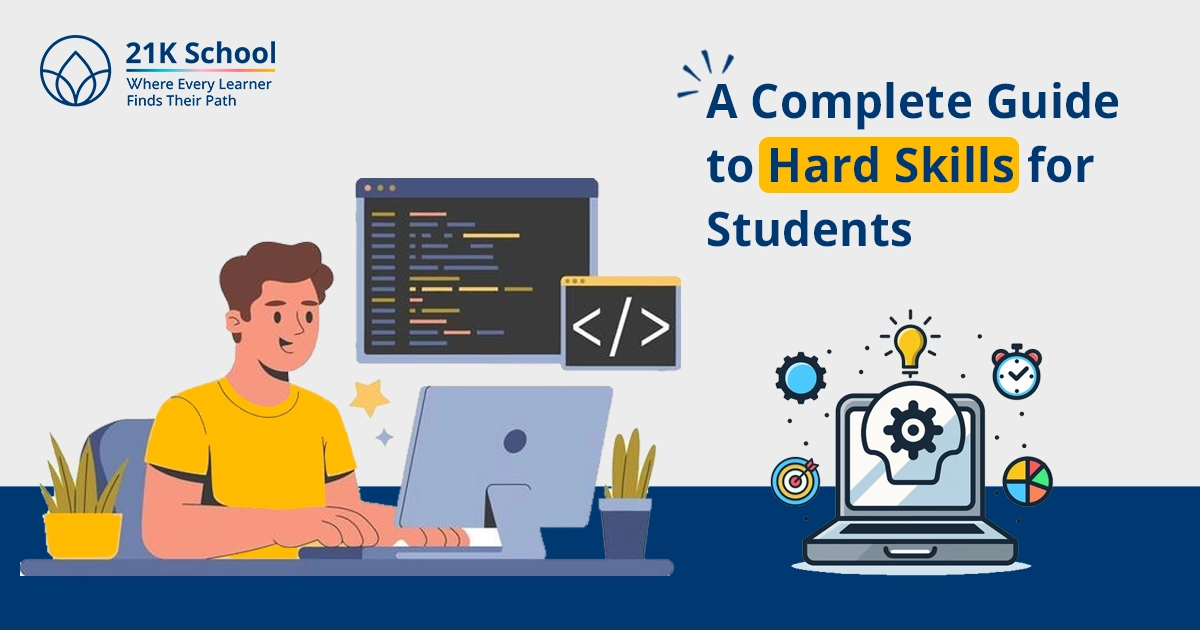
A Complete Guide to Hard Skills for Students!
 Written byRahul PalContent Specialist
Last modified: Sep 7, 2026 16 min read
As education and careers increasingly become skill-based, students need more than just theory to help them accomplish their tasks.
Practical skills allow kids to learn, operate equipment, perform specific tasks, and demonstrate proficiency. Coding and data analysis, graphic design, and foreign languages are all things that can be gained through systematic learning and practice.
Knowing hard skills will give students a clue of what they are capable of doing, what they require to improve on, and how to prepare to take other academic and other opportunities in their future.
What is a hard skill?
A hard skill is a particular, trainable and measurable skill that allows an individual to become able to perform a particular activity or task. Such skills are usually acquired either through education, training, practice or even through hands-on experience.
This can be in the form of coding, study of data, accounting, graphic design, proficiency in a foreign language and operation of specialised equipment.
Hard skills are occasionally measured through tests, practicals, demonstrations, certifications, projects, or other measurable outcomes. As compared to soft skills, hard skills are more technical and task-oriented.
Types of hard skills
Hard skills can be categorised, depending on the mode of their learning, the task they entail, and the type of task that they assist an individual to do.
1. Technical skills
Technical competences relate to the skills and approaches which are required to perform certain activities.
These skills are acquired and enhanced in students through systematic learning, training and rehearsal.
2. Digital skills
Digital skills involve the use of technology, programs, digital learning and online tools to fulfil activities.
They also help students to learn effectively in the technological environment of learning.
3. Analytical skills
Analytical skills involve studying and analysing facts and notes, recognising patterns and drawing acceptable conclusions.
They help students to acquire information and make good decisions.
4. Academic skills
The learning tasks can be achieved using academic skills. They include skills which were used in the study, research, writing assignments, understanding information, and writing scholarly work.
5. Creative skills
The creative skills introduce fresh methods of thinking along with known methods of thinking to generate a certain output.
They help students transform ideas into written, visual, digital work or any other creative work.
6. Language skills
Language skills involve proper use of language to read, write, speak, listen or translate.
Lessons, practice, and frequent communication can help students develop these skills.
Top 6 importance of hard skills
Hard skills provide students with practical skills to work on the job, implement the knowledge, use tools and prepare students for academic and professional opportunities.
1. Improve academic performance
Hard skills assist students in completing assignments, research, utilising digital tools, information analysis and project work.
These skills simplify academic tasks and assist students in applying the knowledge in subjects in practical activities.
2. Build technical skills
Hard skills allow students to be conversant with how to operate certain tools, software, techniques and methods.
The skills gained within the framework of this development will allow the students to use their experience in academic tasks, projects, contests, internships, and other circumstances related to their job.
3. Prepare for career opportunities
Hard skills assist students in acquiring skills which will be required in other professions.
It also provides them with a chance to explore their areas of interest in the career, what areas the industry needs to offer and what technical skills they may need in the career of their choice.
4. Increase job readiness
Hard skills provide students with hands-on skills which can be applied in real workplace scenarios.
They enable students to comprehend the job requirements, fulfil the simple requirements, do the given tasks and get them ready for internships, apprenticeships and other minimum working places.
5. Develop practical abilities
Hard skills are used to help students apply abstract knowledge in practice.
Other skills which involve coding, design, data analysis, research as well as software use, among others, are incorporated with practical tasks which show what they have learnt.
6. Prepare students for higher education
Hard skills that include research, academic writing, data analysis, computer use and presentation tools assist students in coping with higher education requirements.
It will be capable of helping with tasks, term papers, presentations, lab projects and other tasks at the college level.
Top 10 examples of hard skills
Hard skills refer to any particular skills that are learned by students during school, training, practice and activities.
1. Computer skills
Computer skills are related to the use of computers, software and other digital materials to carry out different tasks are known as computer skills.
Students can learn word processing, spreadsheets, presentations, file handling and any other simple capabilities of computers.
2. Coding and programming
Coding and programming entail the writing of instructions which instruct computers or applications what to accomplish.
They can teach students how to write programming languages like Python, Java or JavaScript so that they are able to create websites, applications and other computerised deliverables.
3. Research skills
Research skills involve the search, authentication, listing and exploitation of information in credible sources.
These abilities assist students in writing assignments, doing projects, researching issues and giving evidence to support their thoughts.
4. Data analysis
Data analysis can be defined as the analysis of data using numbers, tables, charts and other data to identify patterns and understand the results.
The skill is enhanced by the assistance of spreadsheets, statistics, graphs and simple datasets amongst the students.
5. Writing and editing
Writing and editing skills entail compiling concise written information and proofreading it to make sure that it is correct in grammar, structure, spelling and accuracy.
These skills are applied by students in essays, reports, assignments, presentations, applications and other academic assignments.
6. Foreign language skills
The skills of foreign language are the ability to know and use another language as opposed to the first language.
The learning is systematic and the practice repetitive, giving the students an opportunity to practice speaking, writing, listening, reading, grammar and vocabulary.
7. Graphic design
Graphic design is the production of visual materials based on the conceptions of design and the use of computer programs.
With the design software, students will be taught how to create posters, presentations, illustrations, and graphs on social media and other visual aids.
8. Financial literacy
Financial literacy presupposes the knowledge of the fundamentals of finance and budgeting, saving, expenses, banking, and money management.
The skills will assist the students to make prudent decisions in their own finances, and to know the everyday financial procedures.
9. Photography
Photography is a process that involves the application of cameras, lights, setting up and editing to enhance and create pictures.
This skill can be developed by the students in the course of practical assignments where they are expected to play with the settings of a camera, framing, editing of pictures and narrating the stories visually.
10. Digital marketing
Digital marketing refers to marketing using digital resources to sell commodities, services, or ideas.
The skills include search engine optimisation, social media marketing, content creation, email marketing and simple digital analytics.
Difference between hard skills and soft skills
Both hard and soft skills are beneficial to students, but they characterise various abilities. Hard skills are concerned with what one can do technically, but soft skills are concerned with how one does it in regard to the manner in which they work, speak and behave.
| Aspect | Soft Skills | Hard Skills |
|---|---|---|
| Meaning | Soft skills are behavioural attributes where students can exhibit empathy, relationships, interaction and so forth. | Hard skills are specific skills which enable children to perform physical work and practical tasks. |
| Application | Soft skills are needed to carry out various tasks, and they relate to other skills. | Hard skills can be applied in most manual jobs, e.g. a job or any other activity that involves practical skills. |
| Usage | Soft skills are the communication and development of relationships due to empathy and communication. | Hard skills are implemented in accomplishing a goal or aim with physical work or with hands-on training. |
| Importance | Soft skills are needed in order to be able to communicate with people positively and to be confident in this. | Hard skills are important as they allow students to be engaged in practical and physical activities as they gain hands-on experience. |
| Learned Basis | Soft skills can be instructed through communication and interactions, as well as the usual group actions. | Hard skills might be acquired through internships, on-the-job training, manual work and any form of practical work. |
| Measurement | Soft skills cannot be measured since it is hard, but they can be known depending on how children can interact and communicate. | Hands-on experience and practical knowledge of students can be relied upon to measure the hard skills. |
1. Meaning
Soft Skills: Behaviour and interpersonal skills by which students will be able to communicate, interact, cooperate and establish relationships.
Hard Skills: Hard skills refer to specific measurable skills, which can be applied to assist students with technical or practical skills.
2. Application
Soft Skills: These skills can be applied in different situations of different kinds where communication, working as a team, relationships, and personal behaviour are involved.
Hard Skills: These are those skills that are used within the particular work, and in this case, they are applied in technical skills, practical training or hands-on skills.
3. Usage
Soft Skills: How to communicate effectively, listen to others, be able to work with other people and cope with various social activities.
Hard Skills: Students can perform some tasks using their new method of doing, instruments, software or practice.
4. Importance
Soft Skills: Teach students how to communicate with their colleagues positively, share their ideas, collaborate as teams and cope with various situations.
Hard Skills: Aid the students to build their usable skills that can be used in both academic and technical work as well as in future work.
5. Learning basis
Soft Skills: This is learnt through the process of communication, teamwork, group work, discussions, social interaction and day-to-day experiences.
Hard Skills: Developed in classes, courses, training, projects, internship, and practice.
6. Measurement
Soft Skills: More difficult to quantify, as they are most evident in the behaviours of a person, in terms of communication and interaction with other people.
Hard Skills: They are easily tested by examining and working on projects, certifying, demonstrating and so on.
Top 6 benefits of hard skills
The advantages of hard skills give students viable choices, because they help them use their skills, demonstrate what they can do and give them more learner freedom.
1. Improves confidence
One of the benefits of hard skills is that students learn and practice in such a way that they will know a range of activities.
Completion of projects, utilisation of tools or utilisation of technical knowledge could enable students to be more confident in their capabilities and encourage them to do more difficult tasks.
2. Encourages independent learning
Hard skills enable students to learn the skills and practice them without having to be dependent on a teacher or anyone.
The students can learn on their own; as soon as they get familiar with the basics, they can refer to tutorials and books, and use practical activities.
3. Supports participation in competitions
Competitions in schools and colleges that involve applied skills include coding, design, writing, photography, research or data analysis.
Students can develop the needed hard skills to be a participant, which allows them to complete tasks in a competition and prove their competencies.
4. Encourages hands-on learning
Hard skills encourage students to practice as opposed to just using theoretical knowledge.
The students can use coding programs, designing, analysing data, conducting experiments or creating videos, among other activities, to put into practice what they have learned.
5. Provides evidence of competence
Hard skills that can be described easily are shown through projects, certificates, portfolio, practical tests or completed tasks.
The types of evidence will help the students more clearly present their skills and will prove them to be able to apply their knowledge in real-life situations.
6. Helps explore career interests
The various-sphere activities will enable the students to be exposed to a variety of hard skills, which should be discussed.
Attempting to code, design, research, finance, photograph, or digital marketing can assist students in realising what they are best suited to, and what they would like to find out more about.
How hard skills can be acquired?
Hard skills can be acquired under different phases where the learning of simple concepts and observation of examples, practice, application in real life, feedback, and lastly doing it on their own are integrated.
1. Classroom instruction
Hard skills are introduced to the students, and the elementary concepts involved in the classroom and basic processes involved are taught.
The teachers explain ideas, present examples, clarify questions and provide simplified tasks to enable pupils to know what the skill entails and how it can be applied.
2. Demonstration
Students have an opportunity to observe a teacher, trainer or a talented individual performing something.
Watching all steps will enable students to become aware of how tools are utilised, instructions and how the task should be accomplished before they can attempt to do the same.
3. Guided practice
The new skill is practised with a teacher/trainer guiding the students. They can inquire and enquire or request help and correction of mistakes during practice.
Such counselling will enable the students to calm down and will work towards performance over time.
4. Practical application
When the student applies the skills in the project, experiment, assessment or any other real-world activity, then the hard skills are learned.
Practical work can be used to familiarise them with the application of a skill and to give them some experience in applying their knowledge in doing specific tasks.
5. Feedback and review
Hard skills can be acquired by students by re-reading the work and receiving clear feedback about the work.
Educators are able to indicate errors and propose corrections. Frequent checking assists the students in realising what they should correct and be more accurate after practising.
6. Independent performance
When the students are well practised and they are certain they can do the work, then they should be left to do it on their own.
They can be tested independently, understand instructions, use the tools they need to, and solve simple tasks and complete an assignment with the help of the hard skills they are trained to use.
6 practical ways to develop hard skills
Hard skills assist students in developing their skills based on opportunities to learn, which is characterised in terms of frequency of practice as well as the real tasks undertaken in the learning activity. Such strategies would aid in the transfer of knowledge to skills.
1. Online courses
Under online classes, learners are left to acquire certain skills at the comfort of their own and the comfort of their homes.
They can learn how to code, create a design, perform a data analysis, learn other technical skills and so on using video lessons, exercises, quizzes and any other type of task.
2. Hands-on projects
Students are also provided with an opportunity through projects to practice what they have learned.
Building a site, designing it, analysing data/doing research may help students practice their skills and create something that they can offer to others.
3. Participate in competitions
Competitions also ensure that the students can apply their competencies in the process of fulfilling a given objective.
Competitions in code writing, science competitions, design events and research events might be an incentive for students to do it and to work out and get better.
4. Internships
Internships also assist students in having a taste of real work and how some of the skills would be utilised in practice.
Professional interaction may also offer practical experience in technical activities, assist students in learning more of the tools used in the workplace and create process experience that cannot be learned in the classroom.
5. Extracurricular activities
The students can be taught skills through extracurricular activities as they equip them with practical skills.
The school clubs, workshops, photography clubs, robotics clubs and coding clubs, among others, are some of the places where students could develop some of the skills.
6. Practise digital tools
Widespread utilisation of digital tools will enable students to feel more at ease with technology.
By using them on a daily basis, students can develop their technical skills through the use of spreadsheets, presentation packages, design packages, coding sites, video editors, etc.
Conclusion
Hard skills provide students with practical skills, which are measurable, can be learned and practised.
Academic activities and opportunities may be assisted by such skills as coding, research, data analysis, computer use, graphic design and foreign languages.
The students can acquire these skills via online courses, projects, competitions, internships, extracurricular activities and practice, which will be offered on a continuous basis.
An early construction of hard skills may also be effective in helping students realise their interests and be better prepared for higher education and work.
Frequently asked questions
6 questions
What are hard skills for students?
Hard skills are not only expressible but also applied to students; they are: Coding, computer use, research, graphic design skills, photography skills and foreign language skills.
What are 5 hard skills for students?
The five skills that are valuable amongst students are computer skills, coding, data analysis, research and writing, which fall under the category of useful hard skills. This set of skills can facilitate academics and enable students to acquire practical skills in the future.
What are the best hard skills for students to learn?
The helpful hard skills are coding, data analysis, computer skills, research, digital design, foreign language, financial literacy, digital marketing and writing. The choice depends on a student's interests and future aspirations.
Why are hard skills important for students?
Hard skills help students complete practical assignments, apply knowledge in practice, become familiar with a specific tool, take part in projects and competitions, and gain skills that may prove helpful in college and after college.
What is the difference between hard skills and soft skills?
Hard skills are specific skills that can be taught, trained and tested, e.g. coding or information analysis. Soft skills are associated with the performance of individuals and the relationships among individuals, e.g. communication, teamwork, flexibility and empathy.
What are examples of hard skills?
The hard skills include computer skills, data analysis skills, research, writing and editing skills, graphic design skills, photography skills, digital marketing skills, financial literacy and foreign language proficiency.
About the author
Rahul Pal
Content Specialist
Rahul Pal is an Education Content Specialist at 21K School- India’s fully accredited online school recognised by the Cambridge International (IA702) and Pearson Edexcel (94883). His graduation from Journalism and Mass Communication from Swami Vivekananda University gives him a strong foundation in factual reporting, source verification, and investigative research. With around 2 years of experience at 21K School, he has written extensively for the CGPA conversion guides, marking schemes, and Indian and International boards (IGCSE, GCSE, and A-Levels). His articles are highly relevant for the guardians looking to guide their learners for board exam preparation across 78+ countries. All Rahul’s content is reviewed by the school’s academic team to ensure alignment with the latest board guidelines and latest notifications from the official resources
Every 21K School guide is written by our education team and reviewed by a subject facilitator before publishing.
Exploring a CBSE-pathway online school?
Talk to an advisor about 2026–27 admissions — no obligation.
Talk to an advisorComments
No comments yet — be the first to share your thoughts or ask a question.