


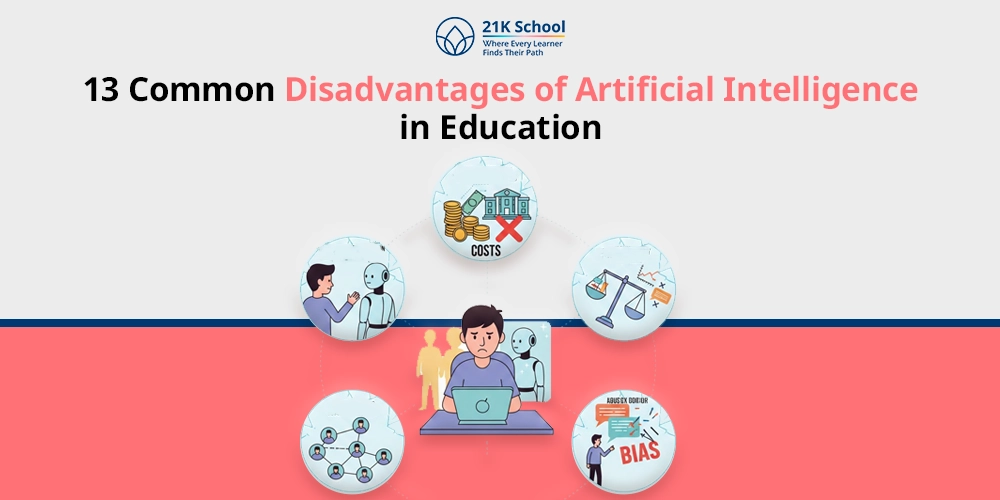
In the 21st century, technology is everywhere from offices to schools. Professionals use it to access accurate data and schools use it for providing education.
Over time, the role of artificial intelligence in education offers various advantages from young kids to adults like teachers and parents.
But, do you know every positive side has some drawbacks which one should know about.
Yes, artificial intelligence also has some disadvantages in education. And by understanding these negative effects of AI in education one can avoid upcoming challenges.
In this blog, we are going to explore about 13 major disadvantages of AI in education in detail.
Table of Contents
- What is Artificial Intelligence in Education?
- 13 Disadvantages of Artificial Intelligence in Education
- 1. Lack of Human Interaction and Emotional Support
- 2. High Implementation and Maintenance Costs
- 3. Data Privacy and Security Concerns
- 4. Bias and Inaccuracy in Algorithms
- 5. Overdependence on Technology
- 6. Reduced Teacher Autonomy
- 7. Inequality and Digital Divide
- 8. Decreased human skill development
- 9. Risk of Job Displacement for Educators
- 10. Lack of Creativity and Personal Touch
- 11. Technical Issues and System Failures
- 12. Ethical Concerns Over Monitoring and Surveillance
- 13. Dehumanisation of learning
- Conclusion
What is Artificial Intelligence in Education?
Education is important for kids and AI in education provides opportunities to learn effectively and engage them in different areas.
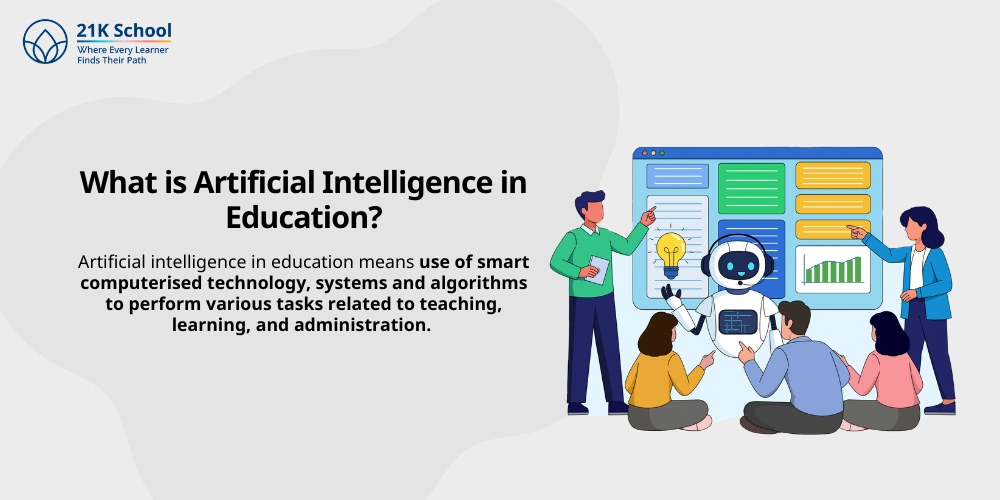
Artificial intelligence in education means use of smart computerised technology, systems and algorithms to perform various tasks related to teaching, learning, and administration.
It helps in analysing learners’ data, predicting their performance, and customising their educational experiences through personalised learning .
13 Disadvantages of Artificial Intelligence in Education
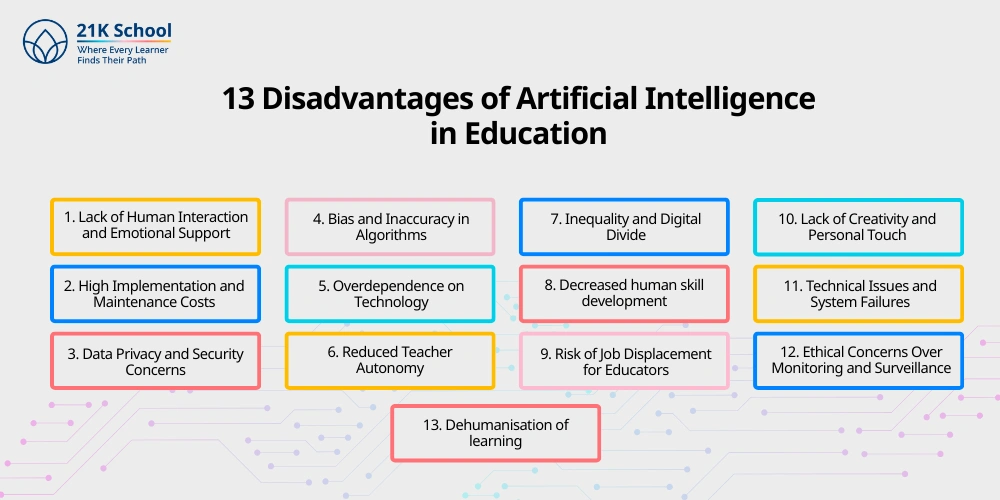
To understand the role of technology in education , one must discover the top 13 disadvantages of AI in education to avoid future challenges.
1. Lack of Human Interaction and Emotional Support
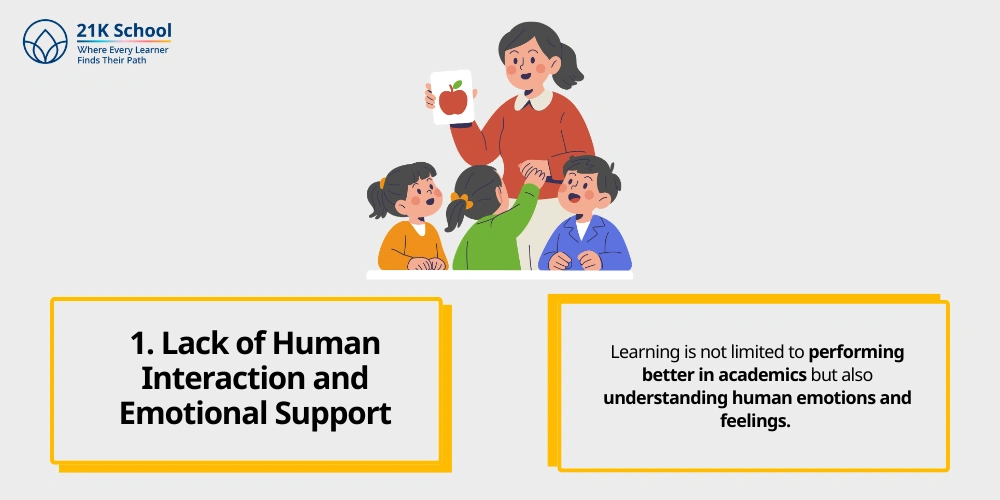
Learning is not limited to performing better in academics but also understanding human emotions and feelings.
AI in education is helpful for students but it often lacks human interaction and support. Learning only with AI can isolate students easily, which is one of the common challenges of online education .
2. High Implementation and Maintenance Costs
High Implementation and Maintenance Costs
Sometimes parents and schools need to deal with high implementation and maintenance costs due to AI.
Well-funded schools and organisations can effectively invest in technology like artificial intelligence.
3. Data Privacy and Security Concerns
Education institutes who rely on AI often share their data and other important documents to generate needful information.
However, that’s why individuals are concerned about their personal data privacy and security which can be breached due to inadequate security measures in AI systems.
4. Bias and Inaccuracy in Algorithms
As you all know, AI systems are operated on data and if the data is not accurate the AI provides inappropriate results which can impact the outcome.
This can impact on various areas such as:
- Unfair grading
- Misjudging student behaviour
- Wrong predictions of academic performance etc.
5. Overdependence on Technology
Parents, teachers, and students are often over dependent on technology which reduces their human touch in feedback, personal guidance, and assignments.
Instead one should choose hybrid teaching techniques where both AI and human touch are involved which ultimately enhance the learning outcome .
6. Reduced Teacher Autonomy
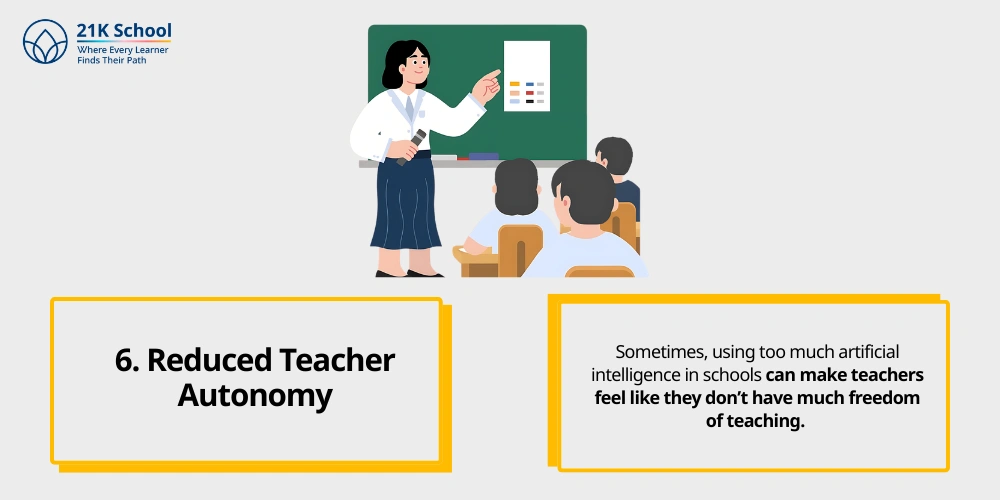
Sometimes, using too much artificial intelligence in schools can make teachers feel like they don’t have much freedom of teaching.
Instead of planning fun lessons in their own way, teachers should follow what the computer says, what to teach, how fast to teach, and how to test students.
This can negatively impact learning in creative and reduce teacher-student interactions .
7. Inequality and Digital Divide
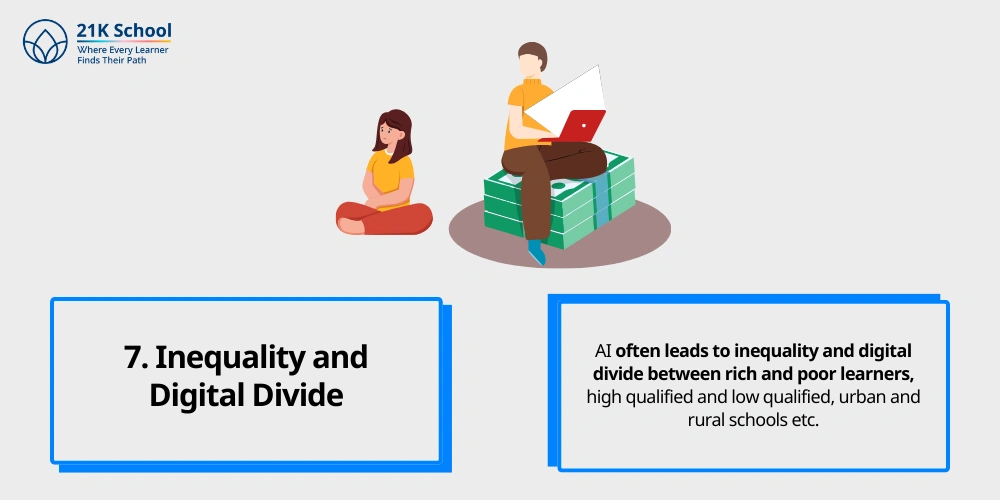
AI often leads to inequality and digital divide between rich and poor learners, high qualified and low qualified, urban and rural schools etc.
It favours those with tech access, amplifying biases through algorithms, and demanding new 21st century skills .
8. Decreased human skill development
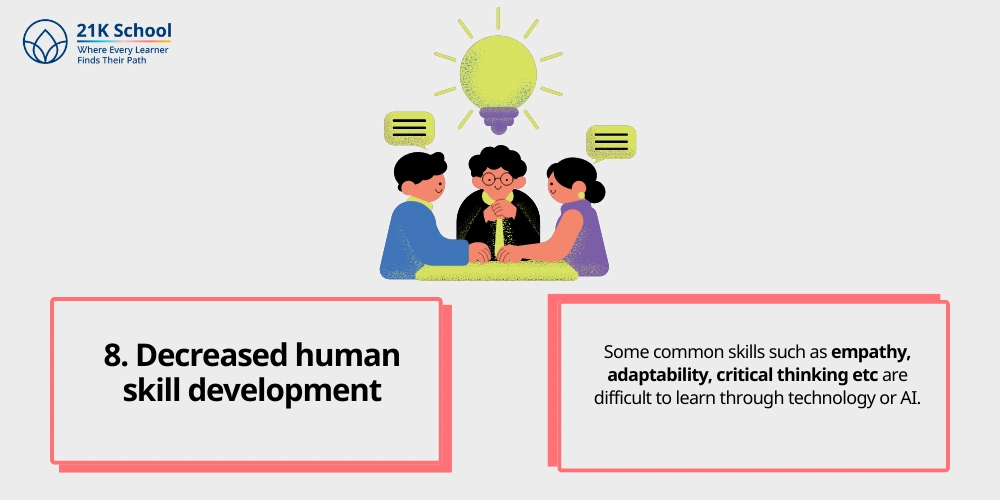
In the 21st century, human skill development is crucial for kids to improve their academic and personal growth.
Some common skills such as empathy , adaptability, critical thinking etc are difficult to learn through technology or AI.
9. Risk of Job Displacement for Educators
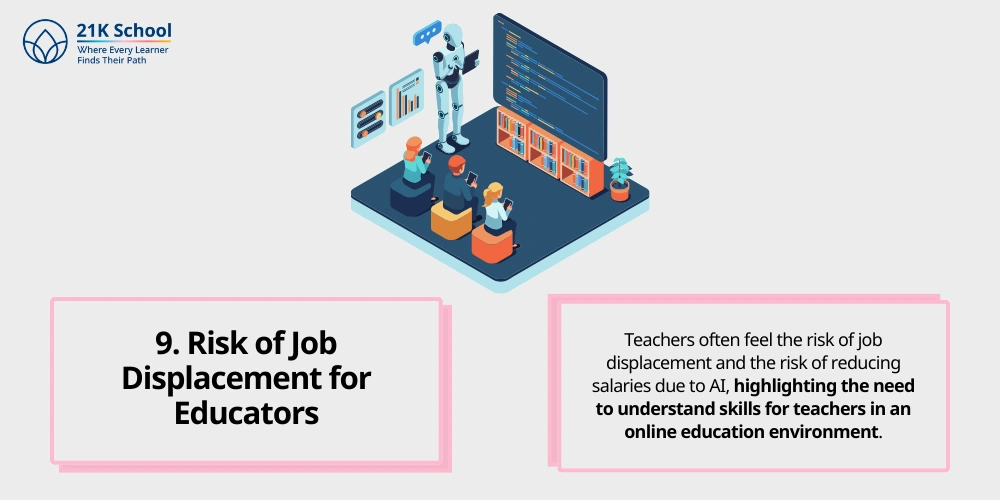
Teachers often feel the risk of job displacement and the risk of reducing salaries due to AI, highlighting the need to understand skills for teachers in an online education environment .
Currently, AI cannot fully replace educators. But, the thought of job risk can impact the quality of teaching.
10. Lack of Creativity and Personal Touch
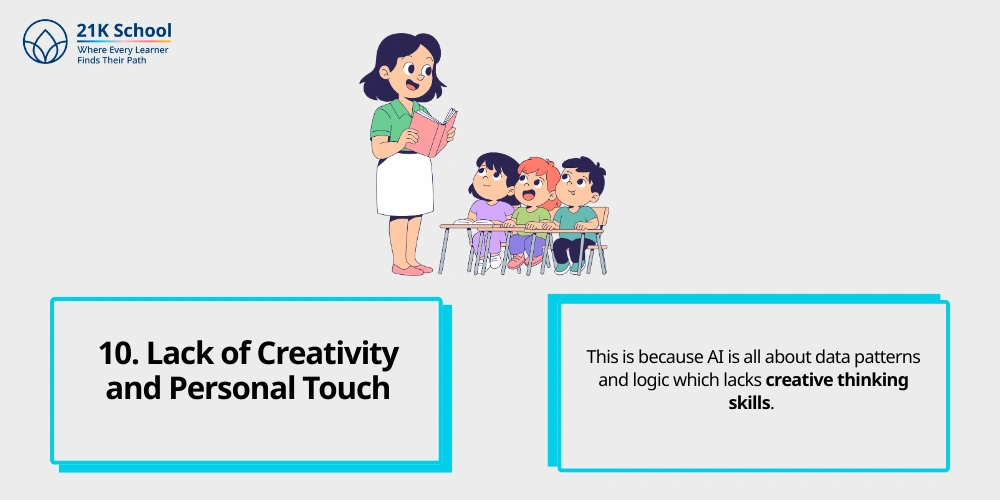
One of the disadvantages people often feel is lack of creativity and personal touch. This is because AI is all about data patterns and logic which lacks creative thinking skills .
However, education from humans is rich in creative thinking in the classroom where teachers bring diversity.
11. Technical Issues and System Failures
Technology is not fully stable. Users often experience technical issues and system failures. This can create barriers especially for students who are in rural areas.
However, a hybrid learning where teachers collaborate with AI to provide education can be beneficial.
12. Ethical Concerns Over Monitoring and Surveillance
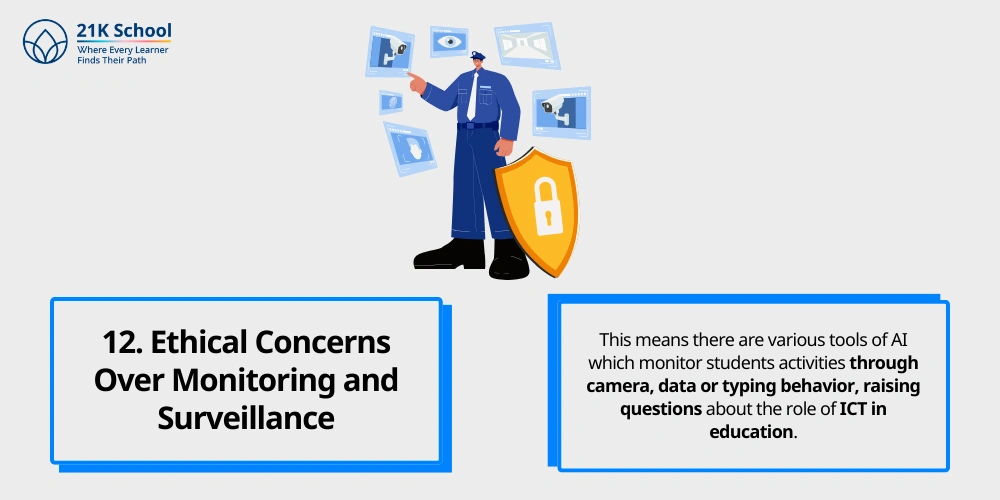
One of the disadvantages of AI in education is ethical concerns over monitoring and surveillance.
This means there are various tools of AI which monitor students activities through camera, data or typing behavior, raising questions about the role of ICT in education .
13. Dehumanisation of learning
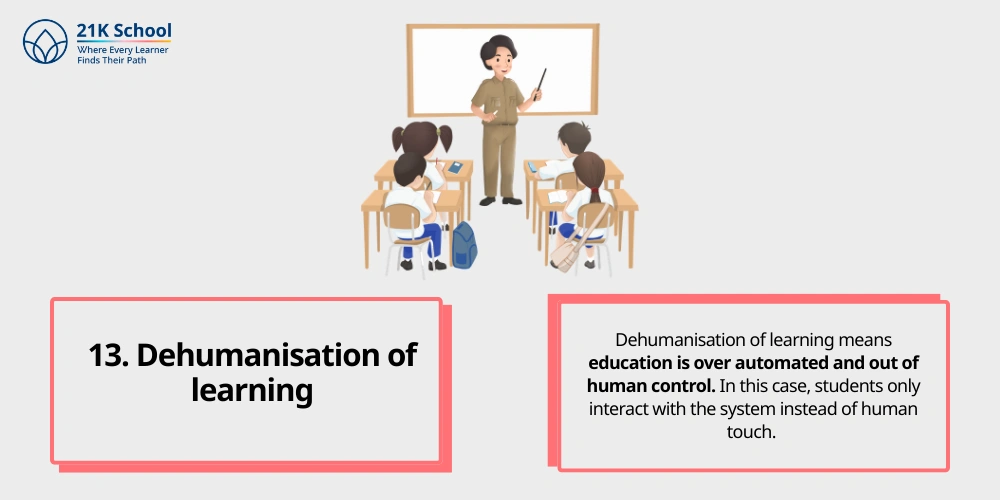
Dehumanisation of learning means education is over automated and out of human control. In this case, students only interact with the system instead of human touch.
Without personalised attention, students’ decisions get dominated by AI tools and unable to perform tasks with creativity, critical thinking, and emotional intelligence .
Conclusion
In the 21st century, technology like artificial intelligence is used everywhere from analysing data by teachers to getting help in homework .
As it offers many benefits to different age groups they also struggle due to misuse or out of control. That’s why understanding the disadvantages in the initial stage helps to avoid future consequences.
Hope, all the above-mentioned key points on the disadvantages of AI in education help you to understand and adapt the right approaches to conquer the educational opportunities and step into the future of AI in education .
Also, explore what is the impact of AI in special education .
