

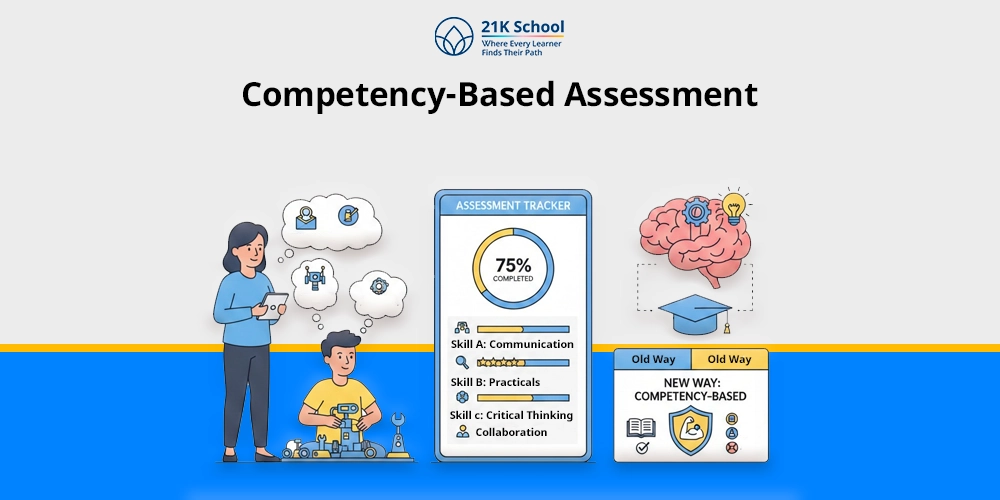
Competency-based assessment is an important process within modern education and workforce development, and it assists in transforming traditional testing into a more practical skill practice.
The less constant the learning conditions, the greater the need to test what the learners have learned, but also the scope of their abilities to apply their knowledge in daily life situations.
Instead of using time-based tests or theoretical knowledge to identify the extent of learning, the approach finds out the strength of the learners to apply whatever they have learned to real and job-specific situations.
In this way, individual learning, understanding of expectations and performance, and correspondence between learning and the needs in the real world will be possible, and the process of assessment will be more useful and efficient.
Table of Contents
- What is Competency-Based Assessment?
- Components of Competency-Based Assessments
- Traditional Assessment vs Competency-Based Assessment
- Competency-Based Assessment Process
- Benefits of Competency-Based Assessment for Students
- Benefits of Competency-Based Assessment for Teachers
- Examples of Competency-Based Assessment
- Ending Note
What is Competency-Based Assessment?
Competency-based assessment is a component of competency-based education. It is a learning assessment programme, it is based on the ability of a learner to exhibit a group of skills and competencies, rather than a learner merely passing courses or exams.
It focuses on measurable outcomes, practices and control of certain standards. Students move forward to demonstrating what they are capable of doing based on practical assignments, projects or performance-based assessments.
This strategy will make sure that evaluation is in line with the real job or education demands, facilitate individualised education, and meaningful skill formation.
Components of Competency-Based Assessments
The elements of competency-based tests establish the method of measuring and displaying learning. They are clear, fair, and practical in their evaluation using goals, rubrics, authentic tasks, evidence-based observation, and frequent feedback The elements of competency-based assessment are shown here.
1. Clear Goals
The factors that dictate what the learners should know and do are clarity of both short-term and long-term goals. They also participate in teaching, assessment aspects, whereby they define some of the competencies that ought to be achieved.
With clear goals, the learners can be in a position to learn what is expected and can thus tend to focus their efforts effectively and monitor the progress they are making in mastering the required skills.
2. Measurable Goals
Outcome-based education is quantified using measurable goals, which convert an outcome-based education into measurable assessments.
By rendering competencies measurable, it would be true to monitor the progress, early detect the gaps and be data-driven and transparent about the decisions on mastery or improvement.
3. Rubrics Criteria
They give expectations, frequent and fair assessments, as well as aid the learners to have an idea of what mastery would be like.
The rubrics are a self-reflection tool; they reveal the positive aspects and the points that need to be changed, and may provide specific and evidence-based feedback based on the learning outcomes and skills development.
4. Authentic Assessment Methods
Real-life assessment practice gives the learners the opportunity to be assessed through the execution of the activities that refer to the real world, which depicts the skills being applied. This could be work projects, simulations, cases and work assignments.
Through such approaches, it is possible to show the competencies which are evident in real life, which can add to the merit of the analysis and make it closer to the academic, professional or working performance.
5. Evidence-Based Observation
Evidence-based observation entails evaluation of the learners based on documented evidence of performance, which can be in the form of samples of their work or the way the learner demonstrates or observes behaviours.
The aspect of inquiry-based learning takes care of the fact that judgment is based on facts and not speculations. It promotes objective judgment, enhances reliability, and assists in confirming whether learners have really acquired the necessary competencies.
6. Frequent Feedback
Regular feedback will give the learners frequent information on their performance and progress. It also brings out strengths, areas of improvement and provides directions to learners on the way to mastery.
Through continuous feedback, the learners should be able to reflect, promote faster acquisition of skills, and more adaptive approaches to learning to help them achieve competency expectations in a better way.
Traditional Assessment vs Competency-Based Assessment
The traditional assessment measures the amount the learners learned, and the competency-based assessment measures the amount the learners can accomplish. The differences between traditional assessment and competency-based assessment are as follows.
| Aspect | Traditional Assessment | Competency-Based Assessment |
| Focus | The traditional assessment techniques test the knowledge through administering exams, grades or time-based tests. | Competency-based assessment is an assessment that evaluates the ability of skills and describes the competencies in actual life situations. |
| Progression | The conventional measurement is time-based, where students are either promoted by the courses or by a test. | In a competency-based assessment, students can only be promoted to the next level when they demonstrate competence. |
| Learning Approach | Traditional assessment follows a one-size-fits-all, less personalised learning approach. | Competency-based assessment is part of a personalised and flexible and it adheres to the individual learning pace and needs. |
| Feedback | Feedback is either restricted or delayed, usually at the termination of a term. | Instant and regular feedback leads to perfection and progress. |
| Outcome | Grades or scores are indicative of knowledge and not of skills. | Concentrates on mastery, practical assignments, and preparation to work in the real world. |
Competency-Based Assessment Process
The competency-based assessment practice helps learners in self-reflection to mastery of skills. It entails assessment, feedback, development plan, re-evaluation and constant improvement so as to have practical, real-life competence and growth. The competency-based assessment process is given below.
1. Self Assessment
Self-assessment enables the learner to evaluate themselves in terms of their skills, knowledge and performance as per the competencies. It promotes an ownership of learning, and it assists people in recognising their strengths and weaknesses.
Self-assessment helps the learners to be more conscious of what is expected of them, have their own goals and be more involved in the process of designing their own development and growth.
2. Workplace Review
Workplace review is the process of assessing the performance of an individual in a real or simulated workplace. Monitoring of the application of competencies by the learners in real tasks is done by mentors, supervisors or assessors.
This is to ensure that the assessments are fit and job relevant in providing useful information on the performance, behaviour and readiness to work as per the norms that exist in the workplace.
3. Development Needs
The identification of development needs is aimed at the identification of the gaps between the existing performance and the necessary competencies. This action assists students and companies in developing specific learning methods.
Meeting development needs makes the training process meaningful, efficient in resource use, and the learner gets assistance based on the needs, in particular, the improvement needs.
4. Continuous Learning
Continuous learning does not focus on skills that are measured once but on continuous skills development. Competencies are strengthened by learners through training, practice and sharing of knowledge with each other as time goes by.
This strategy facilitates flexibility, maintains competence, and promotes the growth mentality that matches learning to the changing industry and organisational needs.
5. Re-Assessment
Re-assessment enables the learners to exhibit improvement upon further learning or practising. It makes sure that advancement is identified and competencies are certified when they have been acquired.
This is to help maintain fairness as it provides the learners with more than one opportunity to succeed, and also helps emphasise mastering the social skills and not just a one-time achievement.
6. Continuous Improvement
Continuous improvement involves the findings of an evaluation and feedback to enhance the methods of lifelong learning, evaluation strategies and performance standards. It fosters a culture of regularly testing and evaluating the outcomes by the learners and organisations, thus correcting them.
This continuous process will aid in the sustenance of quality assessment, the creation of capability in the long term and also assist in the enhancement of performance.
Benefits of Competency-Based Assessment for Students
The competence-based testing has the benefit that it promotes individualised learning, flexibility, application of skills in practice, setting of expectations, continuous feedback, interest and motivation, and helps students to learn and succeed in learning and further employment.
1. Personalised Learning
Competency-based assessment helps in personalised learning since the students will be able to learn at their own rates, depending on mastery.
It identifies the personal strengths and learning styles and needs, and therefore makes it provides instructions and encouragement in a targeted manner. The approach will help the students focus on the areas that should be improved and advance confidently in the competencies that have been mastered.
2. Flexible Learning
Flexible learning aids the students to exhibit the competencies in a versatile fashion and at different times. Students can decide modes that would be more fitting to them than to take strict study schedules or exams.
This flexibility reduces the students stress, enables different learners, and enables the students to deal with the learning and personal or academic commitments, or even professional commitments.
3. Real-World Experience
Competency-based assessment is focused on practice and actual use of competencies. Projects, simulations and authentic assessment of the students give them experience based on real-life situations.
This aids in the unification of theory and practice and equips students with job-related skills and making them more prepared to attend higher education or the workforce.
4. Clear Expectations
Clear expectations are built using clear competencies and evaluation criteria. Students know precisely what they have to do to reach mastery and how they will be judged on this.
Such transparency minimises confusion, fosters confidence and allows learners to be held accountable for the achievement of given learning outcomes.
5. Continuous Feedback
Constant feedback gives the students feedback at every instance. Rather than waiting to get the final results, learners get timely information about their strengths and improvement.
Such continual feedback allows reflection, facilitates improvement and lets the students adjust their learning strategies in order to become capable of mastering the competencies.
6. Equity in Learning
Competency-based assessment promotes equity in learning as it is a fair assessment method, as it focuses on the competencies rather than the background, learning rate or the capacity to pass tests.
The students have a number of opportunities and motivation to succeed. It is one of the ways of reducing the bias effect and establishing a just assessment of sincere performance and mastery.
7. Enhanced Engagement
Increased student engagement is achieved when the students are actively engaged in significant learning activities. Competency-based models promote involvement in hands-on activity and self-directed learning.
As students realise the usefulness of what they are being taught, they learn to be more interested, listen, and dedicated to the realisation of their academic objectives.
8. Enhanced Motivation
Competency-based assessment enhances motivation in that it focuses on progress and mastery instead of on grades. Some of the factors that drive students include clear milestones that can be achieved, attained goals and improvement.
It also provides flexibility to the teaching process, and the teacher has the ability to set the objectives, besides relating the lessons to practical application in a manner that the learning would be meaningful and ultimately effective.
Benefits of Competency-Based Assessment for Teachers
The advantages of the competency-based assessment on the part of the teacher include the fact that it provides the teacher an insight into what is required by the learners, it is not biased, and the learning process is empowered.
It also provides leeway to the teaching practice and gives the teacher the ability to stipulate the goals, in addition to relating the lessons to reality in a manner that will make the learning meaningful and ultimately effective.
1. Understanding of Students’ Needs
The assessment based on competencies assists the teachers in better understanding the weaknesses and strengths of the respective students and the weaknesses in the learning process.
The comparison of the gained skills and their comparison with the test scores will enable the teachers not only to reach even more efficient and responsive teaching methods, but also to refer to the test scores and define the areas where they will have to help the student and organise instructions.
2. Reduced Learning Bias
This kind of assessment minimises the biases in learning process as it concentrates on performance and mastery, rather than background, learning pace and capacity to pass tests.
The evidence-based evaluation and unambiguous criteria will allow the teachers to assess students more objectively, that is, all students will be assessed according to what they can demonstrate, not any subjective or traditional standards.
3. Student Empowerment
The Competency-based assessment gives power to the students as they actively participate in the learning and assessment process.
The teachers encourage self-reflection, self-goal setting and study habits. This shared task improves the connection between the teachers and the students, and it helps the students be more assured, self-sufficient and focused on their learning outcomes.
4. Teaching Flexibility
There would be greater flexibility in the learning styles and the methods of evaluation by the teachers. The competency-based models permit the instructors to embrace various approaches, materials as well and schedules to mastery.
Such flexibility enables teachers to design lessons based on various learning styles and adjust the learning process with the results of the assessment being given continuously.
5. Setting Goals for Students
Well-interpreted competencies can help the instructors design the objectives that are challenging yet attainable. These objectives give a guide to the teaching and assessment, and help the teachers trace the progress.
Goal-setting also allows a teacher to guide students to mastery through formalised designs of learning and through narrowly focused feedback.
6. Real-World Relevance
Competency-based assessment allows teachers to relate the learning goals and the practice of learning in the real world. Through the creation of testing, which represents real-life situations, teachers make students appreciate the applicability of what they are learning.
The effectiveness of the lesson is enhanced by such a strategy, and the transfer of the skills is enhanced, and the students are better prepared to address the challenges in the academic or working environment in the future.
Examples of Competency-Based Assessment
Competency-based assessment can be used in a large variety of contexts, including, but not limited to, K-12 education, higher education, workplace training, on-the-job training and off-the-job training and standardised assessment, where skills are evaluated in terms of practical activities.
1. K-12 Education
Competency-based assessment, as applied in K-12 education, is centred on students who have mastered certain skills and learning outcomes instead of advancing grade levels.
The students’ progress is assessed after they show their understanding in the form of projects, presentations or performance tasks. Such a strategy promotes differentiated education, allows addressing the learning gaps at an early stage, and ensures that the basic skills are learned before proceeding.
2. Higher Education
The other competency-based assessment in higher learning is that students are able to obtain credits after showing their abilities in specific competencies.
The evaluation may be in the shape of initiatives, portfolios, case studies or practical review. This model promotes flexibility of the learning pathways, recognition of past learning and support of the needs of the industry and workforce in academic programmes.
3. Workplace Training
At the workplace, competency-based assessment is used for the training of employees in accordance with the job skills and behaviours. The performance is measured depending on the accomplishment of tasks, work-based simulations or activities.
This ensures that training is effective, the skills are developed in line with the objectives of the organisation, and the employers are able to identify the readiness, gaps and areas in which the skills need to be developed.
4. On-the-Job and Off-the-Job Training
Under on-the-job and off-the-job training, competency-based assessment is relied on to gauge the skills which were learnt in the course of the experience and in the course of the formal training.
On-the-job tests are based on real job assignments, and tests in off-the-job may be in the shape of simulations or projects. Using them, competence is fully evaluated, applied and theoretical.
5. Common Assessment
Common assessment is where standardised competency criteria are used among the learners, among programmes or among institutions. They are also more uniform and objective as they compare all the people to the same performance level.
The standardised tests help in comparisons of the results, to provide quality control and also to ensure that the competencies measured are reliable regardless of the place and method of smart learning.
Ending Note
Competency-based assessment is a dramatic shift to evaluate what the learners can do and not what they can memorise and achieve within the stipulated timeframes.
This strategy is more appropriate for students and teachers in the learning institutions and the workplaces since it focuses on core competencies, practical application, continuous feedback and mastery.
It encourages individualised and adaptable education, equity and interaction and professional and employment affiliations.

You may also want to read