5E Learning Model: Complete Guide to Its Stages
 Written byRahul PalContent Specialist
Last modified: 2 Sep 2026 10 min read
Have you ever thought about how the 5E learning method is considered an advanced learning method?
Studying today does not involve memorising things but rather helping students grasp concepts by engaging them and providing an experience. To enable this strategy, educators use various pedagogical tools that enable them to foster curiosity, critical thinking, and problem-solving.
The 5E Learning Model is among the most common types of instructional models that have been adopted to help students approach new concepts step by step and, in turn, enhance learning as more interactive, meaningful and learner-centred when it comes to any subject and in different grades.
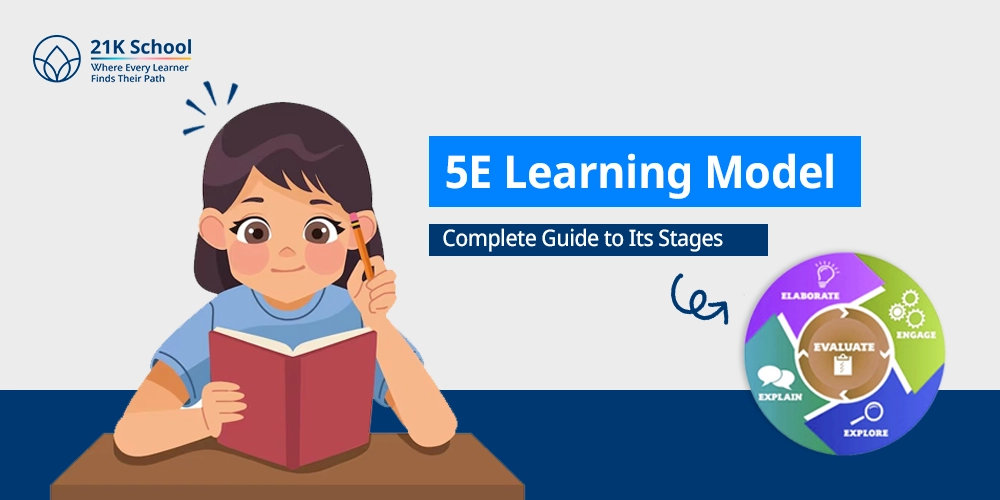
A 5E Learning Model is an instruction and learning process that develops active student-focused learning in five consecutive steps, i.e. Engage, Explore, Explain, Elaborate and Evaluate.
What is the 5E learning model?
The 5E Learning Model is a student-centred instructional model that promotes inquiry-based learning and experiential learning in five sequential phases, that is, Engage, Explore, Explain, Elaborate and Evaluate.
It helps students to engage more in constructing knowledge through linking the prior knowledge gained with new experiences as opposed to depending on direct instructions.
Its model was formulated in the late eighties and was characterised by the Biological Sciences Curriculum Study (BSCS). Roger W. Bybee, along with his colleagues, led it as part of the attempts to enhance science education by using inquiry-based teaching.
It is now possible to apply the 5E Learning Model to many different subjects to promote critical thinking, problem solving, group work and enhanced conceptual learning.
5 stages of the 5E learning model
The 5E Learning Model is a set of five connected processes, which can assist students in an exciting, inquiry-based, and meaningful learning process.
1. Engage
Engage stage not only activates the prior knowledge of the students, but also makes them interested in what is communicated to them.
Teachers describe thought-provoking questions, real-life examples, stories or demonstrations and provoke curiosity to make students actively participate in the learning process.
2. Explore
At the Explore stage, students explore concepts using hands-on activities, experiments, observations or group discussions.
They will accumulate their own knowledge in the form of asking questions and testing ideas and collaborate with other students since the teacher will not be a lecturer but a facilitator.
3. Explain
The explain stage enables students to share their findings and discoveries from the exploration activities.
The learners are then provided with formal concepts, definitions and vocabulary peculiar to the subject by teachers who help the students to correlate their experiences to the accurate academic knowledge and demystify their misconceptions.
4. Elaborate
At the Elaborate stage, students also familiarise themselves with their new knowledge in different situations, projects or real-world problems.
This helps to reinforce the concepts, build understanding and critical thinking and make the learners practice their understanding outside the classroom.
5. Evaluate
This stage is employed to assess the learning process and comprehension of the students.
Not only can teachers test the knowledge with the help of quizzes, assignments, projects, presentations or observations, but students also have the opportunity to reflect on the process of their learning and on what they should learn and demonstrate their mastery of the material learned.
Why use the 5E learning model: 8 reasons
The 5E Learning Model has many educational advantages, enabling the teacher to develop interesting lessons and enhance the knowledge level of students and their interest and ability to think critically.
1. Constructivist approach
The concept behind the 5E Learning Model is the constructivist philosophy whereby the student constructs knowledge actively through exploration and experiences.
The learners relate new ideas to the previously acquired background, instead of memorising facts (or half-hearted memorisation), which results in greater comprehension and lifelong learning.
2. Student-centered
The model also focuses on the learning process in students, as it promotes participation, asking questions and thinking on their own.
The teachers guiding the students enable the students to experiment with the concepts, confront the ideas and assert their learning.
3. Critical thinking
The 5E Learning Model builds critical thinking as the model involves the student analysing information to solve problems, asking significant questions, and evaluating evidence.
The activities help the learners to make effective judgments and reasoning on different academic subjects.
4. Better engagement
Covering discussions, interactive activities, experiments and real-life examples are more interactive and fun to learn.
The model will be used to make sure that the students are involved in all of the lessons, which will increase motivation, engagement and overall interest in the learning process.
5. Real-world application
It makes learning more incentive and pertinent since the students are enabled to apply the acquired knowledge in the classroom in real-life scenarios.
Through this, they will be able to know how concepts are applied in the real world, and they will also learn how to problem-solve, make decisions and apply them.
6. Encourages collaboration
This model promotes teamwork as it promotes group discussions, group projects and group learning.
Cooperation with peers improves communication and helps in sharing of ideas, and students learn from other perspectives as they achieve common learning goals.
7. Flexible teaching method
The 5E Learning Model is adaptable and can be adjusted to all subjects, levels and environments. Activities and various teaching strategies that are to be modified to suit the needs and curriculum of various students can be done through teacher modification.
8. Develops lifelong learning skills
The 5E Learning Model assists students to be lifelong learners because it promotes curiosity, inquiry, creativity and independent learning.
Such skills will allow students to cope with emerging challenges, keep on learning on their own, and excel outside of the classroom.
5 advantages of the 5E learning model
The 5E Learning Model comprises a number of strengths that create interactive, meaningful and effective learning for learners in various subjects and even grade levels.
1. Encourages active learning
The 5E Learning Model involves the students in active learning by discussing, trying things, projecting and problem-solving.
Learners are involved in the learning process as opposed to the passive reception of information, and this would assist the learners to gain a deeper knowledge and deeper involvement with the topic.
2. Enhances knowledge retention
Long-term retention is possible with the help of the model, which makes one get used to linking new concepts to old information and enables people to learn by doing.
This will enable students to learn in a meaningful manner and not through memorisation; they will easily remember and apply ideas.
3. Builds communication skills
The model challenges students to share ideas and ask questions, discuss and explain their findings.
Through these activities, their verbal and listening skills, teamwork and presentation are raised and could enable them to excel in school and in their lives later.
4. Promotes inquiry-based learning
They are capable of learning, doing research and studying without being taught in a formal manner.
This inquisitive lesson structure develops interest, critical thinking and problem-solving abilities and involvement of the student in the learning methods.
5. Supports different learning styles
The 5E Learning Model uses a combination of teaching strategies, such as visual, auditory, reading, writing, and hands-on activities.
This flexibility will allow teachers to accommodate different learning requirements because learners, who have different types of strengths, will learn effectively.
How teachers can effectively use the 5E learning model
The effectiveness of the 5E Learning Model can be maximised with the help of practical strategies when teachers have the opportunity to participate in active learning and even get pleasure out of the learning process.
1. Plan interactive activities
Lessons should be designed by teachers to include experiments, demonstrations, discussions, games, and hands-on activities.
Interactive learning will keep the students interested, engaged and active in the learning process, and will assist them in grasping the concepts more quickly by being involved in practice instead of learning passively.
2. Encourage student questions
Teachers should also create a positive learning environment where students feel free to make queries and share ideas.
Curiosity can also be elicited, and it enables learners to explore more of the concepts and learn to think critically and become active in the learning process.
3. Use technology
The learning process can be improved with the integration of digital technologies (videos, simulations, virtual laboratories, educational applications, and interactive presentations).
Technology helps in making the lessons more interactive; it is employed to suit different styles of learning and helps in visualising complex issues for students.
4. Connect lessons to real life
Using the concepts taught in the classroom in real-life situations enables students to see how concepts taught are practically applied. Authentic examples are more meaningful to the lessons, create a better understanding and encourage students to apply knowledge in the real world.
5. Promote collaboration
The professors will be required to promote group learning, group projects and group discussions.
Using it collaboratively would assist the students to share ideas and enhance his/her communication, teamwork and learn about other perspectives as they work as a group to solve the problems.
6. Provide continuous feedback
The constant feedback will help the students identify their strengths and weaknesses as well as encourage them to remain motivated during the learning process.
Positive feedback enables educators to keep track of the progress and help learners attain improved academic results.
5 E-learning model examples
The 5E Learning Model can be used in various subjects in different ways and make classroom lessons interesting and effective; some of those ways are as follows:
1. Science
The students learn a bit of plant growth by observing the seeds (Engage), conducting an experiment on planting (Explore), the process of photosynthesis (Explain), the growth of plants under different conditions (Elaborate), and presenting their findings (Evaluate).
2. Mathematics
For fractions, students should start with pizza or cake models ( Engage ), models of fraction manipulation (Explore), rules of fractions mastery (Explain), real-life problems (Elaborate) and quiz/other tasks (Evaluate).
3. Social studies
Students studying the water cycle or community helpers get to know the practical examples; they are given the opportunity to discuss it, complete group work and present or demonstrate the study at the end of each stage of the 5E.
4. Environmental studies (EVS)
Waste management is learned with students first finding waste in the world (Engage), sorting waste into recyclable (Explore), learning about waste segregation (Explain), creating recycling projects (Elaborate), and reflecting on a greener world (Evaluate).
Conclusion
The 5E Learning Model is a very effective pedagogical model and methodology that makes learning interesting, interactive and meaningful.
It encourages exploration, critical thinking, collaboration and application of concepts in the real world and therefore allows students to have more insight into concepts.
It is flexible to suit various learning needs and might be applied in various courses. When applied in the right manner, the 5E Learning Model enhances academic achievement and prepares students with the skills needed to gain knowledge during life and be successful in it.
Frequently asked questions
6 questions
What is the 5E Learning Model?
The 5E Learning Model is a student-centred learning model which promotes active learning through five processes, which are: Engage, Explore, Explain, Elaborate and Evaluate.
What does the "5E" stand for?
The 5E is a representation of the Engage, Explore, Explain, Elaborate and Evaluate 5 consecutive processes of learning.
Who developed the 5E Learning Model?
The Biological Sciences Curriculum Study (BSCS) was developed by Roger W. Bybee and his team in the late 1980s into the 5E Learning Model.
Why is the 5E Learning Model important?
It facilitates active learning, critical thinking, curious learning, and real-world application of information, and students have a better perception of information and are more effective in remembering information.
Which subjects can use the 5E Learning Model?
The 5E Learning Model can be implemented in any subject of learning: Science, Mathematics, English, Social Studies, Environmental Studies, and other areas of interdisciplinary learning.
What is the 5E model in science teaching?
The 5E Model of teaching science can help students learn about all things in science by investigating, experimenting, creating ideas, putting them into practice and evaluating them; therefore, scientific research will be more practical and inquiry-based.
About the author
Rahul Pal
Content Specialist
Rahul Pal is an Education Content Specialist at 21K School- India’s fully accredited online school recognised by the Cambridge International (IA702) and Pearson Edexcel (94883). His graduation from Journalism and Mass Communication from Swami Vivekananda University gives him a strong foundation in factual reporting, source verification, and investigative research. With around 2 years of experience at 21K School, he has written extensively for the CGPA conversion guides, marking schemes, and Indian and International boards (IGCSE, GCSE, and A-Levels). His articles are highly relevant for the guardians looking to guide their learners for board exam preparation across 78+ countries. All Rahul’s content is reviewed by the school’s academic team to ensure alignment with the latest board guidelines and latest notifications from the official resources
Every 21K School guide is written by our education team and reviewed by a subject facilitator before publishing.
Exploring a CBSE-pathway online school?
Talk to an advisor about 2026–27 admissions — no obligation.
Talk to an advisorComments
No comments yet — be the first to share your thoughts or ask a question.