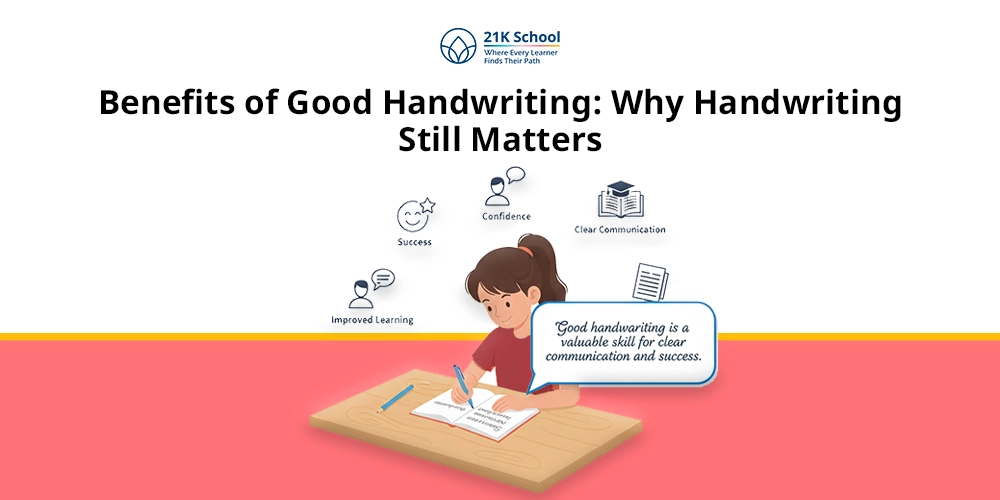
15 Key Benefits of Good Handwriting for Students!
 Written byAnkita SinghaContent Specialist
Last modified: 25 Jul 2026 6 min read
In the 21st century students require different skills that make their educational journey meaningful.
There are plenty of skills to learn but one of the most important students often neglect is good handwriting.
In the world of digital tools, good handwriting is immensely valuable. This is because a person with good handwriting develops various benefits
Let's go through what is good handwriting and top 15 powerful benefits of good handwriting.
What is good handwriting?
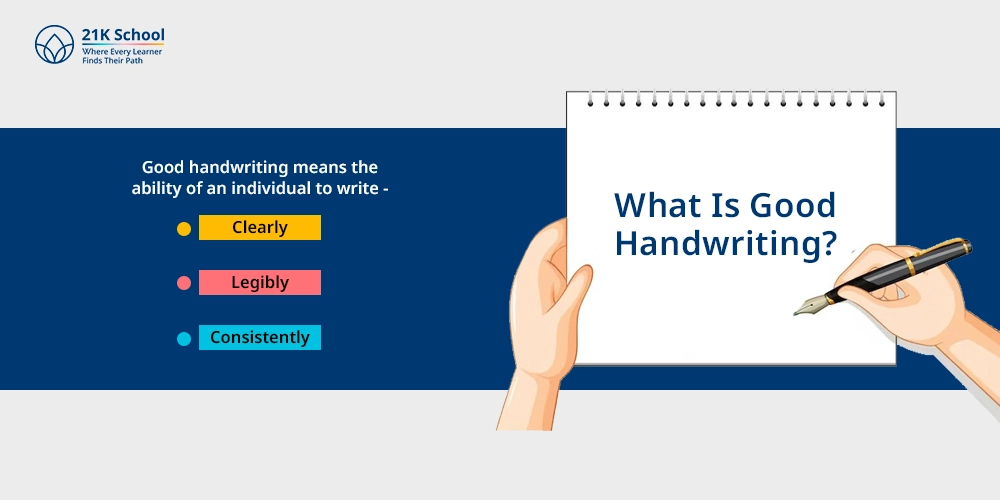
Good handwriting means the ability of an individual to write clearly, legibly, and consistently.
Good handwriting does not mean writing in a specific style.
Instead a student who forms letters correctly, maintains proper spacing while writing, keeps the writing aligned, and easy to read have good handwriting.
15 benefits of good handwriting
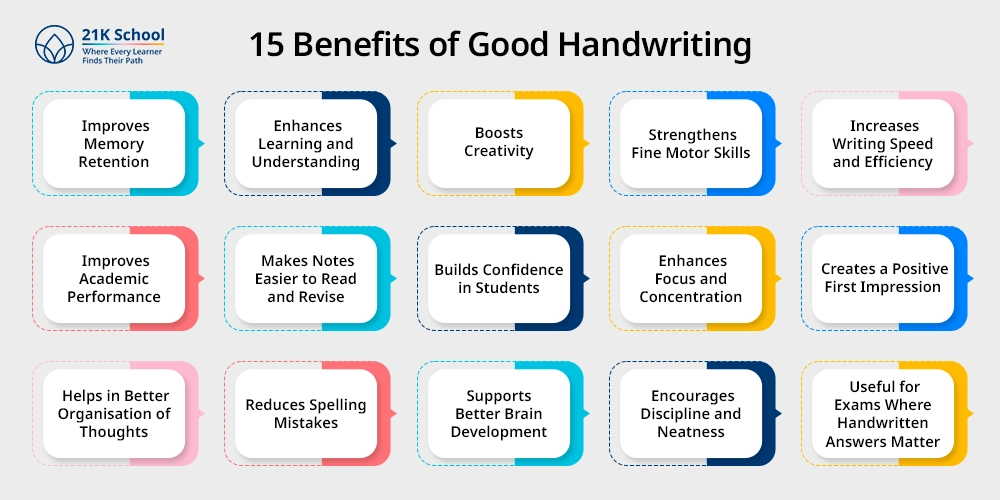
Given below are the 15 benefits of good handwriting one must know:
1. Improves memory retention

Writing by hand helps learners to improve their memory retention. It directly impacts students’ multiple sensory channels such as vision and movement.
This stimulates the brain to think and retain maximum knowledge which makes learning meaningful and interesting.
2. Enhances learning and understanding

Students often believe that good handwriting is only a skill. But it is also beneficial to enhance learning and understanding.
Students who engage in writing often learn concepts faster and clearer. It directly improves the academic grades .
3. Boosts creativity

While practicing good writing students become free and express their ideas naturally. This helps them to become creative thinkers.
Many students practice good writing and later become good writers who tell stories to the world.
4. Strengthens fine motor skills
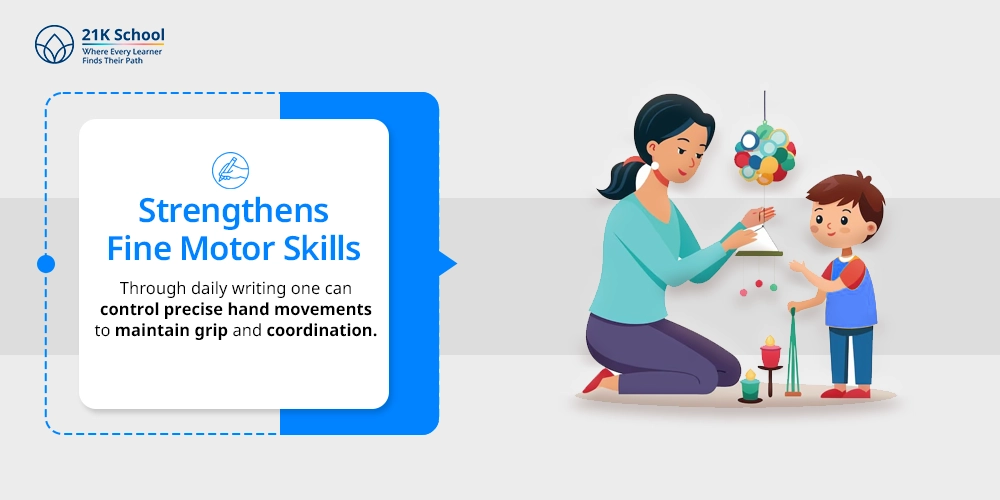
One of the reasons why parents and teachers encourage students to practice good writing is because it strengthens their fine motor skills .
Through daily writing one can control precise hand movements to maintain grip and coordination. It is an effective fine motor skills activity help in:
- Better drawing ability.
- Improved coordination.
- Enhanced overall writing skills.
- Stronger cognitive development .
5. Increases writing speed and efficiency
Students with good handwriting can increase their speed and efficiency. It helps in writing accurately and quickly, especially in exams .
An individual’s smooth writing flow helps them:
- Complete tests on time
- Take clear and organized notes quickly
- Write extended answers without fatigue
6. Improves academic performance

Students often think about improving their academic performance and with a good handwriting it is possible.
Having a neat, proper and organised writing showcases mind clarity which leads to good marks. Teachers can easily evaluate the answer and are satisfied with quality writing.
7. Makes notes easier to read and revise
From summarising long lessons to making diagrams to remembering key points, handwriting plays a crucial role in students’ lives.
Practicing good handwriting makes notes easier to read and revise without confusion. In this way students create well-structured content.
8. Builds confidence in students
Students with additional skills like good handwriting often feel confident in front of their peers and teachers.
The confidence increases when people appreciate the hard work during classwork, assignment submission, or project writing.
9. Enhances focus and concentration
Writing engages students for a longer time which ultimately enhances their focus and concentration.
To increase students’ interest towards daily learning, practicing good handwriting skills can be a great start.
10. Creates a positive first impression

Students can create a positive first impression in front of the classroom and teachers by reflecting neat handwriting in exams, homework etc.
This gives appreciation and creates a unique personality in front of people.
11. Helps in better organisation of thoughts

Writing by hand needs time to complete. But, it also comes with a benefit such as it forces the brain to process information logically.
This results in:
- Better sequencing of ideas
- Clearer expression
- Improved analytical thinking
- More coherent writing
12. Reduces spelling mistakes
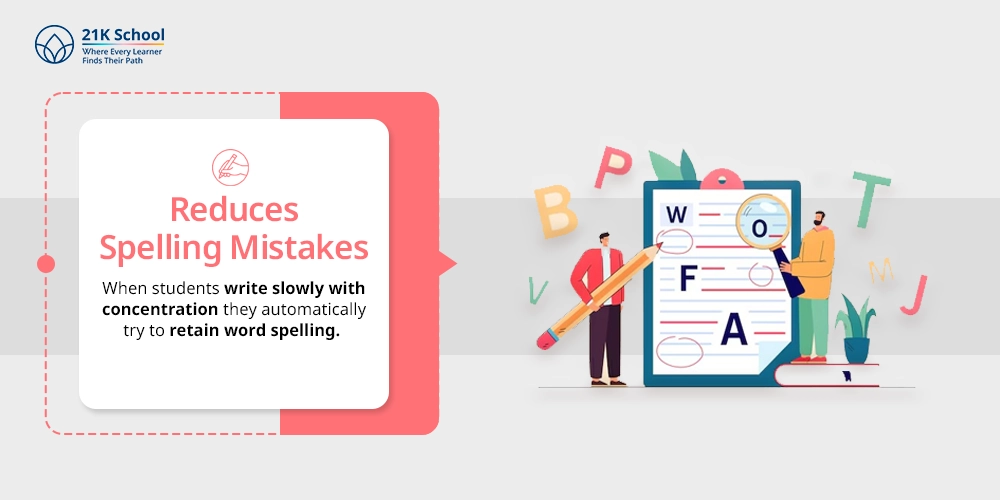
One of the benefits of practicing good handwriting is that it reduces students’ spelling mistakes.
When students write slowly with concentration they automatically try to retain word spelling.
And continuous writing helps in recognising errors, learning correct spellings, improving vocabulary development .
13. Supports better brain development
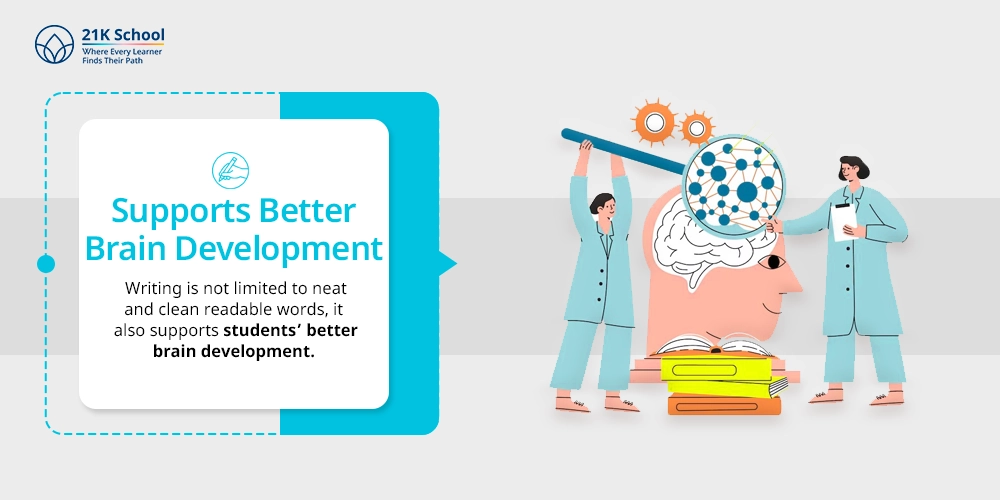
Writing is not limited to neat and clean readable words, it also supports students’ better brain development.
Some common skills students able to achieve:
- Visual perception
- Problem-solving
- Logical thinking
- Reading and writing skills
14. Encourages discipline and neatness

Handwriting is a powerful tool to encourage discipline and neatness in students’ lives. They learn how to write accurately, understand the pattern, and prepare for the future.
This discipline in education also encourages them to stay connected with other areas of life such as studying, planning, and overall behaviour.
15. Useful for exams where handwritten answers matter
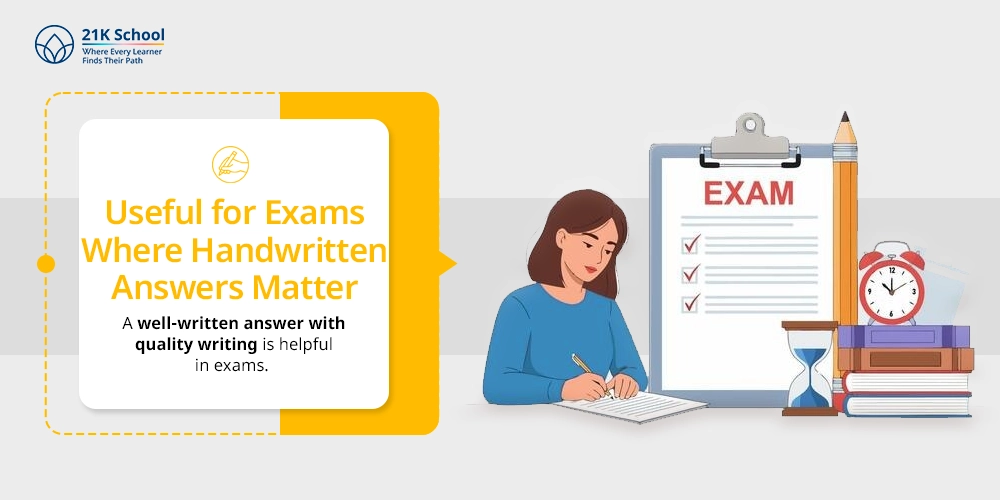
Involving digital tools offers various benefits in students life but, remember some exams still require handwritten answers.
And to get good marks by writing neat, clear, and beautiful students need to practice daily. A well-written answer with quality writing is helpful in exams.
Conclusion
A good handwriting is a key to presenting yourself in front of the classroom, teachers, and peers.
Some common advantages to improve handwriting are enhanced academic, cognitive, and creative skills. As a student one should practice to improve handwriting skills. Learn several handwriting tips to improve writing
Frequently asked questions
8 questions
How to improve your handwriting?
To improve handwriting students must analyse current handwriting, proper physical preparation, using the right tools, and focus on daily practice.
What are the 5 S's of handwriting?
The 5 S's of handwriting are: Size Spacing Speed Slant Skill
What if a person has good handwriting?
If a person has good handwriting it helps in the development of fine motor skills, improve memory, enhanced focus and understanding.
Is Gen Z losing handwriting?
Not all Gen Z losing handwriting. But, one can improve it by holding the pen or pencil correctly, not freezing arms, stretching before long writing, and practicing writing daily.
How to hold a pen for good handwriting?
For good handwriting, students should hold a pen in the correct position. The most recommended way is the dynamic tripod grip. It helps in relaxing, balancing, and allows students to write smoothly.
How to write fast with good handwriting?
To write fast with good handwriting students need to focus on simplifying the letterforms, maintaining good posture, and practicing with concentration.
Why is it important to improve your handwriting?
Students should improve their handwriting because: Enhances cognitive skills. Creates a positive impression. Improve speed. Boosts confidence in front of peers and teachers.
Is good handwriting directly linked with intelligence?
No, good handwriting is not linked with students' intelligence. However, it is essential to improve fine motor skills, academic success, and personal development.
About the author
Ankita Singha
Content Specialist
Ankita Singha is an Education Content Specialist at 21K School, India’s first accredited fully online K-12 School. She focuses on the in-depth research and creation of the well-drafted guides on early childhood education, school admission processes, and CBSE/ICSE curriculum guidance. With more than 2 years of experience at 21K School, a fully accredited institute- Cambridge International (IA702) and Pearson Edexcel (94883), Ankita works closely with the school’s curriculum heads and academic coordinators. Ankita’s every article reflects on the official board guidelines, practical realities, and current policies of online education in 78+ countries. Ankita’s content has helped thousands of parents in understanding the topics like RTE eligibility, NIOS pathways, and age-appropriate admission criteria.
Every 21K School guide is written by our education team and reviewed by a subject facilitator before publishing.
Exploring a CBSE-pathway online school?
Talk to an advisor about 2026–27 admissions — no obligation.
Talk to an advisorComments
No comments yet — be the first to share your thoughts or ask a question.