CBSE Class 10 Subject List: Compulsory & Optional Subjects
 Written byRahul PalContent Specialist
Last modified: 23 Oct 2026 19 min read
Are you wondering which subjects are compulsory in CBSE Class 10 and how they impact your future stream choices?
Class 10 has some compulsory subjects that are prescribed by the Central Board of Secondary Education. These subjects are mandatory for all students who will be taking the Class 10 board examinations, and these are subjects of core academic and language studies.
The knowledge of the mandatory subject structure will assist students to prepare well, make the right decisions and ensure that they are qualified to undergo promotion into higher education.
What are the CBSE compulsory subjects for Class 10?
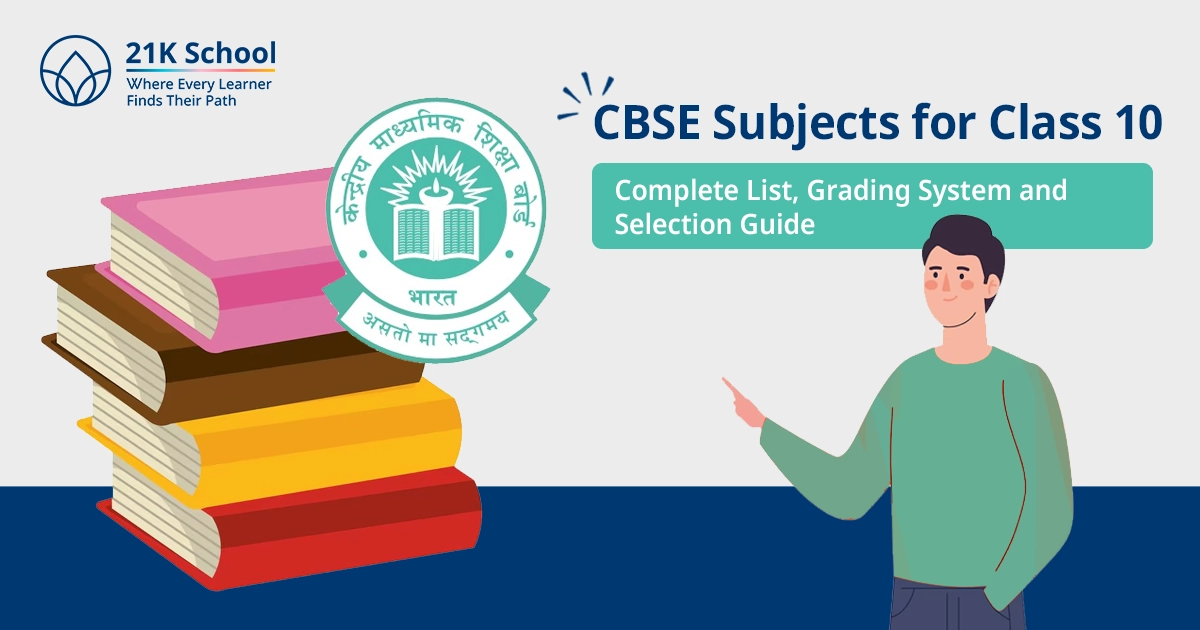
CBSE has made five subjects mandatory for every Class 10 student. These are the main subjects of the Class 10 curriculum and are compulsory for all students irrespective of their plans in school or career life. These five subjects could include a sixth subject, which the students could select as an additional or optional subject.
CBSE Class 10 total subject count
A student in Class 10 pursuing CBSE will be expected to have a total of six subjects. Five of them are compulsory, and the other is an optional or supplementary one.
Three of them are internal evaluation courses, or courses not examined by any board, but rated on a continuous basis by the school. The board examination will cover the five compulsory subjects and will be part of the final outcome and evaluation.
Understanding CBSE subject groups
CBSE Class 10 subjects are classified in a manner that simplifies them to understand. Group A1 will include five subjects, which will be mandatory for all students.
Group A2 comprises academic elective subjects where students are free to choose either of the subjects as the 6th subject.
Group B also has skill-based vocational subjects, and they can be chosen as the sixth subject. The subjects found in Group C during internal assessment are Health and Physical Education, Work Experience and Art Education.
1. Language subjects
Language subjects mostly focus on communication and literature skills.
- English
- Hindi
- Sanskrit
- Urdu
2. Scholastic (Academic) subjects
- Theory-based subjects are assessed through board examinations, which include:
- Mathematics
- Science
- Social Science
3. Skill-based / elective subjects
- Skill-based subjects are designed to promote vocational and practical knowledge.
- Information Technology
- Artificial Intelligence
- Banking & Insurance
- Marketing & Sales
| Subject Category | Subject Name | Code |
|---|---|---|
| Core Subject | English Language and Literature | 184 |
| Core Subject | Hindi Course A or Course B | 002 / 085 |
| Core Subject | Mathematics (Standard or Basic) | 041 / 241 |
| Core Subject | Science | 086 |
| Core Subject | Social Science | 087 |
| Skill Subject (Optional) | IT, AI, Financial Literacy, Retail | Varies |
| Internal Evaluation | Physical Education, Art Education | School-Based |
List of 5 compulsory subjects in CBSE Class 10 (2025-26)
CBSE makes five subjects compulsory for all Class 10 students. These are the subjects which are the essence of the Class 10 curriculum and are relevant to everyone, irrespective of their schooling or career intentions.
These five are in addition to another subject that students are provided with an option of taking as an additional subject or an optional subject.
1. English (Language and literature)
The English language is used, and every student of CBSE has to compulsorily study English in Class 10. The syllabus is divided into prose, poetry, and drama, reading comprehension, writing, grammar and literature.
The English board examination has 80 marks in theory and 20 marks in internal assessment, i.e. 100 marks.
2. Second language (Hindi or any other approved language)
Every learner of the CBSE Class 10 is supposed to possess a second language. The second most spoken language is Hindi, and then there is any other language that is authorised by CBSE.
These are Sanskrit, Urdu, Tamil, Telugu, Kannada, Malayalam, Punjabi, Bengali, Gujarati, and Marathi, among others, depending on which are taught in their school. The second language paper also has theory and internal assessment marks, which are 80 and 20 marks, respectively.
3. Mathematics (Standard or basic)
Math is among the mandatory subjects for all students who have pursued CBSE Class 10. Under CBSE, mathematics has been offered in two grades, viz, Mathematics Standard (Subject Code 041) and Mathematics Basic (Subject Code 241).
Standard and Basic level is Mathematics Basic, which is designed for students who do not want to study Mathematics in classes 11 and 12.
Students who pursue Mathematics Basic and who opt to take Mathematics in Class 11 afterwards must pass the examination of Mathematics Standard compartment. The two papers have an 80-mark theory section and a 20-mark internal assessment section.
4. Science (Physics, chemistry, biology)
Science is mandatory at the Class 10 level and includes Physics, Chemistry and Biology as inseparable units of one subject. Among the topics are chemical reactions, life processes, light, electricity, natural resources, etc.
The board examination has 80 marks in theory and 20 marks in internal assessment, which includes practical work.
5. Social science (History, geography, political science, economics)
The fifth compulsory subject is Social Science, which has four parts, namely History, Geography, Political Science (Civics) and Economics.
The board examination will have 80 marks on theory and 20 marks on internal assessment, such as map work and project work. Social Science is also relevant to students intending to take up Humanities or Commerce in Class 11.
Optional & elective subjects in CBSE Class 10
CBSE also gives Class 10 students an opportunity to take a sixth subject in addition to the five subjects that are mandatory. This sixth subject is referred to as an additional subject, and it is optional.
It can be worthwhile to choose an extra subject because, in case the student has scored better in the additional subject compared to their performance in one of their five main subjects, then the extra score can be included to replace the low-scoring main subject in the best of five calculation, hence increasing the overall score.
Choosing an extra subject is important; in case the student has scored better in the additional subject other than their five main subjects, then the extra score can be included to replace the low-scoring main subject in the best of five calculation, hence increasing the overall score.
1. Skill subjects
CBSE also provides a variety of skills-based subjects in its vocational education system, which students may take as their sixth subject.
They are Artificial Intelligence (Subject Code 417), Information Technology (Subject Code 402), Introduction to Financial Markets (Subject Code 405), Tourism (Subject Code 406) and, of course, several others.
The skills subjects are evaluated by means of both theory and practical parts, and they are planned to provide the students with the skills related to the job and academic learning.
| Code | Subject Name | Theory Marks | Practical Marks |
|---|---|---|---|
| 401 | Retail | 50 | 50 |
| 402 | Information Technology | 50 | 50 |
| 403 | Security | 50 | 50 |
| 404 | Automotive | 50 | 50 |
| 405 | Introduction to Financial Markets | 50 | 50 |
| 406 | Introduction to Tourism | 50 | 50 |
| 407 | Beauty & Wellness | 50 | 50 |
| 408 | Agriculture | 50 | 50 |
| 409 | Food Production | 50 | 50 |
| 410 | Front Office Operations | 50 | 50 |
| 411 | Banking & Insurance | 50 | 50 |
| 412 | Marketing & Sales | 50 | 50 |
| 413 | Health Care | 50 | 50 |
| 414 | Apparel | 50 | 50 |
| 415 | Multi Media | 50 | 50 |
| 416 | Multi Skill Foundation Course | 50 | 50 |
| 417 | Artificial Intelligence | 50 | 50 |
| 418 | Physical Activity Trainer (New) | 50 | 50 |
| 419 | Data Science | 50 | 50 |
| 420 | Electronics and Hardware (New) | 50 | 50 |
| 421 | Foundation Skills for Sciences (Pharmaceutical and Biotechnology) (New) | 50 | 50 |
| 422 | Design Thinking and Innovation | 50 | 50 |
2. Third Language option
Students registered in Classes 6 to 8 in a third language were also allowed to do it as an optional subject in Class 10. This will be available to the student in case he/she has a language course in his/her school, and it has been approved by the CBSE.
3. Additional academic subjects
There are also a few such students who are allowed to undertake a sixth subject like Home Science, Computer Science or Elements of Business as their sixth subject because their school has to offer that subject and the provision of CBSE during the session.
It is worth mentioning that the skills subjects are optional at the level of Class 10 or not, but are significantly promoted by NEP 2020 to provide the students with hands-on experience in the vocational fields at such a tender age.
Passing criteria for compulsory subjects
The students must be made familiar with the passing criteria in the mandatory classes of CBSE Class 10. CBSE also has certain conditions that one would have to satisfy in each subject individually.
1. Minimum marks required
Students have to qualify in all the subjects by attaining a minimum of 33% marks in all the compulsory subjects.
Where both the subject matters have the element of theory and practical or internal assessment, the students must pass 33% each separately in the theory exam and 33% in the internal or practical assessment. A high score in one of the components does not make up for a failed score in the other component.
2. Overall pass requirement
In order to pass CBSE Class 10 and 12 exams, students have to get at least 33% marks per subject in five subjects.
In the case of Class 10, it is a mixed amount of theory as well as internal assessment, whereas in Class 12, it is both theory and practical/internal assessment. In case they fail in any of the compulsory ones, a student does not pass the entire session.
3. Compartment examination
In case a student performs poorly in one/two compulsory subjects, he/she can pursue the CBSE compartment examination, which they do a few months after the main board results are announced.
Students who pass the examination in the compartment are considered to have passed such subjects. The student will be required to retake the entire Class 10 examination in the following year in case he/she fails in more than two subjects.
4. Grace marks policy
CBSE has a provision of grace marks under which a student who is just close to the passing mark in a subject can be awarded a few grace marks. This is, however, at the behest of CBSE, and students should not rely on the grace marks policy as a strategy.
5. Additional subject and passing
CBSE permits an optional sixth subject to substitute a failed compulsory subject in the final result computation, should the optional sixth subject be able to meet the requirements of CBSE, in a case where a student fails in one of the compulsory subjects and passes in the optional sixth subject.
CBSE Class 10 marking scheme and exam pattern 2025-26
1. Theory vs internal assessment weightage
The examination board divides 100 marks out of five compulsory subjects. It is divided into 80 marks for theory subjects and 20 marks for internal examination.
Internal assessment marks are allotted by the schools based on the students' periodical assessment test marks and subject-based practical or project work.
According to the CBSE guidelines, the Internal Assessment of 20 marks is usually structured in the following way: Periodic Tests (10 marks), calculated as the average of the best two out of three tests; Subject Enrichment Activities (5 marks); Portfolio/Practical Work/Notebook Submission (5 marks).
The main subjects follow:
- 80 marks: Board Theory Exam
- 20 marks: Internal Assessment (Periodic Tests, Portfolio, Practical Work).
Some skill subjects may follow a 50:50 or other approved ratio.
2. Key exam pattern changes for 2025-26
CBSE has also changed the question paper format that will be used in the year 2025-26 to have more competency-based questions.
There are multiple-choice questions, assertion-reason questions, case-based questions and source-based integrated questions.
3. Passing criteria
In order to pass, students have to achieve a minimum of 33% marks in every subject that is regarded as compulsory. Where the subjects have both theory and practical or internal assessment elements, 33% is required in each of the elements.
In case a student fails in one or two of the compulsory subjects, then he/she can take the CBSE compartment examination. In case they fail in the above two subjects, they will have to repeat Class 10 the next year.
In case a sixth subject was undertaken, the marks can be used to substitute one of the failed subjects that were mandatory according to the CBSE regulations.
How to choose the right subject combination in Class 10?
Even though the five subjects required are fixed in stone, and only each pupil can have an extra subject as an option, the level of Mathematics which a person will take determines the academic path in the future. This is how students should handle such decisions.
1. Interest and career alignment
The initial one would involve determining the long-term career objectives and their interests. The student will be more productive in the discipline where he or she really likes and is familiar with.
The choice of subjects that will suit the future requirements, be it scientific or commercial, humanities or practical ones, creates a strong academic base and confidence in the future development of scholars and the profession.
2. Future stream selection impact
The choice of Class 10 subjects by the Central Board of Secondary Education plays a very crucial part in the eligibility and preparation of an individual in either the Science, Commerce or Humanities stream in Class 11.
It is advisable to make informed decisions so that there will be easy entry into the streams of preference without restrictions on eligibility in the future.
3. Consultation with teachers
Teachers can give great information about the strengths and weaknesses of a student and his or her potential to excel academically. Meeting with subject teachers or school counsellors can assist students in knowing their performance patterns and other viable choices.
Professional advice provides the opportunity to make decisions according to ability and readiness, but not intuition, which results in more warranted and thought-out academic decisions.
4. Research future opportunities
Career choices, entry requirements and prerequisites for courses are to be researched by the students before finalising combinations. There are numerous professional courses with eligibility criteria for their subjects.
Knowing about academic and career needs in future assists students to make a strategic selection of subjects to stay within the bracket of being permitted to pursue various forms of higher education and competitive exams.
5. Avoid peer pressure
The choice of subject should not be influenced by friends, trends and social expectations. Selecting a topic based on the fact that peers select it would also result in student stress and poor academic performance.
One has to make a selection based on individual interests, skills and future objectives that one wants to achieve and receive steady academic success.
How CBSE Class 10 subject choice affects Class 11 stream selection?
The selection of Class 10 subjects by the Central Board of Secondary Education has a very crucial role in ensuring that one will be ready and qualified in either of the streams in Class 11: science, commerce or the humanities.
1. Science stream requirements
Students planning to study Science in Class 11 and will combine it with Physics, Chemistry and Mathematics must have successfully cleared the Mathematics Standard in Class 10.
Students opting for Maths Basic in Class 10 are not allowed to pursue Maths in Class 11 without doing the Mathematics Standard compartment examination.
Class 10 Science is also required as it provides the foundation of Physics, Chemistry, and Biology in the higher secondary level.
2. Commerce stream requirements
Students who are interested in choosing Commerce in Class 11 need to focus on Mathematics and Economics in Class 10.
Having good subject knowledge in Mathematics and Economics concepts provides a considerable boost to students in other subjects, such as Accountancy, Business Studies, and Economics in Class 11.
3. Arts and humanities stream requirements
A good foundation in Class 10 Social Sciences is the most beneficial to students intending to do Humanities or Arts during Class 11.
Class 10 History, Geography, Political Science, and Economics are directly related to subjects taught in Humanities in higher secondary education. Class 10 language performance is also important to students intending to learn Literature subjects in Class 11.
4. Subject choice decision framework
When making their Class 10 subject choices, especially the Mathematics level and elective subject, students must take into account three things. Second, what they really have strengths and interests in, and not what peers are making a decision on.
Third, what their school provides and what the future entrance examination requirements would be are associated with the career they are pursuing. It is highly advisable to consult the subject teachers and career counsellors before such decisions are made.
CBSE subject codes for Class 10
The subject codes are necessary for the students to be aware of since they are required during the registration of their examination, when they are generating their CBSE admit card and even when they are handling their results.
The subject codes of the major compulsory subjects and the most preferred optional subjects in CBSE Class 10 are the following.
| CBSE Subject Code Class 10 | CBSE Class 10 Subject Name |
|---|---|
| 002/085 | HINDI COURSE-A/COURSE B |
| 003 | URDU COURSE-A |
| 184 | ENGLISH LANGUAGE and LITERATURE |
| 041/241 | MATHEMATICS (STANDARD/BASIC) |
| 086 | SCIENCE |
| 004 | PUNJABI |
| 005 | BENGALI |
| 006 | TAMIL |
| 007 | TELUGU |
| 008 | SINDHI |
| 009 | MARATHI |
| 010 | GUJARATI |
| 011 | MANIPURI |
| 012 | MALAYALAM |
| 013 | ODIA |
| 014 | ASSAMESE |
| 015 | KANNADA |
| 016 | ARABIC |
| 017 | TIBETAN |
| 018 | FRENCH |
| 020 | GERMAN |
| 021 | RUSSIAN |
| 023 | PERSIAN |
| 024 | NEPALI |
| 025 | LIMBOO |
| 026 | LEPCHA |
| 031 | CARNATIC MUSIC VOC |
| 032 | CAR. MUSIC MEL INS |
| 034 | HIND.MUSIC VOCAL |
| 035 | HIND.MUSIC MEL.INS |
| 036 | HIND. MUSIC.PER.INS |
| 041 | MATHEMATICS |
| 037 | PSYCHOLOGY |
| 049 | PAINTING |
| 064 | HOME SCIENCE |
| 076 | NATIONAL CADET COR |
| 085 | HINDI COURSE-B |
| 086 | SCIENCE-THEORY |
| 087 | SOCIAL SCIENCE |
| 089 | TELUGU - TELANGANA |
| 090 | SCIENCE WITHOUT PR |
| 092 | BODO |
| 093 | TANGKHUL |
| 094 | JAPANESE |
| 095 | BHUTIA |
| 096 | SPANISH |
| 165 | COMPUTER APPLICATION |
Concluding thought
The subject structure of CBSE Class 10 is highly structured, whereby the subject structure is pegged on five subjects, namely, compulsory English, a second language, Mathematics, Science, and Social Science and an optional sixth additional or skill subject.
Every student planning to complete the Class 10 board examination should be aware of this hierarchy, the criteria for passing the exam and the implications of taking the exam subjects.
Students who make wise decisions when it comes to selecting their subjects to study and also know how to follow the rules are much better placed to succeed not only in Class 10 but also in the subsequent academic years.
Frequently asked questions
8 questions
How many compulsory subjects are there in CBSE Class 10?
CBSE Class 10 has five mandatory subjects, including English, a second language, Mathematics, Science and Social Science. Students are also able to choose the sixth subject, which is optional.
Is Mathematics compulsory in Class 10 CBSE?
Yes, Mathematics is mandatory for all students of Class 10 with CBSE. Students would have an option of taking Mathematics Standard (Code 041) and Mathematics Basic (Code 241) based on their intentions to take Mathematics in Classes 11 and 12.
Can a student replace a failed subject with an additional subject?
Yes, if a learner fails one of the compulsory subjects and has taken an additional sixth subject, the CBSE allows the additional subject to replace the failed subject in the final result calculation, which is subject to the eligibility conditions.
Are skill subjects compulsory in CBSE Class 10?
No, Class 10 does not have mandatory subjects in terms of skills. They are elective and may be taken as an optional sixth subject. Nevertheless, CBSE highly promotes enrollment in the skilled subjects according to NEP 2020.
What is the minimum passing mark requirement in CBSE Class 10?
The students will have to achieve a minimum of 33% in each subject. In subjects having both theory and practical elements, 33% has to be achieved in theory and internal assessment or practical parts independently.
How many languages are compulsory in CBSE Class 10?
CBSE Class 10 has two mandatory languages. English is the first language, and it is a compulsory language for all students. The second language should be one of the CBSE-approved list of languages, i.e. Hindi, Sanskrit, Urdu or any other local language, subject to their school availability.
Is Hindi a compulsory subject in the CBSE board?
No, it is not mandatory for all students. CBSE makes students study two languages, and the second language could be Hindi, Sanskrit, Urdu or any other acceptable regional or foreign language in the school.
Is it compulsory to pass an additional subject in CBSE?
The other (sixth) subject is optional. In a few situations, the marks of the extra subject may be taken as a substitute for one failed compulsory subject in the final result, as per the CBSE regulations.
About the author
Rahul Pal
Content Specialist
Rahul Pal is an Education Content Specialist at 21K School- India’s fully accredited online school recognised by the Cambridge International (IA702) and Pearson Edexcel (94883). His graduation from Journalism and Mass Communication from Swami Vivekananda University gives him a strong foundation in factual reporting, source verification, and investigative research. With around 2 years of experience at 21K School, he has written extensively for the CGPA conversion guides, marking schemes, and Indian and International boards (IGCSE, GCSE, and A-Levels). His articles are highly relevant for the guardians looking to guide their learners for board exam preparation across 78+ countries. All Rahul’s content is reviewed by the school’s academic team to ensure alignment with the latest board guidelines and latest notifications from the official resources
Every 21K School guide is written by our education team and reviewed by a subject facilitator before publishing.
Exploring a CBSE-pathway online school?
Talk to an advisor about 2026–27 admissions — no obligation.
Talk to an advisorComments
No comments yet — be the first to share your thoughts or ask a question.