


All our lives we have heard about private schools and government schools.
But if you are a parent, you might be concerned about choosing a type of school that would be apt for your child and their future.
Government schools are administered and controlled by state governments unlike private schools that are maintained by private bodies and groups.
In this article, we will openly discuss the difference between a private school and a government school and what would be best according to your kid.
Table of Contents
What is a Private School?
A private school is an institution where an individual, organization, trust, or other communities manage and fund the institution.
The government has a bit less involvement in such schools as a whole.
The schools are supported by the student fees, donations, and sponsorships to carry out their operations.
Private schools can be associated with CBSE, CISCE, IB, Cambridge, and some state boards.
They tend to lay emphasis upon good infrastructures, teaching methods, small classes, student-discipline, and extracurricular activities.
The private schools usually have higher fees because of the modern classrooms and facilities provided.
In most schools that are run privately, English is emphasized more and is considered a basic medium of instruction.
Parents are also involved actively in private schools, which are led by a heavily competitive environment in these schools.
What is Government School?
A government school refers to a publicly funded school, where government authorities including state or central government manage it, often following a standardised Indian curriculum.
These schools are financed by government taxes.
This tends to offer free or very cheap education to all kids, especially the children living in economically disadvantaged areas.
State Boards or CBSE (Government schools) are the boards followed. Their mission is based on universal education, equal opportunity, and social inclusion.
In fact, government schools provide midday meals and scholarship programs that motivate learners to get education.
The focus of these schools is to let education reach rural and semi-urban areas.
9 Key Difference Between Private and Government School
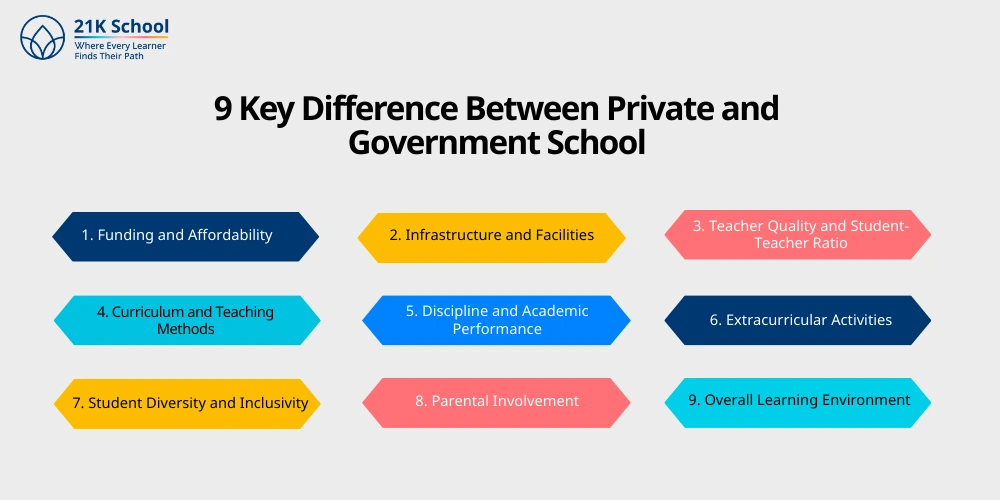
The major differences can be many when we talk about private school vs government school.
Let’s first look at them through a table and then in detail with bullet points.
| Reasoning behind the Difference | Private School | Government School |
| Funding & Affordability | Funded by student fees and donations; costly | Funded by the government; low-cost or free |
| Infrastructure | Modern buildings, Labs, digital boards, and spacious classrooms | Simple facilities; depends on the area |
| Teacher Quality and Student-Teacher Ratio | Smaller classes, higher performance-based recruiting | Teachers are recruited through competitive examinations; bigger classes |
| Curriculum & Teaching | Modern, digital learning | Traditional, standard teaching |
| Discipline and Academic Performance | Tougher rules, tough competition | Mixed academic results, stricter rules, strict competition |
| Extra-Curriculum Activities | Large variety of sporting activities, arts, skills clubs | Lesser number of activities because of low resources |
| Diversity & Inclusivity | Often similar socio-economic backgrounds | High diversity and social inclusion |
| Parental Involvement | Regular meetings and school activities | Less involved because of huge system size |
| Learning Environment | Competitive and resource-rich | Supportive and resource-limited |
1. Funding and Affordability
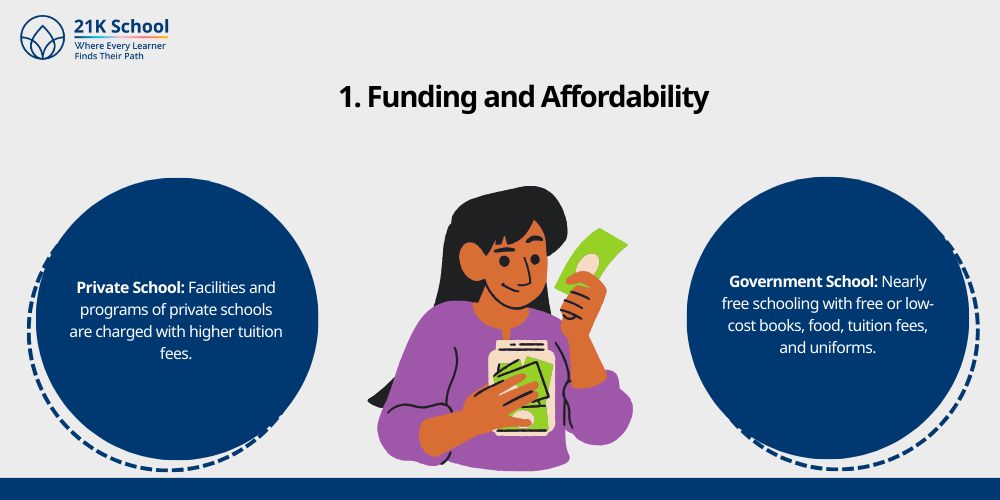
- Private School: Facilities and programs of private schools are charged with higher tuition fees.
- Government School: Nearly free schooling with free or low-cost books, food, tuition fees, and uniforms.
2. Infrastructure and Facilities
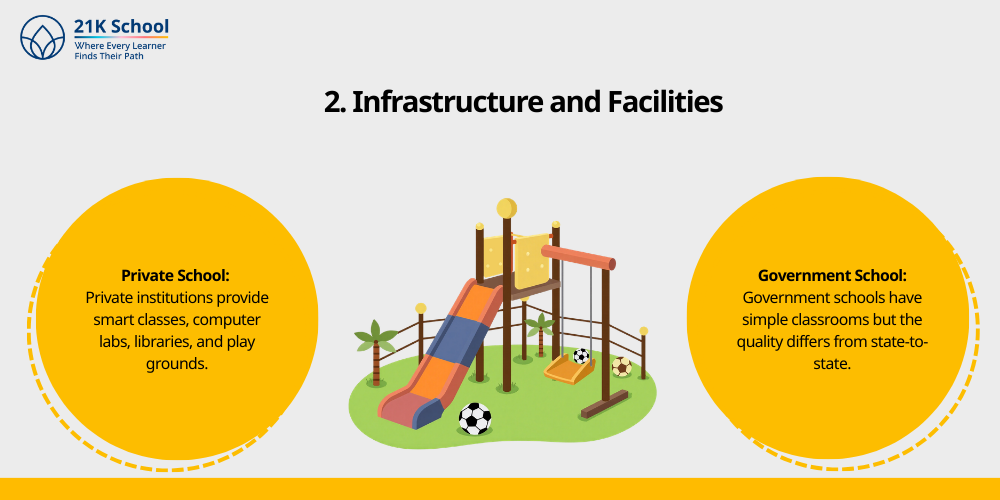
- Private School: Private institutions provide smart classes, computer labs, libraries, and play grounds.
- Government School: Government schools have simple classrooms but the quality differs from state-to-state.
3. Teacher Quality and Student-Teacher Ratio
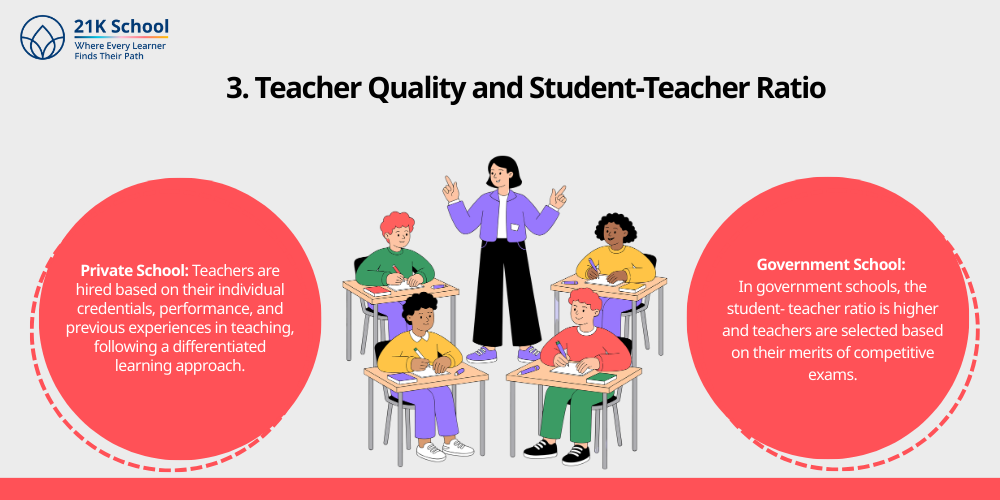
- Private School: Teachers are hired based on their individual credentials, performance, and previous experiences in teaching, following a differentiated learning approach. Also, the student-teacher ratio is less in private schools.
- Government School: In government schools, the student- teacher ratio is higher and teachers are selected based on their merits of competitive exams.
4. Curriculum and Teaching Methods
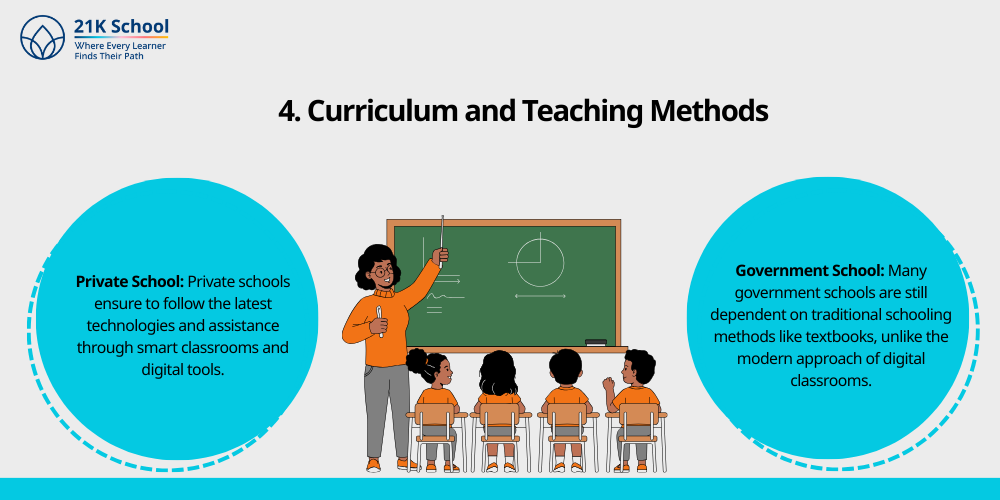
- Private School: Private schools ensure to follow the latest technologies and assistance through smart classrooms and digital tools. These are dependent on activity-based and project-based learning.
- Government School: Many government schools are still dependent on traditional schooling methods like textbooks, unlike the modern approach of digital classrooms.
5. Discipline and Academic Performance
- Private School: Strict discipline and constant examinations are common for assessing learners’ performance in private schools.
- Government School: Government schools also follow strict rules and regulations. They take individual tests of students as well.
6. Extracurricular Activities
- Private School: Private schools hold space for several extracurricular activities like sports, music, drama, robotics, dance, and so much more.
- Government School: Government schools can also support different activities for overall personality development of students, depending on the funds and resources available.
7. Student Diversity and Inclusivity
- Private School: The students are predominantly from middle-class and higher-income families. Though it accepts students from every background, caste, creed, and gender.
- Government School: Students of government schools have huge diversity as no child is different from the other. It fosters inclusive education.
8. Parental Involvement
- Private School: Parents are asked to cooperate and participate in school activities. They also visit private school teachers to know their students’ status in learning.
- Government School: Government schools don’t demand too much involvement from parents’ side.
9. Overall Learning Environment
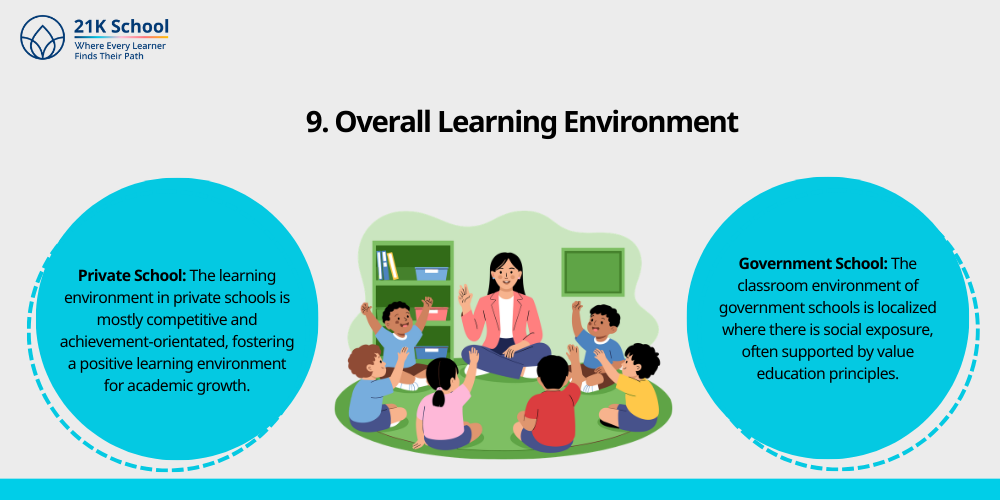
- Private School: The learning environment in private schools is mostly competitive and achievement-orientated, fostering a positive learning environment for academic growth.
- Government School: The classroom environment of government schools is localized where there is social exposure, often supported by value education principles.
Advantages of Private School
Private schools consists of the following advantages:
- New technology, learning materials, and equipment that support the role of technology in education.
- Personal attention and small classes
- Wide-ranging extra-curriculum experience
- English-language exposure supporting international education criteria, similar to what the British curriculum offers.
- Disciplined and exam-oriented culture
- Active parental-engagement
- Newer ways of teaching including student-centred learning approaches.
Disadvantages of Private School
The possible disadvantages of private schools might include the following:
- Difficult to access due to higher tuition fees
- Increase in competitive pressure and study-stress, which requires effective stress management for students
- Socio-economic homogeneity
- Quality among institutions is different
- Many are mainly profit-making without giving apt education
Advantages of Government School
Government schools have several benefits that are included in the following list:
- Education that is either free or very cheap
- Non-discriminatory admission based on economic status
- Teaching staff that is qualified by the government
- Programs to enhance attendance through mid-day meal programs
- Rural outreach and universal access
- Language and cultural diversity
Disadvantages of Government School
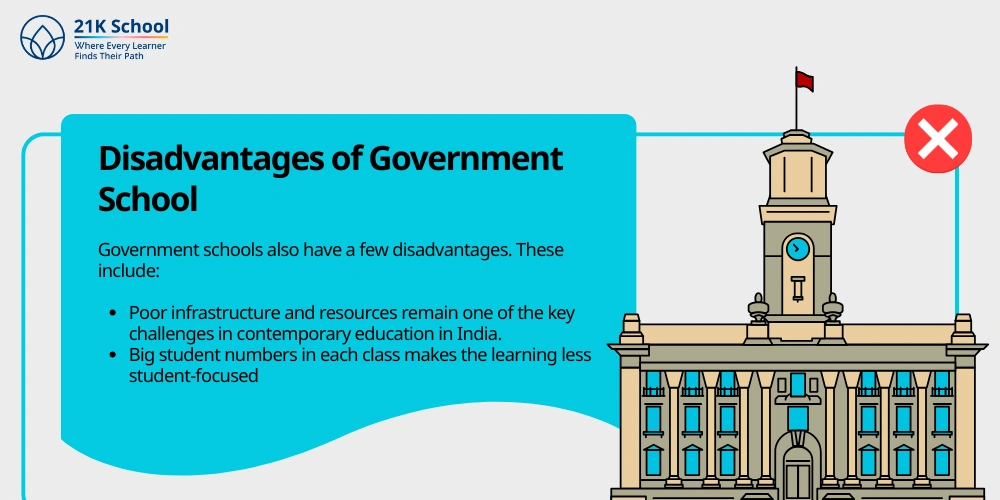
Government schools also have a few disadvantages. These include:
- Poor infrastructure and resources remain one of the key challenges in contemporary education in India.
- Big student numbers in each class makes the learning less student-focused
- Unstable teacher access in some areas
- Conventional teaching modes, unlike the collaborative learning methods used in modern schools.
Conclusion
Your child’s choice for getting education can decide if they want to get admission in government schools or private schools, and understanding the future of education in India can help guide this decision.
The basic difference between private and public schools is that public schools are run by the government and private schools are administered by private communities.
Both of them have their own positives and negatives that make them stand apart from each other, and choosing the right school is part of preparing children for the future.

You may also want to read
CBSE Passing Marks Out of 100: Theory, Practicals & Grading
- Last updated on: 16 Mar, 2026
- 6 min read